


Here's a hard truth: 90% of the 'strategies' you find online are repackaged garbage designed to sell you a course.

David van der Merwe
Trader de Mercados Emergentes ·  South Africa
☕ 13 min de lectura
Lo que aprenderás:
- 1The Foundation: What Makes a Strategy Actually Work?
- 21. Price Action Trading (The Core)
- 32. Trend Following Strategies
- 43. Range Trading Strategies
- 54. Breakout Trading
- 65. Scalping (The Fast Game)
- 76. Swing Trading (For Normal Lives)
- 87. Carry Trade (The Sleeping Giant)
- 98. News Trading (High Risk, High Reward)
- 109. Prop Firm Challenge Strategies
- 1110. The Hybrid Mechanical System

Here's a hard truth: 90% of the 'strategies' you find online are repackaged garbage designed to sell you a course. After 12 years and blowing up my first account with R15,000, I learned the hard way that success comes from a handful of core methods, executed with discipline. This isn't about fancy indicators with silly names. This is a breakdown of the top 10 forex strategies that have consistently put money in my pocket, adapted for the realities of trading from South Africa.
Before we list the top 10 forex strategies, let's clear the air. A strategy isn't a magical signal generator. It's a rules-based framework for making decisions. The best ones have three things: a clear edge (a statistical reason to work), defined risk parameters, and the psychological durability for you to stick with it through drawdowns.
I don't care if you're in Sandton or Soweto, the market doesn't know your location. But your broker's spreads, your internet latency, and the ZAR's volatility? Those matter. A strategy that works on a London server with 0.1 pip spreads might choke on a local connection with 3 pip spreads. Always backtest with your broker's real conditions.

Warning: If a strategy requires you to predict the news or 'feel' the market, run. Your feelings are a liability. The goal is to remove emotion, not invite it in.
The core components of any strong strategy are:
- Entry Trigger: The specific condition that tells you to get in (e.g., price closes above a 20-period EMA).
- Stop Loss: Your predefined exit for a losing trade. This is non-negotiable. Not having one is how you get a margin call.
- Take Profit: Your predefined exit for a winning trade. This locks in the edge.
- Position Sizing: How much you risk per trade. Never more than 1-2% of your capital. Use a position size calculator every single time.

This is the bedrock. It's reading the raw price movement on the chart, without the clutter of a dozen lagging indicators. You're looking for patterns in how buyers and sellers are battling.
Key Price Action Concepts
Support & Resistance: These are price levels where the market has historically paused or reversed. A break of a strong resistance level often leads to a strong move upward. I've caught some of my best EUR/USD runs by waiting for a clean break and retest of a weekly resistance level.
Candlestick Patterns: Pin bars, engulfing bars, inside bars. These tell stories of rejection and momentum shifts. A pin bar at a key support level is a high-probability reversal signal. Don't overcomplicate it.
My Go-To Setup: I look for a clear support/resistance level on the H4 or Daily chart. I then drop to the H1 or 30-minute chart and wait for a price rejection (a pin bar or a false break) at that level. Entry is on a break of the high/low of that rejection candle. Stop goes just beyond the extreme of the level.

Pro Tip: Draw your support/resistance lines on the higher time frame (Daily/Weeks). Then switch to a lower timeframe (H4/H1) to fine-tune your entry. The higher timeframe gives you the direction, the lower one gives you the timing.
It sounds simple because it is. The hard part is the discipline to wait for the setup and not chase price. I once lost R2,500 in a week because I kept seeing 'setups' that weren't there, just because I was bored.

💡 Consejo de Winston
The 'best' strategy is the one you won't abandon after three losing trades. Your psychology is the final boss.

The old adage is true: 'The trend is your friend.' But most people identify a trend after it's halfway done. The goal here is to catch a meaty middle section of a sustained move.
The Moving Average Stack: My favourite simple method. Plot a fast EMA (like 20) and a slow EMA (like 50) on your chart. When the fast EMA is above the slow EMA and both are sloping up, you have an uptrend. You only look for buy opportunities on pullbacks to the fast EMA. Do the opposite for downtrends.
The ADX Filter: The Average Directional Index (ADX) measures trend strength, not direction. A reading above 25 suggests a strong trend. I use this to filter out my trend trades. No point buying a pullback in a weak, choppy market. If ADX is below 25, I stay out.
A classic trade I took on USD/ZAR in 2020: Price was above the 20 and 50 EMA on the daily, ADX was reading 32. It pulled back to the 20 EMA. I entered at R16.85, placed my stop at R16.65, and rode it for weeks to R18.40. The trend did all the work.
The psychological challenge? Sitting through the pullback without getting shaken out. You have to trust your levels. This is where a tool with automated trailing stops can save your sanity, letting you lock in profits as the trend runs without micromanaging.
“90% of the 'strategies' you find online are repackaged garbage designed to sell you a course.”
Markets trend only about 30% of the time. The other 70%, they're ranging or consolidating. In a range, you're a fade trader: you buy at support, sell at resistance.
The Stochastic Oscillator is your friend here. In a clear horizontal range, look for the stochastic to dip below 20 (oversold) near support as a buy signal. Look for it to rise above 80 (overbought) near resistance as a sell signal.
The Big Mistake: The number one error is trading a range as a trend, or vice-versa. If price keeps making lower highs and lower lows, that's a downtrend, not a range. Don't buy the 'support'.

Example: Let's say GBP/ZAR is bouncing between R23.00 (support) and R23.80 (resistance). You sell at R23.70, stop at R24.00 (above resistance), target R23.20. You're aiming for the middle of the range, not the absolute extreme. This gives you a solid 2:1 risk-to-reward ratio (risking 30 cents to make 50).
Range trading requires patience and a very quick trigger finger to exit if the range breaks. It's perfect for a scalping strategy mindset on lower timeframes, but you must be aware of the higher spread costs eating into those small profits.

This is about catching the explosive move when a range or consolidation finally ends. The key is distinguishing a true breakout from a false breakout (a fakeout).
The Method: Identify a clear consolidation pattern (like a triangle or a tight rectangle) on the H4 or Daily chart. Place an entry order above the resistance for a bullish breakout, and below the support for a bearish one. Your stop loss goes on the opposite side of the pattern.
Volume Confirmation (If you can get it): A breakout on higher-than-average volume is more likely to be genuine. Some brokers and advanced platforms provide volume data for forex.
I got absolutely smoked on a false breakout in Gold (XAU/USD) a few years back. Price broke above a triangle at $1810, I jumped in, and it immediately reversed, stopping me out at $1805. I broke my own rule: I entered before the daily candle closed above the level. Now, I wait for the candle to close convincingly outside the pattern before entering on the retest. It means I sometimes miss the very first spike, but my win rate improved dramatically. For more on trading gold, check our XAU/USD guide.
Scalping aims to profit from very small price movements, often holding trades for seconds to minutes. It's intense, requires total focus, and is heavily impacted by transaction costs.
You need three things to scalp from SA: 1) A true ECN/RAW account with ultra-low spreads (look at IC Markets or Pepperstone for this). 2) A reliable, low-latency internet connection. 3. Ice-cold nerves.
A Simple Scalping Tactic: Use a 1 or 5-minute chart with a 20-period EMA and a 5-period RSI. In a strong micro-trend, wait for price to pull back to the 20 EMA. As it touches the EMA, check the RSI indicator. If RSI is crossing back above 30 (from oversold) in an uptrend, that's your long signal. Aim for 5-10 pips, and your stop is just below the recent swing low. You're in and out.
It's grueling. The spreads and commissions are your enemy. You need to win a high percentage of trades just to break even. I did it for six months and made a 3% return. My friend doing swing trading made 12% in the same period with 1/10th the screen time. Scalping is a game for a specific type of person with the right infrastructure.
💡 Consejo de Winston
If you can't explain your strategy's edge in one sentence, you don't have one. Complexity is the enemy of execution.
“Your feelings are a liability. The goal is to remove emotion, not invite it in.”
This is my personal recommendation for most South African traders with day jobs. Swing trading holds positions for several days to weeks, aiming to capture the 'swing' within a larger trend. You're not trying to catch the absolute top or bottom.
The Process: You do your analysis on the Daily and H4 charts in the evening or morning. You set your orders. Then you walk away and live your life, checking in maybe once a day. It's sustainable.
My Swing Trading Cocktail: I combine the higher timeframe trend (using EMAs and ADX) with a momentum indicator like the MACD indicator on the H4 chart. I look for the MACD histogram to start rising from below the zero line during a pullback in an uptrend. That's often a great signal that momentum is shifting back in the trend's direction.
This approach saved my trading career. Staring at screens all day made me impulsive. Moving to swing trading forced me to be more selective and patient. My account equity curve smoothed out significantly. You need to be comfortable with wider stop losses and overnight swaps (which can be positive or negative), but the mental freedom is worth it.
This is a longer-term, fundamental strategy that many retail traders ignore. You profit from the interest rate differential between two currencies. You buy the currency with the higher interest rate and sell the currency with the lower rate. You earn the 'swap' or 'rollover' interest each day you hold the position.
Why it's relevant for South Africans: The ZAR has historically been a high-yield currency. A classic carry trade was long ZAR/JPY (funding with low-yield Yen to buy high-yield Rand).
The Massive Caveat: You are exposed to the spot price movement, which can easily wipe out months of swap gains in a single day of risk-off sentiment. This is not a set-and-forget strategy. You must have a solid risk management plan for the underlying price action.
Pro Tip: Only consider a carry trade in the direction of the prevailing trend. If the Daily chart is bullish for the high-yield currency, the swap is a nice bonus on top of potential capital appreciation. Fighting the trend for a few pips of swap is a surefire way to lose money.
It's a sophisticated strategy that requires an understanding of global macroeconomics. Don't just chase the highest swap rate your broker shows.
Trading around major economic news releases (like US Non-Farm Payrolls, SA Budget Speeches, or SARB interest rate decisions). Volatility spikes, and big moves happen fast.
The Two Main Approaches:
- Straddle/Strangle: Placing both a buy and a sell order just before the news, anticipating a big move in either direction. One order gets triggered, you hope it runs, and you cancel the other. It's expensive and requires perfect execution.
- Trading the Reaction: Waiting for the news to hit, letting the initial spike and volatility settle (the 'fade' or the 'continuation'), and then trading in the direction of the established post-news trend. This is safer but requires quick analysis.
My Stance: I mostly avoid it. The spreads widen to absurd levels (I've seen 50+ pips on EUR/USD), slippage is guaranteed, and it's a coin flip. The few times I've done it successfully didn't make up for the times I got stopped out instantly by a whipsaw. If you must, use tiny position sizes and accept that it's gambling, not strategic trading. A platform that can execute complex entry orders instantly is the only way to even attempt this.
💡 Consejo de Winston
Backtest your plan on the most volatile, awful market period you can find. If it survives that, it might just work.

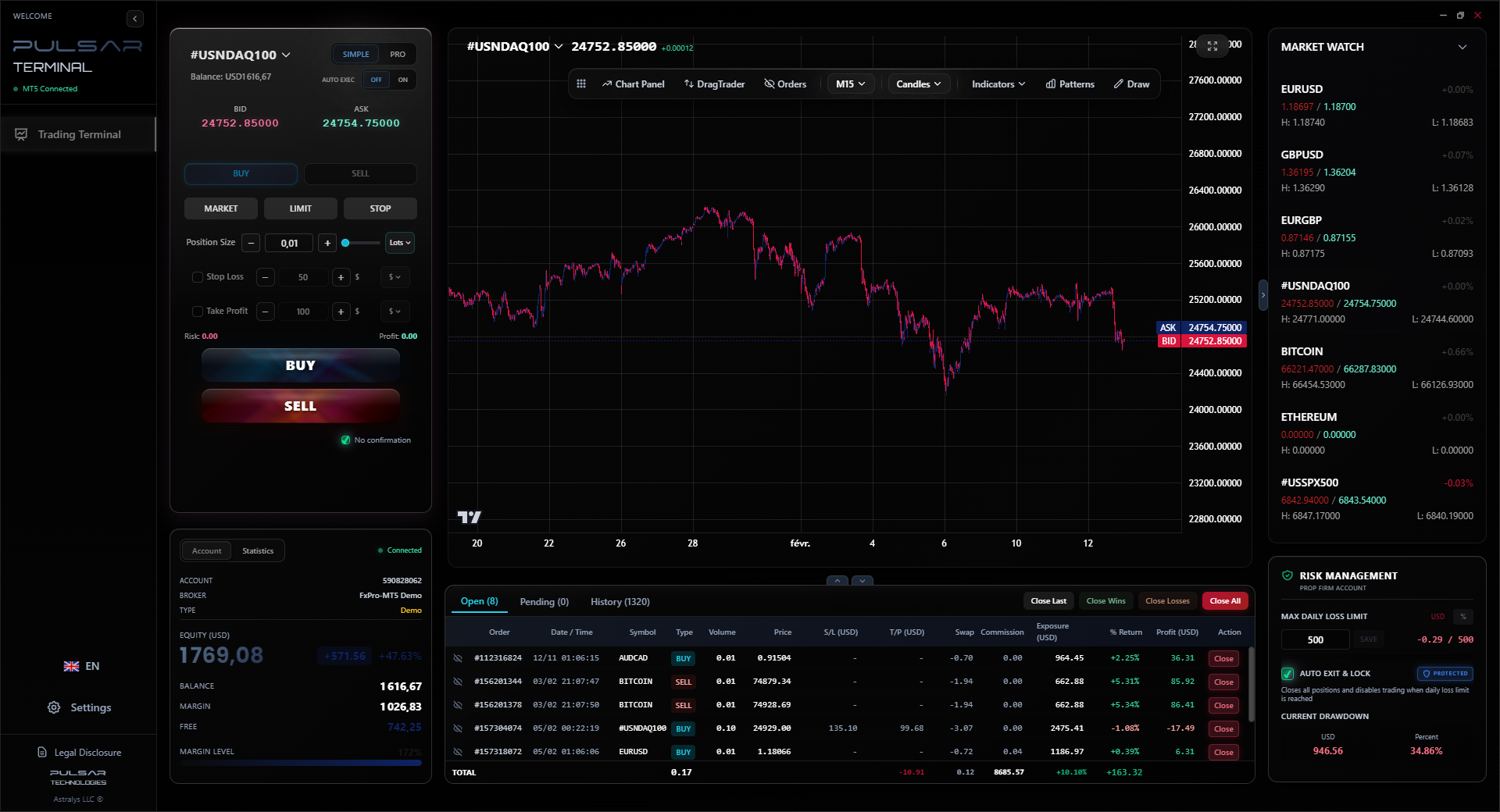
Managing the strict daily loss limits of a prop firm challenge is a huge psychological burden, which is why automating those rules with a tool like Pulsar Terminal can be the difference between passing and failing.
Pulsar Terminal
La herramienta MT5 todo-en-uno: órdenes drag-and-drop, multi-TP/SL, trailing stop, grid trading, Volume Profile y protección prop firm. Usado por más de 1.000 traders diariamente.
“The system is boring. It misses moves. But over 100 trades, the math works in your favour.”
This is a modern meta-strategy. Passing a proprietary trading firm's evaluation (like FTMO, The5%ers) to trade their capital. The rules are specific: a profit target, a maximum daily loss, a maximum overall loss. Your strategy must be tailored to these rules first, and the market second.
The Key Adjustment: Aggressive trailing stops and daily loss limits are paramount. Your goal isn't just to make money, it's to not hit their strict loss limits. A strategy that has large drawdowns will fail, even if it's profitable long-term.
My Approach for Challenges: I use a very conservative, high-probability trend-following method on the H4 chart. I aim for consistent 1:2 risk-reward wins. The moment I'm up 0.5-1%, I move my stop to breakeven. I never risk more than 0.5% of the challenge account on a single trade. The name of the game is survival and steady growth, not home runs.
Warning: Many traders blow challenges because they use their normal strategy. You can't afford a 5% drawdown when your max daily loss is 3%. This environment demands hyper-vigilant capital preservation. Tools that automate daily loss protection and breakeven stops are almost a necessity here.
This is what I use now. It's not one strategy, but a rules-based system that combines elements from several of the top 10 forex strategies above. The goal is to remove all discretionary guesswork.
The Framework:
- Trend Filter (Daily Chart): Is price above the 200 EMA? If yes, only look for longs on lower timeframes. If no, only look for shorts.
- Entry Zone (H4 Chart): Identify key support/resistance or a moving average confluence within the trend.
- Entry Trigger (H1 Chart): Wait for a specific price action signal (like a pin bar rejection) or a momentum indicator confirmation (like RSI crossing 50) at the H4 zone.
- Risk Management: Fixed 1% risk per trade. Stop loss is placed at the logical invalidation point of the H4 setup. Take profit is set at a minimum 1:1.5 risk-reward ratio.
Why it works: It forces me to trade with the higher timeframe trend, be patient for a clear setup, and removes emotion from entry and exit. I backtested this on 5 years of EUR/USD data and it showed a 42% win rate with an average win 1.8x larger than the average loss. That's an edge. You can learn the pairs with our EUR/USD guide.
The system is boring. It misses moves. But over 100 trades, the math works in your favour. That's the secret. Find a logical, testable process, and have the discipline to follow it through the inevitable losing streaks.

FAQ
Q1Which of these top 10 forex strategies is best for beginners in South Africa?
Start with Swing Trading using the Trend Following method. It's slower, less stressful, and teaches you to analyse higher timeframes without the pressure of scalping. It also works with most local brokers like XM or Exness that offer decent conditions on H4/Daily charts. Avoid scalping and news trading completely at first.
Q2How much money do I need to start with these strategies?
With brokers offering micro and cent accounts, you can start with as little as R500 or $30. However, to trade properly using sane position sizing (risking 1% or less), a R10,000 account allows more flexibility. A R1,000 account risking 1% is R10 per trade, which can be wiped out by a single wide spread on entry.
Q3Do I need expensive software for these strategies?
No. MetaTrader 4 or 5 (free with your broker) has all the basic indicators (Moving Averages, RSI, MACD, Stochastic) you need for 9 out of 10 strategies listed. The edge comes from your discipline, not a fancy tool. Advanced tools become useful for automation and advanced order management once your process is solid.
Q4How many strategies should I use at once?
One. Master one. Trying to jump between a scalping system and a swing system will confuse your brain and destroy your results. Pick the one that fits your personality and schedule, backtest it thoroughly, and trade it for at least 100 trades before you even think about changing it.
Q5What's the biggest mistake traders make when choosing a strategy?
They choose based on recent profits, not fit. A strategy that requires you to be glued to the screen from 10pm to 2am SA time (during London/NY overlap) is useless if you have a 6am day job. Be brutally honest about the time and focus you can commit.
Q6Are automated trading robots (EAs) a good way to use these strategies?
Only if you can code and backtest the logic yourself. Buying a 'winning robot' is the fastest way to lose money. The market adapts. A robot that worked last year may fail spectacularly this year. Understanding the underlying strategy is always more important than the automation.
Q7How important is the choice of broker for strategy success?
Critically important. A scalping strategy will fail with a broker that has high, variable spreads. A news trading strategy is impossible with a broker that doesn't guarantee stops during volatility. Always match your broker's conditions (spread type, execution model, slippage policy) to the demands of your chosen strategy.
Lección del Prof. Winston
Puntos clave:
- ✓Master one strategy; don't collect ten.
- ✓Risk 1% per trade, no exceptions.
- ✓The higher timeframe trend is the ultimate filter.
- ✓Your broker's spreads can break a good strategy.
- ✓Backtest with real spread data, not ideal conditions.
¿Te resultó útil este artículo?
Haz clic en una estrella
Análisis Trading Semanal
Análisis y estrategias semanales gratis. Sin spam.
Sobre el autor
David van der Merwe
Trader de Mercados Emergentes
Trader con sede en Johannesburgo con 11 años en divisas de mercados emergentes. Especialista en pares ZAR, trading regulado por la FSCA y análisis del mercado sudafricano.
Comentarios
Aviso de riesgo
El trading de instrumentos financieros conlleva un riesgo significativo y puede no ser adecuado para todos los inversores. El rendimiento pasado no garantiza resultados futuros. Este contenido tiene fines educativos únicamente y no debe considerarse asesoramiento de inversión. Siempre realice su propia investigación antes de operar.
También te puede interesar

Cara Trading Forex Sukses: 7 Prinsip dari Trader Profesional
Cara trading forex sukses dengan 7 prinsip trader pro: manajemen modal, disiplin, journal trading, backtest. Data nyata, bukan janji profit palsu.
Jam Trading Forex Terbaik untuk Trader Indonesia: Panduan Lengkap dengan Tabel Waktu
Panduan jam trading forex untuk trader Indonesia. Tabel 4 sesi dunia, jam emas 20:00-00:00, sesi mana yang harus dihindari. Data akurat + tips dari trader berpengalaman.
Top 5 Sàn Forex Uy Tín Nhất 2026: Review Jujur dari Trader Indonesia
Top 5 sàn forex uy tín 2026 untuk trader Indonesia. Review jujur: spread, deposit, withdraw, dukungan lokal. Exness, XM, IC Markets & lebih.
Obtener Pulsar Terminal
Todas estas calculadoras están integradas en Pulsar Terminal con datos en tiempo real de su cuenta MT5.
Obtener Pulsar Terminal