


Let's get one thing straight: searching for a 'top 10 forex trading books pdf' is the easiest part of this journey.

Rajesh Sharma
Analista Forex Sénior ·  India
India
☕ 11 min de lectura
Lo que aprenderás:
- 1The Indian Reality Check (Read This First)
- 2The Essential Book List (For the Legal Indian Trader)
- 3A Personal Mistake: When Book Smarts Met Dumb Regulation
- 4How to Apply These Global Books to Your Local Trades
- 5The PDF Question & Straight Talk on Ethics
- 6Building Your Legal Indian Trading Plan
- 7Final Word: Wisdom Over Wizardry
Let's get one thing straight: searching for a 'top 10 forex trading books pdf' is the easiest part of this journey. The hard part is understanding that 90% of what those books teach is illegal for you to practice in India if you're not careful. I've seen too many sharp minds get burned not by the markets, but by the RBI's rulebook. This list isn't just about titles; it's about filtering that global wisdom through the harsh, non-negotiable lens of Indian regulation. I'll give you the books that built my career, then show you exactly how to use them without inviting a SEBI notice or an FEMA penalty.
Before we talk about a single book, we need to talk about the law. This isn't boring compliance stuff; this is what keeps your bank account open and you out of legal trouble. The Reserve Bank of India (RBI) and SEBI don't mess around. They've drawn a very clear, very narrow line for retail forex trading.
You are allowed to trade currency derivatives (futures and options) on Indian exchanges like the NSE or BSE. The pairs? Extremely limited: USD-INR, EUR-INR, GBP-INR, JPY-INR, and the cross-currency pairs EUR-USD, GBP-USD, USD-JPY. That's it. Full stop.
What's absolutely forbidden? Opening an account with an offshore broker like Exness, IC Markets, or Pepperstone to trade AUD/USD, GBP/JPY, or any other exotic pair you read about in those books. Using the Liberalised Remittance Scheme (LRS) to fund such an account for trading is also illegal. The RBI maintains an 'Alert List' of unauthorized entities - names like Binomo, eToro, and Olymp Trade are on it. Getting involved with them isn't just risky; it's a direct violation of FEMA.
The penalties are no joke. Think fines that can be three times the amount involved, frozen accounts, and even imprisonment. I once knew a guy who thought he was clever using an international platform. He wasn't. The taxman and the RBI had a field day. His trading was decent, but his legal awareness was zero. Don't be that guy.
So, when we discuss these top 10 forex trading books pdf or hardcover, you must mentally add a filter: "How does this apply to trading USD-INR futures on the NSE?" That's your sandbox. Play within it.

💡 Consejo de Winston
Forget the PDF hunt. The cost of 10 books is less than the loss from one poorly managed trade. Treat your education as your first and most important investment.
These books aren't about giving you a secret offshore strategy. They're about building the timeless foundations of market understanding, psychology, and risk management - skills that translate directly to trading USD-INR volatility. Forget hunting for shady PDFs; invest in the real thing. The knowledge is worth a thousand times the price.
1. Trading in the Zone by Mark Douglas
This is book number one for a reason. Indian markets are driven by emotion, especially around RBI announcements and budget days. Douglas drills into the probabilistic mindset you need. It won't teach you a chart pattern, but it will teach you how to not panic-sell a USD-INR position when the rupee gaps 30 pips against you at open. This book saved me from myself more times than I can count.
2. The New Trading for a Living by Dr. Alexander Elder
Think of this as your all-in-one manual. Elder covers the three M's: Mind, Method, Money. His triple screen trading system is adaptable to the 15-minute and hourly charts you'll use for scalping strategy or swing trading INR pairs. His emphasis on risk management is gospel.

Warning: When these books talk about 'use,' mentally replace it with the use allowed by your SEBI-regulated broker on the NSE. It's much lower than the 500:1 the international books brag about. That's a good thing. It keeps you alive.
3. Market Wizards by Jack D. Schwager
This is your dose of inspiration and brutal honesty. Reading interviews with legends like Paul Tudor Jones shows you that success isn't about a perfect indicator. It's about discipline, risk management, and sometimes, being wildly wrong. It puts your own 5-lot trade in perspective.
4. Technical Analysis of the Financial Markets by John J. Murphy
The bible. If you want to understand why USD-INR respects a certain moving average or how volume confirms a breakout on the NSE platform, this is your reference. Don't read it cover-to-cover in one go. Use it to look up concepts as you encounter them.
5. Japanese Candlestick Charting Techniques by Steve Nison
Candlesticks are a universal language. A bearish engulfing pattern on the USD-INR daily chart means the same thing as it does on EUR/USD. Nison is the original source. Learning to read the story of price action through candles is a fundamental skill, whether you're using a XM review platform (illegally) or your legal NSE terminal.
6. Day Trading and Swing Trading the Currency Market by Kathy Lien
While Lien discusses global pairs, her frameworks for analyzing central bank impact (hello, RBI monetary policy!) and economic data releases are pure gold. You can directly apply her fundamental analysis approach to understanding rupee flows.
7. Reminiscences of a Stock Operator by Edwin Lefèvre
A timeless story about Jesse Livermore. This book teaches you about market psychology, crowd behavior, and the cost of ego. The market doesn't care if you're trading Infosys shares or USD-INR futures. The emotional pitfalls are identical.
8. The Art of Currency Trading by Brent Donnelly
This is for when you've got the basics down. Donnelly, a former bank trader, dives deep into the real-world flow of the market. It gives you a sense of what the big players (the ones that actually move USD-INR) are thinking about.
9. Currency Trading for Dummies by Brian Dolan & Kathleen Brooks
Don't let the title fool you. It's a brilliantly structured primer that explains everything from what a pip definition is to how an economic calendar works. It lays the groundwork without overwhelming you.
10. The Disciplined Trader by Mark Douglas (Bonus)
Yes, Douglas gets two spots. If "Trading in the Zone" is the philosophy, this is the practical workbook for developing the mental discipline. In a market where FOMO can make you chase a runaway USD-INR move, discipline is your anchor.

Pro Tip: Apply the MACD indicator or RSI indicator strategies from these books to the USD-INR chart. The math is the same. The regulatory safety is not.
“Searching for a 'top 10 forex trading books pdf' is the easiest part. The hard part is understanding that 90% of what those books teach is illegal for you to practice in India.”
Early in my career, around 2015, I got my hands on a book heavy on carry trade strategies - borrowing in a low-yielding currency to invest in a higher-yielding one. The math was beautiful. I was trading legally on the NSE but decided to test a correlated idea using a then-popular international broker (now on the RBI's alert list) to access the AUD/JPY pair, thinking I was 'hedging.'
I wasn't hedging. I was breaking the law.
The trade itself was mildly profitable. I made about $1200. But the stress was immense. Every login felt illicit. When I withdrew the profit, the bank asked questions. I had to fabricate a story about 'software services.' It was a wake-up call. The $1200 wasn't worth the constant low-grade fear of a penalty or a frozen account. I closed the offshore account and doubled down on mastering the USD-INR and EUR-INR markets legally. The irony? I've made more consistent money trading RBI policy decisions on the NSE than I ever did trying to be clever with illegal cross-pairs. The books gave me the analytical skill, but I almost misapplied it in a legally dangerous way. Let my near-miss be your lesson.
This is the critical translation layer. You can't just copy-paste.
1. Translate the Pairs: When a book discusses EUR/USD volatility around the ECB, translate that to USD/INR volatility around the RBI MPC meeting. The fundamental principle (central bank impact) is identical.
2. Adjust for use & Volatility: Books often assume high use. Indian exchange use is capped much lower. This forces better position size calculator habits. A strategy that risks 2% per trade in a 500:1 environment needs careful recalculation for a 20:1 environment. It changes your trade structure.
3. Focus on Universal Technicals: Support/Resistance, trendlines, MACD indicator divergences, candlestick patterns - these work on any chart, anywhere. A head and shoulders top on the GBP/INR weekly chart is as valid as one on XAU/USD guide. Spend 80% of your time mastering these universal concepts from Murphy and Nison.
4. Internalize the Psychology: This needs no translation. The fear, greed, and hope Mark Douglas describes are human constants. Managing them is your single biggest edge, especially in the often-gappy Indian market.
5. Use Legal Tools to Execute the Wisdom: This is where modern tools fit in. The discipline taught in these books - like moving stops to breakeven or using a trailing stop - can be automated. You're not trading the illegal EUR/USD guide, but you can apply the same careful order management to your legal USD-INR trades.
💡 Consejo de Winston
When you read about a 'stop loss,' immediately think 'RBI regulation' as your first stop loss. If your trade idea requires breaking the law, it's not a trade. It's a liability.
“A pirated PDF mindset often leads to pirated, illegal trading approaches. Don't go down that road.”
Let's address the elephant in the room: everyone wants a free 'top 10 forex trading books pdf' download. Here's my blunt take.
Scouring the internet for pirated PDFs is a waste of your energy and a massive security risk. Those files are often riddled with malware or lead to scammy 'broker' sites (probably on the RBI's alert list). More importantly, it starts your journey on the wrong foot - looking for shortcuts and circumventing rules. This mindset will bleed into your trading and your approach to regulation.
Invest in the books. Buy them legally. The cost of 10 books is less than the spread definition on one bad trade. It's a sign of commitment. The authors dedicated years to their craft; the least you can do is pay for their condensed wisdom. If money is tight, start with one or two. Get "Trading in the Zone" and "Currency Trading for Dummies." Master them. Then get the next one.
Your education is the one part of trading where you should never cut corners. The knowledge from these books, applied correctly within India's legal framework, will pay for itself a thousand times over. A pirated PDF mindset often leads to pirated, illegal trading approaches. Don't go down that road.
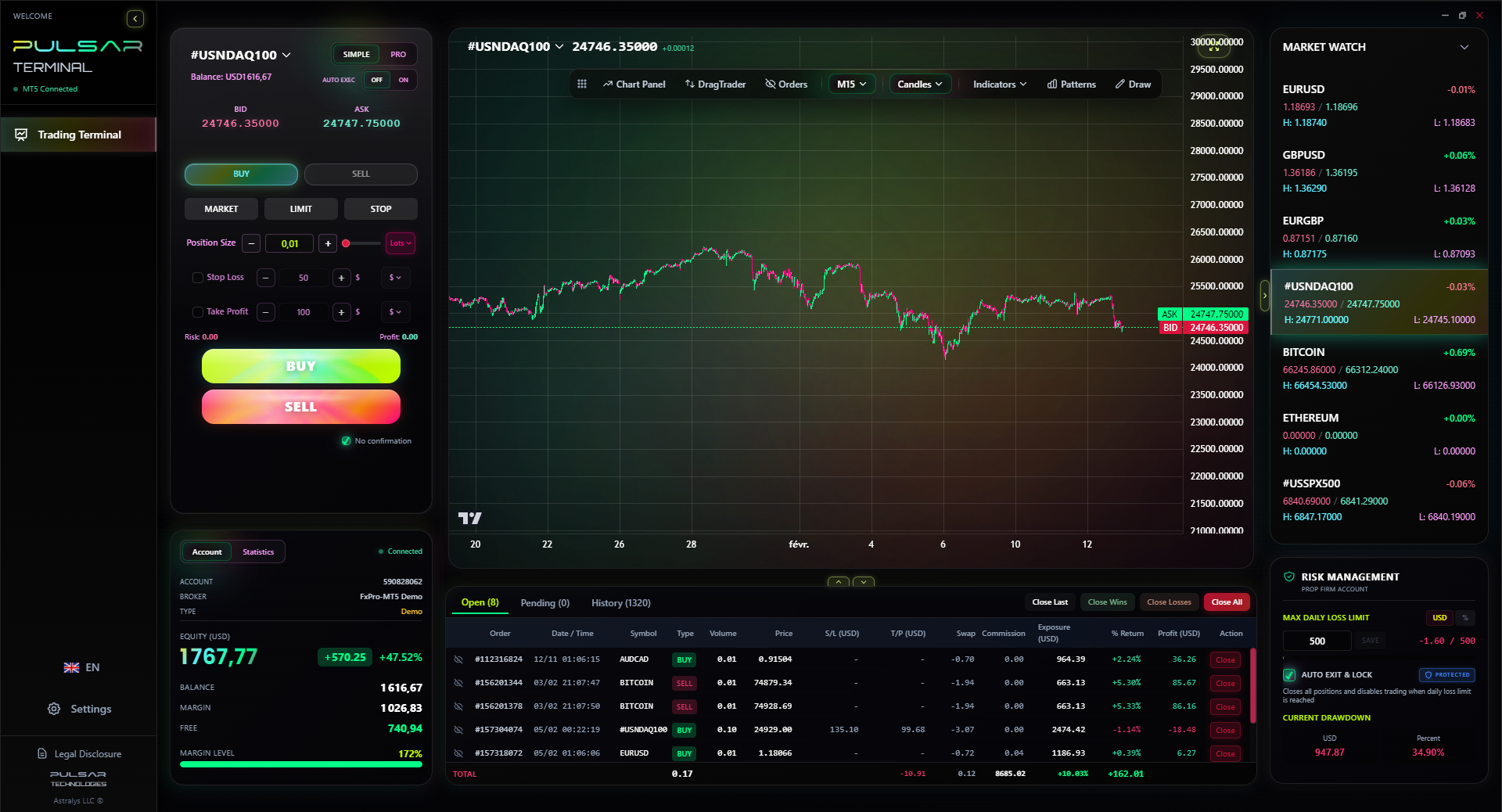
Executing the disciplined order management from these books—like partial closures and trailing stops on your NSE trades—is exactly what Pulsar Terminal automates directly on your MT5 platform.
Pulsar Terminal
La herramienta MT5 todo-en-uno: órdenes drag-and-drop, multi-TP/SL, trailing stop, grid trading, Volume Profile y protección prop firm. Usado por más de 1.000 traders diariamente.
So you've read the books. Now what? You need a plan that respects the Indian context.
Step 1: Get Your Setup Legally. Open an account with a SEBI-registered broker that offers currency derivatives on the NSE. Verify their SEBI registration number. Fund it through normal banking channels. This is your only legal playground.
Step 2: Paper Trade the INR Pairs. Don't use demo on some offshore platform. Use your broker's simulation feature to trade the actual USD-INR, EUR-INR futures. Get a feel for the liquidity, the tick size (0.0025 for USD-INR), and the session timings.
Step 3: Develop a USD-INR Specific Strategy. Combine the technicals from Murphy/Nison with the fundamental analysis of RBI policy from Lien's principles. For example, maybe you look for RSI indicator oversold conditions on the hourly USD-INR chart ahead of known RBI intervention levels.
Step 4: Implement Brutal Risk Management. This is where all the books agree. Use a position size calculator. Your maximum risk per trade should be 1-2% of your capital. Know your margin call level intimately. The lower Indian use is a blessing here - it physically prevents you from over-leveraging like the books warn against.
Step 5: Keep a Journal. This is non-negotiable. Log every trade: entry, exit, why you took it (which book's principle?), P&L, and emotional state. Review it weekly. This turns book knowledge into personal experience.

Example: Your capital is ₹200,000. Your risk per trade is 1% = ₹2,000. You're buying 1 USD-INR futures lot (standard lot size). You place your stop loss 20 ticks away. Each tick is ₹12.50. 20 ticks * ₹12.50 = ₹250 risk per lot. To risk ₹2000, you could theoretically trade 8 lots. But you must also consider margin and your own comfort. See how the theory meets practical constraints?
“The edge for the Indian trader isn't in a secret offshore strategy; it's in superior psychology, solid technicals, and strict regulatory compliance.”
The quest for a 'top 10 forex trading books pdf' is really a quest for an edge. I'm telling you, the edge isn't in a secret strategy from a pirated file. The edge for the Indian trader is in this combination:
- Superior Psychology: Gained from Douglas, Elder, and "Market Wizards."
- Solid Technical Foundation: Built from Murphy and Nison.
- Impeccable Risk Management: Drilled into you by every good book.
- Strict Regulatory Compliance: The non-negotiable filter you must apply to points 1-3.
The traders who last in India aren't the cowboys trying to sneak trades on offshore platforms. They're the disciplined analysts who have mastered the nuances of the USD-INR contract, who understand the impact of FII flows and RBI repo rates, and who execute their legally-sound plan with the cold precision described in all these great books.
Start with the mindset books. Build your technical knowledge. Practice legally. The path is narrower here, but that's not a disadvantage - it's a focus. Now go read, learn, and trade smart within the rules. Your future self will thank you for doing it the right way.
FAQ
Q1Is it legal to download free PDF versions of these forex trading books?
Legally, downloading copyrighted books without payment is piracy. Practically, it's a terrible idea. These PDFs are often malware traps or lead to scam sites. More importantly, starting your education by circumventing rules sets a bad precedent for how you'll approach market rules. Invest in the real books; it's the cheapest and most important part of your trading capital.
Q2Can I use the strategies from these books to trade with international brokers like Exness or IC Markets?
No. For an Indian resident, trading forex on international platforms like Exness or IC Markets for non-INR pairs is illegal under FEMA, regardless of the strategy. The RBI explicitly prohibits this and lists such entities on its 'Alert List.' You can only apply the universal principles from these books (like technical analysis or psychology) to trade the permitted INR pairs (e.g., USD-INR) on SEBI-regulated Indian exchanges like the NSE.
Q3Which single book is most important for managing emotions while trading USD-INR?
Hands down, "Trading in the Zone" by Mark Douglas. The USD-INR market can be whippy around RBI news and global risk events. This book trains you to see trading as a probability game, not an emotional rollercoaster. It's the best defense against panic selling or FOMO buying during rupee volatility.
Q4Do I need to understand complex fundamentals for trading in India?
Yes, but your focus is specific. Instead of global fundamentals, you need to deeply understand RBI monetary policy, inflation data (CPI), fiscal deficit news, and foreign institutional investor (FII) flows. Books like Kathy Lien's teach you how to analyze central bank impact - just apply that framework to the RBI and the US Fed (which influences USD).
Q5How do I adjust the high-use strategies mentioned in these books for Indian markets?
Indian exchanges offer significantly lower use on currency derivatives. This is a good thing. It forces stricter risk management. When a book talks about a 2% risk with 100:1 use, you must recalculate your position size using the actual use (e.g., 20:1) allowed on the NSE. Always use a position size calculator based on your actual account equity and the tick value of the USD-INR contract.
Q6Are the chart patterns and indicators in these books relevant for INR pairs?
Absolutely. A bullish engulfing pattern, a head and shoulders top, or an RSI indicator divergence works the same on a USD-INR chart as it does on any other chart. The technical analysis principles in books by John Murphy and Steve Nison are universal languages of price. Your job is to learn that language and apply it to the charts of your legally permitted pairs.
Lección del Prof. Winston
Puntos clave:
- ✓Psychology books like 'Trading in the Zone' are more critical than strategy books for Indian traders.
- ✓Always filter book knowledge through the lens of RBI/SEBI regulations.
- ✓Technical analysis is universal; apply Murphy & Nison directly to USD-INR charts.
- ✓The cost of 10 legal books is less than 1% of a typical trading account.
¿Te resultó útil este artículo?
Haz clic en una estrella
Análisis Trading Semanal
Análisis y estrategias semanales gratis. Sin spam.
Sobre el autor
Rajesh Sharma
Analista Forex Sénior
Más de 10 años operando en mercados indios y del sur de Asia. Comenzó con derivados de divisas en el NSE antes de pasar al forex internacional. Especialista en USD/INR y pares de mercados emergentes.
Comentarios
Aviso de riesgo
El trading de instrumentos financieros conlleva un riesgo significativo y puede no ser adecuado para todos los inversores. El rendimiento pasado no garantiza resultados futuros. Este contenido tiene fines educativos únicamente y no debe considerarse asesoramiento de inversión. Siempre realice su propia investigación antes de operar.
También te puede interesar

Cara Trading Forex Sukses: 7 Prinsip dari Trader Profesional
Cara trading forex sukses dengan 7 prinsip trader pro: manajemen modal, disiplin, journal trading, backtest. Data nyata, bukan janji profit palsu.
Jam Trading Forex Terbaik untuk Trader Indonesia: Panduan Lengkap dengan Tabel Waktu
Panduan jam trading forex untuk trader Indonesia. Tabel 4 sesi dunia, jam emas 20:00-00:00, sesi mana yang harus dihindari. Data akurat + tips dari trader berpengalaman.
Top 5 Sàn Forex Uy Tín Nhất 2026: Review Jujur dari Trader Indonesia
Top 5 sàn forex uy tín 2026 untuk trader Indonesia. Review jujur: spread, deposit, withdraw, dukungan lokal. Exness, XM, IC Markets & lebih.
Obtener Pulsar Terminal
Todas estas calculadoras están integradas en Pulsar Terminal con datos en tiempo real de su cuenta MT5.
Obtener Pulsar Terminal