


You're a decent trader.

James Mitchell
Analista de Trading Sénior
☕ 14 min de lectura
Lo que aprenderás:
- 1What Actually Makes a Firm "Top-Tier"?
- 2US Regulations: What's Changing and Why You Should Care
- 3The Numbers Game: Fees, Splits, and Your Real Odds
- 4Matching a Firm to Your Trading Style
- 5Passing the Evaluation: A Step-by-Step Survival Guide
- 6Red Flags and Scams: How to Spot the Bad Apples
- 7Your First Steps and My Final Piece of Advice
You're a decent trader. You've got a solid edge, you manage your risk, and you're tired of watching your own small account grow at a snail's pace. You've seen the ads: 'Get $100,000 to trade!' 'Become a funded trader!' It sounds like the golden ticket. But how do you separate the real, toptier prop firm from the glorified fee-collection schemes? I've been there, I've traded with several, and I've learned the hard way what actually matters. Let's cut through the hype.
Forget the flashy websites and influencer sponsorships. A real toptier prop firm isn't defined by its marketing budget. After trading with a few and watching many others, I've narrowed it down to three non-negotiable pillars.
Capital and Payouts: The Proof is in the Payment
First, they have real, deployable capital and a proven track record of paying traders. I'm talking tens of millions paid out, consistently, for years. You can check this. Firms like Apex Trader Funding, for example, have publicly reported paying out over $598 million to traders. That's not a promise, that's a fact. A firm that's cagey about its payout history is a red flag the size of Texas.
A true toptier prop firm treats your profits as a business expense, not a liability. They want you to make money because they get a cut. The payment process should be smooth, reliable, and on a clear schedule (like twice a month). If you hear stories of 'payment delays' or excuses, run.
Rules and Structure: Fair Play, Not a Trap
Second, their rules are designed to find profitable traders, not to trick you into failing. Let me give you a personal example. Early on, I joined a firm with a ridiculously tight 'consistency rule' that wasn't clearly explained. I hit my profit target but had two winning days that were 'too big' compared to my average. Failed. My fee was gone. That's a trap, not an evaluation.
A top-tier firm will have clear, achievable rules. Look for reasonable drawdown limits (both daily and overall), realistic profit targets (8-10% for an evaluation is standard), and no hidden 'gotchas' like trailing drawdowns that only move against you. Their goal should be to see if you can trade well under sensible constraints, not to design an impossible obstacle course.

Warning: Be extremely wary of firms that use 'simulated' or 'demo' accounts for their funded phase. A real prop firm gives you access to a live account with real capital. If they're not risking real money on you, you're not really funded.
Support and Infrastructure
Finally, they provide the tools to succeed. This means a reliable trading platform (like MT4/MT5), competitive spreads, and access to responsive support. You're a business partner, not a customer service ticket. Some of the best firms also offer educational resources, community forums, and scaling plans that automatically increase your capital as you prove yourself.

💡 Consejo de Winston
The evaluation fee is the cheapest tuition you'll ever pay for a lesson in real risk management. If it stings to lose it, you're trading too big.
“A real toptier prop firm isn't defined by its marketing budget.”
This is the boring-but-critical stuff most traders ignore. The prop firm world in the US isn't the wild west anymore, and that's a good thing for you. Stricter rules are coming, and they separate the serious operators from the fly-by-night shops.
The big agencies are the SEC (Securities and Exchange Commission) and the CFTC (Commodity Futures Trading Commission). Right now, most prop firms skate by as 'evaluation service providers.' But by 2026, the CFTC is expected to push for many to be classified as Commodity Trading Advisors (CTAs).
What does this mean for you, the trader?
- Your Money is Safer: CTA classification would force firms to hold funds in segregated accounts. Your earned profits and even your challenge fee should be treated as your money until services are rendered. No more worrying about the firm blowing up with your cash.
- Clearer Rules: Expect standardized, transparent rules around things like news trading. No more firm-specific surprises that wipe you out.
- Lower use: This is a big one. Regulators are pushing for lower max use, especially on volatile stuff like crypto or indices. A toptier prop firm is already preparing for this, not offering insane 1:500 use that will get yanked away.
The recent SEC moves around the 'Dealer Rule' show the landscape is in flux. A firm that's proactively adapting to these coming rules is one planning to be here in five years. A firm ignoring them is a risk.

Pro Tip: When researching a firm, don't just look at their profit split. Look for their compliance page. Do they mention KYC/AML procedures? Do they talk about fund segregation? This boring legalese is a sign of a mature, legitimate business.
“Only about 7% of all traders who buy a challenge ever see a payout.”
Let's talk numbers, because this is where dreams meet reality. The stats are humbling, but knowing them keeps you honest.
The Costs: Evaluation fees typically run you $100 to $500. Some firms, like OneFunded, have a 100% refundable model, which is a nice safety net. Think of this fee as the cost of a very serious, high-stakes final exam. It's not a ticket to a payout.
The Profit Splits: This is where firms compete. The standard for a toptier prop firm is an 80/20 split in your favor. Some go to 85/15, 90/10, or even have programs that scale to 100% after you hit certain milestones (like The5ers). Apex has a unique model where you keep 100% of the first $25k. Don't get blinded by the highest split; a 80% split from a firm that pays like clockwork is better than a 95% split from a shaky one.
The Cold, Hard Statistics: This is the part most articles gloss over. I wish someone had slapped me with these numbers earlier.
- Only 5-10% of traders pass the evaluation on the first try.
- Only about 7% of all traders who buy a challenge ever see a payout.
- The average trader spends over a thousand dollars on multiple challenge attempts before getting funded, if they ever do.
Why is this? It's not because the tests are unfair (though some are). It's because most retail trading strategies aren't consistently profitable under the mild pressure of an evaluation. The firms aren't just testing your strategy; they're testing your psychology. Can you stick to your plan when real money (their money) is on the line?
My own journey? I failed two challenges before passing a third. That was about $450 in fees down the drain. On my first funded account, I got nervous, over-traded, and hit my daily loss limit in 3 hours. Blown account. It was a brutal, expensive lesson in discipline that my personal account never taught me. The structure of a good prop firm forces you to become a professional, and that process has a price.

Example: Let's say you pass a $100,000 account challenge. Your profit target is 10% ($10,000). You achieve it and get a standard 80% split. Your first payout is $8,000. Minus your evaluation fee, that's a net of $7,900. That's the potential upside that makes the grind worthwhile.
💡 Consejo de Winston
A firm's profit split is a marketing number. A 70% split from a firm that pays reliably is infinitely more valuable than a 90% split from a firm that doesn't.
“Only about 7% of all traders who buy a challenge ever see a payout.”
Not all prop firms are created equal, and the best one for a scalper is a nightmare for a swing trader. You need to read the fine print on their rules.
For Scalpers and Day Traders: You need a firm with the absolute lowest spreads and fastest execution. Slippage on a 5-minute chart will kill your edge. Look for firms that offer raw spread accounts or direct market access. Also, check their rules on minimum trading days. Some require you to trade for a certain number of days during the evaluation, which is agony for a scalper who might only take 2-3 A+ setups a week. A firm friendly to a scalping strategy won't have this barrier.
For Swing Traders and Position Traders: Your biggest concerns are overnight holding costs (swaps) and weekend drawdown rules. Some firms have rules that calculate your drawdown based on the daily close, which is fine. Others use a trailing drawdown based on your peak equity, which can be dangerous if you hold trades over multiple days. You also need a firm that allows holding trades over weekends and through news events. Your strategy might use the MACD indicator on a daily chart, which requires patience a day-trading firm might not accommodate.
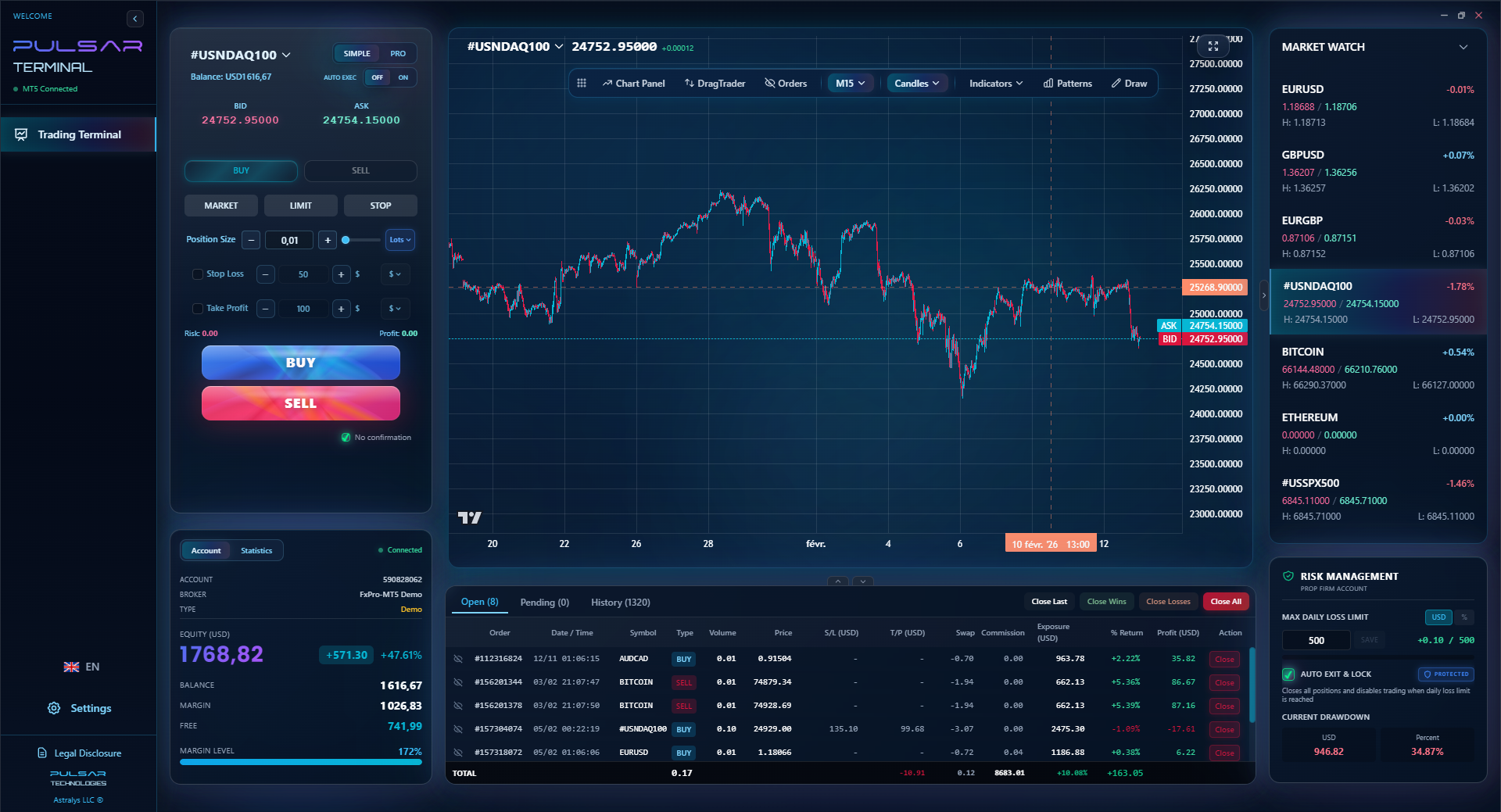
The Platform Matters: Most firms use MetaTrader 4 or 5. If you rely on specific tools or custom indicators, make sure they're compatible. This is where a tool like Pulsar Terminal, which works as a companion to MT5, can be a game-saver, adding advanced order types and charting tools the native platform lacks.
Here’s a quick comparison of two common rule types:
| Rule Type | Good For | Bad For | Watch Out For |
|---|---|---|---|
| Static Drawdown | Swing traders, beginners. Your max loss is fixed. | Less flexible. | Is it a true 'hard' stop or just a violation level? |
| Trailing Drawdown (from peak equity) | Consistent grinders. Locks in profits as a buffer. | Swing traders. A winning trade that pulls back can violate the rule. | Is it trailing from account opening balance or from your highest equity point? The latter is stricter. |
I learned this the hard way. My main edge was in swing trading forex pairs. I picked a firm with a trailing drawdown from peak equity. I entered a trade on the EUR/USD, it went +2.5%, then retraced 1% before taking off again. That 1% retracement dipped my equity below the trailing threshold. I was liquidated out of a winning trade for a "drawdown violation." My strategy was sound, but I was with the wrong firm.
“The prop firm is not your strategy. It is a capital source and a risk framework.”
Okay, you've picked a reputable, toptier prop firm that fits your style. Now you have to pass the test. This is a mental marathon, not a sprint.
Phase 1: The Challenge (Usually 1-2 Stages) This is where you prove you can hit a profit target (e.g., 8-10%) without violating drawdown rules (e.g., 5-10%).
- Size Tiny: This is my number one rule. Your goal is to pass, not to get rich on the challenge. Use a position size calculator. I'm talking 0.5% risk per trade, max. On a $100k challenge, that's a $500 risk. It feels silly, but it keeps you in the game.
- Trade Your Plan, Nothing Else: Do not watch the profit target. Do not trade more aggressively as you get close. Just execute your strategy, one boring trade at a time. If your plan says wait for the RSI indicator to hit oversold on the 4H chart, you wait.
- Manage the Daily Limit: The daily loss limit is your circuit breaker. If you hit it, you're done for the day. No revenge trading. Close the platform. Go for a walk.
Phase 2: The Verification (Sometimes Called "Phase 2") Some firms have a shorter, second stage after the challenge. The rules are often similar, but the profit target is smaller (e.g., 5%). The psychology here is tricky. You're so close you can taste it, and that makes you prone to mistakes. Treat it exactly like Phase 1. Size tiny. Follow the plan.
The Funded Account Mindset You passed! Now the real test begins. The rules usually relax a bit (higher drawdown, no profit target), but the pressure increases because it's 'real' now.
- Withdraw Early and Often: Set a goal for your first withdrawal. Maybe it's just $1,000. Get money in your pocket. It proves the system works and relieves psychological pressure.
- Beware of Scaling Plans: Many firms automatically increase your capital after you hit certain profit milestones. This is amazing, but it can destabilize you. When your account size jumps from $100k to $150k, your position size in lots should not jump 50%. Re-calculate your risk based on the new balance. Keep your dollar risk per trade consistent.
The biggest mistake I see funded traders make? They start trading 3x the size they used in the challenge because 'it's real now.' That's a fast track to a margin call and a lost account.
💡 Consejo de Winston
Your first funded withdrawal should be for a trivial amount - $500. The psychological proof that the system works is worth far more than the cash.
Managing a prop firm's strict daily loss and drawdown rules is stressful, but tools like Pulsar Terminal can automate these protections directly on your MT5 chart, so you can focus on trading.
Pulsar Terminal
La herramienta MT5 todo-en-uno: órdenes drag-and-drop, multi-TP/SL, trailing stop, grid trading, Volume Profile y protección prop firm. Usado por más de 1.000 traders diariamente.
“The prop firm is not your strategy. It is a capital source and a risk framework.”
The prop firm space has its share of shady operators. Here’s how to spot them before you hand over your money.
1. The "Too Good to Be True" Offer. $1,000,000 account for a $99 fee? 1:1000 use? 100% pass rate? Come on. A real toptier prop firm is running a business, not a charity. Their rules are designed to make them money when you make money, not from collecting endless failure fees.
2. Opaque or Constantly Changing Rules. If you can't find clear, written rules on their website, or if they seem to change every month, avoid them. You need a stable environment. A firm that suddenly bans a popular trading style (like certain news trades) overnight is not trustworthy.
3. Poor or Non-Existent Customer Support. Before you buy a challenge, test their support. Send an email with a technical question. How long do they take to reply? Is the answer helpful? If you can't get help before you pay, you definitely won't get it after.
4. No Verifiable Payout Proof. A legitimate firm will have a track record. Look for payout statistics on their site, or at least allow traders to voluntarily share proof. Search the firm's name plus "payout proof" on YouTube or trading forums. Silence or complaints are a major warning sign.
5. Pressure to Use Specific "Signal" Services or "Educators." This is a huge one. A real prop firm does not care how you make money, as long as you follow the rules. If they are pushing you to buy a $500/month signal service from their 'partner,' they are likely getting a kickback and the evaluation is a funnel into that scam.
Stick with firms that have stood the test of time and have thousands of independent, verifiable reviews from actual traders. Do your homework on broker partners too - reputable firms use well-known brokers like those reviewed on our site (Exness, IC Markets, XM, Pepperstone).
“Size tiny. Your goal is to pass, not to get rich on the challenge.”
So, you're ready to take the plunge. Here's a concrete action plan.
- Audit Your Trading: Before you spend a dime, go back through 6 months of your personal trading. Are you consistently profitable? What's your average win rate? Your average risk/reward? Be brutally honest. If you're not green in your own account, a prop challenge will just be an expensive lesson.
- Shortlist 2-3 Firms: Based on your style (scalper vs. swinger), pick 2-3 firms that look good. Compare their key rules side-by-side in a spreadsheet: Profit Target, Max Drawdown, Daily Loss Limit, Minimum Trading Days, Profit Split, Fee, Payout Schedule.
- Start Small: Choose the smallest, cheapest challenge they offer. Even if you can afford the $100k challenge, buy the $10k one first. Use it as a live drill. The goal is to learn the process and the platform pressure. The profit from a passed $10k account can fund your attempt at a larger one.
- Paper Trade the Rules First: For one week, trade on a demo account but enforce the prop firm's rules on yourself. If the daily loss limit is 5%, stop trading if you hit it. This simulation is priceless.
My final, most important advice: The prop firm is not your strategy.
It is a capital source and a risk framework. Your edge, your discipline, your psychology - that's on you. A toptier prop firm provides a professional environment, but you still have to be the professional. It won't fix a broken trading plan. It will, however, magnify the strengths and weaknesses of the trader you already are. Go in with your eyes open, size small, and treat it like the serious business opportunity it is.
FAQ
Q1Is my money safe with a prop firm? Are they regulated?
This is the biggest concern. In the US, most prop firms are not directly regulated like brokers. However, the landscape is shifting towards more oversight (like potential CFTC CTA classification). Your safety comes from choosing a firm with a long history, transparent fund segregation practices, and millions in verified payouts. Your challenge fee is most at risk, so treat it as the cost of an exam. Earned profits should be held separately; reputable firms treat this as a liability they owe you.
Q2What's the difference between a prop firm and a broker?
A broker (like IC Markets or Pepperstone) provides you the platform and market access to trade with your own money. You keep 100% of your profit but also absorb 100% of your loss. A prop firm provides you with their capital to trade. You follow their rules, and they take a cut of your profits (e.g., 20%). They absorb the losses on their capital, which is why their rules are strict. You're trading their book, not your own account.
Q3Can I trade crypto or gold with a prop firm?
Most top-tier firms focused on forex and futures will offer CFDs on commodities like gold (XAU/USD) and major cryptocurrencies. However, expect stricter rules on them - lower use, smaller position sizes, and sometimes no holding over weekends due to volatility. Always check the firm's list of allowed instruments and specific rules for each. Our XAU/USD guide covers trading gold specifically.
Q4What happens if I hit the daily loss limit?
Your trading for that day is over. Full stop. The platform may automatically close your trades and prevent new ones. This is a critical risk management tool. The correct move is to walk away, analyze what went wrong calmly, and come back fresh the next trading day. Trying to 'trade back' immediately is the fastest way to fail the entire challenge.
Q5How are profits taxed?
In the US, profits from trading with a prop firm are typically considered self-employment income (Schedule C). You are responsible for paying income tax and self-employment tax (Social Security & Medicare) on your share of the profits. The firm will usually send you a 1099 form if you earn over a certain threshold. Consult a tax professional familiar with trading income.
Q6Can I use automated trading or EAs?
Many firms allow Expert Advisors (EAs) on MT4/MT5, but you must check their specific policy. Some prohibit them entirely, some allow them but may require review, and some welcome them. Even if allowed, remember the EA must operate within all the firm's rules (daily loss, drawdown, etc.). A poorly coded EA can blow your account in minutes.
Q7What's a "scaling plan"?
A fantastic feature offered by many top-tier firms. After you're funded and prove consistent profitability over time (e.g., make 10% profit over 3 months), they automatically increase your trading capital - say, from $100k to $150k. It's a way to grow your earning potential without having to pass new challenges. The key is to manage your risk appropriately as your account grows.
Lección del Prof. Winston
Puntos clave:
- ✓Verify payout history, not promises.
- ✓Match firm rules to your trading style.
- ✓Risk 0.5% or less during evaluation.
- ✓Withdraw early to prove the system.
- ✓Regulatory compliance is a sign of maturity.
¿Te resultó útil este artículo?
Haz clic en una estrella
Análisis Trading Semanal
Análisis y estrategias semanales gratis. Sin spam.
Sobre el autor
James Mitchell
Analista de Trading Sénior
Con sede en Nueva York y más de 9 años de experiencia en trading. Se enfoca en pares USD principales, desafíos de prop firms y el panorama regulatorio estadounidense.
Comentarios
Aviso de riesgo
El trading de instrumentos financieros conlleva un riesgo significativo y puede no ser adecuado para todos los inversores. El rendimiento pasado no garantiza resultados futuros. Este contenido tiene fines educativos únicamente y no debe considerarse asesoramiento de inversión. Siempre realice su propia investigación antes de operar.
También te puede interesar

Cara Trading Forex Sukses: 7 Prinsip dari Trader Profesional
Cara trading forex sukses dengan 7 prinsip trader pro: manajemen modal, disiplin, journal trading, backtest. Data nyata, bukan janji profit palsu.
Jam Trading Forex Terbaik untuk Trader Indonesia: Panduan Lengkap dengan Tabel Waktu
Panduan jam trading forex untuk trader Indonesia. Tabel 4 sesi dunia, jam emas 20:00-00:00, sesi mana yang harus dihindari. Data akurat + tips dari trader berpengalaman.
Top 5 Sàn Forex Uy Tín Nhất 2026: Review Jujur dari Trader Indonesia
Top 5 sàn forex uy tín 2026 untuk trader Indonesia. Review jujur: spread, deposit, withdraw, dukungan lokal. Exness, XM, IC Markets & lebih.
Obtener Pulsar Terminal
Todas estas calculadoras están integradas en Pulsar Terminal con datos en tiempo real de su cuenta MT5.
Obtener Pulsar Terminal