


Every week, I see another trader asking for a 'trendline trading strategy PDF' like it's some magic scroll that will unlock profits.

Rajesh Sharma
Analista Forex Sénior ·  India
India
☕ 11 min de lectura
Lo que aprenderás:
- 1What Trendline Trading Actually Is (And Isn't)
- 2The Indian Rules Your Trendline Strategy Must Follow
- 3The Real Cost of Trading Trendlines in India
- 4Brokers, Platforms & Tools for the Indian Trader
- 5Building a Trendline Strategy That Actually Works
- 6The 5 Mistakes That Blow Up Trendline Traders
- 7What To Do After You Understand Trendlines
Every week, I see another trader asking for a 'trendline trading strategy PDF' like it's some magic scroll that will unlock profits. Let me save you the search. That PDF, if it even exists, is worthless without understanding the Indian market's rules, costs, and brutal realities. I've watched too many traders draw perfect lines on a chart only to get wrecked by SEBI regulations, brokerage fees they didn't account for, or the simple fact that 91% of individual F&O traders lose money. This isn't about drawing lines. It's about surviving long enough to use them.
A trendline is just a diagonal support or resistance level. You connect swing lows in an uptrend or swing highs in a downtrend. The strategy involves buying near an ascending trendline support or selling near a descending trendline resistance. Simple, right?
Here's what most PDF guides won't tell you: a trendline isn't a prediction. It's a probability zone. The market doesn't owe you a bounce. I learned this the hard way in 2018 trading Nifty futures. I drew a beautiful trendline on the daily chart, bought the touch, and watched price slice right through it like butter. I lost ₹42,000 on that single trade because I trusted the line more than my stop loss.
The real skill isn't in the drawing. It's in knowing when the line breaks and what that means. A break isn't a failure of the tool; it's a signal the trend may be changing. Most traders get this backwards. They fall in love with their lines and ignore the price action screaming at them.

Warning: No trendline strategy works in a sideways or choppy market. You'll get whipsawed and lose on transaction costs alone. In India, with brokerage per order, this death by a thousand cuts is real.
You need other tools to confirm. I often pair trendlines with the RSI indicator to look for divergences at the trendline, or use volume to see if a breakout has conviction. A trendline alone is a shaky foundation.

💡 Consejo de Winston
A trendline touched 4+ times is a crowded trade. The market sees it. The break, when it comes, will be violent. Always know where the crowd is positioned.
You can have the best trendline system in the world, and SEBI will still shut you down if you don't follow their book. This is where global PDFs fail Indian traders completely.
The Algo Trading Trap
Thinking of automating your trendline strategy? Think again. Since April 1, 2026, SEBI's new algo rules are a game of thrones. Your broker is now legally responsible for every automated order. Every single strategy, especially if it uses any AI to 'optimize' trendlines, needs pre-approval from the exchanges and SEBI. They've banned open APIs. Your algo must run on your broker's servers.
I tried to code a simple trendline breakout scanner in 2025. The compliance paperwork was thicker than the code. It's designed to protect the market, but it also means your 'quick algo' isn't happening.
The Broker Accountability Shift
The SEBI (Stock Brokers) Regulations, 2026, kicked in on January 7, 2026. It's a full rewrite from the 1992 rules. Now, your broker has to have a resident director, and they have a strict list of 'material changes' they must tell you about. If their systems go down during your trendline trade, you have more recourse. Their grievance redressal now has a timeline. This is good for you.
The Big One: No Manipulation
This should be obvious, but I'll say it. Drawing a trendline on a small-cap stock and then trying to 'pump' it on social media when price hits the line is a one-way ticket to a SEBI investigation. The Prohibition of Insider Trading and PFUTP Regulations are no joke. The fines can be up to ₹25 crore or three times your profit. They will also ban you from the market.
“A trendline isn't a prediction. It's a probability zone. The market doesn't owe you a bounce.”
Let's talk numbers. That 'free' trendline PDF doesn't mention that your profits get eaten by fees before you even see them.
Here’s what a single round-trip trendline trade on Nifty Futures could actually cost you (approx.):
| Charge Type | Example Cost | Who Charges It |
|---|---|---|
| Brokerage | ₹20 per order (₹40 round trip) | Your Broker (e.g., Zerodha, Angel One) |
| Exchange Transaction Charge | ~₹53 per ₹1 crore turnover | NSE |
| SEBI Turnover Fee | ₹5 per ₹1 crore turnover | SEBI |
| GST | 18% on Brokerage & Exchange Charges | Government |
| Stamp Duty | ~₹1000 per ₹1 crore on sell side | State Government |
See the problem? If you're scalping 5-minute trendline bounces, making 10 trades a day, your costs just on brokerage and GST are ₹40 * 10 * 1.18 = ₹472 per day. That's over ₹10,000 a month just to break even. Your trendline strategy needs to be incredibly accurate to overcome this friction.

Example: You use a trendline to buy 100 shares of Reliance at ₹2,800. Your buy cost is ₹20 brokerage + small exchange fees. It rises ₹5 to ₹2,805 and you sell at the next resistance. Your gross profit is ₹500 (100 shares * ₹5). Your net profit after ₹40 brokerage + GST + other fees is maybe ₹440. A 2% move nets you a 1.5% gain after costs. Now imagine if the trade goes against you by ₹5.
The infamous SEBI FY24 report said 91.1% of individual F&O traders lost money, averaging ₹1.1 lakh. A huge part of that is costs compounding bad strategies. Always use a position size calculator that includes these fees. If your trendline strategy can't survive after adding ₹40 per trade, it's not a strategy, it's a donation.
You need a chart to draw on. In India, you've got two main choices: your broker's platform or a third-party tool.
Broker Platforms (Where Your Money Is):
- Zerodha Kite: Clean, reliable, has decent drawing tools. It's where I hold my main account. Their trendline tool is basic but does the job.
- Upstox Pro / Angel One: Similar offerings. Good for execution. The charting is getting better but still lags behind dedicated platforms.
- ICICI Direct / HDFC Securities: Full-service, higher costs, but with research. Not ideal for pure technical trendline trading.
Third-Party Analysis Tools (Where Your Brain Is):
- TradingView: This is the king for a reason. The trendline tools, ray extensions, and multi-timeframe analysis are superb. Most Indian brokers don't offer direct integration for trading, so you're analyzing here and executing on your broker's app. It's a disconnect.
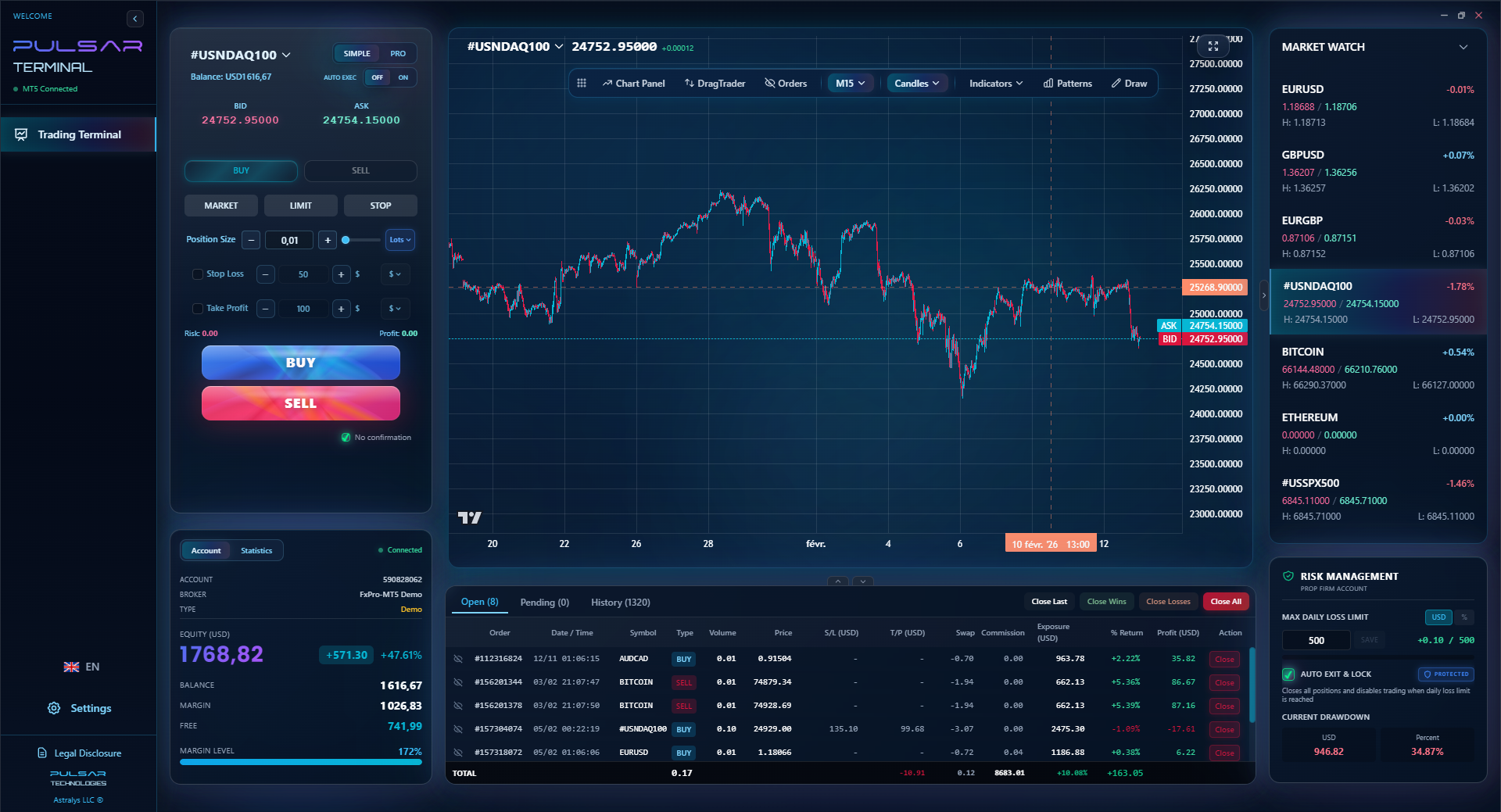
- Pulsar Terminal: This is an MT5 companion app. If you trade forex or global indices through an international broker like IC Markets or Pepperstone, Pulsar sits on top. Its drawing tools are extensive, and it has pattern recognition which can automatically spot potential trendline breaks and chart patterns. For a trendline trader, that's a powerful second pair of eyes.
- Chartink / Trendlyne: Great for screening Indian stocks. You can scan for stocks approaching a key trendline on the daily chart, for instance.

Pro Tip: Don't fall for the 'perfect platform' hunt. Pick one broker for execution (I use Zerodha) and one charting tool for analysis (I use TradingView). Master them. Jumping platforms constantly is a distraction from mastering price action.
Remember, all these brokers are SEBI-regulated. Your funds are safe in a segregated account. The recent 2026 broker regulations made that even more solid - brokers must upstream client money to clearing corporations daily.
💡 Consejo de Winston
Your first drawn trendline is usually the correct one. Redrawing it to catch every minor price move is a sign of uncertainty, not analysis.
“91% of individual F&O traders lose money. A huge part of that is costs compounding bad strategies.”
Forget the generic PDF. Let's build an Indian-context trendline plan.
Step 1: Find the Right Timeframe & Market.
- For swing trading (holding days to weeks): Use daily or weekly charts. The trendlines are stronger, and costs are a smaller percentage of your expected move. Look for large-cap Nifty stocks or the Nifty index itself.
- For intraday: Use 15-minute or 1-hour charts. Stick to highly liquid instruments like Nifty Bank Futures or liquid stocks like Reliance, TCS. The bid-ask spread will be tighter, and your trendline break will have cleaner execution.
Step 2: Draw Correctly (The Winston Method).
- In an Uptrend: Connect at least two significant swing lows. The line should not cut through price bodies in between. The third touch is the confirmation for a trade.
- In a Downtrend: Connect at least two significant swing highs.
- The Angle Matters: A trendline steeper than 45 degrees is unstable and will break soon. A very shallow trendline shows a weak trend.
I once forced a trendline on a crashing Yes Bank chart in 2019. The angle was nearly 60 degrees. I bought the 'touch,' thinking it was oversold. The line broke the next day, and I took a 5% loss. The angle warned me, and I ignored it.
Step 3: Define Your Entry, Stop Loss, and Target.
- Entry: On a pullback to the trendline in an uptrend. Don't chase. Be patient.
- Stop Loss: Place it below the trendline (for longs). Not at the line, but a buffer below. For Nifty, that might be 0.5-1% below the line. This respects market noise.
- Target: Look for prior resistance levels. Or, use a risk-reward ratio. Never risk ₹1 to make ₹0.50. Aim for 1:2 or 1:3. If your stop is 50 points away, your first target should be at least 100 points up.
Step 4: Add Confirmation. A trendline touch isn't enough. Wait for a bullish candlestick pattern (like a hammer or bullish engulfing) at the trendline. Or, see if the MACD indicator histogram is starting to turn up. This filters out false touches.
Step 5: Manage the Trade. If price breaks your trendline decisively (closes below it on your timeframe), you're wrong. Exit. Don't 'redraw' the line to fit the new price. The market is telling you something has changed.
Manually spotting every trendline break is exhausting, but tools like Pulsar Terminal can automate pattern recognition and alert you directly on your MT5 platform.
Pulsar Terminal
La herramienta MT5 todo-en-uno: órdenes drag-and-drop, multi-TP/SL, trailing stop, grid trading, Volume Profile y protección prop firm. Usado por más de 1.000 traders diariamente.
I've made most of these. Here's your cheat sheet to avoid my losses.
- Redrawing the Trendline After Every Wiggle: This is the #1 sin. You're not drawing to fit history; you're drawing to project future action. If you keep adjusting the line, it has no predictive power. Pick your points and stick to them until a clear break invalidates them.
- Ignoring Volume on a Breakout: A trendline breakout on low volume is a fakeout, a trap. In Indian markets, institutional money moves with volume. If price breaks above a downtrend line but volume is pathetic, it's likely to fall back. I got caught in a fake breakout on Tata Motors in 2022 this way.
- Forgetting About Time: Trends don't last forever. A trendline that's been tested 5-6 times is getting weak. The probability of a break increases. The market absorbs all information, and that old trendline becomes too obvious.
- Trading Against the Higher Timeframe Trend: You see a nice downtrend line on the 15-minute chart and want to short a bounce. But the daily chart is in a powerful uptrend. You're fighting the tide. The higher timeframe usually wins. Always check the daily trend direction first.
- No Plan for the Break: Traders are so focused on the bounce play they have no idea what to do when the line breaks. A break is a trading signal, not a tragedy. It can mean a trend reversal or acceleration. Have a plan. Will you reverse your position? Will you wait for a retest of the broken line as new resistance? If you don't know, you'll freeze and lose.
“You're not drawing to fit history; you're drawing to project future action. If you keep adjusting the line, it has no predictive power.”
So you can draw a line. Congratulations. Now the real work begins.
First, Backtest Mentally. Go through charts of Nifty, Bank Nifty, and top 10 Nifty stocks for the last 5 years. Draw your trendlines in hindsight. How often did price respect the line? Where did it break? What did volume look like? This is free education.
Second, Paper Trade. Use a trading journal. Note down every trendline trade you would take, your entry, stop, target, and the outcome. Do this for 100 trades. Don't use real money until your paper trade journal shows a consistent edge after factoring in brokerage and slippage. Most strategies fall apart here.
Third, Integrate with Market Context. A trendline on XAU/USD (Gold) might behave differently than one on Nifty. Is there an RBI policy meeting coming up? Are FIIs selling? A trendline is a micro-tool in a macro world.
Finally, understand that no single tool is holy. A trendline is a guide, not a god. The best traders I know use them as one piece of a larger puzzle that includes market structure, momentum, and fundamental catalysts. They also have the discipline to follow their rules, especially when the line breaks and their ego wants them to stay in the trade. That's the difference between a PDF collector and a professional.
FAQ
Q1Where can I find a free trendline trading strategy PDF for the Indian market?
Honestly, I wouldn't bother. Most free PDFs are generic, outdated, and ignore SEBI regulations and Indian transaction costs. You're better off using free resources from SEBI's investor website or the NSE's learning center, then applying the core trendline concepts yourself to Indian charts on TradingView or your broker's platform.
Q2Is trendline trading profitable in India?
It can be, but not because of the trendline itself. It's profitable if you combine it with sound risk management, an understanding of Indian brokerage costs, and confirmation from other indicators. Remember, 91% of individual F&O traders lose money. Your edge has to overcome significant costs and psychological hurdles. A trendline alone isn't an edge.
Q3What is the best timeframe for trendline trading in Indian stocks?
For beginners, start with the daily chart for swing trading. The signals are stronger and less noisy, and the impact of per-trade brokerage costs is lower relative to your holding period. Intraday trendline trading on 15-minute or 1-hour charts is possible but requires more skill, tighter stops, and an awareness that transaction costs will eat a larger portion of your profits.
Q4How do I know if a trendline breakout is real or fake?
Look for three confirmations: 1) Closing Price: The candle should close beyond the trendline, not just wick past it. 2) Volume: A real breakout should have significantly higher than average volume. A low-volume break is suspect. 3) Follow-through: The next candle should continue in the breakout direction, not immediately reverse. A fakeout often snaps back within 1-2 candles.
Q5Are there any SEBI rules against automated trendline trading?
Yes, absolutely. As of April 2026, SEBI's new algo trading rules are strict. Any automated strategy (including one that places orders based on a trendline break) must be pre-approved by the exchange and SEBI. Your broker becomes legally liable for the orders. You cannot use open APIs. If you want to automate, you must work directly with your broker's approved systems, which is a complex process for retail traders.
Q6What's a common mistake when drawing trendlines on Nifty?
The most common mistake is connecting minor wicks instead of significant swing points. On the Nifty chart, focus on the clear, obvious highs and lows that formed over several days. Also, traders often draw lines that are too steep. A sustainable trendline on the Nifty daily chart usually has a moderate slope. A very steep line will break quickly.
Lección del Prof. Winston
Puntos clave:
- ✓Trade the break, not just the bounce.
- ✓Add 1% to every trade for Indian fees.
- ✓Steeper than 45 degrees? Expect a break.
- ✓No volume on breakout = likely fakeout.
¿Te resultó útil este artículo?
Haz clic en una estrella
Análisis Trading Semanal
Análisis y estrategias semanales gratis. Sin spam.
Sobre el autor
Rajesh Sharma
Analista Forex Sénior
Más de 10 años operando en mercados indios y del sur de Asia. Comenzó con derivados de divisas en el NSE antes de pasar al forex internacional. Especialista en USD/INR y pares de mercados emergentes.
Comentarios
Aviso de riesgo
El trading de instrumentos financieros conlleva un riesgo significativo y puede no ser adecuado para todos los inversores. El rendimiento pasado no garantiza resultados futuros. Este contenido tiene fines educativos únicamente y no debe considerarse asesoramiento de inversión. Siempre realice su propia investigación antes de operar.
También te puede interesar

Cara Trading Forex Sukses: 7 Prinsip dari Trader Profesional
Cara trading forex sukses dengan 7 prinsip trader pro: manajemen modal, disiplin, journal trading, backtest. Data nyata, bukan janji profit palsu.
Jam Trading Forex Terbaik untuk Trader Indonesia: Panduan Lengkap dengan Tabel Waktu
Panduan jam trading forex untuk trader Indonesia. Tabel 4 sesi dunia, jam emas 20:00-00:00, sesi mana yang harus dihindari. Data akurat + tips dari trader berpengalaman.
Top 5 Sàn Forex Uy Tín Nhất 2026: Review Jujur dari Trader Indonesia
Top 5 sàn forex uy tín 2026 untuk trader Indonesia. Review jujur: spread, deposit, withdraw, dukungan lokal. Exness, XM, IC Markets & lebih.
Obtener Pulsar Terminal
Todas estas calculadoras están integradas en Pulsar Terminal con datos en tiempo real de su cuenta MT5.
Obtener Pulsar Terminal