


I remember staring at my screen in 2018, watching USD/NGN climb.

Olumide Adeyemi
Pionero del Trading en África Occidental ·  Nigeria
☕ 12 min de lectura
Lo que aprenderás:
- 1The Basic Mechanic: Buying and Selling Air
- 2Real Trades from Lagos (With Numbers)
- 3The Real Costs of Going Long or Short in Nigeria
- 4Choosing Your Side: It's About Market Context
- 5Nigerian Regulatory & Practical Realities
- 6Managing Risk on Both Sides of the Trade
- 7Common Pitfalls (I Fell for Most of These)
- 8Putting It All Together: Your First Deliberate Trade
I remember staring at my screen in 2018, watching USD/NGN climb. I was convinced the Naira would strengthen. I clicked 'buy' on a USD/NGN pair, thinking I was betting against the dollar. The trade immediately went red. I'd made the most fundamental mistake: I didn't understand what a long or short position actually was. That single misclick cost me ₦85,000 and taught me that in forex, your first profit isn't money, it's clarity. Let's get you that clarity right now.
Forget stocks for a second. In forex, you're not buying a physical asset you hold. You're trading a rate, a relationship between two currencies. Every single trade is a pair. When you open a position, you are simultaneously buying one currency and selling the other. That's the core of what is long and short position in forex trading.
A long position means you buy the currency pair. You're betting the first currency (the base) will go up in value against the second (the quote). If you go long on EUR/USD, you want the Euro to get stronger than the Dollar. You buy now, hoping to sell later for more Dollars.
A short position is the opposite. You sell the currency pair first. You're betting the base currency will fall against the quote. You sell now, hoping to buy it back later at a cheaper price. If you short GBP/NGN, you're betting the British Pound will weaken against the Naira.

Pro Tip: An easy way to remember: Long = Buy First. Short = Sell First. The 'first' refers to your opening trade action. Your closing trade is always the opposite action to lock in profit or loss.
My costly 2018 mistake? I wanted to bet against the US Dollar. To do that on USD/NGN, I needed to sell the pair (go short). By clicking 'buy', I went long, betting the Dollar would strengthen further against the Naira... which was the exact opposite of my intention. The market, of course, obliged my error.

💡 Consejo de Winston
The market doesn't know if you're long or short. It doesn't care. Your job is to align your position with its current direction, not argue with it.
Let's make this concrete with examples from my own journal, using numbers a Nigerian trader would see.
A Long Trade That Worked (EUR/USD)
In June 2023, I saw a setup on the daily chart for EUR/USD. Price was bouncing off a key support level and the RSI indicator showed oversold conditions. My analysis said the Euro was due for a rise against the Dollar.
- Action: Went LONG (Buy)
- Entry Price: 1.0715
- Lot Size: 0.5 Standard Lots (€50,000 position)
- Stop Loss: 1.0650 (65 pips risk)
- Take Profit: 1.0850 (135 pips target)
- Broker Used: IC Markets (Raw Spread Account)
The trade took about 8 days. Price drifted up, hit my take profit at 1.0850, and closed automatically.
- Profit: 135 pips x $5 per pip (for 0.5 lots) = $675
- Costs: Commission was $3.50 per lot, round turn. So $3.50 for my 0.5 lot = $1.75. Net profit ~$673.25.
A Short Trade That Didn't (GBP/NGN)
Earlier this year, I tried a short on GBP/NGN. The chart looked bearish, and I thought the CBN's moves might temporarily strengthen the Naira.
- Action: Went SHORT (Sell)
- Entry Price: ₦1,850 per £1
- Position Size: Used my position size calculator to risk only 1.5% of my account.
- Stop Loss: ₦1,880
I was wrong. The Pound kept climbing. The stop loss hit two days later.
- Loss: 30 Naira per Pound x my position size = ₦42,000 loss.
- Lesson: Going short on a currency pair with your home currency (NGN) adds a layer of emotional and fundamental complexity. Local news can cause wild, unpredictable spikes. My technical analysis was overruled by macro factors I hadn't weighed enough.
“In forex, your first profit isn't money, it's clarity.”
Your profit isn't just entry minus exit. The broker takes a cut, and in Nigeria, you need to be sharp about these costs. They eat into both long and short trades equally.
The main cost is the spread. That's the difference between the buy (ask) and sell (bid) price. When you open a long trade, you enter at the slightly higher ask price. When you open a short, you enter at the slightly lower bid price. You start the trade slightly in the red.
| Broker Type | Typical EUR/USD Spread | Cost on a 1 Lot ($100k) Trade | Good For |
|---|---|---|---|
| Standard Account | 1.0 - 1.8 pips | $10 - $18 | Beginners, smaller accounts |
| Raw/ECN Account | 0.0 - 0.3 pips + Commission | ~$6 - $7 total (commission) | Active traders, scalping |
For example, with a broker like XM, their Zero account might show 0.0 pip spread on EUR/USD, but charge a $5 commission per lot per side ($10 round turn). On a standard account at a broker like Exness, you might pay no commission but a 1.2 pip spread ($12 cost on 1 lot).
Other costs:
- Swap/Rollover Fees: If you hold a position past 5 PM Nigeria time (when the trading day rolls over), you pay or earn a small interest fee. It depends on the interest rate differential between the two currencies. Long positions on high-interest currencies can sometimes earn you a small daily credit.
- Payment Fees: Funding your account with your Nigerian bank card or transfer often has fees. Some brokers absorb these, some don't. Withdrawing profits back to your Naira account also sometimes incurs a fee.

Warning: That 'unlimited use' you see advertised? It's a double-edged sword. A 1:1000 use means a 0.1% move against you can wipe out your entire margin. I learned this the hard way early on with a short USD/JPY trade that spiked. I got a margin call in minutes. High use makes the costs of being wrong catastrophic.
So how do you decide whether to go long or short? It's not a coin flip. You need a reason, a context from the market itself.
Going Long Makes Sense When:
- The price is in a clear uptrend, making higher highs and higher lows.
- It bounces off a recognized support level (like a moving average or previous swing low).
- There's bullish divergence on an oscillator like the MACD indicator (price makes a lower low, but MACD makes a higher low).
- Fundamental news favors the base currency (e.g., ECB raising rates for EUR).
Going Short Makes Sense When:
- The price is in a clear downtrend.
- It rejects from a strong resistance level.
- There's bearish divergence (price makes a higher high, indicator makes a lower high).
- Fundamentals weaken the base currency.
My biggest shift was learning to trade both sides. I was a 'perma-bull' for years, only looking for buys. I missed half the opportunities. A healthy market moves up and down. Your job is to identify the current direction, not wish for a direction.
For instance, during periods of strong Dollar demand in Nigeria, USD/NGN might show persistent strength (an uptrend). Fighting that trend by trying to short it prematurely is a recipe for losses. Sometimes, the best trade is to go long with the trend, even if it feels counter-intuitive to your local perspective.
💡 Consejo de Winston
Write down your reason for every trade. 'Going long EUR/USD' is not a reason. 'Going long because price held the 200-day MA and RSI showed bullish divergence' is. If you can't write it, don't trade it.
“A long position can lose money. A short position can lose money. The common denominator is poor risk management.”
Let's talk about the rules of the road here. Forex trading is legal in Nigeria. The Central Bank of Nigeria (CBN) and the Securities and Exchange Commission (SEC) are the main watchdogs.
For you as an individual trader: You do not need a license from the CBN to trade your own money. That's a common misconception. The regulation is focused on entities that manage other people's funds or operate as financial institutions.
The real regulatory issue is broker choice. Most Nigerian traders use international brokers regulated abroad (like FCA, CySEC, ASIC). This is perfectly legal and often offers better platform stability and client protection. The CBN's rules mainly affect how you fund your account, especially with Naira cards for large amounts. You might encounter limits or need to use alternative payment methods like crypto or fintech wallets.
Taxation: Yes, your trading profits are technically subject to Capital Gains Tax (CGT) at 10%. In practice, for individual retail traders, enforcement is inconsistent. However, the smart move is to keep impeccable records: all deposit/withdrawal statements, trade history reports from your broker. If you grow to a significant size, being able to show your income source is crucial.
Pro Tip: When choosing a broker, prioritize their international regulation over a local registration. A broker licensed by the UK's FCA or Australia's ASIC is held to stricter capital and conduct standards than many local options. Check our reviews for brokers like Pepperstone or IC Markets that accept Nigerian clients under strong regulatory frameworks.
A long position can lose money. A short position can lose money. The common denominator is poor risk management. Here’s the non-negotiable toolkit for any position.
1. The Stop Loss (SL): This is your emergency exit. Before you click buy or sell, you must decide where you’re wrong. For a long trade, your stop loss goes below your entry. For a short trade, it goes above your entry. Place it at a level that, if hit, invalidates your trade idea. Never move a stop loss further away to avoid a loss. I’ve broken this rule. It turns a small, manageable loss into a portfolio-wrecker.
2. The Take Profit (TP): Your goal. Where will you take your money off the table? A good starting point is to aim for a risk-to-reward ratio of at least 1:2. If you risk 50 pips, target 100 pips profit.
3. Position Sizing: This is everything. Use a calculator. If your account is ₦500,000, risking 2% per trade means you can lose ₦10,000 on this one trade. Your stop loss distance (in pips) determines your maximum position size. A tight 20-pip stop allows a bigger lot size than a 100-pip stop for the same ₦10,000 risk.
Advanced Idea: Trailing Stops Once a trade moves in your favor, you can protect profits by using a trailing stop. It’s a stop loss that automatically moves up (for a long trade) or down (for a short trade) as the price moves your way. It locks in profit while giving the trade room to run. Doing this manually is stressful. Automation is key.
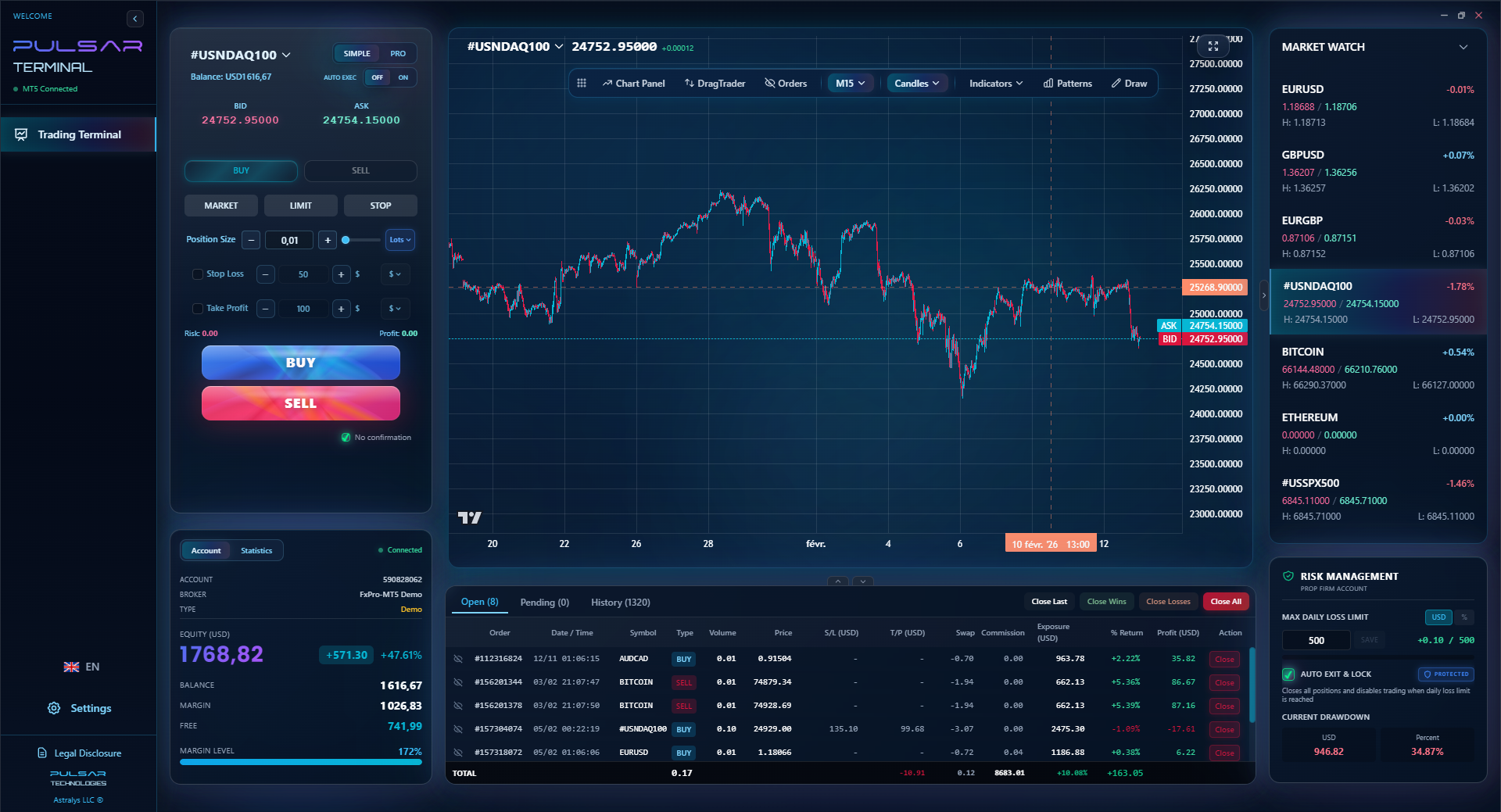
Managing multiple trades and trailing stops manually is a headache, which is why tools like Pulsar Terminal automate partial closures and trailing stops directly on your MT5 platform.
Pulsar Terminal
La herramienta MT5 todo-en-uno: órdenes drag-and-drop, multi-TP/SL, trailing stop, grid trading, Volume Profile y protección prop firm. Usado por más de 1.000 traders diariamente.
“You're not betting 'for' or 'against' a country. You're taking a financial position based on your analysis of price movement.”
Let me save you some pain and Naira.
Pitfall 1: Trading Based on 'News' and Rumors. You hear the CBN is going to intervene, so you immediately go short on USD/NGN. The 'news' is already in the price, or it's wrong, or the market reacts opposite to expectations. Trade the price action you see, not the gossip you hear.
Pitfall 2: Over-leveraging on Shorts Because It Feels Faster. New traders often think shorting is a quicker path to riches because 'markets fall faster than they rise.' This leads them to use insane use on short positions. A quick, sharp rally (a short squeeze) will obliterate that account.
Pitfall 3: Not Understanding the Quote Currency. When you trade EUR/NGN, the quote is NGN. If you go long, you profit if the Naira weakens. If you go short, you profit if the Naira strengthens. This ties your P&L directly to your local currency's volatility, which can be emotionally challenging.
Pitfall 4: Ignoring the Time of Day. The EUR/USD is most liquid during the London and New York overlaps. Trying to scalp or enter large positions at 2 AM Nigeria time often means wider spreads and slippery, unpredictable price action.
Pitfall 5: No Written Plan. 'I think GBP will go down' is not a plan. A plan is: 'I will go short on GBP/USD if price rejects the 1.2750 resistance with a bearish pin bar on the H1 chart. SL at 1.2785, TP at 1.2680. Risking 0.5% of my account.' Write it down. Then follow it.
💡 Consejo de Winston
Your first profit target should always be to move your stop loss to breakeven. Protecting your capital is rule number one. Profits come after.
Let's walk through a structured example from analysis to execution.
Step 1: Analysis. You're looking at Gold (XAU/USD). You've read our XAU/USD guide and see it's in a weekly uptrend but has pulled back to a daily support level around $2320. The MACD indicator on the 4-hour chart is curling up from below its signal line. The context suggests a potential long opportunity.
Step 2: Decision. You decide to look for a LONG position.
Step 3: Plan.
- Entry: A buy order at $2325 (entering on a slight bounce off support).
- Stop Loss: $2310 (15 points/ $150 risk per standard lot). This is below the recent swing low.
- Take Profit: $2355 (30 points / $300 target per lot). A 1:2 risk-reward ratio.
- Position Size: Your account is $2,000. You risk 1.5% = $30. With a $150 risk per lot, your position size is 0.2 lots ($30 / $150).
Step 4: Execution. You log into your broker platform (e.g., Exness or XM). You select XAU/USD, set your order to buy limit at 2325, input your stop and take profit levels, and set the volume to 0.20. You click submit. The order is now waiting in the market.
Step 5: Management. If the order fills, you do nothing unless you decide to move your stop to breakeven after price moves favorably. You do not cancel your TP out of greed. You let the plan work. If the SL hits, you accept the $30 loss as the cost of doing business and look for the next setup.
This process - analysis, decision, planning, execution, management - is what separates gambling from trading. It works for both long and short positions. The direction changes, but the discipline must remain the same.
FAQ
Q1As a Nigerian, do I need a license from CBN to go long or short on forex?
No. If you are trading your own personal capital for yourself, you do not need an individual license from the CBN. The regulations target businesses that manage client funds or operate as financial institutions. Your main concern should be using a reputable, internationally regulated broker.
Q2Which is riskier, a long position or a short position?
Neither is inherently riskier. The risk is determined by your position size and where you place your stop loss. However, short positions can feel riskier during sudden, sharp market rallies (short squeezes), which can move very fast. This is why using a stop loss on every single trade, long or short, is non-negotiable.
Q3Can I go long and short on the same currency pair at the same time?
Technically, yes, on most platforms you can have opposing positions open. This is called 'hedging.' However, for a beginner, it's confusing and often just doubles your transaction costs (you pay spreads on both trades). It's a more advanced technique and not a substitute for having a clear directional view.
Q4How do swap rates affect my long vs. short decision?
If you hold a position overnight, you pay or receive a swap fee. If you go long on a currency with a higher interest rate than the one you're short, you typically earn a small daily credit. If you go short on that higher-rate currency, you typically pay a fee. For short-term traders, this is a minor factor. For swing trading positions held for weeks, it can add up.
Q5What's the minimum amount I need to start practicing long/short trades in Nigeria?
You can start with a very small amount to practice. Brokers like XM or Exness offer accounts with minimum deposits as low as $5 or $10. With this, you can open micro or nano lots (0.01 lots) to get a real feel for how prices move and what the spread costs you, without significant financial risk.
Q6When I short a pair like USD/NGN, am I betting for or against Nigeria?
You're not betting 'for' or 'against' a country. You're taking a financial position based on your analysis of price movement. Shorting USD/NGN means you believe the value of one US Dollar will buy fewer Naira in the future (i.e., the Naira strengthens relative to the Dollar). It's a market view, not a patriotic one.
Lección del Prof. Winston
Puntos clave:
- ✓Long = Buy First. Short = Sell First.
- ✓Always use a stop loss, no exceptions.
- ✓Risk max 2% of capital per trade.
- ✓Trade the price, not the rumor.
¿Te resultó útil este artículo?
Haz clic en una estrella
Análisis Trading Semanal
Análisis y estrategias semanales gratis. Sin spam.
Sobre el autor
Olumide Adeyemi
Pionero del Trading en África Occidental
Uno de los educadores de trading forex más activos de Nigeria. 8 años de experiencia operando desde Lagos. Especialista en estrategias de bajo capital y desafíos de prop firms para traders africanos.
Comentarios
Aviso de riesgo
El trading de instrumentos financieros conlleva un riesgo significativo y puede no ser adecuado para todos los inversores. El rendimiento pasado no garantiza resultados futuros. Este contenido tiene fines educativos únicamente y no debe considerarse asesoramiento de inversión. Siempre realice su propia investigación antes de operar.
También te puede interesar

Cara Trading Forex Sukses: 7 Prinsip dari Trader Profesional
Cara trading forex sukses dengan 7 prinsip trader pro: manajemen modal, disiplin, journal trading, backtest. Data nyata, bukan janji profit palsu.
Jam Trading Forex Terbaik untuk Trader Indonesia: Panduan Lengkap dengan Tabel Waktu
Panduan jam trading forex untuk trader Indonesia. Tabel 4 sesi dunia, jam emas 20:00-00:00, sesi mana yang harus dihindari. Data akurat + tips dari trader berpengalaman.
Top 5 Sàn Forex Uy Tín Nhất 2026: Review Jujur dari Trader Indonesia
Top 5 sàn forex uy tín 2026 untuk trader Indonesia. Review jujur: spread, deposit, withdraw, dukungan lokal. Exness, XM, IC Markets & lebih.
Obtener Pulsar Terminal
Todas estas calculadoras están integradas en Pulsar Terminal con datos en tiempo real de su cuenta MT5.
Obtener Pulsar Terminal