


I was staring at the USD/NGN chart in late 2024, watching it carve out a series of lower highs and lower lows.

Olumide Adeyemi
Pionero del Trading en África Occidental ·  Nigeria
☕ 13 min de lectura
Lo que aprenderás:
- 1The Two Faces of Market Structure
- 2Reading the Chart Like a Pro: Swings, Trends, and Breaks
- 3Nigerian Market Realities: CBN, Naira, and Your Trades
- 4Trading With Structure, Not Against It
- 5Common Structural Traps (And How to Avoid Them)
- 6Putting It All Together: A Nigerian Trader's Weekly Routine
- 7Beyond the Basics: Order Blocks & Fair Value Gaps
I was staring at the USD/NGN chart in late 2024, watching it carve out a series of lower highs and lower lows. The official rate was around ₦1,382, but the real story was in those swings. I'd just taken a short position based on a broken support level, but the price wasn't dropping cleanly. It was chopping around, refusing to follow the textbook trend. That's when I stopped looking at my indicators and started really seeing the market structure. It wasn't just going down, it was distributing - unloading positions before the next big move. I got stopped out for a 1.5% loss. That lesson, right there in Abuja, cost me real Naira but taught me more about what market structure in forex actually means than any book ever could. It's not lines on a chart, it's the story of who's buying, who's selling, and who's about to get caught out.
When Nigerian traders ask 'what is market structure in forex?', they're usually asking one of two things. The first is the technical, chart-based definition we use for analysis. The second is the real-world, institutional hierarchy that determines how prices are actually set. You need to understand both.
The Chart Structure: Your Roadmap This is the practical, tradeable definition. Market structure is the repeating pattern of price movement - the sequence of swing highs and swing lows that tells you if the market is trending up, trending down, or stuck in a range. It's the blueprint. A healthy uptrend, for example, makes higher highs and higher lows. A downtrend makes lower highs and lower lows. When that sequence breaks, the structure is breaking, and a reversal might be coming.
I used to ignore this, chasing every little blip on the GBP/USD chart. I'd see a green candle and jump in, only to get smacked when price reversed into the next swing low. Now, I wait for the structure to confirm itself. If price can't make a new high, I'm not buying.
The Institutional Structure: The Real Market This is the less glamorous but more important answer. The forex market isn't a single place like the Nigerian Stock Exchange. It's an over-the-counter (OTC) network. At the very top, you have the interbank market, where the big players like CBN, commercial banks, and hedge funds trade directly with each other. The prices and liquidity trickle down from there to institutional brokers, then to the retail brokers you and I use, like Exness or IC Markets.
Why should you care? Because the spreads you see, the slippage you experience, and sometimes even the mysterious 'stop hunts' are a direct result of this layered structure. Your retail broker is often just a gateway to this larger pool. When liquidity is thin - like during major Nigerian news announcements - the spreads on your USD/NGN pair can widen violently because the big players upstairs have stepped back.

Warning: Don't confuse the two. Your chart shows you the result of the institutional market structure. You're reading the footprints of the elephants. Successful trading means using your chart structure to anticipate where those elephants might walk next.
“Market structure isn't lines on a chart, it's the story of who's buying, who's selling, and who's about to get caught out.”
Let's get concrete. How do you actually see market structure on your MT5 platform? You stop drawing a thousand lines and start looking for a few key things.
Identifying Swing Highs and Lows
A swing high is a candlestick with a higher high than the candle before it and after it. A swing low is a candle with a lower low than its neighbors. That's it. Mark these on your chart. In an uptrend, each swing low should be higher than the last. If the price makes a lower low, the uptrend structure is threatened. This is basic, but I've watched traders in Port Harcourt ignore a clear sequence of lower highs because their MACD indicator was still bullish. The structure told the truth first.
The Three Core Phases
Price is always in one of three structural phases:
- Trending: Making consistent higher highs/lows (HH/HL) or lower highs/lows (LH/LL). The moves are impulsive and directional.
- Ranging (Consolidation): Price is bouncing between a clear support and resistance level, making roughly equal highs and lows. This is accumulation or distribution.
- Breaking/Reversing: This is the transition. A break of a key swing point (like a prior low in an uptrend) signals a potential change in structure.
A Lagos Example: In early 2025, EUR/USD was in a tight range between 1.0780 and 1.0880 for two weeks. The structure was flat - no new highs, no new lows. I treated every bounce off support as a potential long. The third time it touched 1.0780, it sliced straight through. That was the structural break. The range was over, and a new downtrend began. I entered short at 1.0765 and rode it down for 110 pips. The structure gave the signal, not an oscillator.
Support & Resistance as Structural Pillars
In a range, the highs and lows are the structure. In a trend, prior swing points become your future support or resistance. A broken resistance often becomes new support on a retest. This isn't magic, it's psychology - traders remember where they bought or sold before.

Pro Tip: Zoom out. The structure on the 1-hour chart might look like a downtrend, but on the 4-hour, it could just be a pullback within a massive uptrend. Always check the bigger picture. A tool like Pulsar Terminal can help by letting you sync multi-timeframe charts easily, so you see the full structural story.

💡 Consejo de Winston
Kid, if you can't draw the market's structure with three lines or less on a blank chart, you don't understand it. Simplify. Always.
“If the price can't make a new high, I'm not buying. Let the structure confirm itself, or keep your Naira in your pocket.”
Trading theory is fine, but let's talk about the Naija context. Our market structure is uniquely shaped by the Central Bank of Nigeria (CBN).
The CBN's reforms, especially the 2024 unification of the FX windows and the new Nigerian FX Code, have directly changed the market's institutional structure. They've tried to collapse the multiple rates into one "willing buyer, willing seller" model on the Nigerian Foreign Exchange Market (NFEM). The goal? More transparency, less arbitrage. For you, this means the USD/NGN pair you might see on an international broker is reflecting a more unified price than it did five years ago, though the parallel market rate (around ₦1,895/$ in early 2026) still tells a different story.
The new Electronic Foreign Exchange Matching System (EFEMS) is a big deal. It's a centralized platform for interbank NGN/USD trades. This means the big banks now trade on a visible electronic system, which should, in theory, lead to fairer pricing that eventually filters down to us. It also means minimum trade sizes upstairs are huge - $100,000 minimum! That's why we need brokers.
What This Means For Your Account:
- Broker Choice is Critical: You must use a broker that has reliable access to top-tier liquidity. This affects your spreads and execution. A broker like Pepperstone or XM, with strong institutional connections, will often provide tighter spreads on majors than a less-connected one.
- Mind the Naira Pairs: If you trade USD/NGN, understand you're trading a derivative of the official market. Your broker's price is an estimate. Major news from the CBN can cause massive gaps or liquidity dry-ups.
- Taxes: Remember, profits are subject to a 10% Capital Gains Tax. Factor that into your risk management. A 5% trade win becomes a 4.5% win after tax. Your position size calculator should account for net profits, not gross.
The structure here is more controlled, more influenced by policy than, say, the EUR/USD. You're not just trading charts, you're trading CBN policy decisions.
“If the price can't make a new high, I'm not buying. Let the structure confirm itself, or keep your Naira in your pocket.”
This is where the rubber meets the road. How do you turn this understanding into executed trades and banked profits?
The Golden Rule: Trade in the direction of the higher timeframe structure. If the daily chart is in a clear uptrend (making HH/HL), then on the 4-hour or 1-hour chart, you should primarily look for buying opportunities. You're looking for pullbacks to support within that larger uptrend. I learned this the hard way trying to scalp against the daily trend. I'd win seven small trades and then get obliterated by one trend-resuming move that blew through all my stops.
Entry & Exit Based on Structure:
- Entry: Look for price to approach a key structural level (a prior swing high that's now support, or a trendline) and show a rejection candlestick pattern (like a pin bar or engulfing candle).
- Stop Loss: Place your stop loss beyond the recent structural level. In an uptrend buy, put your stop below the most recent swing low. If that level breaks, the structure is invalidated, and your thesis is wrong.
- Take Profit: Target the next structural resistance level ahead. This could be the previous swing high or a measured move.
Example from my journal (Gold/XAUUSD): The daily chart for XAU/USD was in an uptrend. On the 4-hour, price pulled back to a previous resistance level (now support) at $2,320. It formed a bullish engulfing candle right there. That was the structural entry signal. I bought at $2,323. Stop loss placed below the recent swing low at $2,308 (15 points risk). First take profit was at the previous high of $2,355. Price hit it three days later. That's a pure structure trade.

Example: Let's say you're trading EUR/USD, and the 4-hour chart shows a clear sequence of HH/HL. Price pulls back to the last HL at 1.0850. You buy there with a stop at 1.0820 (30 pips risk). Your first TP is the last HH at 1.0950 (100 pips reward). That's a 1:3.3 risk/reward ratio, all defined by the market structure.
💡 Consejo de Winston
In Nigeria, the most important swing high on your chart is often the one set by a CBN governor's speech. Trade the policy structure first.
“You're not just trading charts, you're trading CBN policy decisions. Ignore that at your peril.”
We all get caught. Here are the structural mistakes I see every week, especially with new traders in Nigeria.
1. Chasing Breaks Without Retests: This is the big one. Price breaks above a resistance level, and traders FOMO in immediately. Often, price will retest that broken level from the other side (now as support). If it holds, that's your higher-probability entry. The initial break can be a false move (a 'stop hunt'). Wait for the structure to confirm the break with a successful retest.
2. Ignoring the Range Until It's Too Late: In a ranging market, the strategy is to sell resistance and buy support. But traders get bored and try to predict the breakout direction. They place orders in the middle of the range, which is a no-man's-land with no structural edge. I've sat for days in a range on GBP/JPY, doing nothing, which is frustrating but correct. The moment you force a trend trade in a range, you lose.
3. Misplacing Stops: Placing a stop loss too tight, right at the edge of a structural level, is asking to be taken out by market noise. The big players know where the retail stops are clustered. Give your trade room to breathe by placing your stop beyond the obvious swing point.
4. Overcomplicating It: Market structure is about price. Pure and simple. I've had students show me charts with 15 moving averages, 10 indicators, and so many lines it looked like a spiderweb. They couldn't see the simple HH/HL sequence staring them in the face. Strip it back. Start with just naked price action and your swing points. Tools like the RSI indicator can be a helpful confluence, but the structure is the foundation.
Remember, the market's job is to trap the majority. If a structural setup looks too obvious and easy, it probably is. The clean, quiet retest of a level after a breakout often makes more money than the noisy, emotional initial spike.
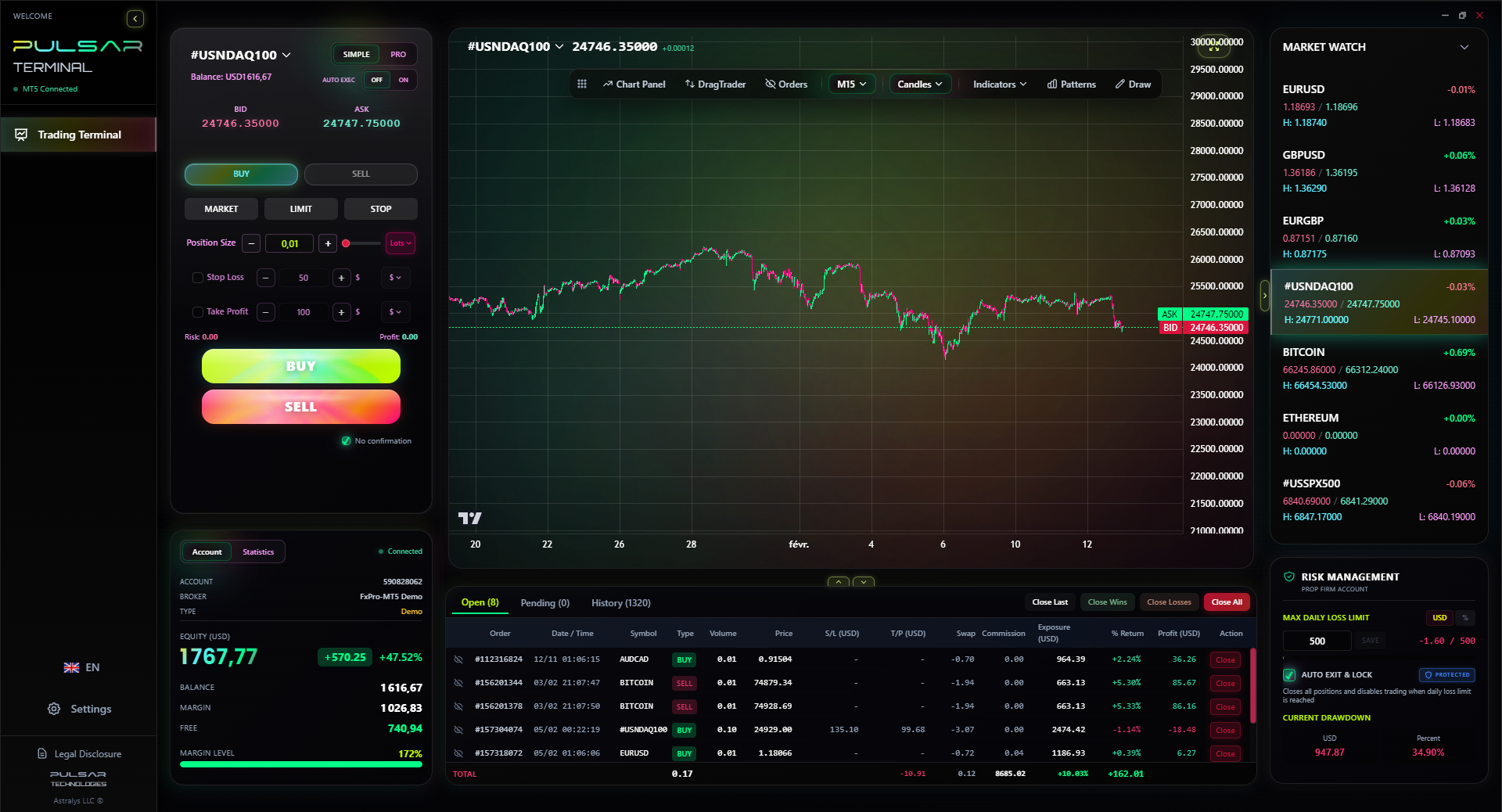
Managing multiple take-profit levels and moving stops to breakeven based on new swing points is a manual headache; Pulsar Terminal automates this directly on your MT5 chart.
Pulsar Terminal
La herramienta MT5 todo-en-uno: órdenes drag-and-drop, multi-TP/SL, trailing stop, grid trading, Volume Profile y protección prop firm. Usado por más de 1.000 traders diariamente.
“You're not just trading charts, you're trading CBN policy decisions. Ignore that at your peril.”
How do you apply this daily? Here's a practical routine.
Sunday Night/Monday Morning (Planning):
- Zoom Out: Open the weekly and daily charts for your 2-3 favorite pairs (maybe EUR/USD, GBP/USD, and Gold). No indicators. Just mark the major swing highs and lows from the last few months. What's the overarching structure? Up, down, or range? Write it down.
- Identify Key Levels: Note the obvious support and resistance levels on the daily chart. These are your structural pillars for the week.
- Align with News: Check the economic calendar. Is the CBN making an announcement? US Non-Farm Payrolls? Know when structural breaks are more likely.
During the Week (Execution):
- Drop to Lower Timeframes: Now go to the 4-hour and 1-hour charts. Look for price approaching those key daily levels you identified.
- Wait for the Setup: Is price reacting? Is it bouncing or breaking? Don't pre-empt. Let the structure show its hand. A good swing trading opportunity might only come 2-3 times a week.
- Manage the Trade: Once in, manage according to structure. If you're in a trend trade and price makes a new extreme (new high in an uptrend), consider moving your stop to breakeven. You're now protecting capital and riding the structure.
Broker Logistics: Ensure your broker's conditions support structural trading. You need reliable execution to hit your precise entry levels. You also need to understand their specific spread patterns - does it widen massively during London open or news events? Test this on a demo account. A broker like IC Markets, known for tight spreads, can make a difference when you're trying to enter at an exact structural support level.
Finally, keep a journal. Note not just your wins and losses, but the structural context of each trade. "Bought EUR/USD at daily support after a 4-hour bullish pin bar" is a useful entry. "Bought because it felt low" is not. Your journal will reveal your structural strengths and weaknesses.
💡 Consejo de Winston
A trend isn't a straight line. It's a staircase. Your job is to buy on the steps (pullbacks to structure), not chase the elevator up.
“The market's job is to trap the majority. If a structural setup looks too obvious and easy, it probably is.”
Once you're comfortable with basic swing points, you can explore concepts that describe how price moves between these levels. These are like seeing the wiring behind the walls of market structure.
Order Blocks: These are areas where a strong, impulsive move began. Think of a big, green candle that launched a rally. The body of that candle is a bullish order block. The theory is that institutional orders were placed there. On a future pullback, price will often revisit that same area (the order block) to find support and continue the move. It's a more precise level than a broad swing low.
Fair Value Gaps (FVGs) / Imbalances: These are created by strong, impulsive moves that leave a "gap" or imbalance in price on a lower timeframe. It looks like three candles where the wicks don't overlap, creating a clean space. Price has a tendency to return to "fill" this imbalance later. An FVG can act as a temporary support or resistance zone.
A Quick Warning: Don't jump into these advanced ideas before mastering basic HH/HL and support/resistance. I made that mistake. I started seeing order blocks everywhere and ignored a simple, clear downtrend structure. It was a costly detour. Get the foundation rock solid first. These concepts are best used as confluent areas within your existing structural analysis. If price is pulling back into a daily support zone and that zone contains a 4-hour bullish order block, your trade thesis is much stronger.
The real power of understanding what market structure in forex means comes from synthesis. You see the CBN's policy (institutional structure), which influences the USD/NGN pair's liquidity, which creates a chart pattern (technical structure), which gives you a clear level to trade. You're no longer just reacting to candles, you're understanding the engine behind them.
FAQ
Q1Is forex trading legal in Nigeria?
Yes, it is legal for individuals to trade forex in Nigeria, but you must use a broker that is properly licensed. The Central Bank of Nigeria (CBN) and the Securities and Exchange Commission (SEC) are the main regulators. The CBN prohibits using unofficial forex windows to fund accounts for speculation, so funding your international broker account requires using approved channels like domiciliary accounts or certain e-wallets.
Q2What is the simplest way to identify market structure?
The simplest way is to zoom out on your chart and look for the most recent major swing highs and swing lows. Connect them mentally. Are the highs getting higher and the lows getting higher? That's an uptrend. Are the highs getting lower and the lows getting lower? That's a downtrend. If price is bouncing between two horizontal levels, it's a range. Start with just that.
Q3How does the CBN affect forex market structure for retail traders?
The CBN affects it massively. Their policies (like unifying exchange rates, creating the EFEMS trading system, and setting rules for BDCs) directly influence the liquidity and price discovery of the Naira. This trickles down to the spreads and availability of Naira pairs on your broker's platform. A major CBN announcement can cause a structural break on the USD/NGN chart, invalidating previous support/resistance levels.
Q4What's more important: market structure or indicators?
Market structure is the foundation; indicators are supplemental tools. Structure tells you where price might go (to the next resistance level) and when your idea is wrong (if a swing low breaks). Indicators like RSI or MACD can suggest why (e.g., overbought conditions) and add confluence. But trading against the clear market structure because an indicator gives a signal is a common recipe for losses.
Q5Can I use market structure for scalping?
Absolutely, but you have to align timeframes. If you're scalping on the 1-minute chart, the 5-minute and 15-minute charts become your higher-timeframe structure guide. You should look for scalps in the direction of the 15-minute trend. Trying to scalp against the higher-timeframe structure is extremely difficult and risky, as you'll be fighting the larger flow of orders.
Q6What is a market structure break?
A market structure break (MSB) is a clear signal that the existing trend or range has potentially ended. In an uptrend, it's when price breaks below and closes under a previous significant swing low. In a downtrend, it's a break above a prior swing high. This doesn't guarantee a full reversal, but it signals a shift in momentum and is a warning to exit trades in the old direction.
Q7Do I need a special broker to trade using market structure?
You don't need a "special" broker, but you do need a reliable one with tight spreads and fast execution. Since structural trading often involves entering at precise price levels, slippage or wide spreads can ruin your risk/reward ratio. Look for brokers known for good execution, like many of the ECN brokers we review.
Lección del Prof. Winston
Puntos clave:
- ✓Identify swing highs/lows before placing a single trade.
- ✓Trade in the direction of the higher timeframe structure.
- ✓Place stops beyond structural levels, not at them.
- ✓A 1:3 risk/reward is achievable with clear structure.
- ✓In Nigeria, always factor CBN policy into your analysis.
¿Te resultó útil este artículo?
Haz clic en una estrella
Análisis Trading Semanal
Análisis y estrategias semanales gratis. Sin spam.
Sobre el autor
Olumide Adeyemi
Pionero del Trading en África Occidental
Uno de los educadores de trading forex más activos de Nigeria. 8 años de experiencia operando desde Lagos. Especialista en estrategias de bajo capital y desafíos de prop firms para traders africanos.
Comentarios
Aviso de riesgo
El trading de instrumentos financieros conlleva un riesgo significativo y puede no ser adecuado para todos los inversores. El rendimiento pasado no garantiza resultados futuros. Este contenido tiene fines educativos únicamente y no debe considerarse asesoramiento de inversión. Siempre realice su propia investigación antes de operar.
También te puede interesar

Cara Trading Forex Sukses: 7 Prinsip dari Trader Profesional
Cara trading forex sukses dengan 7 prinsip trader pro: manajemen modal, disiplin, journal trading, backtest. Data nyata, bukan janji profit palsu.
Jam Trading Forex Terbaik untuk Trader Indonesia: Panduan Lengkap dengan Tabel Waktu
Panduan jam trading forex untuk trader Indonesia. Tabel 4 sesi dunia, jam emas 20:00-00:00, sesi mana yang harus dihindari. Data akurat + tips dari trader berpengalaman.
Top 5 Sàn Forex Uy Tín Nhất 2026: Review Jujur dari Trader Indonesia
Top 5 sàn forex uy tín 2026 untuk trader Indonesia. Review jujur: spread, deposit, withdraw, dukungan lokal. Exness, XM, IC Markets & lebih.
Obtener Pulsar Terminal
Todas estas calculadoras están integradas en Pulsar Terminal con datos en tiempo real de su cuenta MT5.
Obtener Pulsar Terminal