


If you're trading from Nigeria without a VPS, you're basically handing your money to the market.

Olumide Adeyemi
Pionero del Trading en África Occidental ·  Nigeria
☕ 9 min de lectura
Lo que aprenderás:
If you're trading from Nigeria without a VPS, you're basically handing your money to the market. It's not a question of if you'll get a margin call from a random disconnection, but when. I've seen more accounts blown from 'NEPA has taken light' than from bad analysis. This isn't a fancy tech upgrade, it's survival gear. I'll show you exactly what a VPS is, why you need one, and how to set it up without getting scammed.
Alright, let's cut through the noise. A VPS, or Virtual Private Server, is a remote computer you rent. It runs 24/7 in a data center with industrial-grade power and internet. You connect to it from your laptop or phone to control it.
Think of it like this: your trading platform (like MetaTrader 4 or 5) isn't running on your PC in Lagos. It's running on this super-stable computer in London or New York. Your internet going off in Ibadan doesn't matter. The trade keeps running on the VPS.
The key here is uptime. A good VPS guarantees 99.9% uptime. Compare that to the average Nigerian power situation. That's the difference between a strategy executing and you staring at a black screen while your stop loss gets hunted.

Warning: A VPS doesn't make your trading strategy profitable. It just ensures your strategy, good or bad, gets a fair shot at executing without being murdered by infrastructure failures.
This is where we get real. The trading conditions in Nigeria aren't a minor inconvenience, they're a direct threat to your capital. Let's break down the enemies.
The Power Problem
You know the drill. You're in a perfect scalping strategy setup on EUR/NGN. The market is moving. You click buy... and the room goes dark. By the time your inverter kicks in (if you have one), the moment is gone, or worse, you're in a losing trade that kept running. A VPS eliminates this. The server never sleeps.
The Internet Lottery
Even with power, our internet can be a tragedy. High latency (ping) means your order reaches the broker slower than other traders. In fast markets, that's the difference between your intended price and a terrible fill. A VPS hosted near your broker's servers (often in Europe) has a ping of 1-5ms. Your connection from Port Harcourt might be 200ms+.
The Practical Reality for Strategies
Certain strategies are impossible here without a VPS. If you're using automated trading (Expert Advisors or robots), they must run non-stop. A 2-hour power cut kills the bot. Swing trades can also be vulnerable. Imagine holding a gold position over the weekend (XAU/USD guide) and a storm knocks out power for a day. You can't monitor or adjust.
I learned this the hard way in 2018. I was swing trading GBP/USD. I entered at 1.3050 with a stop at 1.3000. A sudden blackout in my area lasted 8 hours. When power returned, I was stopped out at 1.2995. The kicker? The price had dipped to 1.2980, then reversed sharply to 1.3100. My trade was right, but my infrastructure failed. That was a $500 lesson. A $20/month VPS would have saved it.

💡 Consejo de Winston
The monthly cost of a reliable VPS should be viewed as your 'desk rent.' It's the non-negotiable cost of having a professional trading office that never loses power. If you can't afford this rent, you can't afford to trade professionally.
“A VPS doesn't make your strategy profitable. It just ensures your strategy gets a fair shot without being murdered by infrastructure.”
Traders often think, 'My laptop is fine, why pay extra?' Let's do the actual math, factoring in Nigerian realities.
| Factor | Your Home PC (Lagos/Abuja) | A Proper Forex VPS |
|---|---|---|
| Uptime | 60-80% (Depends on NEPA & inverter) | 99.9% (Guaranteed) |
| Internet Latency | 150-500ms to broker servers | 1-5ms (Located in same data center) |
| Power Cost | You pay for fuel/inverter battery wear | Included in monthly fee |
| Security | Vulnerable to local theft, damage | Physically secure in a guarded facility |
| Maintenance | Your problem (updates, crashes) | Managed by the hosting company |
The hidden cost of using your PC isn't just the lost trade I mentioned. It's the constant anxiety. It's refusing to enter a trade because 'light has been unstable.' It's the missed opportunities. When you calculate the potential profit lost from missed setups or bad fills, the $15-$30 monthly VPS fee becomes the cheapest insurance you'll ever buy.

Pro Tip: Don't just think about the VPS cost. Think about the cost of ONE avoided margin call. If your account is $1,000, a single 10% loss from a disconnection is $100. That pays for 5-6 months of VPS service immediately.
Not all VPS services are created equal. Many cheap, generic VPS hosts are useless for trading. Here’s what to look for, specifically for Nigeria.
1. Location, Location, Location: The server must be geographically close to your broker's trading server. Most major brokers like IC Markets, Pepperstone, and XM have their main servers in London (LD4), New York (NY4), or Tokyo. Your VPS must be in the same data center. A VPS in South Africa while your broker is in London adds latency, defeating the purpose.
2. Low Latency Guarantee: Look for providers that advertise ping times of <5ms to major forex hubs. They should show network maps.
3. Specs That Matter: You don't need a gaming PC. Focus on:
- CPU Cores: At least 2 dedicated vCores for smooth operation.
- RAM: 2GB is the absolute minimum; 4GB is comfortable, especially if running multiple charts or a heavy EA.
- SSD Storage: 20-40GB is plenty. Speed is key.
4. The Broker-Provided Option: Many brokers offer 'free' VPS services if you maintain a certain minimum account balance or trading volume. For example, some brokers offer it with a $5,000 balance or 5 lots traded per month. This can be a great way to start. Check our Exness review and others to see who offers this.
A word of caution: I tried a dirt-cheap VPS from a general hosting company in 2020. Saved $8 a month. The performance was jumpy, and during a major news event (NFP), the CPU spiked to 100% and my platform froze. I got filled 15 pips away from my limit order. The savings weren't worth the slippage. Now I use a specialized forex VPS provider.
💡 Consejo de Winston
Test your VPS setup with a demo account first. Place a trade, disconnect your laptop completely for 24 hours, then reconnect. If the trade is still there, running smoothly, you've passed the test. Never go live without this dry run.
“When you calculate the profit lost from missed setups, the $20 monthly VPS fee becomes the cheapest insurance you'll ever buy.”
It sounds technical, but it's straightforward. Here's the process.
- Purchase & Access: After buying your plan, you'll get an email with an IP address, username, and password. You use a built-in Windows program called Remote Desktop Connection to log in.
- The First Login: You'll see a bare Windows desktop. It's a fresh, clean computer. The first thing you do is install your trading platform (MT4/MT5) directly on this VPS. Download it from your broker's website.
- Install Everything ON the VPS: This is the crucial mental shift. Install your indicators (RSI indicator, MACD indicator), your EAs, and your custom templates directly onto the VPS's platform. Don't try to run them from your local machine.
- Configure & Walk Away: Set up your charts, attach your EAs, and place any manual trades. Then, you simply close the Remote Desktop window. The platform continues to run. You can disconnect your laptop entirely. The trade is now living on the VPS.
- Monitoring from Anywhere: You can reconnect from your phone, your office PC, or a cybercafé to check on it, modify trades, or close positions. The VPS is the always-on hub.
This setup is perfect for managing a prop firm challenge, where strict daily loss limits are enforced 24/5. A VPS ensures your stop losses are always active, protecting you while you sleep or during outages.
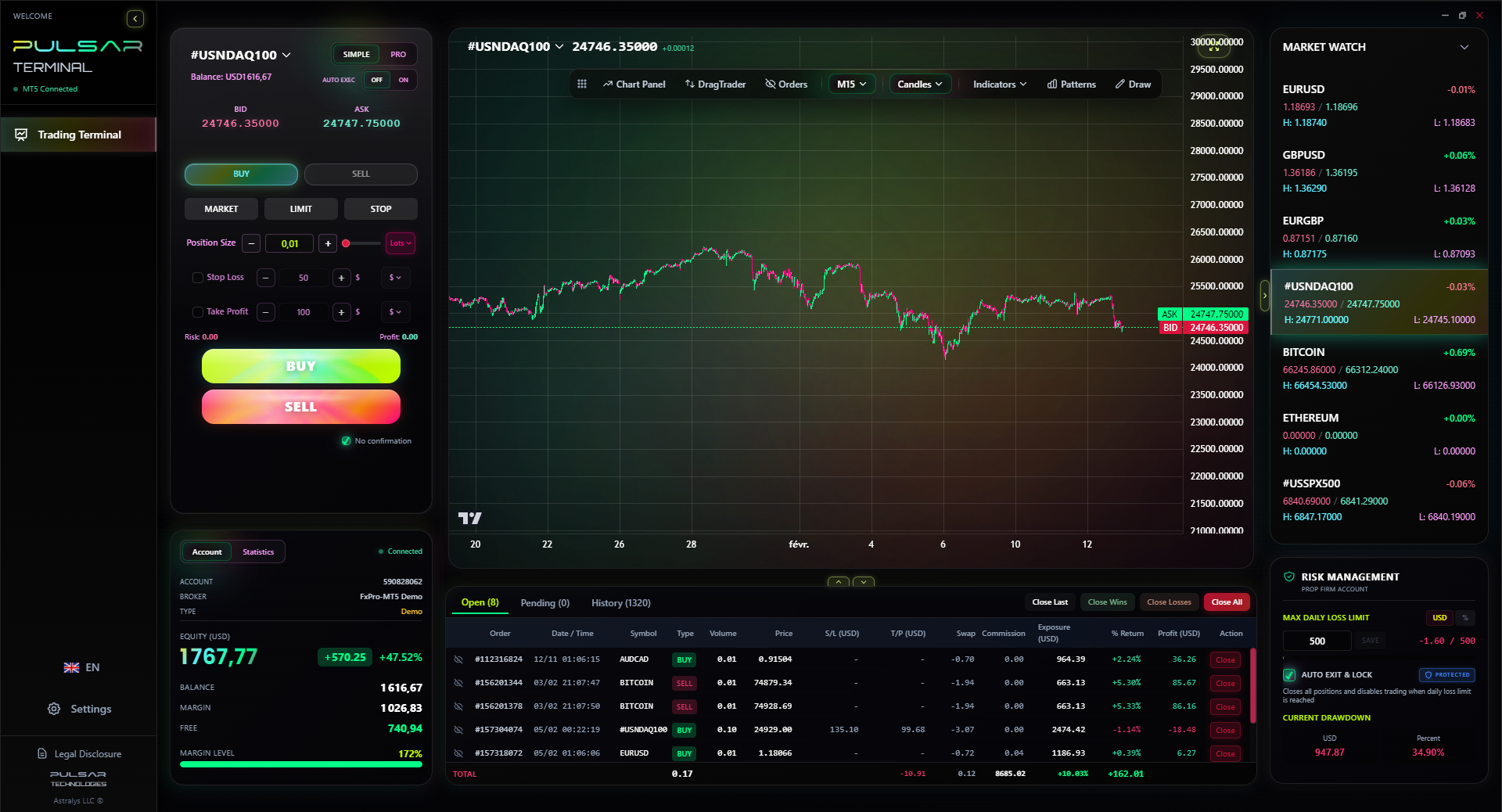
Managing trades 24/5 from a VPS is easier with tools like Pulsar Terminal, which lets you set advanced multi-TP/SL and trailing stop orders directly on your MT5 platform running remotely.
Pulsar Terminal
La herramienta MT5 todo-en-uno: órdenes drag-and-drop, multi-TP/SL, trailing stop, grid trading, Volume Profile y protección prop firm. Usado por más de 1.000 traders diariamente.
Let's talk numbers in Naira. Prices are usually in USD, so factor in exchange rate fluctuations.
- Specialized Forex VPS: $20 - $40 per month. This is the sweet spot for reliability. Reputable providers include ForexVPS.net, CheapForexVPS.com, and some offerings from MQL5.com. For a N50,000 account, this is a 0.04%-0.08% monthly cost. Worth it.
- Broker-Free VPS: Often 'free' but tied to volume or balance requirements. Effectively, you're paying for it through spreads or by holding a larger balance.
- Generic Cloud VPS (AWS, DigitalOcean): $5 - $15. Technically possible but requires more tech skill to set up. Latency might not be optimized for forex. I don't recommend this for beginners.
My advice: Start with a broker's free VPS if you qualify. It's the easiest path. If not, budget for a proper forex VPS as a non-negotiable business expense. Don't try to save $5 here. The mental peace of knowing your trades are safe is priceless.
Remember, the goal is to remove every possible edge the market has over you. Your analysis is one thing. Fighting with infrastructure is a battle you will always lose. Use a position size calculator to manage your risk, and use a VPS to ensure that risk management is actually enforced, no matter what's happening with PHCN.
💡 Consejo de Winston
Your broker's 'free' VPS is often the best deal, but read the fine print. Sometimes the required trading volume generates more in spreads than a paid VPS would cost. Always do the full math.
“Trading from Nigeria without a VPS is handing your money to the market. It's not a question of if you'll get a margin call from a disconnection, but when.”
Even with a VPS, you can mess up. Here are the final traps.
Forgetting to Update/Check: The VPS runs, but you still need to log in periodically. Update your trading platform when your broker requires it. Check that your EA is running correctly. I once left an EA on a VPS for 3 months without checking, only to find it had stopped after a Windows update. Minor losses, but a silly mistake.
Poor Security: Use a strong, unique password for your VPS. It's a computer on the internet. Enable firewall rules if you know how.
Assuming It's Set-and-Forget for Manual Trading: A VPS keeps your platform online. It doesn't place trades for you. If you're a manual trader, you still need to connect to the VPS to execute. It just means you can do so from anywhere, reliably.
Ignoring Your Local Device: Your local PC or phone is just a window. If it's full of malware, your keystrokes (including passwords) could be logged. Keep your own device reasonably clean.
, a VPS is the foundation. It lets you focus on the market, not on the madness of Nigerian utilities. It turns trading from a hopeful gamble dependent on light into a real, manageable business. Combine it with solid strategies like swing trading and a deep understanding of your instruments (like our EUR/USD guide), and you've finally leveled the playing field.
FAQ
Q1Is a VPS really necessary if I only trade manually a few times a week?
If you only trade manually and close all positions before you log off, you can maybe get by. But the risk remains. What if you take a trade and then have to leave the house? A power cut could hit your stop loss or prevent you from taking profit. For peace of mind, even manual traders benefit from a VPS for the 'set and monitor from anywhere' capability.
Q2Can I use a VPS on my phone?
Yes, but not directly. You can't install the VPS software on your phone. You use a Remote Desktop app (like Microsoft Remote Desktop) on your phone to connect to and control the Windows-based VPS. It's like seeing your VPS desktop on your phone screen. It works for checking charts and managing trades in a pinch.
Q3What happens if my VPS provider has a problem or goes down?
This is why you choose a reputable provider with a 99.9% uptime SLA (Service Level Agreement). Major outages are extremely rare in good data centers. However, you should always have your broker's mobile app or web platform login ready as a backup to close positions in a true emergency.
Q4Does using a VPS violate my broker's terms?
No, it does not. Brokers often recommend or provide VPS services themselves. They want your orders to reach them reliably. Using a VPS is completely standard and acceptable in the industry.
Q5How do I know if my VPS is close enough to my broker's servers?
Ask your broker's support for the location of their main trading servers (e.g., 'LD4, London'). Then, ask your VPS provider if they have servers in that specific data center or can guarantee a low ping (under 5ms) to it. Good providers will have this information readily available.
Q6Can I share one VPS with a friend to split the cost?
Technically possible, but a terrible idea. You'd be sharing a computer. They could see your open trades, accidentally close them, or install something that crashes the system. Your trading business deserves its own dedicated, private environment. Don't cut this corner.
Lección del Prof. Winston
Puntos clave:
- ✓A VPS guarantees 99.9% uptime vs. 60-80% on a local Nigerian PC.
- ✓Latency drops from 200ms+ to under 5ms for better order fills.
- ✓Budget $20-$40/month as a non-negotiable business expense.
- ✓Always host your VPS in the same data center as your broker's servers.
¿Te resultó útil este artículo?
Haz clic en una estrella
Análisis Trading Semanal
Análisis y estrategias semanales gratis. Sin spam.
Sobre el autor
Olumide Adeyemi
Pionero del Trading en África Occidental
Uno de los educadores de trading forex más activos de Nigeria. 8 años de experiencia operando desde Lagos. Especialista en estrategias de bajo capital y desafíos de prop firms para traders africanos.
Comentarios
Aviso de riesgo
El trading de instrumentos financieros conlleva un riesgo significativo y puede no ser adecuado para todos los inversores. El rendimiento pasado no garantiza resultados futuros. Este contenido tiene fines educativos únicamente y no debe considerarse asesoramiento de inversión. Siempre realice su propia investigación antes de operar.
También te puede interesar

Cara Trading Forex Sukses: 7 Prinsip dari Trader Profesional
Cara trading forex sukses dengan 7 prinsip trader pro: manajemen modal, disiplin, journal trading, backtest. Data nyata, bukan janji profit palsu.
Jam Trading Forex Terbaik untuk Trader Indonesia: Panduan Lengkap dengan Tabel Waktu
Panduan jam trading forex untuk trader Indonesia. Tabel 4 sesi dunia, jam emas 20:00-00:00, sesi mana yang harus dihindari. Data akurat + tips dari trader berpengalaman.
Top 5 Sàn Forex Uy Tín Nhất 2026: Review Jujur dari Trader Indonesia
Top 5 sàn forex uy tín 2026 untuk trader Indonesia. Review jujur: spread, deposit, withdraw, dukungan lokal. Exness, XM, IC Markets & lebih.
Obtener Pulsar Terminal
Todas estas calculadoras están integradas en Pulsar Terminal con datos en tiempo real de su cuenta MT5.
Obtener Pulsar Terminal