


You're watching your Friday trades, maybe you're in profit and thinking of holding over the weekend.

Olumide Adeyemi
Pionero del Trading en África Occidental ·  Nigeria
☕ 9 min de lectura
Lo que aprenderás:
You're watching your Friday trades, maybe you're in profit and thinking of holding over the weekend. But a nagging question hits you: what time does the forex market close on Friday, really? If you think it's 11 PM WAT when your broker's platform goes offline, you're in for a rude awakening. The real closing time is a different beast entirely, and misunderstanding it has cost me more money than I care to admit. Let's get this straight, once and for all.
Most brokers will tell you the forex market closes at 10 PM GMT on Friday. For us in Nigeria, that's 11 PM West Africa Time (WAT). Your MT4/MT5 platform might even show a "Market Closed" message. It feels definitive. I used to think that was the hard stop, the finish line. I was wrong, and it cost me.
The truth is, that 11 PM WAT time is just when the interbank market and most electronic communication networks (ECNs) shut down for the weekend. It's the official close of the weekly trading cycle. But price discovery? Liquidity? They don't just vanish at the stroke of 11. They start drying up hours earlier. The most important price of the week - the weekly close - is often set between 8 PM and 10 PM GMT (9 PM - 11 PM WAT), as the big banks square their books.
Here's my painful lesson. Back in 2021, I was long on GBP/USD, up about 45 pips. It was 10:30 PM WAT on a Friday. My broker's server time said market closes in 30 minutes. I thought, 'I'll just ride it out, the close is soon anyway.' I didn't use a stop loss because I was being clever (or stupid). Between 10:45 PM and 11:00 PM, a massive sell order hit the thin liquidity. GBP/USD dropped 80 pips in 15 minutes. My position was closed at my broker's guaranteed stop-out level. I went from +$225 to -$400 in the blink of an eye. The market 'closed' with my account much lighter.

Warning: Your trading platform's 'market close' is an administrative event. The effective close, where liquidity evaporates and volatility can spike, happens much earlier. Treat any trade after 8 PM GMT (9 PM WAT) on a Friday as extremely high-risk.

💡 Consejo de Winston
The market's most important close is the weekly one. The price at 11 PM WAT Friday is the anchor for every fund manager's chart on Monday morning. Trade with that weight in mind.

To understand the Friday close, you need to see the whole weekly picture. The forex market runs 24 hours a day from Monday morning in New Zealand until Friday night in New York. But it's not one market, it's a relay race across three major sessions.
| Session | Major Hub | Time (WAT) | Key Characteristic |
|---|---|---|---|
| Asian | Tokyo, Singapore | 12 AM - 9 AM | Often range-bound. Sets the tone. |
| London | London, Europe | 8 AM - 5 PM | Highest liquidity, biggest moves. |
| New York | New York | 1 PM - 10 PM | Overlaps with London for 4 hours (1 PM - 5 PM WAT). Volatile. |
The Friday close happens at the end of the New York session. But here's the key: liquidity from major American banks and funds starts pulling out from around 4 PM New York time (9 PM WAT). By 5 PM NY time (10 PM WAT), the market is a ghost town. The last hour (10 PM - 11 PM WAT) is like trading on a village road after midnight - anything can jump out at you.
For a practical scalping strategy, I avoid the last two hours of Friday completely. The spreads widen, and your execution suffers. For swing trading, you must decide before 8 PM WAT whether you're carrying that position over the weekend. Don't leave it to the last minute.

“The real closing time is a different beast entirely, and misunderstanding it has cost me more money than I care to admit.”
This isn't just trivia. The Friday closing price is the anchor for the entire weekend. It's the last agreed-upon price before markets reopen 48 hours later. When they reopen on Sunday at 10 PM GMT (11 PM WAT), the price can jump - this is the weekend gap.
Gaps happen because news and events don't stop on Saturday. Central bank statements, geopolitical drama, surprise economic data from other time zones - it all gets priced in at the open. If you have an open trade, your position will be filled at the new price, skipping all the levels in between. I've had both glorious surprise profits and heart-stopping losses from this.
The Swap/Rollover Trap
There's another thing. The forex market has a two-day settlement period (T+2). To avoid physically settling on a weekend, the settlement date is rolled forward. This creates the swap rate or rollover interest. At 11 PM WAT (the broker's close), positions held are either credited or debited this interest.
For Nigerian traders, this is critical. If you're trading a pair with a high-interest rate differential (like USD/JPY or USD/ZAR) and you get the direction wrong on the swap, you can be paying daily fees just to hold the trade. I once held a short USD/TRY position over a weekend and forgot about the swap. The Monday profit was eaten up by three days of negative rollover. Always check your broker's swap calculator before holding over Friday close.

Pro Tip: Most prop firm challenges have strict rules on weekend holdings. Some forbid them, others limit exposure. Always know your rules. A weekend gap can blow your daily loss limit and fail your challenge before Monday even starts.
After my early disasters, I built a strict Friday checklist. This routine has saved me thousands of dollars.
By 7 PM WAT: I've done my weekly review. I look at all open positions and ask one question: 'Does the reason I entered this trade still hold true for the next 48 hours of uncertainty?' If the answer isn't a confident 'yes,' I close it. No emotion.
By 8:30 PM WAT: I've calculated my weekend risk. I use a position size calculator to see what a 1% gap against me would do to my account. If I have multiple positions, I ensure my total exposure is within my weekend risk tolerance (for me, that's never more than 2% of my account).
By 9:30 PM WAT: All decisions are made and orders are set. If I'm holding, I've placed a stop loss that accounts for potential gap volatility - it's wider than my weekday stop. I also cancel any pending orders I don't want triggered in a thin-market spike.
10 PM WAT - 11 PM WAT: I'm not trading. I'm not even watching the charts. This time is for reviewing my journal, planning for next week, or simply switching off. The most expensive lesson was learning that the last pip on Friday is never worth the risk.
This discipline is especially crucial when trading pairs like XAU/USD (gold), which can gap wildly on geopolitical news over the weekend.
💡 Consejo de Winston
Your best trade on a Friday is often the one you don't take. Use the last hour to plan, not to panic-trade.

“The last hour of Friday is like trading on a village road after midnight - anything can jump out at you.”
Not all brokers handle the Friday close the same way. This is non-negotiable to check.
- Trading Hours: Some brokers, especially offshore or unregulated ones, might claim '24/7 trading.' This is often CFD trading on their own prices, not real forex market liquidity. The real market is closed.
- Spread Widening: Expect spreads to widen dramatically in the final hours. A pair like EUR/USD that normally has a 0.8 pip spread on IC Markets or Pepperstone can blow out to 5-10 pips. If you're entering a trade late, your cost of entry is huge.
- Stop Loss Execution: In thin liquidity, your stop loss becomes a market order. If the price gaps, your stop is executed at the next available price, which could be far beyond your set level. This is called slippage. I've seen 50-pip slippage on a GBP/JPY stop on a Friday close.
- Rollover Time: While most use 11 PM WAT, some brokers like XM or Exness might have a different cut-off time by a few minutes. Know yours.

Example: You buy 1 lot of EUR/USD at 1.0850 with a 5-pip spread at 10:45 PM WAT. Your break-even is instantly 1.0855. If the market then gaps down to 1.0830 on Sunday open, you're 25 pips in the hole from your entry, not 20. That extra 5 pips is the Friday-night spread tax.
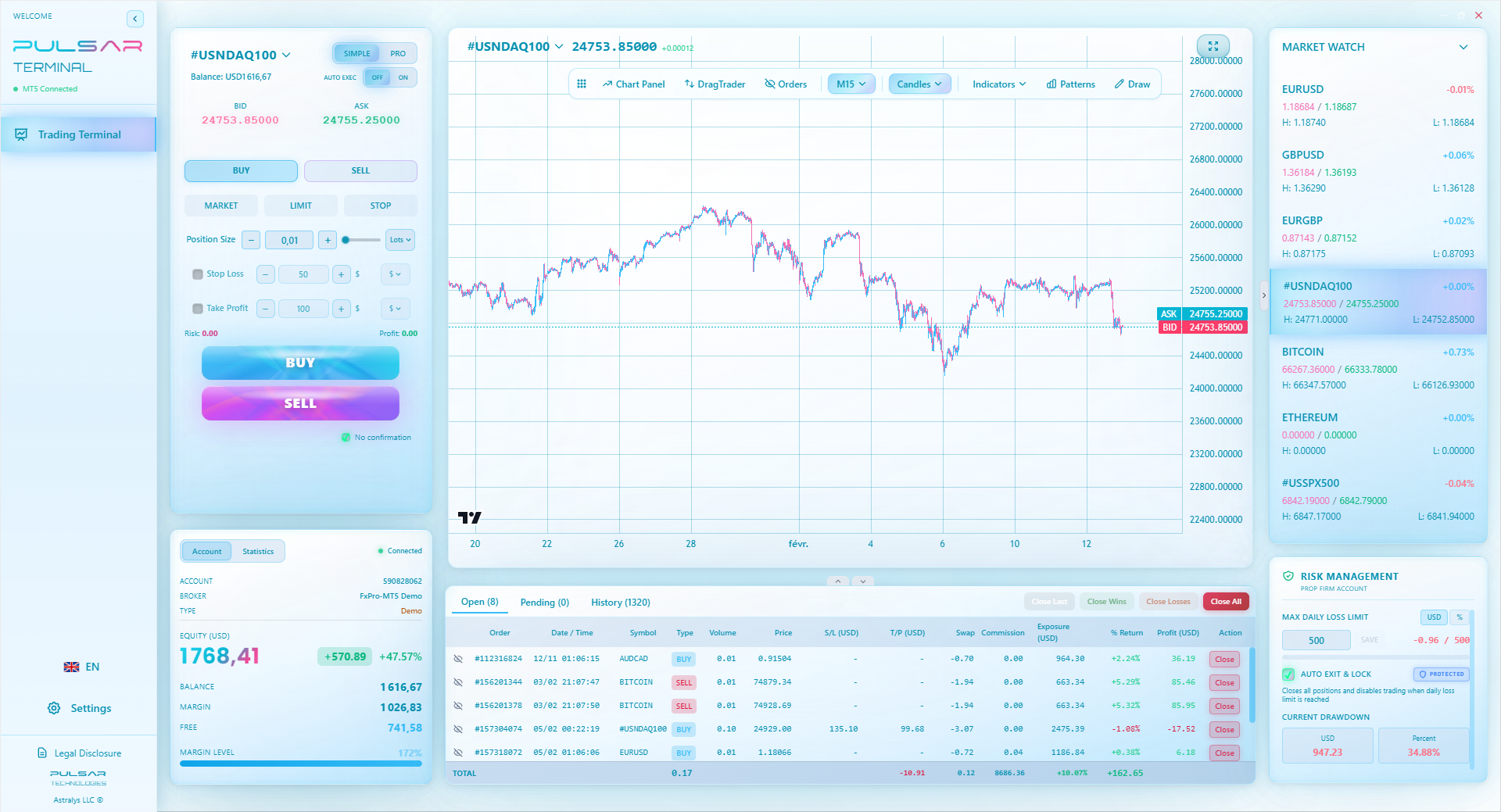
Managing multiple trades and setting protective stops ahead of the volatile Friday close is stressful, but tools like Pulsar Terminal let you drag-and-drop partial closures and set automated trailing stops directly on your MT5 chart before you log off.
Pulsar Terminal
La herramienta MT5 todo-en-uno: órdenes drag-and-drop, multi-TP/SL, trailing stop, grid trading, Volume Profile y protección prop firm. Usado por más de 1.000 traders diariamente.
While avoidance is the safest strategy, you can use the Friday close to your advantage if you're careful.
1. The Weekly Close Grab: This is for the disciplined. Many institutional charts use the weekly candle close (the 11 PM WAT price) for their analysis. A strong close above a key resistance level can signal bullish momentum for the next week. I sometimes place a limit order to buy a breakout 5-10 pips above the expected weekly high, but only if it's set before 8 PM WAT. The order sits over the weekend and gets filled on a gap up. I did this with USD/CAD in 2023, catching a 120-pip gap up from a weekly close breakout.
2. Squaring Off for Profit: If you're in a profitable trade by Friday afternoon, consider closing it. 'Never let a winning trade turn into a loser' is doubly true over the weekend. Banking profit is a strategy. I use the Friday close to lock in gains from my weekly swing trading setups and reset with a clear mind Monday.
3. Hedging (Advanced): Some traders open a small, opposite position just before the close to protect against a gap. This is complex due to swap costs and requires knowing your broker's hedging policy. I don't recommend this for beginners - it's easy to double your loss instead of protecting it.
The core tool for any of these is patience. Don't force a trade on a Friday afternoon because you're bored or feel you 'missed' the week's action. The market will reopen.
“The most expensive lesson was learning that the last pip on Friday is never worth the risk.”
You can't talk about the Friday close without mentioning the Sunday open. Markets reopen at 10 PM GMT (11 PM WAT). This open is often just as volatile as the final hour of Friday.
Liquidity is thin, spreads are wide, and the first 30-60 minutes are pure reaction to the weekend's news. My rule is simple: I do not enter new trades for the first two hours of the Sunday/Monday session. Let the market settle. Let the gaps play out and liquidity return from Asia. Watching the initial spike and retrace can give you better clues for the week ahead than jumping in at the bell.
This patience also protects you from a 'gap and trap' scenario, where price gaps in one direction only to reverse sharply as real volume enters the market. I've been caught in that trap more than once, chasing a gap up only to watch it reverse and hit my stop loss.
💡 Consejo de Winston
A gap is just the market finding a new price without you. Don't fear it, but always respect it. Position size for the gap, not just the daily range.

FAQ
Q1What is the exact forex market closing time on Friday in Nigeria?
The official interbank market closes at 10 PM GMT, which is 11 PM West Africa Time (WAT). However, for practical trading purposes, consider the market 'effectively closed' by 9 PM WAT, as liquidity dries up and volatility can spike unpredictably in the final two hours.
Q2Can I trade forex on Saturday and Sunday in Nigeria?
No, you cannot trade the real spot forex market on weekends. It is closed. Some brokers may offer CFD trading on weekends, but you are trading against their prices, not the global interbank market. Liquidity is virtually non-existent, and spreads are extremely wide, making it very high risk and not recommended.
Q3What happens to my open trades on Friday at 11 PM WAT?
They remain open but are subject to weekend gaps when the market reopens Sunday at 11 PM WAT. Also, at the moment of the Friday close (11 PM WAT), your broker will debit or credit swap/rollover interest for holding the position over the weekend (three days' worth).
Q4Why did my stop loss not work over the weekend?
Stop losses are only triggered when the market is trading. If the price gaps from above your stop level to below it without any trades in between (like over a weekend), your stop becomes a market order. It will be executed at the first available price after the gap, which could be much worse than your set level. This is called slippage.
Q5Is the Friday close a good time to enter trades?
Generally, no. It is one of the worst times due to collapsing liquidity, widening spreads, and the high risk of a weekend gap. Any trade entered after 8 PM WAT on a Friday carries significantly elevated risk. It's better to wait for the market to reopen and stabilize on Sunday/Monday.
Q6Do all currency pairs close at the same time on Friday?
Yes, the global forex market closes at the same time (10 PM GMT). However, pairs involving the USD and EUR from the London/NY sessions will see liquidity drop first. Exotic pairs or crosses can become especially illiquid and volatile in the final hours.
Lección del Prof. Winston
Puntos clave:
- ✓The effective close is 9 PM WAT, not 11 PM.
- ✓Always account for 3-day swap on weekend holds.
- ✓Size positions for potential gaps, not just volatility.
- ✓Never enter a new trade after 8 PM WAT Friday.
¿Te resultó útil este artículo?
Haz clic en una estrella
Análisis Trading Semanal
Análisis y estrategias semanales gratis. Sin spam.
Sobre el autor
Olumide Adeyemi
Pionero del Trading en África Occidental
Uno de los educadores de trading forex más activos de Nigeria. 8 años de experiencia operando desde Lagos. Especialista en estrategias de bajo capital y desafíos de prop firms para traders africanos.
Comentarios
Aviso de riesgo
El trading de instrumentos financieros conlleva un riesgo significativo y puede no ser adecuado para todos los inversores. El rendimiento pasado no garantiza resultados futuros. Este contenido tiene fines educativos únicamente y no debe considerarse asesoramiento de inversión. Siempre realice su propia investigación antes de operar.
También te puede interesar

Cara Trading Forex Sukses: 7 Prinsip dari Trader Profesional
Cara trading forex sukses dengan 7 prinsip trader pro: manajemen modal, disiplin, journal trading, backtest. Data nyata, bukan janji profit palsu.
Jam Trading Forex Terbaik untuk Trader Indonesia: Panduan Lengkap dengan Tabel Waktu
Panduan jam trading forex untuk trader Indonesia. Tabel 4 sesi dunia, jam emas 20:00-00:00, sesi mana yang harus dihindari. Data akurat + tips dari trader berpengalaman.
Top 5 Sàn Forex Uy Tín Nhất 2026: Review Jujur dari Trader Indonesia
Top 5 sàn forex uy tín 2026 untuk trader Indonesia. Review jujur: spread, deposit, withdraw, dukungan lokal. Exness, XM, IC Markets & lebih.
Obtener Pulsar Terminal
Todas estas calculadoras están integradas en Pulsar Terminal con datos en tiempo real de su cuenta MT5.
Obtener Pulsar Terminal