


I remember staring at my screen, down $1,200 of my own hard-earned cash on a single EUR/USD trade that went sideways.

James Mitchell
Analista de Trading Sénior
☕ 9 min de lectura
Lo que aprenderás:
- 1The Basic Deal: Trading with House Money
- 2How It Actually Works: The Two-Step Process
- 3The Rules You Can't Ignore (This Is Where People Blow Up)
- 4The Real Numbers: Costs, Pass Rates, and Payouts
- 5The US Regulatory Gray Area (It's Messy)
- 6Prop Firm vs. Going It Alone: Which Is Right For You?
- 7First Steps: How to Choose a Firm and Start

I remember staring at my screen, down $1,200 of my own hard-earned cash on a single EUR/USD trade that went sideways. My account was blown, and my confidence was shattered. That's when a buddy asked me, 'Why are you risking your own money? You should look into what a prop firm is.' I thought it was a scam. Turns out, it was a lifeline - but one with very specific rules. Let me walk you through what these firms really are, how they've changed, and whether they're a smart move for someone like you.
At its core, a prop firm (short for proprietary trading firm) gives you capital to trade. You don't use your own savings beyond an upfront evaluation fee. If you make money, you keep a big chunk of the profit. If you lose, you lose the firm's money, not yours (though you'll likely lose your spot).
Think of it like this: you're a skilled driver. A prop firm is a dealership that says, "Here's a Ferrari. Show us you can handle it on a test track without crashing, and we'll let you race it for real. You keep 80% of the prize money." The key is they control the risk. They set strict rules on how much you can lose daily and overall. This structure is why understanding your position size calculator is non-negotiable.
It's a trade-off. You get access to serious capital - $10k, $50k, $100k, even more - without the personal bankruptcy risk. In return, you give up some profit and must follow their playbook. For a trader who's consistent but undercapitalized, it's a game-changing model.

Warning: Don't confuse this with a brokerage. You're not depositing money to trade. You're paying a fee to be evaluated. Big difference. Firms like Exness review or IC Markets review are brokers. Prop firms are capital allocators.
The Evaluation (The "Challenge")
This is the gatekeeper. You pay a one-time fee - anywhere from $50 to $500+ - for a simulated account with a target profit and, more importantly, strict loss limits. For example, a common challenge might be: "Make 8% profit without hitting a 5% maximum loss or a 3% daily loss limit."
I failed my first two challenges. On the second one, I was up 7.5% and got greedy on a gold trade. A sudden reversal hit my daily loss limit. Poof. Challenge failed, fee gone. The psychology is brutal; you're trading fake money with very real consequences.
The Funded Account
Pass the challenge, and you get a live, funded account. Now you're trading the firm's real capital. You'll have similar rules (often slightly relaxed), and you'll get paid a profit split - usually 80% to you, 20% to the firm - on a regular basis, often weekly or monthly.
Here’s the catch most people miss: you usually have to hit a first profit target again on the funded account before your first payout. So that 8% challenge profit? You might need to make another 5-10% on the live account before you see a dime.

Example: Let's say you pass a $100,000 account challenge. You then make $6,000 profit on the live account. Your payout would be 80% of $6,000 = $4,800. If your challenge fee was $300, that's a fantastic return. But remember, only about 5-10% of traders ever get to this point.

💡 Consejo de Winston
Your evaluation fee is tuition, not a ticket. If you fail, you paid for a masterclass in your own psychological weaknesses. The lesson is more valuable than the refund.
“A prop firm provides the capital you don't have and the risk framework you probably need.”
Prop firms aren't a free-for-all. Their risk management is the entire business model. Break these rules, and you're out.
1. The Daily Loss Limit: This is your circuit breaker. It's usually a percentage of your starting account balance or your current equity's high watermark. Hit it, and your account is closed for the day or terminated. I learned this the hard way trying to scalping strategy news events; two bad trades in a row triggered my 3% daily loss.
2. The Maximum Drawdown (Overall Loss Limit): This is your total allowed loss from the account's starting balance or its highest point. It's your absolute stop-loss for the entire challenge or account period. You must track this religiously.
3. Consistency Rules: Some firms require you to trade a minimum number of days or restrict you from placing all your profit on one or two huge trades. They want proof of a repeatable process, not lottery tickets.
4. Trading Restrictions: Many firms ban holding trades over weekends or through major news events like NFP. You need to read the fine print.
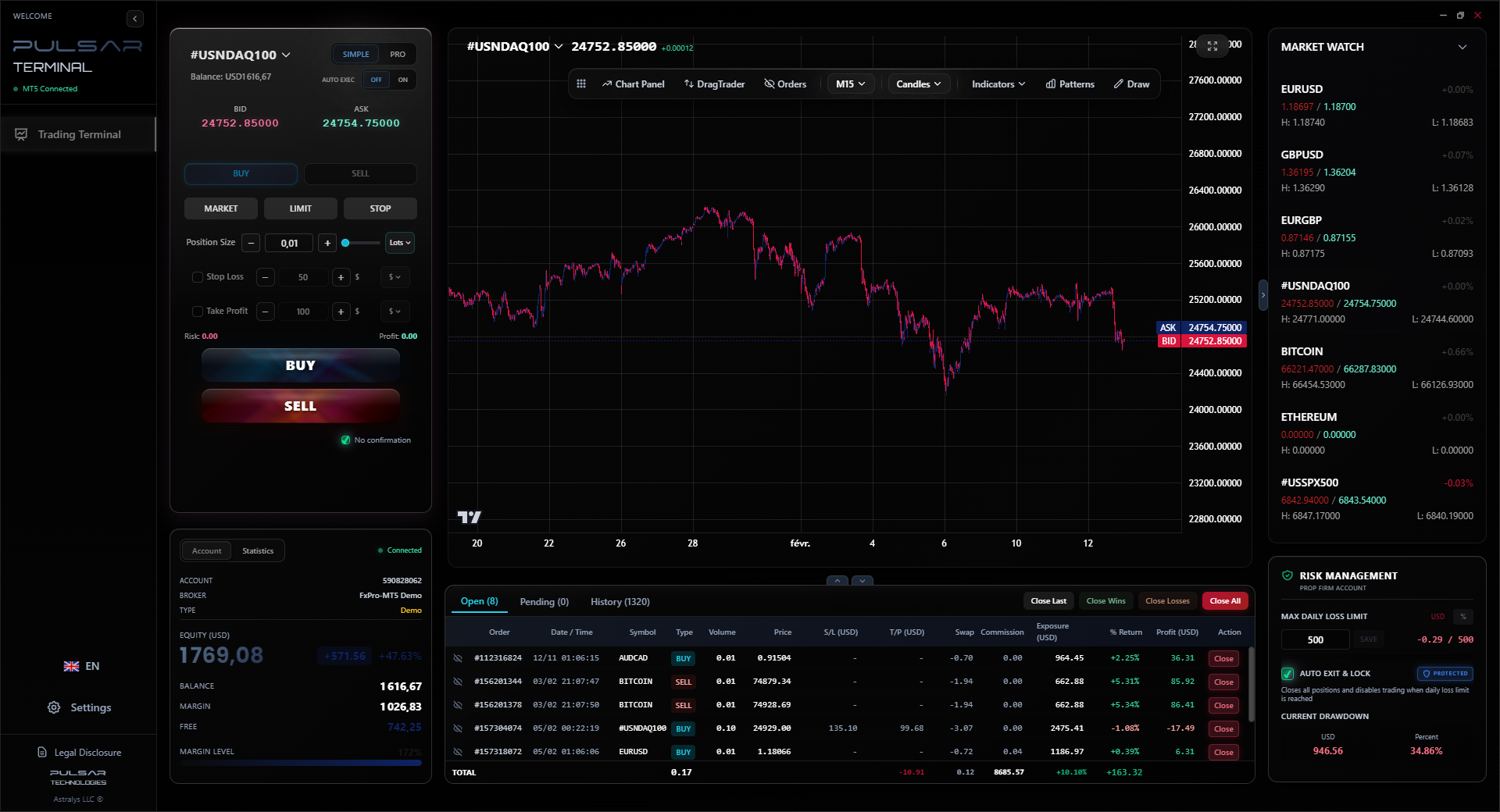
Managing these rules manually is a headache. This is where tech helps. A tool that can auto-calculate your daily loss based on equity and warn you is worth its weight in gold. It prevents emotional, catastrophic errors that lead to a margin call scenario on your challenge.
Manually tracking prop firm daily loss limits is stressful; Pulsar Terminal can monitor it in real-time and alert you before you breach.
Pulsar Terminal
La herramienta MT5 todo-en-uno: órdenes drag-and-drop, multi-TP/SL, trailing stop, grid trading, Volume Profile y protección prop firm. Usado por más de 1.000 traders diariamente.
Let's cut through the marketing. Here are the numbers nobody wants to talk about.
| Item | Typical Range | What It Means For You |
|---|---|---|
| Evaluation Fee | $39 - $1,000 | This is your sunk cost. Consider it tuition. |
| Profit Split | 70/30 to 90/10 | 80/20 is the industry standard. Shop around. |
| First-Time Pass Rate | 5% - 10% | It's low. Very low. Most people fail multiple times. |
| Traders Who Ever Get a Payout | ~7% | That's right. 93% of challenge buyers never cash out. |
| Average Payout for Winners | ~4% of account size | A $100k account yields ~$4,000 average payout. |
My own experience lines up. I spent about $900 on various challenge fees over 18 months before I finally got and kept a $50k funded account. My first payout was $1,920 (80% of $2,400 profit). It felt great, but the net journey was long.
The math is simple but brutal. If you're not a consistently profitable trader with solid discipline before you take a challenge, you're just donating your fee. This model is for refining and scaling an existing edge, not finding one.

Pro Tip: Start with the smallest, cheapest challenge a reputable firm offers. Use it as a paid simulation to learn their platform and rules. Don't go for the $100k account right away. You need reps.
💡 Consejo de Winston
The daily loss limit isn't a suggestion. It's a law. If your strategy can't guarantee you'll stay under it 99% of the time, you don't have a prop firm strategy.

“Only about 7% of people who buy a challenge ever see a payout. This isn't a get-rich-quick scheme.”
This is critical for US-based traders. Prop firms, especially the evaluation-based ones, exist in a regulatory gray zone. They're not brokers like Pepperstone review, so they aren't regulated the same way.
The Old Way (Pre-2024): Many firms used platforms like MetaTrader. Then in early 2024, MetaQuotes (the maker of MT4/MT5) cracked down, cutting off access for many US prop traders overnight. It was chaos.
The Current Landscape: Firms have adapted. Some, like FTMO, have partnered with fully regulated US brokers (like OANDA) to offer MT5 access compliantly. Others have shifted to platforms like cTrader or DXtrade. Futures-focused prop firms use platforms like NinjaTrader.
The Regulatory Pressure: The CFTC and SEC are paying more attention. There's a push to treat these firms more like Commodity Trading Advisors (CTAs), which would mean registration, stricter rules, and clearer disclosures. Some sketchy firms have folded under the pressure.
What This Means For You:
- Stick with established, transparent firms. If a firm's terms are vague or they promise 100% guaranteed funding, run.
- Your fee and profits are not FDIC-insured. There's risk the firm could fail.
- Taxes are your responsibility. You'll get a 1099 for your profit splits. Keep clean records.
The environment is stabilizing but is still evolving. Your due diligence is key.
So, should you pursue a prop firm or just build your own account? It depends entirely on your profile.
A Prop Firm Might Be Good If You:
- Have a proven, disciplined strategy but lack capital to make meaningful profits.
- Need the external structure of loss limits to enforce discipline.
- Want access to higher-end technology and data feeds without the direct cost.
- Are comfortable trading someone else's rulebook.
Going It Alone Is Better If You:
- Have significant starting capital (e.g., $20k+).
- Have a swing trading style that doesn't fit prop firm time limits (like holding for weeks).
- Value total freedom over your trades and risk.
- Are still developing your edge and can't afford to lose challenge fees.
For me, the prop firm path was essential. It provided the capital I didn't have and the risk framework I needed. It forced me to master my MACD indicator and RSI indicator confluence setups because reckless trading wasn't an option. But it's not a shortcut. It's a different, often harder, path to the same goal.
“The rules aren't there to cheat you. They're there because 95% of traders can't follow them.”
If you're ready to try, here's a practical plan.
- Define Your Style: Are you a forex trader? Look at firms offering EUR/USD guide and XAU/USD guide. A futures trader? Your options are different.
- Research Relentlessly: Don't just watch YouTube ads. Read independent reviews and, crucially, the firm's Terms & Conditions. Look for clarity on payouts, loss rules, and what happens if they shut down.
- Start Small: Buy the smallest evaluation for the most reputable firm you can find. Your goal isn't to get rich on the first try; it's to learn the process.
- Paper Trade Their Rules First: Before you pay a dime, simulate their rules on a demo account. Can you hit a 8% profit target without breaching a 5% max loss? If not, you're not ready.
- Plan Your Trade Management: How will you track your daily drawdown? How will you set stop-losses to stay within limits? This operational stuff is 80% of the battle.
Remember, this is a business arrangement. You are a service provider (a trader) to a client (the firm). Act professionally, manage their capital like it's your grandmother's retirement fund, and the profit splits can become a very real income stream. But step one is understanding exactly what a prop firm is - and what it demands from you.
FAQ
Q1Is a prop firm a scam?
Not inherently, but the industry has bad actors. Legitimate prop firms make money from your profit split, not from you failing challenges. Scam firms design challenges to be impossible to pass just to collect fees. Research is your best defense.
Q2Can I really lose more than my evaluation fee?
No. Your maximum financial loss is the fee you paid for the challenge. If you blow the funded account, you don't owe the firm money. You just lose the account. That's the core appeal - capped downside.
Q3How often do prop firms pay out?
Most offer regular payouts, often weekly or monthly, once you've met any initial profit target on the funded account. Some even offer "on-demand" payouts after each profitable trade is closed.
Q4Why do most traders fail prop firm challenges?
They treat it like a lottery ticket instead of a job. The rules (daily loss, max drawdown) require extreme discipline. Most retail traders are used to "riding out" losses or averaging down, which are instant disqualifications in a prop challenge.
Q5Can I use Expert Advisors (EAs) or trade algorithms?
It depends on the firm. Many allow it, but they often require you to disclose it and may monitor for latency arbitrage or other exploitative strategies. Always check the specific rules.
Q6Are prop firms good for beginner traders?
Generally, no. Beginners are still paying for their education. Throwing $500 at challenge fees you'll almost certainly lose is worse than using that money for a smaller personal account to learn real risk management, like understanding the spread definition and pip definition.
Q7What's the biggest mistake new prop traders make?
Overtrading to hit the profit target quickly. This leads to sloppy entries, widened stops, and almost always triggers a loss limit. Slow, consistent, small wins are the only way through.
Lección del Prof. Winston
Puntos clave:
- ✓Maximum loss is your evaluation fee, not the account size.
- ✓Industry average first-time pass rate is only 5-10%.
- ✓Standard profit split is 80/20 in your favor.
- ✓Daily loss limits are the most common reason for failure.
¿Te resultó útil este artículo?
Haz clic en una estrella
Análisis Trading Semanal
Análisis y estrategias semanales gratis. Sin spam.
Sobre el autor
James Mitchell
Analista de Trading Sénior
Con sede en Nueva York y más de 9 años de experiencia en trading. Se enfoca en pares USD principales, desafíos de prop firms y el panorama regulatorio estadounidense.
Comentarios
Aviso de riesgo
El trading de instrumentos financieros conlleva un riesgo significativo y puede no ser adecuado para todos los inversores. El rendimiento pasado no garantiza resultados futuros. Este contenido tiene fines educativos únicamente y no debe considerarse asesoramiento de inversión. Siempre realice su propia investigación antes de operar.
También te puede interesar

Cara Trading Forex Sukses: 7 Prinsip dari Trader Profesional
Cara trading forex sukses dengan 7 prinsip trader pro: manajemen modal, disiplin, journal trading, backtest. Data nyata, bukan janji profit palsu.
Jam Trading Forex Terbaik untuk Trader Indonesia: Panduan Lengkap dengan Tabel Waktu
Panduan jam trading forex untuk trader Indonesia. Tabel 4 sesi dunia, jam emas 20:00-00:00, sesi mana yang harus dihindari. Data akurat + tips dari trader berpengalaman.
Top 5 Sàn Forex Uy Tín Nhất 2026: Review Jujur dari Trader Indonesia
Top 5 sàn forex uy tín 2026 untuk trader Indonesia. Review jujur: spread, deposit, withdraw, dukungan lokal. Exness, XM, IC Markets & lebih.
Obtener Pulsar Terminal
Todas estas calculadoras están integradas en Pulsar Terminal con datos en tiempo real de su cuenta MT5.
Obtener Pulsar Terminal