


Here's a hard truth: 93.7% of young Nigerians aged 18-35 are trading forex, but most are losing money.

Olumide Adeyemi
Pionero del Trading en África Occidental ·  Nigeria
☕ 9 min de lectura
Lo que aprenderás:
Here's a hard truth: 93.7% of young Nigerians aged 18-35 are trading forex, but most are losing money. They're chasing the magic indicator, the one perfect tool that prints cash. I spent years and lost over $2,500 doing the same. The real answer to which indicator is best for forex trading isn't a single tool. It's how you combine a few, understand our local market costs, and manage the insane use brokers offer us. Let's cut through the noise.
Every new trader in Lagos or Port Harcourt makes the same mistake. You download MT4, see 30+ built-in indicators, and start stacking them on your chart. RSI, MACD, Bollinger Bands, Stochastic... your screen looks like a Christmas tree. You think more lines mean more certainty. They don't. They create confusion and paralyze you.
I remember my first major loss on GBP/USD. I had seven indicators all giving slightly different signals. The RSI was oversold, the MACD was bearish, the moving averages were crossed. I froze, missed my exit, and watched a 150-pip move against me. That was a $375 lesson. The problem wasn't the indicators; it was my belief that they could predict the future.
Indicators are lagging. They calculate based on past price. They can't tell you what will happen when the Central Bank of Nigeria (CBN) makes a surprise announcement about the Naira. They're rear-view mirrors, not crystal balls. Your first job is to stop looking for a holy grail. The best indicator setup is the simplest one you actually understand and can execute without hesitation.

Warning: Nigerian brokers often advertise with 'winning indicator' packages. These are almost always repackaged free tools or useless scripts. Never buy an indicator. Learn the core, free ones that have worked for decades.

💡 Consejo de Winston
A professor once told me, 'The market is a master of disguise. Your job isn't to predict its next costume, but to recognize the fabric.' Indicators just describe the fabric of recent price action. Don't confuse the description for the thing itself.
“The problem wasn't the indicators; it was my belief that they could predict the future.”
Let's break down the handful of tools that form the foundation. Forget the exotic ones for now.
Price Action & Support/Resistance
This isn't a flashing indicator, but it's the most important 'tool' you have. It's just reading the raw chart. Where has the price of USD/NGN bounced or reversed before? Those are your key levels. Drawing these horizontal lines is your first step before adding any other tool. Most of my profitable swing trading setups start here.
Moving Averages (The Trend Filter)
A moving average smooths out price noise to show the direction. The 50-period and 200-period Exponential Moving Averages (EMAs) are classics.
How I use them: If price is above the 50 EMA and the 50 is above the 200 EMA, I only look for buy setups. It keeps me on the right side of the trend. In a strong Naira rally or sell-off, this simple rule saves you from trying to pick tops and bottoms, a sure way to blow your account.
Relative Strength Index (RSI)
The RSI indicator measures momentum on a scale of 0 to 100. Above 70 is traditionally overbought, below 30 oversold. The key for forex? Use it to spot divergences.
Real Example: In early 2024, EUR/USD was making higher highs, but the RSI was making lower highs. This bearish divergence signaled weakening momentum. I entered a short at 1.0950 and rode it down to 1.0750. That 200-pip move netted me $1,000 on a standard lot. The RSI didn't cause the move, but it warned me the trend was tired.
MACD
The MACD indicator shows the relationship between two moving averages. Look for the histogram (the bars) to cross above or below the zero line, and for the MACD line (blue) to cross the signal line (orange). It's great for confirming trend changes. I pair it with price action at support/resistance. If price hits a major support level and the MACD histogram is ticking up from a low point, that's a much stronger buy signal than either alone.

Example: Let's say you're trading GBP/NGN. Your broker's spread is 50 pips (common for exotics). If you use the MACD crossover alone, you might enter and exit for a 60-pip 'profit,' but after the spread, you only make 10 pips. You need your indicator-based edge to be larger than our high local costs.
“Your edge doesn't come from a better indicator. It comes from better discipline.”
Now, let's build a practical system with what we've got. You need three components: a trend filter, an entry trigger, and a volatility gauge.
My Go-To Daily Chart System:
- Trend Filter: 50 EMA. Price above = look for buys only. Price below = look for sells only.
- Entry Trigger: Wait for price to pull back to a key support or resistance level.
- Confirmation: Use RSI (divergence or extreme reading) or MACD crossover to confirm momentum is shifting back in the trend's direction.
This isn't sexy, but it's strong. It forces patience and keeps you aligned with the higher-timeframe flow of money.
What about all the other indicators?
- Bollinger Bands: Great for spotting periods of low volatility (bands squeeze) which often precede big moves. Useful for breakout strategies.
- Stochastic: Similar to RSI, but can be more sensitive. It gets whipsawed easily in ranging markets, which happens a lot with pairs like EUR/NGN.
- Fibonacci Retracement: Not an indicator per se, but a drawing tool. Traders worldwide watch the 61.8% retracement level. If price pulls back to that level in a strong trend and your other signals align, it's a high-probability area.
The biggest leak in your system won't be the indicator choice. It will be your position size calculator and discipline. With use of 1:500 (common here), a 20-pip move against you can wipe out 10% of your account if you're over-sized.
💡 Consejo de Winston
In my quant days, we tested every popular indicator. The ones that survived 50 years of markets - like the RSI and MACD - did so because they describe fundamental market forces: momentum and convergence. The flashy new ones usually just describe noise.
“If your total cost is 2 pips, your trade needs to move at least 3-4 pips in your favor just to break even.”
You could have the world's best strategy and still lose money in Nigeria. Here's why.
Spreads & Commissions: When you trade EUR/USD, you're not just betting on the price. You're paying the broker's spread. On a standard account with a broker like XM or Exness, that's often 0.8 to 1.6 pips. If your average winning trade is only 10 pips, the spread eats 10-16% of your profit instantly. For a scalping strategy, this is deadly. You need a raw spread account from a broker like IC Markets or Pepperstone where spreads are 0.0 pips plus a small commission.
Slippage & Requotes: During CBN announcements or major news, the market gaps. Your perfect indicator signal happens at 1.5000, but your order fills at 1.5025. That's 25 pips of slippage. Good execution from a top-tier broker minimizes this.
Taxes: Remember, the FIRS wants 10% of your gross profits. Factor that into your profit targets. If you aim for a 100-pip gain, know that 10 pips of that effectively belong to the taxman.

Pro Tip: Before you trust any signal, know your total cost per trade. Add the spread (in pips) + any commission (converted to pips). If your total cost is 2 pips, your trade needs to move at least 3-4 pips in your favor just to break even. This simple math kills more Nigerian trading accounts than bad indicators.
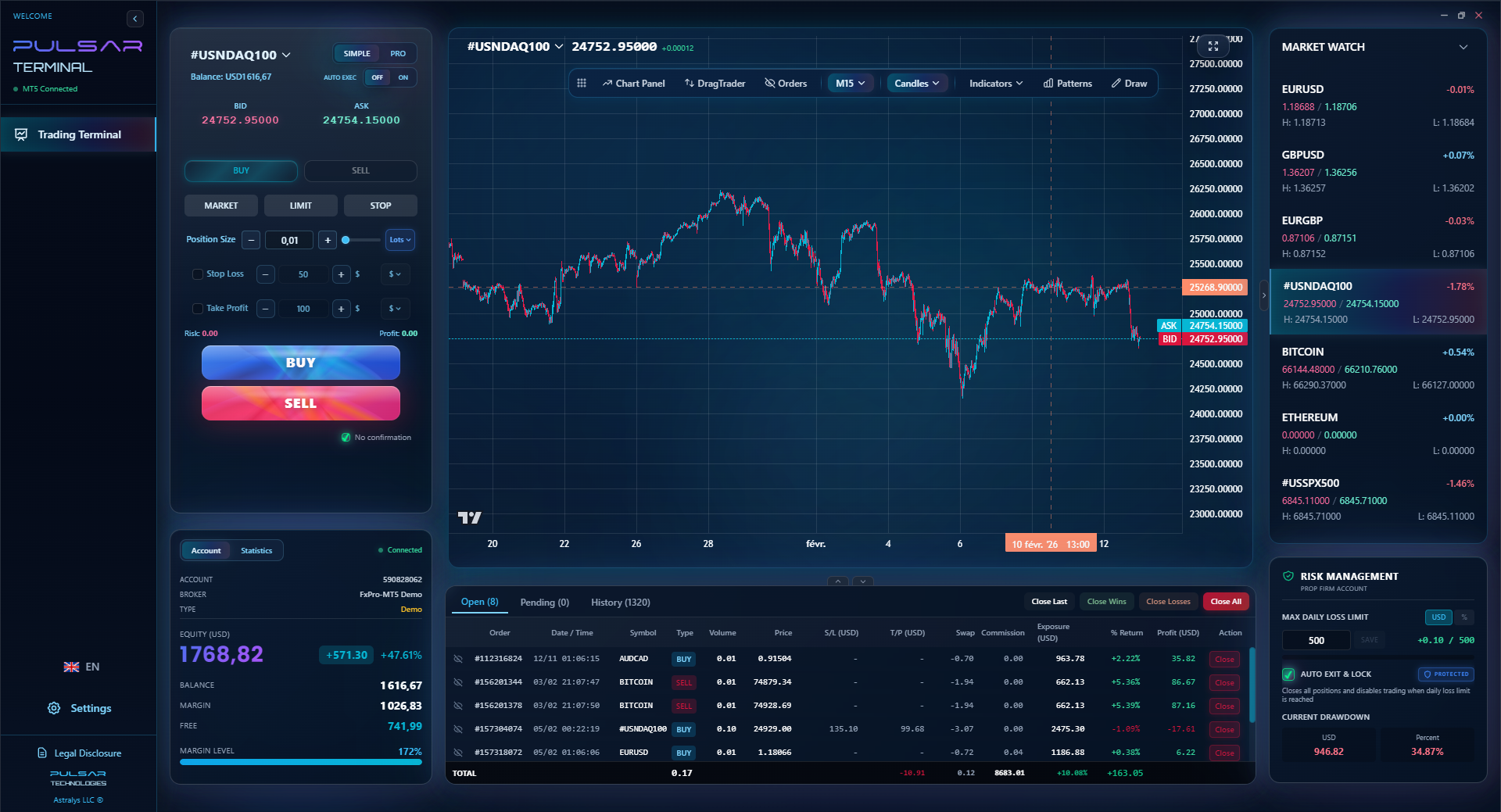
Managing multiple trades and complex exits is where simple setups fail, but tools like Pulsar Terminal automate partial closures and trailing stops directly on your MT5 chart.
Pulsar Terminal
La herramienta MT5 todo-en-uno: órdenes drag-and-drop, multi-TP/SL, trailing stop, grid trading, Volume Profile y protección prop firm. Usado por más de 1.000 traders diariamente.
“If your total cost is 2 pips, your trade needs to move at least 3-4 pips in your favor just to break even.”
Let me be brutally honest about my own path, so you can skip the painful parts.
The Bad: I bought a 'Nigerian Naira Prophet' indicator for 50,000 NGN in 2019. It repainted (changed past signals) and caused a 30% drawdown in two weeks. I broke even on a USD/NGN trade only to have the indicator change its signal on the chart, showing I should have lost. Lesson learned: never buy secret formulas.
The Ugly: I tried to automate everything. I built an Expert Advisor (robot) using a complex mix of 5 indicators. It backtested beautifully on past EUR/USD data. In live markets, it blew through my $1,000 prop firm challenge account in 3 days. The market structure had shifted, but the robot kept blindly following its code. It didn't understand context.
The Good (What Works Now): My main chart for EUR/USD guide or XAU/USD guide has three things: a clean price chart with horizontal support/resistance lines, a 50-period EMA, and the RSI. That's it. I use the 4-hour chart for trend direction and the 1-hour for precise entries. This simplicity lets me see the market clearly and act fast when my setup appears.
My most consistent profits come from this boring simplicity, coupled with strict risk management. I risk 1% per trade, always. No indicator in the world will save you from a margin call if you risk 10% on a single hunch.
💡 Consejo de Winston
The most sophisticated hedge funds use tools you have for free. Their edge is in risk allocation and execution speed, not in secret indicators. Your priority should mirror theirs: manage your size, know your costs, and be patient.
“Start simple. Keep a trading journal. Respect the 10% tax.”
If you held a gun to my head and forced me to choose one indicator to trade with forever, it would be the 200-period Exponential Moving Average on the daily chart.
Why? It's the ultimate trend filter. It tells you the macroeconomic direction. Are we above it (broadly bullish) or below it (broadly bearish)? In forex, the trend is your friend more often than not. Trading with this simple guide would keep you out of 50% of losing trades that go against the major flow.
But you don't have to choose just one. The best combination for a Nigerian trader starting out is this:
- Primary Tool: Price Action & Support/Resistance (FREE)
- Trend Filter: 50-period EMA (FREE)
- Momentum Confirmation: RSI or MACD (FREE)
That's your entire toolkit. Master these. Understand what they mean when the Naira is under pressure and the CBN is intervening. Paper trade this combo for two months. Track every trade.
Your edge doesn't come from a better indicator. It comes from better discipline, better understanding of spread definition and costs, and better psychology. The indicator just gives you a structured way to enter and exit. The real profit is made in the sitting and the waiting, not in the frantic clicking.
Start simple. Keep a trading journal. Respect the 10% tax. And for heaven's sake, use a position size calculator on every single trade. That's the only 'secret' you'll ever need.
FAQ
Q1Is the RSI or MACD better for forex trading?
Neither is universally better. The RSI is excellent for spotting momentum divergences and overbought/oversold conditions in ranging markets. The MACD is stronger for identifying and confirming trend changes. Most professional traders I know use the RSI on lower timeframes for precision and the MACD on higher timeframes for trend confirmation. Try both in your demo account and see which one you find easier to interpret.
Q2What is the best indicator for scalping in Nigeria?
For scalping, where you're in and out in minutes, you need indicators that react quickly. The VWAP (Volume Weighted Average Price) and simple moving averages like the 9 or 20 EMA are popular. However, the most critical factor for scalping in Nigeria is your broker's spread and execution speed. A 2-pip spread will destroy a scalping strategy. You must use an ECN/raw spread account from a broker like IC Markets or Pepperstone. The best indicator won't help if your costs are too high.
Q3How many indicators should I have on my chart?
As few as possible. I recommend 1 to 3, maximum. More than that leads to "analysis paralysis" where indicators conflict and you do nothing. My chart has just two: an EMA for trend and the RSI for momentum. A clean chart helps you see what price is actually doing, which is more important than what a dozen lagging indicators are suggesting.
Q4Are paid indicators worth it for forex trading?
Almost never. In 12 years, I've never seen a paid indicator that provided a lasting edge. The good ones are usually variations of free, classic indicators. The bad ones repaint (change past signals) or are outright scams. The foundational knowledge of how to use free tools like moving averages, RSI, and MACD is infinitely more valuable. Invest your money in education and a good internet connection, not in magic lines.
Q5How do I adjust indicators for the volatile USD/NGN pair?
Volatile pairs like USD/NGN require adjustments. First, use wider stops because the normal noise is greater. Second, consider using slower indicator settings to avoid being whipsawed. For example, try a 14-period RSI instead of a 9-period. Most importantly, be aware of CBN announcement calendars. No indicator can reliably predict central bank intervention, so it's often best to reduce position size or stay out of the market around major news events.
Q6Do I need different indicators for MT4 and MT5?
No, the core indicators (Moving Averages, RSI, MACD, Bollinger Bands) work identically on both MT4 and MT5. The math behind them is the same. MT5 does offer more built-in indicators and timeframes, but the principles of application don't change. Focus on learning the tool, not the platform it's on.
Lección del Prof. Winston
Puntos clave:
- ✓No single indicator is the 'best.' It's the combination and context.
- ✓Always factor in the spread & 10% Nigerian capital gains tax.
- ✓Use a maximum of 3 indicators to avoid paralysis.
- ✓The 200 EMA is the single most reliable trend filter.
- ✓Paid indicators are almost always a waste of money.
¿Te resultó útil este artículo?
Haz clic en una estrella
Análisis Trading Semanal
Análisis y estrategias semanales gratis. Sin spam.
Sobre el autor
Olumide Adeyemi
Pionero del Trading en África Occidental
Uno de los educadores de trading forex más activos de Nigeria. 8 años de experiencia operando desde Lagos. Especialista en estrategias de bajo capital y desafíos de prop firms para traders africanos.
Comentarios
Aviso de riesgo
El trading de instrumentos financieros conlleva un riesgo significativo y puede no ser adecuado para todos los inversores. El rendimiento pasado no garantiza resultados futuros. Este contenido tiene fines educativos únicamente y no debe considerarse asesoramiento de inversión. Siempre realice su propia investigación antes de operar.
También te puede interesar

Cara Trading Forex Sukses: 7 Prinsip dari Trader Profesional
Cara trading forex sukses dengan 7 prinsip trader pro: manajemen modal, disiplin, journal trading, backtest. Data nyata, bukan janji profit palsu.
Jam Trading Forex Terbaik untuk Trader Indonesia: Panduan Lengkap dengan Tabel Waktu
Panduan jam trading forex untuk trader Indonesia. Tabel 4 sesi dunia, jam emas 20:00-00:00, sesi mana yang harus dihindari. Data akurat + tips dari trader berpengalaman.
Top 5 Sàn Forex Uy Tín Nhất 2026: Review Jujur dari Trader Indonesia
Top 5 sàn forex uy tín 2026 untuk trader Indonesia. Review jujur: spread, deposit, withdraw, dukungan lokal. Exness, XM, IC Markets & lebih.
Obtener Pulsar Terminal
Todas estas calculadoras están integradas en Pulsar Terminal con datos en tiempo real de su cuenta MT5.
Obtener Pulsar Terminal