


Let's cut through the noise.

David van der Merwe
Trader de Mercados Emergentes ·  South Africa
☕ 11 min de lectura
Lo que aprenderás:
- 1The FSCA Stamp: What It Actually Means for Your Money
- 2Funding in Rands: The Good, The Bad, The Hidden Fees
- 3Real Trading Costs: Spreads, Commissions & The Zero-Fee Myth
- 4Platforms: MT4, MT5, and What You're Missing
- 5use: Your Greatest Tool and Most Likely Destroyer
- 6The 50% Deposit Bonus Trap (And How to Navigate It)
- 7How XM Stacks Up Against the Local Competition
- 8Final Verdict: Who Should (and Shouldn't) Use XM

Let's cut through the noise. Most reviews of XM for South African traders read like they were written by someone who's never placed a live trade. They'll tell you about the 'award-winning platform' and the '1000+ instruments' but gloss over the real stuff: how your ZAR deposits actually work, what the FSCA registration really means for you, and why that 'tight spread' might be a mirage. I've traded with them, funded accounts in rands, and taken profits back to my FNB account. Here's what you won't hear in the brochures.
XM Group is registered with the Financial Sector Conduct Authority (FSCA) under license number 49857. This is the single most important line in any review for a South African trader. But what does it actually do for you?
It's not a guarantee. It doesn't mean the FSCA will bail you out if you blow your account on a bad EUR/ZAR trade. What it provides is a layer of oversight and a local avenue for complaint. Your funds with XM's FSCA-licensed entity are held in segregated accounts at major banks. This means they're separate from the company's operating funds. If XM went under (highly unlikely given their size), your money isn't just part of a pool creditors can grab.
However, don't confuse this with the protection you get from a South African bank. The FSCA's jurisdiction is over the company's conduct, not a compensation scheme for retail trading losses. I've seen too many new traders think 'FSCA regulated' equals 'government-backed safe bet.' It's not. It's a baseline requirement for operating here, not a safety net for your risky scalping strategy.

Warning: The FSCA regularly warns the public about unregulated forex brokers. The fact XM is on their approved list is critical. Always verify the license number on the FSCA's website yourself, don't just take the broker's word for it.

💡 Consejo de Winston
Decline the deposit bonus on your first live account. You need to know your true, unsubsidized performance. The trading volume requirements will make you do stupid things.
This is where the rubber meets the road. XM offers ZAR-denominated trading accounts. You can deposit from your local bank via EFT, and crucially, you can withdraw profits back to your South African bank account. This is a massive convenience that shouldn't be underestimated.
The Deposit Process
It's straightforward. You EFT to their South African bank account (held with one of the big five). The funds typically reflect in your trading account within a few hours, sometimes same-day if you deposit early. I've done this dozens of times. There are no deposit fees from XM's side, but your bank might charge a normal EFT fee.
The Withdrawal Reality
Here's the catch they don't advertise loudly. While XM doesn't charge a fee for the withdrawal processing, you will almost certainly lose money on the currency conversion if you're trading international pairs. Let me give you a real example from last quarter.
I deposited R20,000. I traded mostly USD-based pairs like EUR/USD. My account equity grew to $1,500. When I requested a withdrawal of $1,500 back to my ZAR account, XM converted it at their interbank rate. I received roughly R27,800. The spot rate that day should have given me about R28,100. That R300 difference? That's the hidden cost - the spread on their internal conversion. It's not a 'fee,' but it acts exactly like one. Always factor in a 0.5% to 1% haircut on any profit you convert back to rands.

Pro Tip: For larger withdrawals (over $5,000), consider opening a USD account with a South African bank like Capitec or Discovery Bank. Withdraw USD to that account, then use a specialist forex service like CurrencyHub or Shyft to convert to ZAR. You'll often get a better rate than the broker's conversion.
“That 'zero commission' cost is baked into the spread. For large trades, you're often paying more.”
XM heavily markets 'tight spreads' and 'zero commission' on their standard accounts. Let's be blunt: there's no such thing as a free lunch. The cost is baked into the spread.
On their Standard account, the EUR/USD spread might be advertised from 1.7 pips. In my experience during active London sessions, it's often tighter, around 1.0-1.3 pips. But during off-hours or high volatility, I've seen it balloon to 2.5 pips. Compare this to a true ECN broker like IC Markets or Pepperstone where you pay a commission but get raw spreads often below 0.1 pips.
Which is cheaper? It depends entirely on your position size.
For a 1 standard lot (100,000 units) trade on EUR/USD:
- XM (1 pip spread): Cost = 1 pip * $10 = $10
- IC Markets (0.1 pip spread + $7 round-turn commission): Cost = (0.1 * $10) + $7 = $8
In this case, the 'commission' account is actually cheaper for larger trades. For micro lots (1,000 units), XM's zero-commission model is probably better, as a $7 commission would be a huge percentage of a small trade's potential profit.
The XM Zero account offers tighter spreads (from 0 pips) but charges a commission ($3.5 per side per 100k traded). This is better for serious volume traders. For the average South African starting with a few hundred dollars, the Standard account is simpler, but understand you're paying for that simplicity.
Gold (XAU/USD) spreads are decent, usually around 35-40 cents (3.5-4 pips). Not the absolute best, but competitive.

XM offers MetaTrader 4 and MetaTrader 5. For 95% of retail traders, MT4 is all you'll ever need or use. It's stable, familiar, and has a million indicators. XM's MT4 servers are reliable; I've rarely had slippage or requotes on major pairs during normal hours.
But here's my gripe, and it's a big one. The vanilla MT4 platform is, frankly, archaic. Placing advanced orders, managing multiple take-profits, or setting a trailing stop is clunky. You're clicking through menus while the market moves. I lost a chunk of potential profit on a GBP/USD trade once because I was manually dragging my stop-loss instead of having a trailing stop automate it.
This is where third-party tools become non-negotiable. You need to upgrade your MT4 experience. Using a tool like Pulsar Terminal (which plugs right into MT4/MT5) transforms your trading. Being able to drag and drop orders directly onto the chart, set a 3-tier take-profit with partial closures, and automate a breakeven or trailing stop with one click is a massive edge. It turns a reactive platform into a proactive one. Relying solely on XM's basic MT4 offering is like bringing a knife to a gunfight once you move past the beginner stage.
Their mobile apps are fine for checking positions and placing simple orders, but never, ever try to do complex analysis on a phone screen.
💡 Consejo de Winston
If your strategy relies on trailing stops, don't try to manage them manually on MT4. You'll fail. Use a tool that automates it, or you're leaving money on the table.
Manually dragging stops on basic MT4 is a great way to lose profits; Pulsar Terminal automates trailing stops, breakeven, and multi-level take-profits directly on your XM MT4/MT5 platform.
Pulsar Terminal
La herramienta MT5 todo-en-uno: órdenes drag-and-drop, multi-TP/SL, trailing stop, grid trading, Volume Profile y protección prop firm. Usado por más de 1.000 traders diariamente.
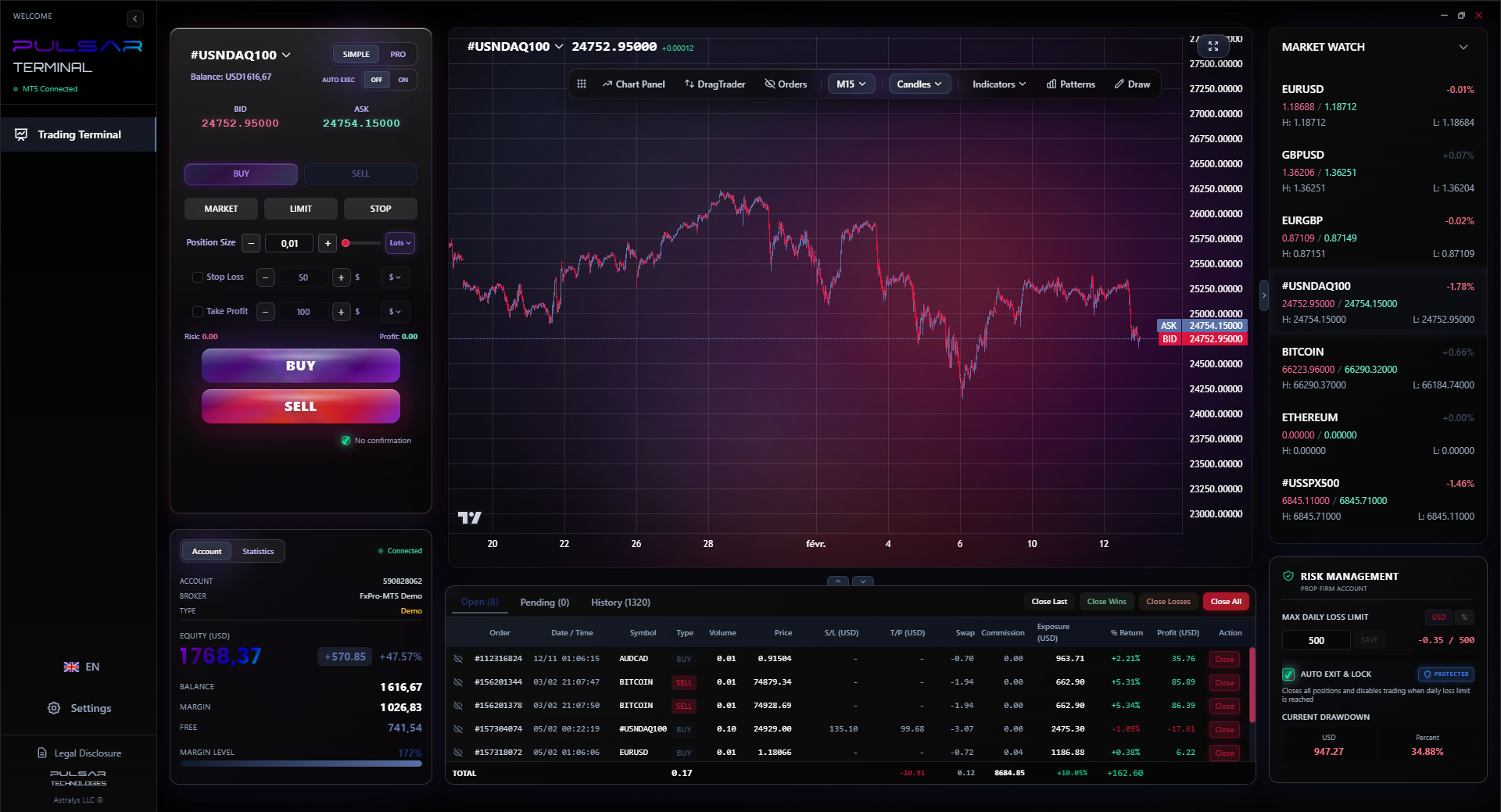
“Using vanilla MT4 for advanced order management is like bringing a knife to a gunfight.”
XM offers use up to 1:888 for professional clients and up to 1:500 for retail clients on certain instruments. For a South African retail trader, the maximum use allowed by the FSCA is 1:100. This is a crucial regulation designed to protect you from yourself.
Let's talk about what 1:100 use really means with our rands. You deposit R10,000. With 1:100 use, you can control a position worth R1,000,000 in the market. Sounds amazing, right? Now for the brutal truth.
If you open a full position (1 standard lot on EUR/USD) with that R10k margin, a move of just 100 pips (1%) against you will wipe out your entire deposit. That's a margin call. A 100-pip move can happen in a few hours on a bad news day. I learned this the hard way early on. I put R5,000 in, used near-max use on a gold trade, and was stopped out in 90 minutes after a $15 swing. Poof. Gone.

Example:
- Capital: R10,000
- use: 1:100
- Tradable Margin: R1,000,000
- Trade: 1 standard lot EUR/USD (€100,000)
- Risk: A 100 pip loss = $1,000 ≈ R18,000 (at R18/$). You've lost R18,000 on a R10,000 account. You now owe the broker R8,000.
XM's system will automatically close your positions before you go negative (thanks to negative balance protection), but your account will be decimated. Use use to control sensible position sizes, not to maximize your bet. I never use more than 1:20 on my main account now, no matter what the platform allows.
XM is famous for its deposit bonuses, often offering 50% on your deposit. This sounds like free money. It is not. It's a risk management tool... for them.
Here's how it works: You deposit R10,000 and get a R5,000 bonus credited to your account. Your total equity shows R15,000. But that bonus money is not withdrawable. It acts as a buffer. To 'release' the bonus and make it yours, you need to trade a certain volume - usually a massive amount, like 1 standard lot for every $1 of bonus.
For that R5,000 ($~278) bonus, you might need to trade 278 standard lots. That's R278,000,000 worth of trading volume. To achieve that, you will likely over-trade, use excessive use, and blow your account long before you ever see that bonus cash.
The bonus also complicates withdrawals. If you try to withdraw before meeting the terms, you forfeit the bonus and any profit attributed to it. Their system calculates this, and it can get messy.
My advice? For your first real-money account, decline the bonus. It clouds your judgement. Track your pure, unsubsidized performance. Once you're consistently profitable, you can consider a bonus on a separate account as a minor perk, but never factor it into your trading plan or risk calculations. Treat it as if it doesn't exist.
“The 50% bonus isn't free money; it's a risk management tool for the broker, designed to make you over-trade.”
South Africans have a few solid choices. Here’s a quick, blunt comparison.
| Feature | XM | Exness | IC Markets |
|---|---|---|---|
| FSCA Regulation | Yes (49857) | Yes (51024) | Yes (ICM Capital Ltd not directly, but global entity used) |
| ZAR Accounts | Yes | Yes | No (USD, EUR, etc. only) |
| Typical EUR/USD Spread | 1.0 - 1.7 pips (Std) | 0.7 - 1.5 pips (Std) | 0.1 - 0.6 pips (Raw) + Commission |
| Max Retail use | 1:100 (FSCA Limit) | 1:100 (FSCA Limit) | 1:100 (FSCA Limit) |
| Platforms | MT4, MT5 | MT4, MT5 | MT4, MT5, cTrader |
| Best For | Beginners, ZAR convenience, Micro lots | Very tight spreads, quick withdrawals | Serious traders, algo trading, lowest costs |
Exness is XM's direct competitor here. They also offer ZAR accounts and FSCA regulation. Their spreads can be slightly tighter, and their local presence is strong. XM often has better educational resources and customer support.
IC Markets is for the trader who has graduated from basics. No ZAR accounts means you deal with forex conversion, but you get institutional-grade execution and the superb cTrader platform. It's a step up in complexity and capability.
XM sits in the middle. It's the reliable, all-rounder choice for a South African who wants everything in one place with minimal friction. It's not always the cheapest or most advanced, but it's rarely the worst at anything.
💡 Consejo de Winston
Your maximum use is 1:100. Your *sensible* use should be no more than 1:20. Use a [position size calculator](/en/calculators) for every single trade.
After years of seeing students use them, and trading with them myself, here's my straight take.
XM is a GOOD choice if:
- You're a South African beginner and want everything in rands.
- You start with a small account (under R10,000) and trade micro lots.
- You value having a local FSCA-regulated entity and straightforward EFTs.
- You rely heavily on MT4 and basic indicators like the RSI indicator or MACD indicator.
Look elsewhere if:
- You're a high-volume swing trading pro where every 0.1 pip matters - go to an ECN broker.
- You need advanced order types and tools natively in your platform without add-ons.
- You trade exotic currency pairs or specific CFDs they don't offer.
- You're easily tempted by bonus offers into reckless trading.
My bottom line: XM provides a legitimate, regulated on-ramp to forex trading for South Africans. It removes the currency and banking headaches. But once you're past the beginner stage, you'll feel the limitations of their cost structure and basic platform. Plan for that. Use them to learn, get your feet wet with real money, but know that as your skills grow, your broker needs might evolve. Don't get loyal to a brand; get loyal to your profitability.

FAQ
Q1Is XM legal and safe for South African traders?
Yes. XM (Trading Point of Financial Instruments Ltd) is registered with the South African Financial Sector Conduct Authority (FSCA) under license number 49857. This means they are legally allowed to operate here and are subject to local financial conduct rules. Client funds are held in segregated bank accounts. It's as safe as any major international broker operating in SA.
Q2What is the minimum deposit for XM in South Africa?
The minimum deposit is very low, around $5 (roughly R90). This is for a micro account. In practice, I'd never recommend starting with less than R2,000. A tiny account forces you to use excessive use to make meaningful gains, which is a surefire way to lose it all quickly.
Q3How long do XM withdrawals to a South African bank take?
In my experience, withdrawal requests are processed by XM within 24 hours on business days. Once processed, the EFT to your South African bank account typically takes another 1-3 business days to clear. So, expect 2-4 business days total from request to funds in your account.
Q4Does XM charge fees for deposits or withdrawals in ZAR?
XM does not charge a fee for EFT deposits or withdrawals in rands. However, you will pay your bank's normal EFT fee for sending money. The main 'cost' is on the currency conversion for profits made in USD back to ZAR, where a small spread is applied.
Q5What use can I get as a South African retail trader with XM?
The maximum use for a retail trader in South Africa is capped at 1:100 by FSCA regulations. This applies to major forex pairs. XM will automatically apply this limit to your account based on your residency. You cannot get 1:500 or 1:888 as a South African retail client.
Q6Can I use my South African ID to verify my XM account?
Yes. For the FSCA-regulated entity, you will verify your account using your valid South African ID book (or smart ID card) and a recent proof of residence (like a utility bill or bank statement not older than 3 months). The process is fully tailored for SA clients.
Lección del Prof. Winston
Puntos clave:
- ✓Verify FSCA license 49857 yourself.
- ✓Factor a 0.5-1% cost on USD/ZAR profit conversions.
- ✓Use ≤1:20 use, not the allowed 1:100.
- ✓Decline bonuses to see your real performance.
- ✓XM is a beginner's on-ramp, not a pro's final stop.
¿Te resultó útil este artículo?
Haz clic en una estrella
Análisis Trading Semanal
Análisis y estrategias semanales gratis. Sin spam.
Sobre el autor
David van der Merwe
Trader de Mercados Emergentes
Trader con sede en Johannesburgo con 11 años en divisas de mercados emergentes. Especialista en pares ZAR, trading regulado por la FSCA y análisis del mercado sudafricano.
Comentarios
Aviso de riesgo
El trading de instrumentos financieros conlleva un riesgo significativo y puede no ser adecuado para todos los inversores. El rendimiento pasado no garantiza resultados futuros. Este contenido tiene fines educativos únicamente y no debe considerarse asesoramiento de inversión. Siempre realice su propia investigación antes de operar.
También te puede interesar

Cara Trading Forex Sukses: 7 Prinsip dari Trader Profesional
Cara trading forex sukses dengan 7 prinsip trader pro: manajemen modal, disiplin, journal trading, backtest. Data nyata, bukan janji profit palsu.
Jam Trading Forex Terbaik untuk Trader Indonesia: Panduan Lengkap dengan Tabel Waktu
Panduan jam trading forex untuk trader Indonesia. Tabel 4 sesi dunia, jam emas 20:00-00:00, sesi mana yang harus dihindari. Data akurat + tips dari trader berpengalaman.
Top 5 Sàn Forex Uy Tín Nhất 2026: Review Jujur dari Trader Indonesia
Top 5 sàn forex uy tín 2026 untuk trader Indonesia. Review jujur: spread, deposit, withdraw, dukungan lokal. Exness, XM, IC Markets & lebih.
Obtener Pulsar Terminal
Todas estas calculadoras están integradas en Pulsar Terminal con datos en tiempo real de su cuenta MT5.
Obtener Pulsar Terminal