
Grid Trading Strategy (2026): Complete Setup & 70% Win Rate
Grid trading places orders every 10–30 pips for profits in ranging markets, with backtests on EURCHF (2018–2023) showing win rates above 70%.

Daniel Harrington
Analista de Trading Senior · Especialista en MT5
☕ 4 min de lectura
Resumen de la estrategia — Grid Trading
| Marcos temporales | M5, M15, H1 |
| Período de retención | Horas a días |
| Riesgo / Beneficio | Variable |
| Dificultad | Avanzado |
| Mejores instrumentos | EURUSD, EURCHF, AUDNZD, USDJPY |
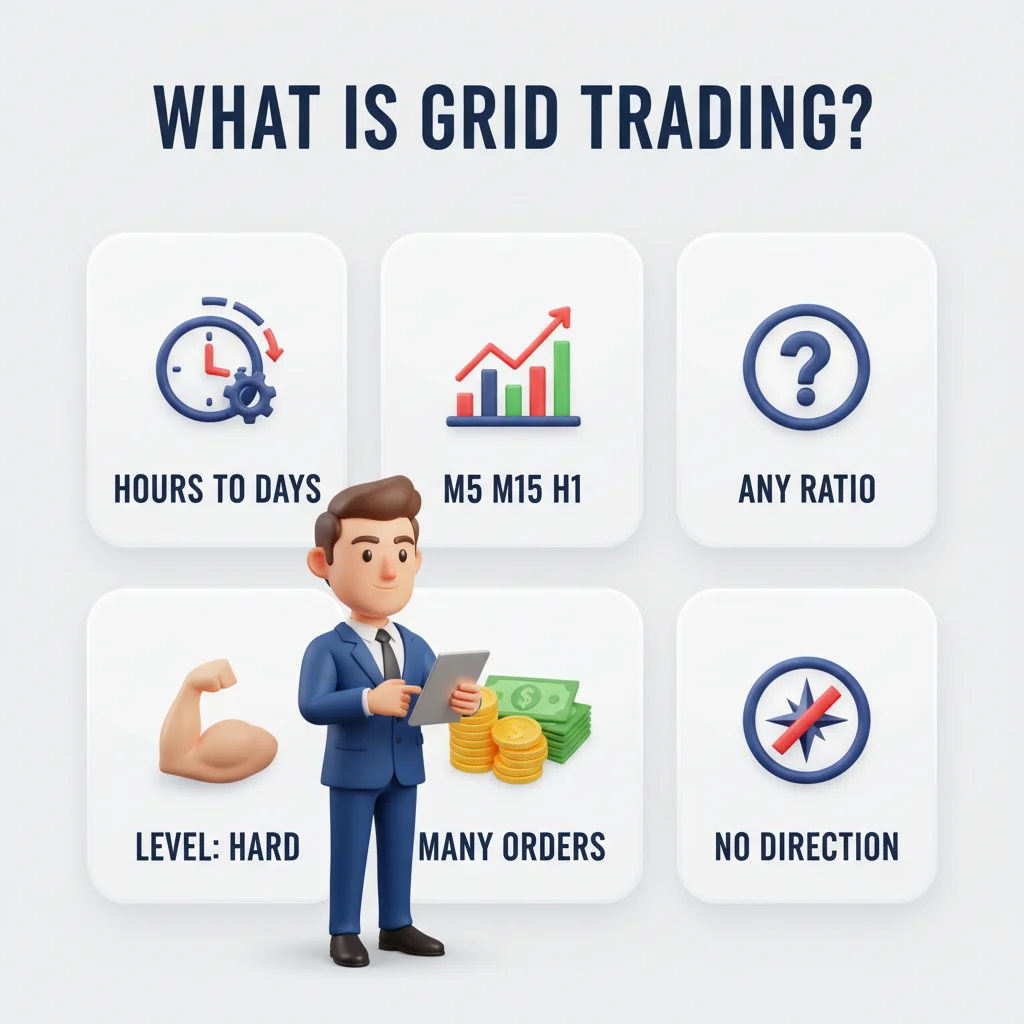
Grid trading in a nutshell: place orders at regular intervals above and below price. Profit from natural market bouncing — no need to predict direction.
Grid trading generates profits from price oscillations by placing orders every 10–30 pips across a defined range — no directional bias required. Backtests on EURCHF from 2018–2023 show win rates above 70% in ranging conditions, but a single trending move without hard stops can wipe 3–5 weeks of gains in hours.
Puntos clave
- Currency pairs like EURCHF and AUDNZD spend roughly 65–70% of trading time in consolidation phases, according to range a...
- Start setup on H1 to identify the range, then drop to M15 or M5 to time your initial activation. Step 1 — Define the gr...
- Here's the uncomfortable truth about grid trading: the strategy has no natural stop loss per trade. That means risk mana...
1Why Grid Trading Works on Low-Volatility Pairs
Currency pairs like EURCHF and AUDNZD spend roughly 65–70% of trading time in consolidation phases, according to range analysis across 2019–2023. That structural behavior is the entire foundation of grid trading — you're not predicting where price goes, you're collecting small profits every time it oscillates through your predefined levels.
The mechanics are simple: place buy limit orders below current price at fixed intervals, and sell limit orders above it. When price drops 20 pips, a buy fires. When it bounces back, that position closes at profit. Rinse, repeat. Each filled order targets a take profit equal to the grid spacing.
The ATR indicator is what separates disciplined grid traders from gamblers. On H1 EURUSD, ATR(14) typically reads between 8 and 18 pips. Grid spacing below the ATR value means price chops through your entire grid in a single candle — you accumulate positions faster than they close. Set spacing at 1.0–1.5x the current ATR reading to give each level room to breathe.
Best instruments by grid suitability: EURCHF (lowest average daily range, tightest oscillations), AUDNZD (strong mean-reversion tendency), EURUSD (high liquidity, low spread — typically 0.1–0.3 pips raw), USDJPY (works well during Tokyo session consolidation). Avoid trending instruments like GBPJPY or commodity currencies during high-volatility macro events.
Cast a wide net, catch profits at every level. Grid trading places orders at regular intervals — like a fishing net that captures moves in both directions.
2Grid Trading Entry and Exit Rules: Exact Parameters
Start setup on H1 to identify the range, then drop to M15 or M5 to time your initial activation.
Step 1 — Define the grid boundary. Use weekly pivot points (PP, R1, R2, S1, S2) combined with visible S/R zones. The grid should fit entirely within S1 and R1 — that's typically 40–100 pips on EURUSD. If the distance between S1 and R1 exceeds 120 pips, the range is too wide for a standard grid; wait for a tighter session.
Step 2 — Calculate grid spacing. Pull ATR(14) on H1. Multiply by 1.2 and round to the nearest 5 pips. Example: ATR reads 12 pips → spacing = 15 pips. For EURCHF with ATR near 6 pips, spacing drops to 8–10 pips.
Step 3 — Set grid levels. Place 3–5 buy limit orders below current price at each spacing interval. Mirror with 3–5 sell limit orders above. Each order carries a TP equal to one grid interval. No individual SL on grid orders — the hard stop is a maximum drawdown limit on the entire grid (see Risk Management section).
Step 4 — Exit conditions. Close the entire grid manually (or via automation) when: price breaks and closes beyond R2 or S2 on H1; a major news event (NFP, central bank decision) is within 4 hours; or total open drawdown hits your max loss threshold. Do not let the grid run through a trend. A clean grid typically completes within 4–48 hours on M15/H1 setups.
Grid trading places orders at fixed intervals. Like a net catching fish at every price level.

Arrows at every intersection. Grid trading does not predict direction — it profits from movement itself, buying and selling at predetermined levels.
“Here's the uncomfortable truth about grid trading: the strategy has no natural stop loss per trade.”
3Grid Trading Risk Management: Position Sizing and Hard Limits
Here's the uncomfortable truth about grid trading: the strategy has no natural stop loss per trade. That means risk management must operate at the portfolio level, not the order level.
Maximum grid exposure rule: Never commit more than 2% of account equity per grid level. On a $10,000 account with 5 grid levels, each order should risk no more than $20 — that's approximately 0.02 lots on EURUSD with 10-pip spacing.
Total grid drawdown cap: Set a hard maximum of 6–8% account drawdown for the entire grid. Once that threshold is hit, close everything. No exceptions. This is the single rule that separates traders who survive grid blowups from those who don't.
Margin buffer: Grid trading consumes margin as more orders fill. Maintain at least 300% free margin relative to required margin when all grid levels are active simultaneously. Calculate worst-case: if all 5 buy orders fire and price drops to S2 before reversing, what's the total floating loss? That number must stay below your 6–8% hard cap.
Correlation risk: Running grids on EURUSD and EURCHF simultaneously is not diversification — both are EUR pairs and will trend together during EUR-specific events. Run only one EUR grid at a time, or hedge with a non-correlated pair like AUDNZD.
Practical example: Account size $5,000. Grid on EURUSD, H1. ATR = 14 pips, spacing = 20 pips. 4 buy limits + 4 sell limits. Position size per order = 0.02 lots. Max drawdown cap = $350 (7%). If all 4 buy orders fill and price drops 80 pips from entry, floating loss ≈ $64 — well within limit. If price drops 200 pips without reversal, loss approaches $160 — still within cap, but the grid should be closed on the S2 break rule before that point.
Características de Pulsar Terminal para Grid Trading
- Sistema de trading en cuadrícula
- Múltiples niveles de SL/TP
- Calculadora de tamaño de posición
- Gestión de riesgos
Mejores brokers
Herramientas de trading
Calcule el tamaño de su posición para Grid Trading
Calculadora de tamaño de posición
Calcula el tamaño de lote óptimo según tu gestión de riesgo
Basado en un lote forex estándar ($10/pip). Ajusta para diferentes instrumentos. Verifica siempre con tu broker.
Calculadora Riesgo/Beneficio
Visualice su ratio riesgo/beneficio antes de abrir una operación.
Basado en el valor estándar del pip forex ($10/pip/lote). Los valores reales pueden variar según el instrumento y el broker.
Calculadora de interés compuesto
Proyecte el crecimiento de su capital con rendimientos compuestos.
Solo proyecciones hipotéticas. Los rendimientos pasados no garantizan resultados futuros. El trading implica riesgo de pérdida.
Sesiones de trading Forex (UTC)
Horarios de apertura y cierre de cada mercado.
Horarios en UTC. Las horas reales pueden variar según el broker y el horario de verano.
Aplicar esta estrategia
Sobre el autor
Daniel Harrington
Analista de Trading Senior
Daniel Harrington es analista de trading senior con un MScF (Máster en Ciencias Financieras) especializado en gestión cuantitativa de activos y riesgos. Con más de 12 años de experiencia en mercados de forex y derivados, cubre la optimización de la plataforma MT5, estrategias de trading algorítmico e información práctica para traders minoristas.

Domina Grid Trading con Pulsar Terminal
Pulsar Terminal le brinda las herramientas avanzadas para ejecutar estrategias Grid Trading en MetaTrader 5 con precisión.
Obtener Pulsar TerminalAviso de riesgo
El trading de instrumentos financieros conlleva un riesgo significativo y puede no ser adecuado para todos los inversores. El rendimiento pasado no garantiza resultados futuros. Este contenido tiene fines educativos únicamente y no debe considerarse asesoramiento de inversión. Siempre realice su propia investigación antes de operar.