
Ask

/æsk/ (rhymes with 'mask')since Centuries-old concept from physical trading floorsAsk — Ask price is the lowest price a seller will accept for an asset - it's what you pay when you want to buy something in the market.
§1So, what IS this 'Ask' thing anyway?
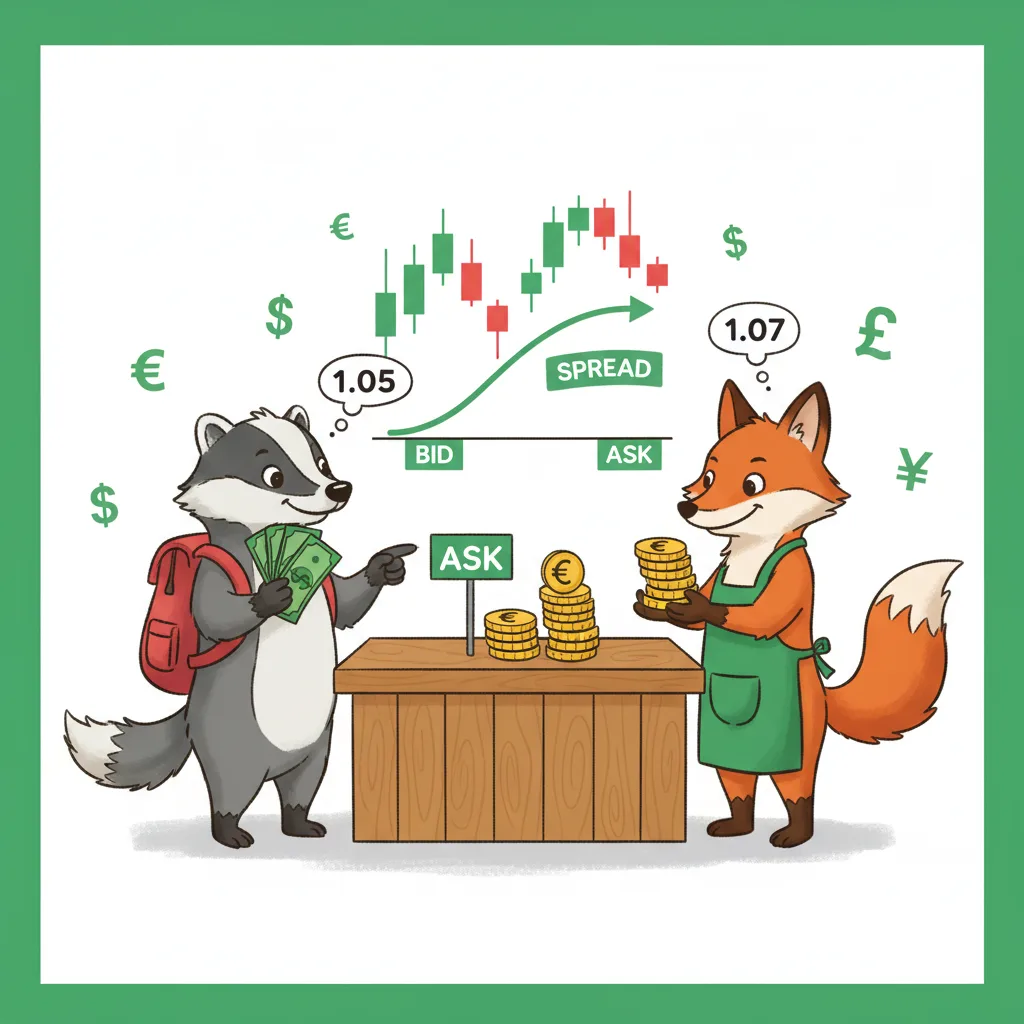
Picture this: you're at a farmer's market, eyeing some gorgeous apples. The farmer says 'I'll sell them for $2 each.' That's the Ask price - the lowest price they're willing to accept. In trading, it's exactly the same concept, just with fancier assets like currencies or stocks. When you want to buy EUR/USD, you're looking at the Ask price - that's what you'll actually pay to get into the trade. Think of it as the 'gatekeeper' to buying anything in financial markets. It's always hanging out with its buddy, the Bid price (what buyers are willing to pay), and the space between them? That's the spread - the market's little service fee. I've seen traders blow accounts by ignoring this simple relationship, so trust me, you want to be friends with both sides of this equation.
§2The math (don't run away - it's simpler than it looks!)
Okay, let's talk numbers without getting that glazed-over look. The Ask price has a simple relationship with its partner-in-crime, the Bid price. The formula is: Spread = Ask Price - Bid Price. See? Not so scary! That spread is like the toll you pay to cross the trading bridge. For major pairs like EUR/USD, this toll is usually 1-3 pips (those tiny price movements). Sometimes it's even tighter - I've seen 0.3 pips on good days! But here's the kicker: when you buy at the Ask and immediately sell at the Bid, you're already down by that spread amount. Your trade needs to move enough to cover that gap before you even start making profit. It's like starting a race three steps behind the starting line.
§3Here's how it plays out in real life
Let's walk through this with a real example. Say EUR/USD is quoted at Bid 1.08010 / Ask 1.08030. If you want to buy euros with dollars (going long EUR/USD), you'll enter at the Ask price: 1.08030. That spread of 0.00020? That's 2 pips - your immediate cost. Now imagine you bought five CFD contracts of Barclays shares at Ask 148.780 while the Bid was 148.740. You're already looking at a spread cost before the market even moves! Here's what most beginners miss: you don't just need the price to go up - you need it to go up enough to cover that spread first. I lost money my first year thinking 'the price moved in my direction, why am I still red?' Yeah, the spread got me every time.
§4The weird exceptions nobody warns you about
Now, just when you think you've got this figured out, the market throws curveballs. First up: JPY pairs. While most currencies play nice with four decimal places, USD/JPY says 'nah, let's do two.' So 109.24/109.26? That second decimal is your pip. Then there's pipettes - those fifth decimal places some brokers use for extra precision. It's like measuring with a ruler that has millimeters instead of just centimeters. And spreads? They're not always well-behaved. Fixed spreads stay put (predictable but often wider), while variable spreads can get wild during news events or when liquidity dries up. I've seen spreads balloon to 30 pips on exotic pairs - talk about an expensive toll bridge!

§5Three examples that'll make it click
Let's look at some real scenarios. First, with EUR/USD at Bid 1.08010 / Ask 1.08030, buying at market means paying 1.08030. That 2-pip spread is your starting handicap. Second, during the London/New York overlap, you might see spreads tighten to 0.3 pips - that's when liquidity is flowing like coffee at a trading desk. Third, imagine a high-impact news event hits and EUR/USD spreads jump to 7 pips. Buying then? You'd need the market to move 7 pips just to break even on the spread alone.
| Scenario | Pair | Ask Price | Spread | Immediate Cost |
|---|---|---|---|---|
| Normal trading | EUR/USD | 1.08030 | 2 pips | $20 per standard lot |
| Peak liquidity | EUR/USD | 1.10001 | 0.3 pips | $3 per standard lot |
| News volatility | EUR/USD | 1.08500 | 7 pips | $70 per standard lot |
See how that spread cost adds up? It's not just numbers - it's real money leaving your account before the trade even gets going.
§6Where this thing even came from
The Ask price isn't some newfangled internet invention - it's been around since traders shouted at each other on physical floors. Picture 18th century coffee houses with guys waving papers and yelling prices. The 'asking' price was literally what sellers would ask for their goods. Fast forward to electronic trading, and the concept stayed the same, just got way faster. Market makers now play the role of those old floor traders, continuously quoting Ask prices and profiting from the spread. The cool part? Technology has generally made spreads tighter - competition between liquidity providers means better deals for us traders. Though I sometimes miss the drama of the trading pits, I don't miss the wider spreads!
§7Key takeaways
- The Ask price is what you pay when buying - it's the seller's minimum acceptable price, and it's always higher than the Bid.
- Spreads of 1-3 pips are normal for majors, but they can balloon to 30+ pips on exotics or during news events.
- You start every trade 'in the hole' by the spread amount - your first job is to recover that cost.
- JPY pairs use two decimal places for pips instead of four - it's their quirky way of keeping things interesting.
§8Frequently asked questions
QWhat exactly is the Ask price when I'm trading?
QWhy is the Ask always higher than the Bid?
QWhen do I actually pay the Ask price?
QHow does the Ask price affect my trading costs?
QWhat's the difference between Ask price and 'current price'?
§See also
§References
- The Trading Mentor's Research Briefing: Ask Price — The Trading Mentor
- Historical Market Structure Evolution — Financial Markets Historical Society