


I blew a $10,000 simulated account in 48 hours.

Sarah Collins
Stratégiste Trading ·  Australia
☕ 11 min de lecture
Ce que vous apprendrez :
- 1What Exactly Is a 1-Step Prop Firm Challenge?
- 2The Australian Rules & The Regulatory Grey Zone
- 3The Real Costs: It's Never Just the Challenge Fee
- 4The Rules That Will Break You (If You Let Them)
- 5A Realistic Strategy to Actually Pass
- 6Choosing a Firm: Red Flags and Green Lights
- 7Life After Passing: The Funded Reality
I blew a $10,000 simulated account in 48 hours. It was a 1-step challenge from a flashy new prop firm, and I treated it like my regular trading. Big mistake. I got cocky, ignored the daily loss limit of $500, and let a single EUR/USD trade run against me for 150 pips. Poof. There went my $289 evaluation fee and any shot at funded capital. That humbling experience taught me more about these challenges than any sales page ever could. Let's cut through the hype and look at what a 1-step prop firm challenge in Australia really involves, how to not lose your shirt, and if it's even worth your time.
Forget the old two-phase gauntlet. A 1-step challenge is exactly what it sounds like: one evaluation phase to prove you can trade. You pay a fee, get a demo account with specific rules, and if you hit the profit target without breaking those rules, you 'graduate' to a funded account. It's simpler, which is its main selling point.
The key difference? Psychology. In a two-step challenge, you often have a profit target, then a 'verification' phase with another target. The mental hurdle of having to do it twice is gone. But don't be fooled, the pressure is just concentrated into one stage. The rules are usually tighter, and the margin for error is often smaller. You're trading the firm's capital in simulation, and if you pass, they give you a live account with real money. Your cut is typically 80% to 90% of the profits. It's a contractor relationship, not a job. You're not their employee; you're a revenue-sharing partner who passed their test.

Warning: Just because it's '1-step' doesn't mean it's easy. The profit target might be 8-10% in one phase, whereas a two-step might be 8% followed by 5%. The total required gain can be very similar. Always read the fine print on the target.
“A 1-step challenge tests discipline, not genius. Your goal isn't to get rich in the evaluation; it's to pass.”
Here's the crucial bit most Aussie traders miss: most of these firms aren't ASIC-regulated. They don't need to be. They're not holding your money as a deposit for trading; you're paying for an evaluation service. They use their own capital for the funded accounts. This puts them in a legal grey area that ASIC is only just starting to poke at.
The Legal Structure
A prop firm operating here legally structures itself as a company that hires you as a contractor after you pass a skills test (the challenge). Your fee is for the test, not for managed funds. This is how they skirt needing an Australian Financial Services License (AFSL). It's clever, and for now, it's legal. But it means you have zero regulatory protection if the firm decides to fold up shop or refuses a payout. You're relying entirely on their terms and conditions and their reputation.
What ASIC Is Doing
ASIC has said they're 'monitoring' the sector. Translation: they're watching, and if they see a flood of consumer complaints about unfair rules or non-payment, they'll step in. For you, this means due diligence is non-negotatory. Don't just go for the cheapest challenge fee. Research the firm's payout history. Are there verifiable testimonials from funded traders? Where are they based? An Australian-based office is a slightly better sign than a purely offshore entity, but it's no guarantee.
The 2021 use caps (1:30 for major forex) imposed on retail brokers like IC Markets or Pepperstone don't apply to prop firms. They can and do offer up to 1:100. This is a double-edged sword: more power, but more rope to hang yourself with. A bad margin call happens twice as fast.

💡 Conseil de Winston
Treat the challenge fee as tuition, not an investment. If you learn about your discipline, even failing is valuable.
“The daily loss limit is the king of all rules. Ignore it, and your challenge ends in minutes, not days.”
Let's talk numbers. That $89 challenge for a $5,000 account looks sweet, right? That's the hook. The real cost is layered. Here’s a breakdown from a challenge I took with a mid-tier firm last year:
| Item | Cost (AUD approx.) | Note |
|---|---|---|
| Challenge Fee | $249 | For a $25,000 account target. |
| Reset Fee | $79 | I didn't need it, but it's there if you blow the account. |
| Live Account Activation | $149 | A one-time fee after passing. A nasty surprise if you didn't read the FAQ. |
| Data Fees (if trading futures) | ~$130/month | Per exchange. This can bite funded traders. |
| Trading Commissions | $3.50 per lot | Their broker's rate. Can eat into scalping profits. |
My mistake: I only looked at the challenge fee. I passed, got my funded account, and then got hit with the activation fee. It came out of my first payout, but it still stung. Then I started trading NAS100, and the data feed fee for CME Globex kicked in. My first month's profit was gutted.
Industry stats are brutal. Only about 14% of traders pass a challenge. Only about half of those ever see a payout. The average payout is roughly 4% of the account size. So, on a $100,000 account, the average payout is $4,000. If your challenge fee was $500, that's an 8x return if you hit the average... but you have to be in that tiny minority first.

Example: You pass a $50,000 challenge. Your profit target was 10% ($5,000). You make exactly that. Your 80% split is $4,000. Minus any activation or platform fees. Your challenge fee was $300. Your net is $3,700. Not bad for a month's work, but remember the 86% who paid $300 and got nothing.
“The daily loss limit is the king of all rules. Ignore it, and your challenge ends in minutes, not days.”
This is where games are lost. You might be a profitable trader in your personal account, but prop firm rules are a different beast. They're designed to filter for consistency and risk management, not just raw profit.
The Daily Loss Limit: This is the king. It's usually around 5% of the account's starting balance. On a $10,000 account, that's $500. Hit that, and your challenge is failed. Immediately. No warning. This is what killed my first attempt. In my own account, I'd sometimes have a $1,000 drawdown day on a $10k account and claw back. Here, that's instant failure. You must use a position size calculator religiously. Every single trade.
The Maximum Overall Loss: This is your drawdown limit, often trailing. Say it's 10% total loss from the starting balance, or 10% from the peak equity. If your account hits $9,000 on a $10k start, you're out. This rule forces you to protect profits. You can't just hit your 10% profit target and then gamble it all back.
The Time Limit: Some have them (30 days), some don't. The ones without time limits are psychologically easier, but don't let that make you complacent.
The 'No News Trading' Trap: Some firms restrict trading around major news events. This is a minefield if you're a scalping strategy fan. You must know their exact calendar and rules.
The secret? Trade smaller than you ever have. Your goal isn't to get rich in the challenge; it's to pass. Grind it out. A 0.5% gain per day is a 10% gain in 20 trading days. Boring? Yes. Effective? Absolutely.

Pro Tip: Your first trade after passing should be to set a hard stop at your daily loss limit for the entire account. Some platforms let you set equity stops. If not, you have to mentally track it. Tools that automate this, like setting a global equity stop, are worth their weight in gold for peace of mind.
💡 Conseil de Winston
Your first goal in a challenge is to survive the week. Your second is to make 1%. Aggression comes later, if at all.
“Only about 14% of traders pass a challenge. The average payout is roughly 4% of the account size. Manage your expectations.”
Forget fancy indicators. Passing a 1-step challenge is about discipline, not genius. Here's the blueprint I used to finally pass one and get funded.
Phase 1: The Setup (Week 1) Don't trade. Seriously. Study the rules until you dream about them. Set up your charts with only volume and maybe one trend indicator like the MACD indicator. I used a simple 20-period EMA. Plan your instrument. I stuck with two: EUR/USD and XAU/USD. You don't need ten. You need two you know intimately.
Phase 2: The Grind (Weeks 2-3) This is the execution. My rule was 1% maximum risk per trade, aiming for a 1:1.5 risk/reward. I used the RSI indicator to avoid overbought/oversold entries. Every morning, I'd calculate my daily loss limit ($500 on a $10k account). My position size was so small that I'd need to lose 5 trades in a row to hit it. That never happened.
A real trade from my successful challenge: Account: $10,000 Challenge. Daily Loss Limit: $500. My risk per trade: $100 (1%). EUR/USD buy at 1.0850. Stop Loss at 1.0830 (20 pips). That means my position size was 0.5 lots (because a 20-pip move on 0.5 lots is about $100). Take Profit at 1.0880 (30 pips). Risk: $100. Target Reward: $150. I took two trades like that per day, max. If I won one and lost one, I was up $50 net. Boring. Incremental. But after 15 trading days, I was at 7.5% profit. I then reduced my risk to 0.5% per trade until I gently nudged over the 10% finish line.
The key was using a trading journal to track my daily P&L against the limit. I never got close to the daily loss. The mental pressure vanished once I had a system.
This grind isn't glamorous swing trading. It's mechanical. But it's what the firms are testing for: can you follow a plan and manage risk when real (simulated) money is on the line?
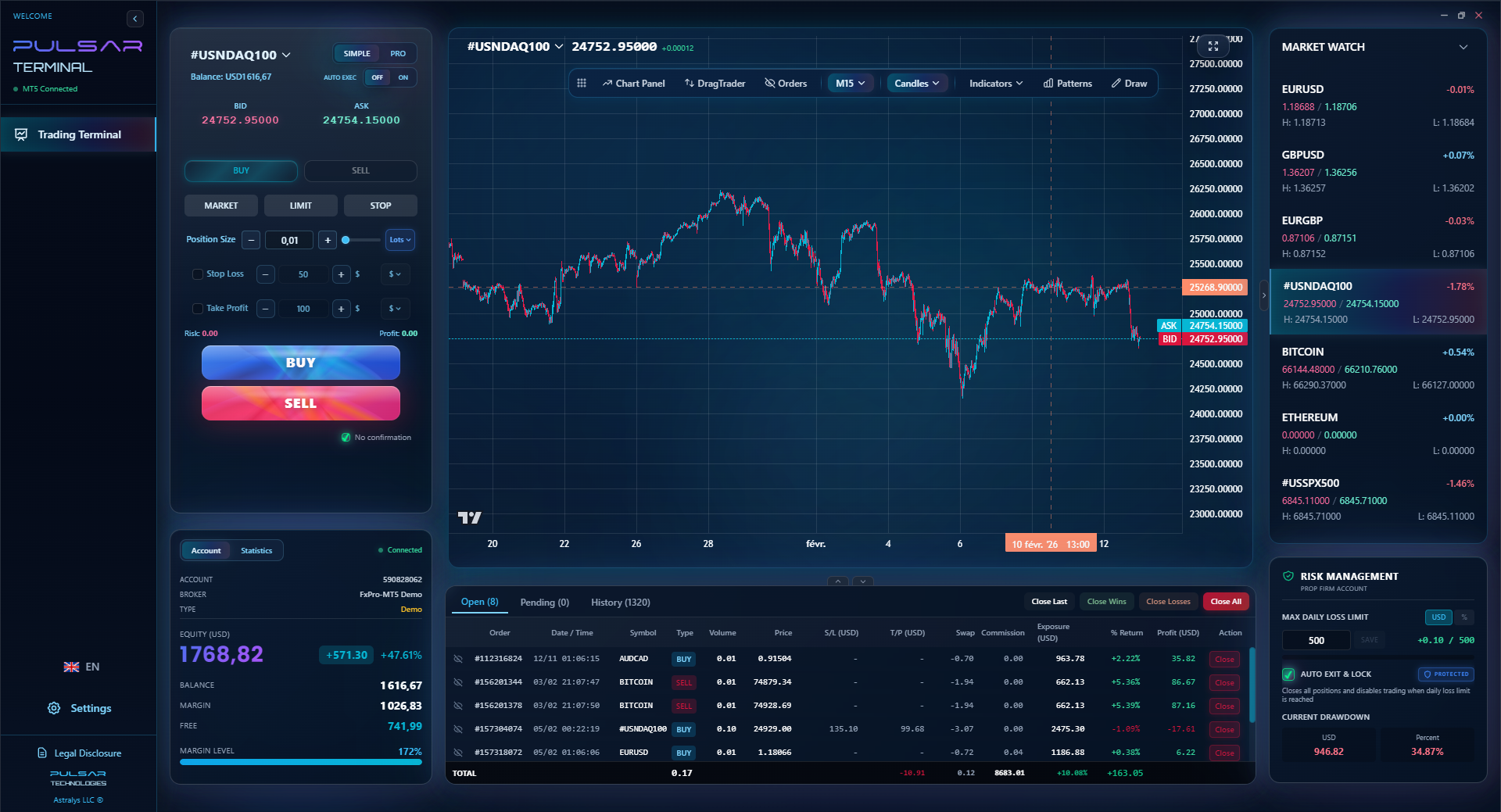
Managing a prop firm challenge's strict daily loss limit is a constant mental burden, but tools like Pulsar Terminal can automate equity-based stop-outs directly on your MT5 chart, acting as your digital risk manager.
Pulsar Terminal
L'outil MT5 tout-en-un : ordres glisser-déposer, multi-TP/SL, trailing stop, grid trading, Volume Profile et protection prop firm. Utilisé quotidiennement par 1 000+ traders.
“Only about 14% of traders pass a challenge. The average payout is roughly 4% of the account size. Manage your expectations.”
With dozens of firms marketing to Aussies, how do you pick one without getting scammed?
Green Lights (Good Signs):
- Clear, accessible rules: No jargon, easy-to-find FAQ.
- Realistic profit targets: 8-12% for a 1-step is standard. 20% is a red flag.
- Transparent payout proof: They show real payment slips (with personal details blurred) to funded traders.
- Multiple payout methods including Wise, Crypto, and direct AUD bank transfer.
- A reasonable reset fee (around the cost of the challenge, not double).
- Good platform support: MT5 or a solid alternative like TradeLocker. Check our XM review and Exness review to see how real brokers compare on platform stability.
Red Flags (Run Away):
- 'Guaranteed' passing or profits. This is trading. Nothing is guaranteed.
- Overly complex, hidden rules. If you need a law degree to understand the drawdown calculation, avoid it.
- No verifiable contact info. A PO Box in a tax haven isn't good enough.
- Extremely high use offers (like 1:500) as a main selling point. They're encouraging you to blow up.
- Bad reviews about payout delays or rejected withdrawals. Search the firm's name + 'payout problem' on forums.
My personal litmus test? I email their support with a technical question about their drawdown rule before I pay a cent. If they don't reply within 48 hours, or give a copy-paste non-answer, I walk. Their support post-payout is critical.
💡 Conseil de Winston
When funded, withdraw your first profit share immediately. It makes the money real and breaks the emotional attachment to the screen number.
“Trade smaller than you ever have. A 0.5% gain per day is a 10% gain in 20 trading days. Boring is effective.”
Congratulations, you passed. Now the real work begins, and it's different. The psychology shifts from 'I must not lose' to 'I must make money.'
First, you'll likely have scaling plans. Make consistent profits for three months, and they might increase your capital. This is the golden ticket. Second, you now have to cover costs. Those data fees and commissions are real. Your trading edge needs to be wide enough to absorb them.
You also have to manage payouts. Most firms do bi-weekly or monthly. You request a withdrawal, they process it. Don't get emotionally attached to the number in your funded account. It's not yours until it's in your bank account. Withdraw your profit share regularly. It reinforces the reality of the income and protects you from a freak drawdown wiping out 'your' money.
The biggest adjustment? You're no longer trading to hit a single target. You're trading for a career. This requires a shift to longer-term thinking. Maybe your scalping strategy needs to blend with some swing trading holds to capture bigger trends. The rules are usually more relaxed on the funded side, but the pressure to perform is now monetary, not just procedural.
Remember the stats: fewer than 15% of funded traders are consistently profitable over a year. The challenge just gets you in the door. Staying in is a whole other game.
FAQ
Q1Are 1-step prop firm challenges legal in Australia?
Yes, the way they are structured is legal. Most firms operate as evaluation service providers, not financial advisers, so they don't need an ASIC license. However, they exist in a regulatory grey area and ASIC is monitoring them. You have less consumer protection than with an ASIC-regulated broker.
Q2What's the catch with the 'pay-after-you-pass' model?
The catch is usually a higher total fee. You might pay a small setup fee (e.g., $19), but the balance due after passing could be $300, making the total cost $319 - more than a standard upfront challenge fee of $250. It's great for reducing upfront risk, but always calculate the total cost.
Q3How is the profit split calculated, and when do I get paid?
You're typically paid a percentage (80-90%) of the net profit you generate in a billing period (e.g., two weeks). If you make $1,000 and have an 80% split, you get $800. The firm takes its $200. Payouts are usually processed after you request them, with processing times of 1-7 business days.
Q4Can I trade during high-impact news events?
It depends entirely on the firm's rules. Some explicitly forbid it, some allow it, and some restrict it to certain instruments. This rule is a major account killer if ignored. You must check your specific challenge agreement before trading any news.
Q5What happens if I hit the profit target but also breach a rule?
You fail. Instantly. The rules are absolute. Hitting the profit target is meaningless if you violated the daily loss limit, maximum drawdown, or a news trading rule along the way. The system is automated to flag breaches.
Q6Is the 1-step challenge easier than the 2-step?
Not necessarily. It's psychologically simpler because there's only one phase. However, the single profit target is often similar to the combined target of a two-step challenge (e.g., 10% vs. 8%+5%). The main advantage is not having the mental reset between phases.
Q7What's the best trading style for a prop firm challenge?
Consistency is key. A style with clear risk management and a positive expectancy works best. This often means swing trading or day trading with strict stop-losses and modest daily targets. High-frequency scalping can be risky due to commission costs and the potential to quickly hit daily loss limits.
La leçon du Prof. Winston
Points clés:
- ✓The challenge fee is just the first cost; factor in reset, activation, and data fees.
- ✓Your maximum risk per trade should be 1% or less of the account balance.
- ✓The daily loss limit is an absolute, non-negotiable circuit breaker.
- ✓Choose a firm with transparent payout history, not just the cheapest fee.
- ✓Passing the challenge is only the beginning; staying funded is harder.
Cet article vous a-t-il été utile ?
Cliquez sur une étoile
Analyses Trading Hebdo
Analyses et stratégies hebdo gratuites. Pas de spam.
À propos de l'auteur
Sarah Collins
Stratégiste Trading
Stratégiste de trading basée à Londres avec 12 ans d'expérience sur les marchés financiers. Ancienne analyste dans un courtier de la City. Couvre les paires GBP, les marchés européens et le trading sous régulation FCA.
Commentaires
Avertissement sur les risques
Le trading d'instruments financiers comporte des risques importants et peut ne pas convenir à tous les investisseurs. Les performances passées ne garantissent pas les résultats futurs. Ce contenu est fourni à titre éducatif uniquement et ne constitue pas un conseil en investissement. Effectuez toujours vos propres recherches avant de trader.
Vous aimerez aussi

Cara Trading Forex Sukses: 7 Prinsip dari Trader Profesional
Cara trading forex sukses dengan 7 prinsip trader pro: manajemen modal, disiplin, journal trading, backtest. Data nyata, bukan janji profit palsu.
Jam Trading Forex Terbaik untuk Trader Indonesia: Panduan Lengkap dengan Tabel Waktu
Panduan jam trading forex untuk trader Indonesia. Tabel 4 sesi dunia, jam emas 20:00-00:00, sesi mana yang harus dihindari. Data akurat + tips dari trader berpengalaman.
Top 5 Sàn Forex Uy Tín Nhất 2026: Review Jujur dari Trader Indonesia
Top 5 sàn forex uy tín 2026 untuk trader Indonesia. Review jujur: spread, deposit, withdraw, dukungan lokal. Exness, XM, IC Markets & lebih.
Obtenir Pulsar Terminal
Tous ces calculateurs sont intégrés dans Pulsar Terminal avec des données en temps réel de votre compte MT5. Dimensionnement de position en un clic, gestion automatique des risques et calculs instantanés.
Obtenir Pulsar Terminal