


You've seen the ads, haven't you? 'Make 50 pips a day, easy money!' It's plastered all over social media, promising a fast track to financial freedom from your flat in Lagos or Abuja.

Olumide Adeyemi
Pionnier du Trading en Afrique de l'Ouest ·  Nigeria
☕ 11 min de lecture
Ce que vous apprendrez :

You've seen the ads, haven't you? 'Make 50 pips a day, easy money!' It's plastered all over social media, promising a fast track to financial freedom from your flat in Lagos or Abuja. But is grabbing 50 pips daily actually a sustainable strategy, or is it just a clever way to blow up your account? I've traded through bull markets, crashes, and everything in between for over a decade. Let's cut through the hype and look at what this strategy really demands, the brutal math behind it, and whether it's a path to profit or a one-way ticket to a margin call.
First, let's get our terms straight. A pip is the smallest price move a currency pair can make. For most pairs like EUR/USD, it's 0.0001. So, 50 pips is a 0.0050 move. Sounds small, right? That's the trap.
Here's the reality: consistently capturing 50 pips every single trading day is a monstrous task. Let's do the annual math. There are roughly 252 trading days a year. 50 pips a day equals 12,600 pips per year. To put that in perspective, EUR/USD's entire yearly range in 2023 was about 1,500 pips. You're aiming for nearly ten times the pair's annual movement. Every. Single. Year.

Example: If you trade a standard lot (100,000 units), 50 pips equals $500. Aiming for that daily means targeting $126,000 per year on a single lot. The market simply doesn't offer that kind of linear, low-volatility movement. The promise assumes the market is a consistent ATM, which it absolutely is not.
The strategy often gets marketed to new traders because it sounds simple and achievable. 'Just one good trade a day!' But this mindset ignores market structure. Markets trend, they range, they consolidate for weeks. Some days, you'll struggle to find a 20-pip range, let alone catch a clean 50-pip move. This pressure to 'hit the daily target' is what leads to overtrading, revenge trading, and ignoring your rules. I learned this the hard way early on, forcing trades during dead London sessions just to feel like I was doing something. All I did was donate my spread to the broker.

💡 Conseil de Winston
A daily profit target is like a fisherman demanding a 10kg catch every single day, regardless of the weather. Some days the sea is calm, and you catch nothing. The great fishermen know when to stay in port.
“Consistently capturing 50 pips every single trading day is a monstrous task.”
Proponents of a 50 pips a day forex strategy usually point to a few specific setups. Understanding them is key, but understanding their failure rate is what will save your account.
The London Breakout Trap
This is the classic: wait for the London open (8 AM GMT), identify the initial range, and trade the breakout. The theory is that volatility injects 30-50 pips of movement. Sometimes it works. Often, it's a fakeout. I've been whipped in and out of EUR/USD more times than I can count with this method. The spread widens at the open, you get filled at a terrible price, and the move reverses before you hit your target. You're left with a loss before most people in Nigeria have even finished their morning tea.
News Scalping
Targeting high-impact news like US Non-Farm Payrolls or ECB statements. The idea is to catch the explosive, directional move. The problem? Slippage. During major news, your market order might get filled 20, 30, or even 50 pips away from your intended price. Your stop-loss becomes meaningless, and your 50-pip target can evaporate in a second of chaos. I once tried to scalp a Fed announcement on GBP/USD. My 25-pip stop was hit, but my fill was 42 pips away. I lost nearly 70 pips on a trade where I only risked 25. That's the hidden cost of news trading.
End-of-Day Momentum
Trying to catch the tail end of a New York session move. This often means you're late to the party. The smart money is already taking profits, and you're becoming the liquidity. These strategies rely on perfect, frictionless execution and predictable market behavior - two things that don't exist. They don't account for the broker's edge (the spread), platform latency, or your own psychological delay. A true scalping strategy requires razor-thin spreads and rock-solid execution, which is why I always check reviews for brokers like IC Markets or Pepperstone for their raw spread accounts before even considering it.
“Your 'profit' from your 50 pips can easily be wiped out by two expensive withdrawals.”
This is where the 50 pips a day dream dies. To make the math work, traders are tempted to use insane use or position sizes. Let's say you have a N500,000 account. A sane risk might be 1% per trade, or N5,000.

Warning: To make N50,000 (a rough equivalent of 50 pips on a decent position) in a day risking only N5,000, you'd need a 10:1 reward-to-risk ratio. That's fantasy-land. No consistent strategy has a 10R win rate.
So, what happens? Traders increase their risk to 5%, 10%, or more per trade. They use a 50-pip stop, aim for a 50-pip target (a 1:1 ratio), and just need to be right more than half the time. Seems fair? Here's the catch: with a 1:1 ratio, you need a 55% win rate just to break even after accounting for spreads and commissions. To actually grow an account, you need 60% or higher. Maintaining that over hundreds of trades is what separates pros from punters.
Most retail traders using this strategy have a win rate below 50%. Combine that with over-leveraged positions, and a string of 3-4 losses can wipe out 30-40% of your capital. You're not trading anymore; you're gambling with your rent money. Always, always use a position size calculator. If it tells you your position is too large for your account, listen to it. I didn't once, and a single failed trade on XAU/USD cost me 22% of my account. It took me three months of disciplined trading to claw that back.
“Your 'profit' from your 50 pips can easily be wiped out by two expensive withdrawals.”
Forget the daily pip target. It's a toxic metric. Instead, focus on monthly or quarterly percentage returns. A 5-10% return per quarter is phenomenal and sustainable. Here's a more realistic framework:
- Trade Less, Quality Over Quantity: Instead of forcing a trade every day, wait for your A+ setup. This might mean 2-3 trades a week. I made more money in one month taking 8 high-conviction swing trading setups than I did in three months of trying to scalp 50 pips daily.
- Aim for Better Risk/Reward: Forget 1:1. Develop strategies that identify trades with a potential 3:1 or 4:1 reward-to-risk. This means your stop is tight (20-30 pips) and your target is wide (60-120 pips). You can be wrong half the time and still be profitable.
- Use Confluence, Not Just Indicators: Don't just trade because the RSI indicator is oversold. Wait for price to be at a key support level, on a higher timeframe trend line, and then see your RSI signal. Confluence increases your probability.
- Track Your Metrics: Know your actual win rate, average win, and average loss. If your average win is 35 pips and your average loss is 25 pips, then a 50-pip daily target forces you to hold winners longer than your strategy dictates, which usually turns winners into break-evens.

Pro Tip: Set a weekly loss limit, not a profit target. For example, if your account is N1,000,000, set a weekly loss limit of N30,000 (3%). If you hit it, you stop trading for the week. This protects you from yourself during drawdowns. Profit will come if your edge is valid.
💡 Conseil de Winston
If your strategy requires you to be right more than 60% of the time to be profitable, you're not trading. You're guessing with a slight bias. Build a system that profits even when you're wrong half the time.

“True consistency comes from following a process, not chasing a number.”
Your strategy is only as good as your broker's execution. In Nigeria, you face unique challenges: potential banking delays, currency conversion fees (NGN to USD), and choosing a reputable international broker.
Spreads are the silent killer of a pip-target strategy. If you're aiming for 50 pips, but the spread on your EUR/USD trade is 2 pips on entry and exit, you've already lost 4 pips. That's 8% of your target gone before the market even moves. During volatile periods or with certain brokers, spreads can widen to 10 pips or more. Your 50-pip target effectively becomes a 40-pip target, destroying your risk/reward math.
use is a double-edged sword. While brokers like Exness or XM may offer high use (1:1000+), using it to chase small pip targets is suicidal. A 5-pip move against you with over-leveraged capital can trigger a margin call. I advise Nigerian traders to treat use as margin for error, not a profit multiplier. Never use more than 1:10 or 1:20 for a strategy like this.
Deposits and Withdrawals: Factor in the cost and time. If you're trading a N500,000 account, a N5,000 bank charge or a poor USD/NGN conversion rate eats into your profits. Choose brokers with reliable local payment channels. The 'profit' from your 50 pips can easily be wiped out by two expensive withdrawals.
“True consistency comes from following a process, not chasing a number.”
This is the core of why you'll fail with a rigid 50 pips a day forex strategy. Trading psychology becomes distorted.
The 'Must Make It Back' Mentality: You end the day down 20 pips. Tomorrow, you now need 70 pips to hit your 'weekly average.' This pressure leads to taking terrible trades you'd normally avoid. You widen your stop, you ignore clear reversal signals, you trade against the trend. I've sat at my screen at 11 PM, exhausted, taking a junk trade on the Tokyo session just to try and get green for the day. It never worked.
Ignoring Market Context: The market might be in a tight 20-pip range for three days. A disciplined trader sits on their hands. A trader enslaved to a daily target will try to manufacture movement, resulting in losses.
Destroying Your Edge: Your strategy has specific entry conditions. When you need to trade, you start accepting 'B-' or 'C-' grade setups. You erode the statistical edge your strategy was built on. Over a month, you might take 50 trades instead of 15 high-quality ones, paying more in spreads and commissions, with a lower win rate. You worked harder to lose money.
True consistency comes from following a process, not chasing a number. Your job is to execute your plan flawlessly. The profits are a byproduct, not a daily quota. Some days you'll make 120 pips. Many days you'll make zero. That's okay. The goal is to finish the month, and the quarter, in positive territory.
💡 Conseil de Winston
The most expensive three words in trading: 'I'll just recover...' They precede the doubling down, the ignored stop-loss, and the margin call.
“This pressure leads to taking terrible trades you'd normally avoid.”
If you want to focus on capturing pips, build a system that respects the market. Don't chase 50 pips daily; build a method that can sometimes capture 50+ pips when the opportunity arises.
1. Multi-Timeframe Analysis: Use the 4-hour or daily chart to identify the overall trend (your bias). Use the 1-hour chart to find key support/resistance levels. Use the 15-minute or 5-minute chart for precise entry. Only take trades in the direction of the higher timeframe trend. This filters out at least 50% of the noise.
2. The 'First Retracement' Entry: After a strong momentum move in your direction (on the 1-hour), wait for the first pullback to a key level (like a 50% Fibonacci or a previous resistance-turned-support). Use a MACD indicator histogram turning back up or a simple price action pin bar to enter. Your stop goes below the pullback low. This can often give you a 2:1 or 3:1 setup for a 40-80 pip move.
3. Partial Profit Taking: This is crucial. Don't hold for one giant 50-pip target. Scale out. Take 50% of your position off at 25 pips (1:1 R:R). Move your stop to breakeven on the remainder. Let the rest run to 60+ pips. This way, you bank some profit, remove risk, and give the trade room to become a big winner. This single change improved my profitability more than any indicator.
4. Define Your 'No-Trade' Zones: Mark on your calendar: major news events, bank holidays, and the first Friday of the month (US jobs report). Do not trade during these times if you're aiming for precise pip captures. The slippage and spread widening will destroy your plan.
This system won't give you 50 pips every day. But it might give you 150 pips over three trades in a good week, and 20 pips in a slow week. Over a month, the results will be more stable and far less stressful than the daily grind. It turns you from a gambler chasing a number into a patient hunter waiting for the right shot.

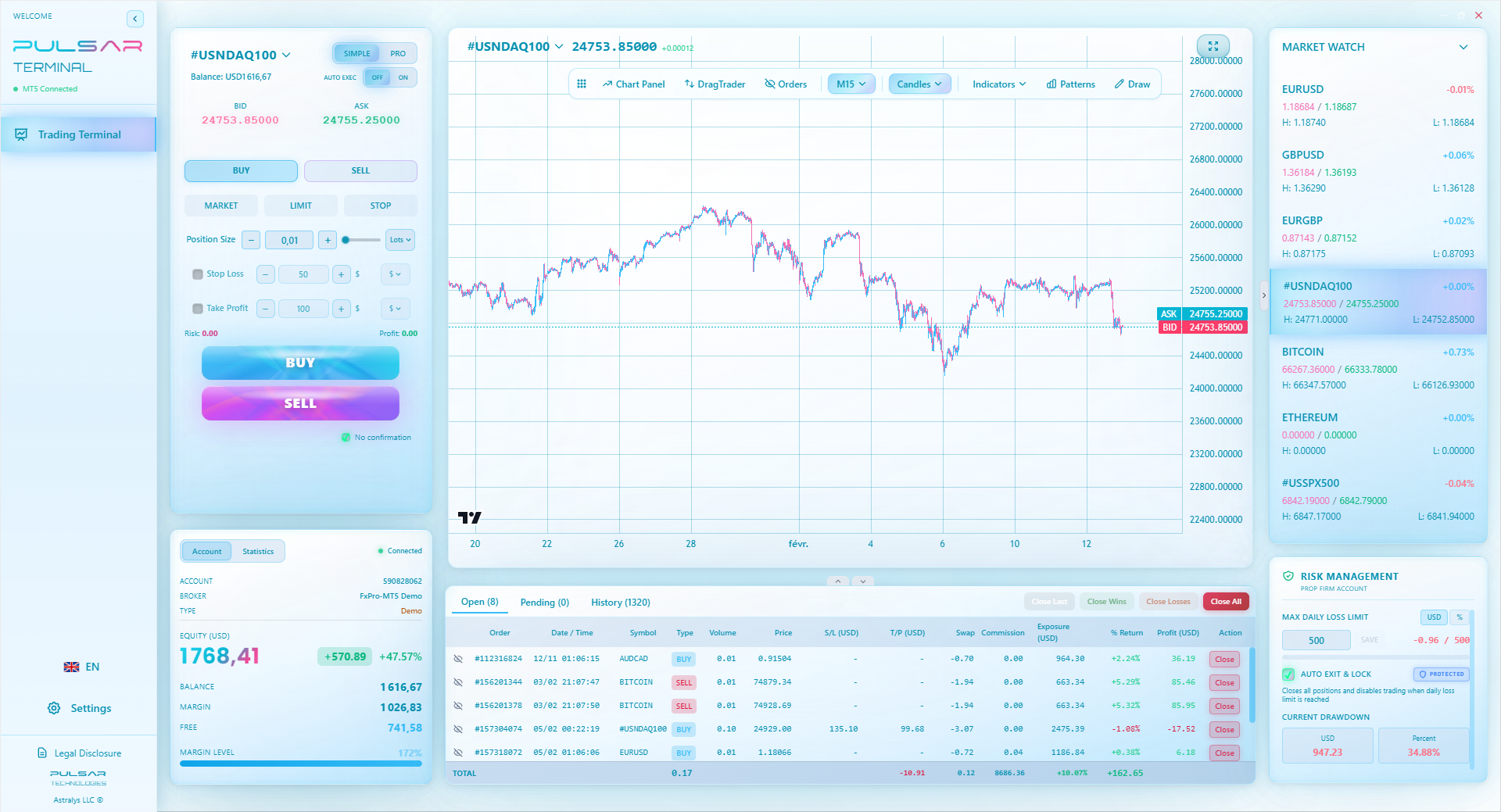
Managing a realistic strategy with partial closures and breakeven stops is manual and stressful, but tools like Pulsar Terminal automate these actions directly on your MT5 chart.
Pulsar Terminal
L'outil MT5 tout-en-un : ordres glisser-déposer, multi-TP/SL, trailing stop, grid trading, Volume Profile et protection prop firm. Utilisé quotidiennement par 1 000+ traders.
FAQ
Q1Is a 50 pips a day forex strategy actually possible?
As a consistent, daily requirement, no. The market doesn't move in consistent, predictable increments. While you can have days where you make 50, 100, or even 200 pips, expecting it every single day is a mathematical fantasy that leads to overtrading and excessive risk.
Q2What's a realistic daily pip goal for a beginner in Nigeria?
Beginners shouldn't have a daily pip goal. Your goal should be to follow your trading plan and manage risk. Focus on not losing more than 1-2% of your account on any single trade. A realistic focus is aiming for a positive percentage return per month, not pips per day.
Q3How much capital do I need to try a 50 pips a day strategy?
If you're risking a sane 1% per trade, you'd need a very large account to make 50 pips meaningful. For example, to make $50 (approx 50 pips on a mini lot) while only risking 1%, you'd need a $5,000 account. But the strategy's flaw isn't capital; it's the unsustainable daily expectation that forces bad behavior regardless of account size.
Q4Which currency pairs are best for this kind of strategy?
Pairs with high liquidity and typically lower spreads, like EUR/USD, GBP/USD, and USD/JPY. Avoid exotics (like USD/NGN isn't a retail pair) or pairs with wide spreads. However, the choice of pair is less important than the flawed premise of the strategy itself.
Q5Can I use this strategy on a prop firm challenge?
It's a terrible idea. Prop firm challenges have strict daily and overall loss limits. The pressure to hit a daily pip target will almost guarantee you violate these rules. Passing a challenge requires extreme discipline, patience, and risk management - the exact opposite of what a forced 50-pip-daily mindset creates.
Q6Do I need special indicators for a 50 pips a day strategy?
No indicator will magically produce 50 pips of predictable movement daily. Many sellers will try to sell you a 'system' with fancy indicators. The truth is, price action and support/resistance are more reliable. Indicators like moving averages or RSI are best used as confirming tools, not signals generators for an impossible target.
Q7How do I handle losses when I'm trying to hit a daily target?
This is the critical flaw. You shouldn't be 'trying to hit a daily target.' If you have a loss, you should stop trading if you've hit your predefined daily loss limit. Chasing losses to meet an arbitrary pip goal is the number one reason traders blow up their accounts.
La leçon du Prof. Winston
Points clés:
- ✓Daily pip targets create destructive psychological pressure.
- ✓Sustainable trading focuses on monthly % returns, not daily pips.
- ✓Aim for 3:1 risk/reward, not 50-pip profits.
- ✓Spread costs silently kill small-pip-target strategies.
- ✓Use a weekly loss limit, not a daily profit target.
Cet article vous a-t-il été utile ?
Cliquez sur une étoile
Analyses Trading Hebdo
Analyses et stratégies hebdo gratuites. Pas de spam.
À propos de l'auteur
Olumide Adeyemi
Pionnier du Trading en Afrique de l'Ouest
L'un des formateurs de trading forex les plus actifs au Nigeria. 8 ans d'expérience de trading depuis Lagos. Spécialisé dans les stratégies à petit capital et les challenges de prop firms pour les traders africains.
Commentaires
Avertissement sur les risques
Le trading d'instruments financiers comporte des risques importants et peut ne pas convenir à tous les investisseurs. Les performances passées ne garantissent pas les résultats futurs. Ce contenu est fourni à titre éducatif uniquement et ne constitue pas un conseil en investissement. Effectuez toujours vos propres recherches avant de trader.
Vous aimerez aussi

Cara Trading Forex Sukses: 7 Prinsip dari Trader Profesional
Cara trading forex sukses dengan 7 prinsip trader pro: manajemen modal, disiplin, journal trading, backtest. Data nyata, bukan janji profit palsu.
Jam Trading Forex Terbaik untuk Trader Indonesia: Panduan Lengkap dengan Tabel Waktu
Panduan jam trading forex untuk trader Indonesia. Tabel 4 sesi dunia, jam emas 20:00-00:00, sesi mana yang harus dihindari. Data akurat + tips dari trader berpengalaman.
Top 5 Sàn Forex Uy Tín Nhất 2026: Review Jujur dari Trader Indonesia
Top 5 sàn forex uy tín 2026 untuk trader Indonesia. Review jujur: spread, deposit, withdraw, dukungan lokal. Exness, XM, IC Markets & lebih.
Obtenir Pulsar Terminal
Tous ces calculateurs sont intégrés dans Pulsar Terminal avec des données en temps réel de votre compte MT5. Dimensionnement de position en un clic, gestion automatique des risques et calculs instantanés.
Obtenir Pulsar Terminal