


Here's a statistic that should make you pause: a study of nearly 20,000 day traders found 97% lost money.
James Mitchell
Analyste Trading Senior
☕ 12 min de lecture
Ce que vous apprendrez :
- 1What AI Forex Trading Actually Is (And Isn't)
- 2The US Regulatory Maze: What's Allowed and What's Watched
- 3Real Costs & Performance: Cutting Through the Hype
- 4How to Actually Set Up AI Trading in the US
- 5The Big Risks & Common Pitfalls (I've Hit Most of These)
- 6Where This is All Heading (2026 and Beyond)
- 7My Final Verdict: Should You Use AI?
Here's a statistic that should make you pause: a study of nearly 20,000 day traders found 97% lost money. Yet, AI trading bots are touted with win rates of 60-80% and annual returns pushing 40%. The gap between human failure and AI promise is where the real story is. I've traded through the rise of automation, bought the hype, lost money on bad algorithms, and finally learned how to use these tools properly. This isn't a sales pitch. It's a journal entry from the trenches, covering what works, what's regulated, and how not to blow up your account chasing the AI dream.
Let's clear the air first. When brokers and software vendors say "AI," they're often just selling you a fancy algorithm. Real artificial intelligence in trading involves machine learning (ML) models that adapt, not just follow static rules. Most retail "AI bots" are Expert Advisors (EAs) on MetaTrader - coded scripts that don't learn. The real, adaptive AI is typically used by institutions or is accessible through specific platforms that use neural networks to analyze news sentiment, chart patterns, and order flow.
I learned this the expensive way. Back in 2019, I paid $2,500 for a "self-learning AI EA" that promised to adapt to any market. It was just a complex grid trading system with a fancy name. It worked beautifully in a ranging market on EUR/USD, making about $800 over two weeks. Then a major Fed announcement caused a strong, sustained trend. The bot kept trying to fade the move, adding losing positions until it hit a margin call. I lost $3,200 in an hour. The AI never learned a thing; it just executed its flawed code.
True AI forex trading today generally falls into three buckets:
- Predictive Analytics: ML models that forecast price direction based on vast datasets (historical prices, economic calendars, even social media).
- Execution Algorithms: These don't predict where price will go, but how to get in and out with minimal slippage and best price. This is where AI shines - managing order flow.
- Sentiment Analysis: Natural Language Processing (NLP) scanning news wires, tweets, and Fed speeches to gauge market mood.

Warning: If a vendor can't explain how their AI learns or what data it trains on, it's probably not true AI. Ask for backtest results on out-of-sample data (data the model wasn't trained on). If they won't provide it, walk away.

💡 Conseil de Winston
Never let an AI trade during the first 90 seconds of a major economic data release (like NFP or CPI). The order book is too thin, and slippage will destroy any algorithmic edge.
“AI doesn't eliminate risk; it changes it. You trade new kinds of failures.”
Trading in the US means playing by the strictest rules in the world. There's no specific "AI trading law," but the existing frameworks from the CFTC, SEC, and FINRA absolutely apply. Ignorance isn't an excuse, and the regulators are paying close attention.
The Key Players and Their 2024-2025 Moves
In late 2024 and 2025, the regulators made their stance crystal clear.
- The CFTC (Commodity Futures Trading Commission) issued an advisory in December 2024. Their message was simple: if you use AI in our markets, all the old rules still apply. You're responsible for its actions - order processing, risk management, everything. Your AI causes a market disruption? That's on you.
- FINRA followed up in mid-2024, reminding brokers that using AI doesn't absolve them of record-keeping or their duty to act in the customer's best interest (Regulation Best Interest).
- The SEC is laser-focused on AI-driven "algos" creating unfair advantages or market manipulation.
What this means for you, the retail trader:
- Your broker must be NFA/CFTC registered. Full stop. The list is short: think OANDA, FOREX.com, tastyfx. If you're using an offshore broker to access unregulated AI tools, you have zero protection. I stick with IC Markets for their raw spreads and execution speed, but for a pure US-focused account, I use FOREX.com for its compliance certainty.
- Prop Firms & AI: This is a grey area. Using an AI to pass a prop firm challenge isn't illegal, but it likely violates the firm's terms of service. If they detect fully automated trading, they can and will void your account. I know traders who've been caught.
- State Laws are Coming: Keep an eye on Texas and Colorado. Laws effective in 2026 will mandate disclosures about AI use and ban certain harmful practices. The landscape is getting more complex, not simpler.

Pro Tip: Always check your broker's Terms of Service for clauses on "automated trading" or "third-party software." Even if it's legal, your broker might restrict it. Transparency is your best defense.
“The gap between a backtest and a live trade is where most AI dreams go to die.”
Let's talk numbers, because that's what matters. The research briefing shows AI bots boasting 25-40% annual returns and 60-80% win rates. In my experience, those are top-tier, optimally configured results. The average user won't hit that. Here's the breakdown of what you'll actually pay and see.
The Cost Structure:
| Cost Type | Typical Range | What It Gets You |
|---|---|---|
| Software/Subscription | $50 - $300/month | Access to the AI platform or signals. |
| Broker Spreads & Commissions | 0.1 - 1.0 pips | Execution. For AI scalping, this is critical. |
| Data Feed Fees | $0 - $200/month | Real-time, high-quality data for the AI to analyze. |
| Profit Share | 10% - 30% | Common with some "managed" AI services. |
A realistic setup for a serious retail trader might look like this: A $150/month subscription to a sentiment analysis AI, trading on a raw spread account at a broker like Pepperstone (where EUR/USD spreads can hit 0.0 pips with a $7 commission). Your all-in cost per round turn trade is the commission plus any tiny spread.
Performance Reality Check: I ran a six-month test in 2025 with a well-regarded ML-based signal service. It wasn't a full bot, just buy/sell alerts.
- Advertised Win Rate: 76%
- My Actual Win Rate: 68% (I filtered signals I didn't like - a human flaw).
- Advertised Avg. Return/Month: 8%
- My Actual Return: 4.2% net after accounting for losses, spreads, and the subscription fee.
Why the gap? The AI didn't account for my specific broker's slippage on news events. A signal to buy at 1.0850 would fill me at 1.0853. On a 10-pip target, that ate 30% of the potential profit. The lesson? AI gives an edge, but your execution and position size management make or break it. A tool that helps immensely with this is a strong trading terminal that can manage orders precisely. For instance, setting multiple take-profit levels is a common AI recommendation, and having a platform that lets you drag-and-drop those levels and automatically close partial positions is a game-saver.
“The gap between a backtest and a live trade is where most AI dreams go to die.”
This is the practical guide I wish I had. It's a step-by-step based on my own mistakes and successes.
Step 1: Choose Your AI Approach. Don't start by buying software. Start by diagnosing your weakness.
- Are you bad at timing entries? Look for an AI that specializes in entry signals, perhaps using the RSI indicator or MACD in novel ways.
- Do you overtrade? Use a risk-management AI that locks you out after a daily loss limit.
- Are you terrible with news? A sentiment analysis NLP tool is your fix.
Step 2: The Broker & Platform Foundation. Your AI is only as good as its connection to the market. You need:
- A US-regulated broker (or a trusted global one if you're comfortable with the regulatory difference) with low latency. I've found Exness and XM have solid infrastructure for EAs, but always verify their policy on automation.
- A platform that supports integration. MT4/MT5 is the universal standard. Most AI tools are built as MT4/MT5 EAs or indicators. TradingView is gaining support for simpler scripts.
Step 3: Integration and Testing. This is where I blew my first test. I ran a live account immediately. Don't do that.
- Demo Test: Run the AI on a demo account for at least two full market cycles (e.g., a period of high volatility and low volatility). Don't just watch it win; analyze why it loses.
- Backtest, But Be Skeptical: Backtests ("optimization" in MT4) are often curve-fitted to past data. They look amazing but fail in live markets. Trust forward tests on demo more.
- Start Small: When you go live, use a position size so small it feels irrelevant. The goal is to test real-world execution, not make money.
Step 4: The Human Oversight Loop. This is the non-negotiable rule. You are the supervisor. Set hard rules:
- Maximum daily drawdown: If the AI hits it, it shuts off for 24 hours.
- No trading during major Fed announcements (unless the AI is specifically designed for it).
- Weekly performance review. Is it behaving as expected?
My current setup uses an AI for initial swing trading signals on XAU/USD, but I manually confirm the setup on higher timeframes and manage the trade myself. The AI finds opportunities I'd miss; I provide the risk context it lacks.
💡 Conseil de Winston
The most valuable AI isn't the one that finds trades; it's the one that monitors your open positions and automatically moves stops to breakeven after a defined profit threshold. This protects capital on winning trades.
“You are not the AI's customer. You are its supervisor, its risk manager, and its failsafe.”
AI doesn't eliminate risk; it changes it. Here are the new ways you can lose money.
1. Over-Optimization (Curve-Fitting): This is the #1 killer. You tweak an AI EA so it perfectly trades past data. It makes 500% in a backtest. You run it live, and the market shifts slightly. It fails completely because it was fitted to noise, not a real strategy. I lost $1,500 learning this lesson.
2. Data Snooping Bias: The AI finds a spurious correlation in historical data - like "EUR/USD rises every third Tuesday when it's sunny in Frankfurt." It works until it doesn't. The model is fooled by randomness.
3. Black Box Risk: You have no idea why the AI took a trade. It loses 5 in a row. Do you shut it off? Trust it? Without understanding its logic, you can't manage it. This emotional turmoil leads to bad decisions.
4. Technical Failure: Internet drops. Your VPS restarts. The broker has a requote. The AI tries to enter a trade 20 times, getting rejected, then finally gets filled at the worst possible price. I once had a bot stuck in a loop during a rollover, trying to open and close the same position. It racked up $400 in spread costs before I caught it.
5. The Strategy Decay Problem: All market edges fade. An AI that exploits a specific arbitrage or pattern will see its effectiveness dwindle as others discover it. You must monitor for declining performance metrics.

Example: My curve-fitting disaster. I optimized a moving average crossover EA on 2022 EUR/USD data. The "perfect" settings were a 13-period and a 48-period EMA. Backtest profit: 22%. Live test in Q1 2023: -8% in two weeks. The market structure had changed from trending to ranging, and the bot was constantly whipsawed.
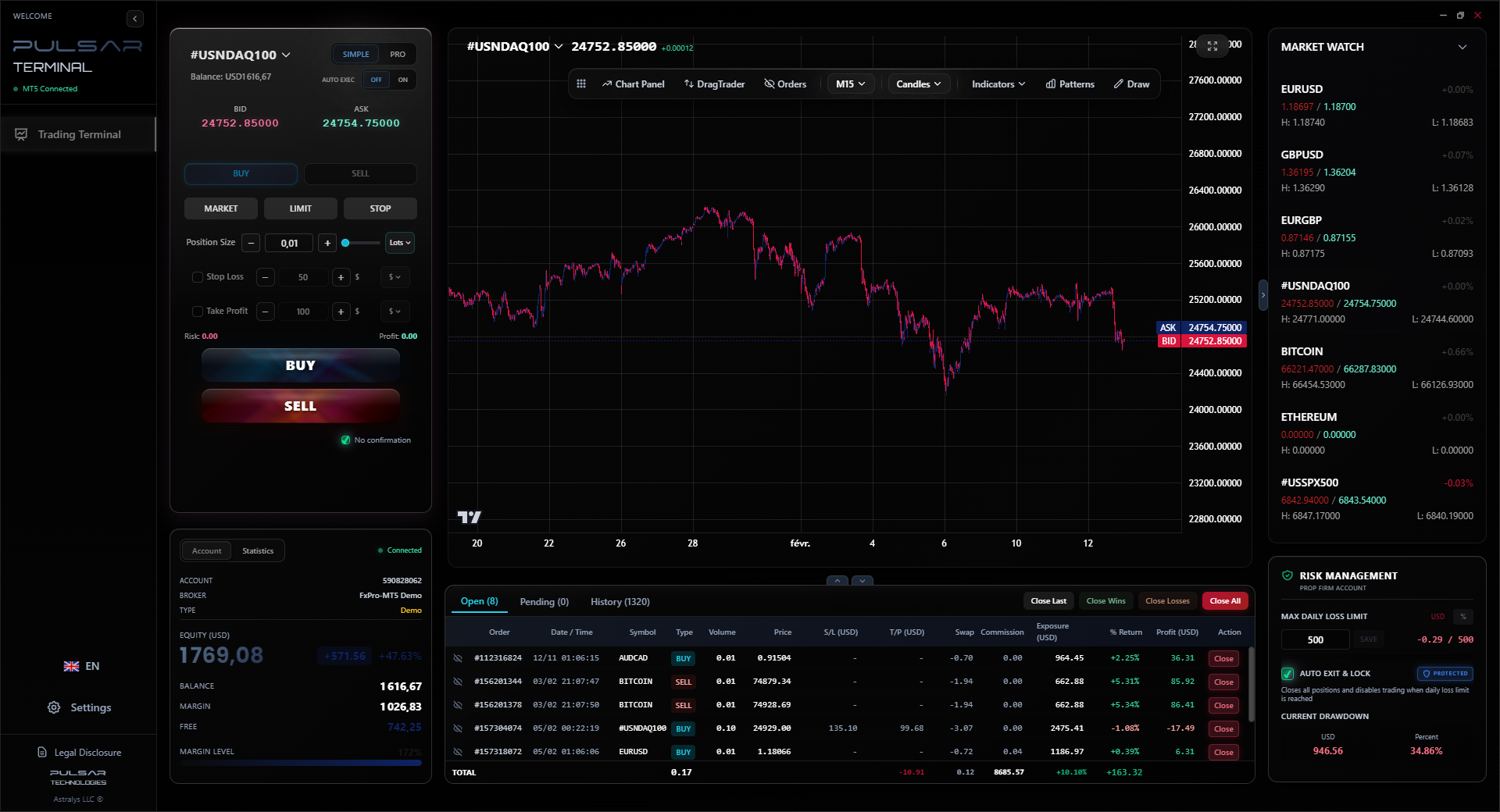
Managing the complex order types and strict risk limits required for AI-assisted trading is far easier with a tool like Pulsar Terminal, which brings advanced drag-and-drop order management and automated daily loss protection directly to your MT5 platform.
Pulsar Terminal
L'outil MT5 tout-en-un : ordres glisser-déposer, multi-TP/SL, trailing stop, grid trading, Volume Profile et protection prop firm. Utilisé quotidiennement par 1 000+ traders.
“You are not the AI's customer. You are its supervisor, its risk manager, and its failsafe.”
The projection that over 65% of forex volume will involve AI-driven algos by 2025 feels about right. We're moving past simple automation. The next wave is about integration and accessibility.
1. AI as a Co-Pilot, Not Autopilot: The most successful traders I know use AI as a powerful assistant. It scans 28 currency pairs for the specific confluence they've programmed (e.g., a hidden bullish divergence on the 4H RSI indicator with a key support level). It pings them. They make the final call. This hybrid model mitigates black-box risk.
2. Democratization of Institutional Tools: Features like Volume Profile and advanced order flow analysis, once the domain of hedge funds, are now in retail platforms. AI will make interpreting this data easier. Imagine an AI that highlights the high-probability reversal zones on a Volume Profile chart for you.
3. Regulatory Clampdown on "Dark Pools" of AI: Regulators will get better at monitoring AI herds - when thousands of retail bots using similar logic all enter or exit at once, causing micro-flash crashes. This may lead to new rules or circuit breakers.
4. The Personalization Tipping Point: The future isn't one AI for all. It's an AI that learns your trading style, your psychological biases, and helps you avoid your specific mistakes. It notices you tend to revenge trade after a loss on EUR/USD and locks your platform for an hour.
The edge will shift from having an AI to having a better-trained, more specialized, and more intelligently supervised AI. The human role evolves from executor to strategist, risk manager, and systems overseer.
💡 Conseil de Winston
If your AI's win rate is above 70%, scrutinize it for over-optimization. In the messy real world, sustainable edges are often subtler. A 55-60% win rate with a strong risk/reward ratio is more believable and durable.
“A realistic AI doesn't make you rich quickly; it helps you stop being poor consistently.”
After 12 years, thousands of trades, and testing more systems than I can count, here's my blunt assessment.
AI forex trading is a powerful amplifier. It amplifies good strategy and disciplined risk management into consistent results. It also amplifies poor strategy, greed, and ignorance into faster, larger losses.
It is not a shortcut. If you're a losing trader manually, you'll be a losing trader with AI - you'll just lose faster and more efficiently. You must first have a foundational understanding of markets, pips, spreads, and risk.
Who it's for: The disciplined trader with a proven edge who wants to scale, remove emotional slippage, and scan more markets. The curious technologist willing to put in months of testing and supervision.
Who it's not for: The beginner looking for a "set and forget" money machine. The trader who can't be bothered to learn how it works. Anyone who thinks it will bypass the need for skill.
My advice? Start as a researcher. Use free AI tools for sentiment analysis or market scanning. Paper trade its signals alongside your own. Get a feel for its rhythm. Treat it like hiring a new, incredibly fast, but slightly alien intern. You wouldn't give an intern your entire net worth to manage on day one. Don't do it with AI either. The future is here, but it still needs a human pilot.
FAQ
Q1Is AI forex trading legal in the United States?
Yes, but with major caveats. There's no law against using AI tools yourself. However, you must trade through a CFTC/NFA-regulated broker (like OANDA or FOREX.com), and the AI's actions must comply with all existing trading rules. Brokers and vendors also have their own terms of service regarding automated trading, which you must follow.
Q2Can I use an AI trading bot with my prop firm challenge account?
Almost certainly not. Most prop firms explicitly forbid fully automated trading or the use of third-party signal services during their evaluation challenges. They have detection methods. Using AI to pass the challenge violates their terms and will result in account termination and loss of your challenge fee. Use AI only if the firm's rules explicitly allow it, which is rare.
Q3What's a realistic return expectation from an AI forex system?
Ignore claims of 40%+ monthly returns. A realistically well-tuned and supervised AI system might target 5-15% annualized return with significantly lower drawdowns than a human trader. The real benefit is often consistency and removing emotional errors, not astronomical gains. My own hybrid approach aims for 8-12% annually.
Q4Do I need to be a programmer to use AI in trading?
Not anymore. Many platforms offer no-code or low-code interfaces where you can define rules in plain English or use pre-built AI modules. However, a basic understanding of logic (if-this-then-that) and trading concepts is essential. You don't need to code the AI, but you must understand how to configure and supervise it.
Q5What's the biggest mistake new AI traders make?
Trusting a backtest over a forward test. They see a perfect, profitable backtest on historical data, invest real money immediately, and are shocked when the bot fails in live markets. Always run the AI on a demo account through different market conditions (trending, ranging, high volatility) for a minimum of 1-2 months before risking real capital.
Q6How much money do I need to start AI forex trading?
The software can cost $50-$300/month. More importantly, your trading capital needs to be sufficient to withstand volatility while using proper position sizing. Even with a great AI, you need to survive the inevitable losing streaks. I wouldn't recommend starting with less than $5,000 in risk capital, and that's assuming you're using a very conservative position size calculator.
La leçon du Prof. Winston
Points clés:
- ✓Test on demo for 2+ months minimum
- ✓US brokers: CFTC/NFA regulation is non-negotiable
- ✓Realistic AI returns: 5-15% annualized
- ✓You must understand the logic behind the signals
- ✓Hybrid human/AI oversight is the winning model
Cet article vous a-t-il été utile ?
Cliquez sur une étoile
Analyses Trading Hebdo
Analyses et stratégies hebdo gratuites. Pas de spam.
À propos de l'auteur
James Mitchell
Analyste Trading Senior
Basé à New York avec plus de 9 ans d'expérience en trading. Spécialisé dans les paires USD majeures, les challenges de prop firms et la réglementation financière américaine.
Commentaires
Avertissement sur les risques
Le trading d'instruments financiers comporte des risques importants et peut ne pas convenir à tous les investisseurs. Les performances passées ne garantissent pas les résultats futurs. Ce contenu est fourni à titre éducatif uniquement et ne constitue pas un conseil en investissement. Effectuez toujours vos propres recherches avant de trader.
Vous aimerez aussi

Cara Trading Forex Sukses: 7 Prinsip dari Trader Profesional
Cara trading forex sukses dengan 7 prinsip trader pro: manajemen modal, disiplin, journal trading, backtest. Data nyata, bukan janji profit palsu.
Jam Trading Forex Terbaik untuk Trader Indonesia: Panduan Lengkap dengan Tabel Waktu
Panduan jam trading forex untuk trader Indonesia. Tabel 4 sesi dunia, jam emas 20:00-00:00, sesi mana yang harus dihindari. Data akurat + tips dari trader berpengalaman.
Top 5 Sàn Forex Uy Tín Nhất 2026: Review Jujur dari Trader Indonesia
Top 5 sàn forex uy tín 2026 untuk trader Indonesia. Review jujur: spread, deposit, withdraw, dukungan lokal. Exness, XM, IC Markets & lebih.
Obtenir Pulsar Terminal
Tous ces calculateurs sont intégrés dans Pulsar Terminal avec des données en temps réel de votre compte MT5. Dimensionnement de position en un clic, gestion automatique des risques et calculs instantanés.
Obtenir Pulsar Terminal