


Here's a hard truth: 95% of the forex signal services marketed to Nigerian traders are complete rubbish.

Olumide Adeyemi
Pionnier du Trading en Afrique de l'Ouest ·  Nigeria
☕ 10 min de lecture
Ce que vous apprendrez :
- 1What Exactly Is a Forex Signal App?
- 2How to Choose a Forex Signal App: The 5-Point Checklist
- 3Must-Have Features in a Signal App
- 4How to Actually Use Signals (Without Blowing Your Account)
- 5The Biggest Mistakes Nigerian Traders Make with Signals
- 6Are Paid Forex Signals Worth the Money in Nigeria?
- 7Final Thoughts & A Path Forward
Here's a hard truth: 95% of the forex signal services marketed to Nigerian traders are complete rubbish. They're designed to sell you a dream, not a real edge. I've lost more money following bad signals than I care to admit, especially when I was starting out. This guide isn't about finding a magic bullet. It's about learning how to use a forex signal app as a tool, not a crutch, so you can make smarter decisions with your hard-earned Naira.
Think of it as a notification service. A forex signal app sends you alerts suggesting when to buy or sell a currency pair. A good signal will include the instrument (like EUR/USD), the action (BUY or SELL), an entry price, and suggested stop-loss and take-profit levels.
These alerts can come from automated algorithms scanning the charts or from a human analyst sharing their trades. They pop up on your phone, so you don't have to stare at screens all day. Sounds convenient, right? It is. But that convenience is the trap for most people.
The moment you start blindly copying signals without understanding the why behind them, you've handed control of your account to a stranger. I learned this the expensive way back in 2018. I subscribed to a popular "VIP" signal group, funded my Exness review account with $500, and copied 10 trades in a row. I was up $150 and felt like a genius. Then the 11th signal was a massive loser on GBP/JPY. It wiped out my gains and $200 of my capital because I had no idea how to adjust the position size for that volatile pair. The signal provider just said "Oops, market moved." My money was gone.

Warning: A signal is just an opinion. It is not a guarantee. The person sending it does not lose money if you follow it and lose. Only you do.
“A signal is just an opinion. The person sending it does not lose money if you follow it and lose. Only you do.”
Forget flashy ads with pictures of cars and stacks of cash. Use this checklist. If a service fails even one point, walk away.
1. Verified, Real-Time Track Record
This is non-negotiable. Anyone can post a screenshot of a winning trade. You need a transparent, real-time history you can verify. Look for services that use a third-party tracking platform like Myfxbook or FX Blue. These platforms connect directly to a live or demo account and automatically record every trade, the entry/exit, profit, and loss. No manual entries, no Photoshop.
2. Clear Risk Disclosure on Every Signal
Every single alert must state the risk. What is the distance in pips from entry to stop-loss? If the signal says "BUY EUR/USD at 1.0850, SL 1.0820, TP 1.0900," you know the risk is 30 pips. This lets you use a position size calculator to determine how much to risk per trade (never more than 1-2% of your account). A signal that just says "BUY EURUSD NOW!" is useless and dangerous.
3. The Strategy Behind the Signal
Are they trading news breaks? Scalping strategy on the 5-minute chart? Swing trading based on daily support and resistance? They should tell you. If they're secretive about their "proprietary algorithm," it's likely because there isn't one. Understanding the strategy helps you know when their method might not work (e.g., a volatility strategy failing in a quiet market).
4. Realistic Profit & Loss Expectations
Be deeply suspicious of any service promising monthly returns of 50%, 100%, or more. Consistent, professional trading aims for 5-20% per year. High returns mean astronomically high risk. A good service will show both winning and losing streaks. A track record with only wins is fake.
5. Cost vs. Value
Some are free, some cost $50/month, some $300/month. Price doesn't always equal quality. A free signal from a transparent trader can be better than an expensive "guru." Start with a free trial or a cheap monthly subscription. Never pay for a year upfront.

💡 Conseil de Winston
The most expensive signal you'll ever get is the free one from your cousin's friend who 'knows a guy.' Trust verified data, not whispers.
“The moment you blindly copy signals without understanding the *why*, you've handed control of your account to a stranger.”
The app itself needs to be reliable. Here’s what separates a good platform from a frustrating one.
| Feature | Why It Matters |
|---|---|
| Instant Push Notifications | Prices move fast. An SMS or email that arrives 2 minutes late is a losing trade. The app must push alerts directly to your phone screen immediately. |
| Detailed Alert Info | The notification should show pair, action, entry, SL, TP, and the current spread definition. You shouldn't have to open another app to get the full picture. |
| Trade History & Performance | The app should have a built-in, clear log of all past signals and their results (P/L in pips and %). This is your main tool for verification. |
| Filtering Options | You should be able to filter signals by currency pair, risk level, or time of day. If you only trade EUR/USD guide and XAU/USD guide, you don't need alerts for exotic pairs. |
| Stable Uptime | The app must work. I once missed a crucial signal because the app server was down for "maintenance" during the London open. Uptime should be 99.9%. |

Pro Tip: Test the notification speed during your free trial. Set an alert and time how long it takes from their dispatch to your phone. If it's more than 10-15 seconds, it's too slow for fast markets.
“The moment you blindly copy signals without understanding the *why*, you've handed control of your account to a stranger.”
This is the most important part. Getting the signal is step one. Executing it properly is where you make or lose money.
First, Always Do Your Own Analysis. Don't just click buy. Open your chart. Does the BUY signal align with a key support level you see? Is the price above the 200-period moving average on your timeframe? Use your own indicators like the RSI indicator or MACD indicator to see if there's confluence. If their signal says BUY but your analysis shows strong resistance overhead, it's okay to skip the trade. Your analysis is your final filter.
Second, Calculate Your Own Position Size. The signal gives you a stop-loss distance (e.g., 25 pips). You decide your risk (e.g., 1% of your $1,000 account = $10). Use your broker's tools or a standalone position size calculator to figure out exactly how many lots or units to trade so that a 25-pip loss equals $10. Never use the signal provider's suggested lot size - they don't know your account size or risk tolerance.
Third, Manage the Trade Actively. Once you're in, it's your trade. If the market moves in your favor, consider moving your stop-loss to breakeven to eliminate risk. A good scalping strategy might target quick profits, while a swing trading signal requires more patience. Don't panic and exit early if the signal's logic is still valid.

Example: Signal: BUY GBP/USD at 1.2650, SL 1.2620, TP 1.2720.
- Your Analysis: Price is bouncing off the daily trendline. RSI is oversold. Confluence = YES.
- Your Risk: 1% of a 400,000 Naira account (~$265) = 2,650 Naira.
- Stop-Loss: 30 pips. Value per pip for a micro lot (0.01) on GBP/USD is about $0.10.
- Calculation: To risk 2,650 Naira (~$1.77), you'd trade 0.06 lots. ( $1.77 risk / (30 pips * $0.10 per pip per 0.01 lot) = 0.06 ). You enter 0.06 lots, not the "1 standard lot" some reckless signal might imply.
💡 Conseil de Winston
If you wouldn't take the trade without the signal, don't take it with the signal. Your own conviction is your final safety net.
“Price doesn't equal quality. A free signal from a transparent trader can be better than an expensive 'guru.'”
I've seen these destroy accounts time and again.
Chasing Losses with Signals: You lose on one signal, so you take the next one with double the lot size to "make it back." This is a guaranteed path to a margin call. Every trade is independent. Your last loss has nothing to do with your next trade's probability.
Subscribing to Multiple Services: You get a BUY signal from App A and a SELL signal on the same pair from App B. You freeze, get confused, and then make an emotional decision. Pick one service you trust and stick with their methodology. More signals just mean more noise.
Ignoring Your Broker's Conditions: A signal might be generated on a broker with razor-thin spreads. If your local broker, like the ones we review at IC Markets review or XM review, has a wider spread, your actual entry will be worse, and your stop-loss might be triggered prematurely. Always account for your own broker's execution.
The "Prop Firm Signal" Scam: This is huge now. A service promises signals "guaranteed" to pass your prop firm challenge. They're not. Prop firms have strict rules on drawdown and daily loss limits. A string of losing signals from a "guru" will blow your challenge before you even know what happened. Managing a prop account requires discipline, not magic signals.
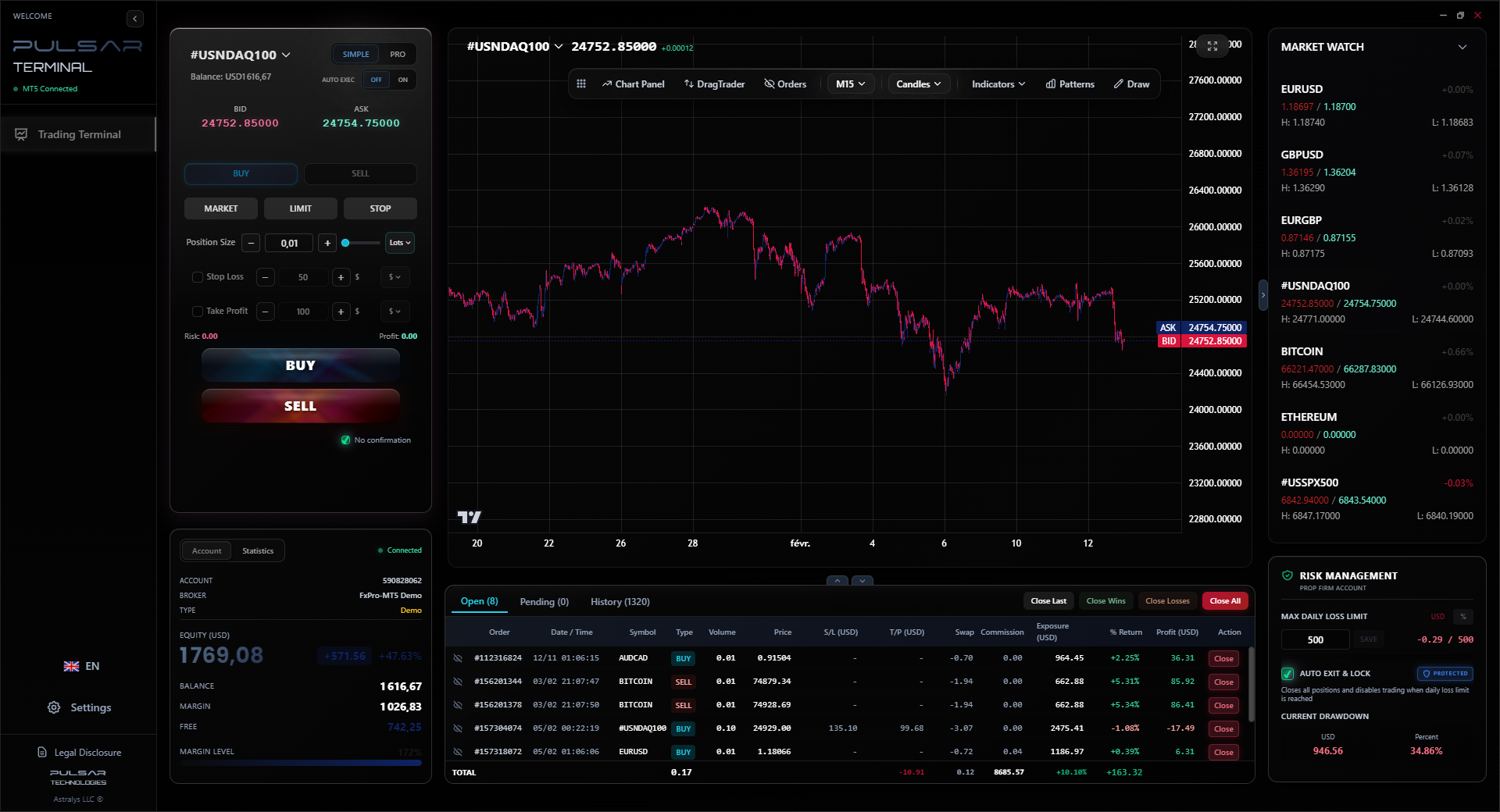
Manually setting stop-losses and take-profits for every signal is tedious and error-prone; Pulsar Terminal lets you drag and drop these levels directly onto your MT5 chart in seconds, exactly as the signal specifies.
Pulsar Terminal
L'outil MT5 tout-en-un : ordres glisser-déposer, multi-TP/SL, trailing stop, grid trading, Volume Profile et protection prop firm. Utilisé quotidiennement par 1 000+ traders.
“Price doesn't equal quality. A free signal from a transparent trader can be better than an expensive 'guru.'”
It depends entirely on your skill level and goals.
For a complete beginner? Probably not. You should spend that monthly fee on education first. Learn what a pip definition is, how to read a candlestick, what support and resistance are. Throwing money at signals when you don't understand them is like paying for driving lessons when you don't know what the steering wheel does.
For an intermediate trader? This is the sweet spot. You understand the basics but struggle with consistency or lack time for analysis. A reliable signal service can act as a mentor, showing you set-ups you might have missed. The cost can be worth it if it saves you from costly mistakes and improves your own skills. Think of it as paying for research.
For an experienced trader? Usually not. You likely have your own edge. A signal might occasionally offer a second opinion, but you shouldn't rely on it.
Here's my personal take: I used a paid service for about 6 months in 2022. It cost $80/month. It didn't make me rich, but it did two valuable things. First, it enforced discipline - I only took trades that matched their clear criteria. Second, by reviewing their rationale, I improved my own understanding of price action. I stopped the subscription when I felt confident in my own analysis. It was a tuition fee, not an income source.
💡 Conseil de Winston
A year of losing small, controlled amounts while learning is cheaper than one week of following a 'sure thing' that blows your entire account.
“The goal isn't to get rich tomorrow by following a signal. The goal is to build skills that last a lifetime.”
There is no single "best forex signal app" for everyone. The best one is the one that fits your trading style, is transparent, and that you use as a learning tool.
Start with this action plan:
- Paper Trade First: Find 2-3 apps with free trials or free signals. Follow them on a demo account for a full month. Track every signal's performance yourself in a spreadsheet.
- Evaluate Honestly: At the month's end, who had the best risk-adjusted returns? Who provided the clearest information? Who had the fewest "oops" moments?
- Start Small: If you choose to go live, start with the smallest possible subscription plan. Fund a live account with money you can afford to lose and trade micro lots.
- Keep Learning: Never stop your own education. The goal is to eventually understand the markets well enough that you need the signals less and less.
The market will always be here. The goal isn't to get rich tomorrow by following a signal. The goal is to build skills and knowledge that last a lifetime. That’s how you protect your capital and grow it steadily, in Naira or any other currency. Good brokers like Pepperstone review offer great tools to help you on this journey, but the most important tool is between your ears.
FAQ
Q1Are free forex signal apps any good?
Some can be, but you must be extra cautious. Free services often make money by promoting specific brokers (through affiliate links) or by upselling you to a "premium" version. The signals might be lower quality to push you to pay. Always verify their track record with the same scrutiny as a paid service.
Q2What's the success rate of a good forex signal service?
A realistic, professional signal service might have a win rate between 55% and 70%. However, the win rate is less important than the risk-reward ratio. A service with a 50% win rate but a 1:2 risk-reward (risking 1% to make 2%) is very profitable. Focus on the overall profit factor (total profits / total losses) shown in their verified track record.
Q3Can I use forex signals for scalping?
Yes, but it's extremely challenging. Scalping signals require near-instant execution and ultra-low spreads. The delay from signal to your phone to your broker can kill the trade. If you want to try a scalping strategy, choose a signal service specifically designed for it and use a broker known for fast execution, like IC Markets or Pepperstone.
Q4How much should I risk per trade when following signals?
The universal rule is never more than 1-2% of your trading account capital on any single trade. This is non-negotiable. If your account is 500,000 Naira, your max risk per trade is 5,000 to 10,000 Naira. Use a position size calculator to determine the correct lot size based on the signal's stop-loss distance.
Q5Do signal providers work with Nigerian brokers?
The signals themselves are broker-agnostic - they just give price levels. However, you must ensure your Nigerian broker's spreads, execution speed, and available instruments match the signal's assumptions. A signal for a pair with a 0.5 pip spread will perform very differently if your broker's spread is 2.5 pips.
Q6What if a signal service has a losing streak?
Every trader and every strategy has losing streaks. It's normal. The key is whether the service communicated this was possible and whether their risk management rules (like the 1-2% risk per trade) would have kept you alive through the drawdown. If they go silent or make excuses during a drawdown, that's a major red flag.
La leçon du Prof. Winston
Points clés:
- ✓Verify track records with third-party tools like Myfxbook.
- ✓Never risk more than 2% of your capital on any signal.
- ✓A good win rate is 55-70%, but risk-reward ratio matters more.
- ✓Always do your own chart analysis for confluence.
- ✓Start with a free trial and a demo account for one month.
Cet article vous a-t-il été utile ?
Cliquez sur une étoile
Analyses Trading Hebdo
Analyses et stratégies hebdo gratuites. Pas de spam.
À propos de l'auteur
Olumide Adeyemi
Pionnier du Trading en Afrique de l'Ouest
L'un des formateurs de trading forex les plus actifs au Nigeria. 8 ans d'expérience de trading depuis Lagos. Spécialisé dans les stratégies à petit capital et les challenges de prop firms pour les traders africains.
Commentaires
Avertissement sur les risques
Le trading d'instruments financiers comporte des risques importants et peut ne pas convenir à tous les investisseurs. Les performances passées ne garantissent pas les résultats futurs. Ce contenu est fourni à titre éducatif uniquement et ne constitue pas un conseil en investissement. Effectuez toujours vos propres recherches avant de trader.
Vous aimerez aussi

Cara Trading Forex Sukses: 7 Prinsip dari Trader Profesional
Cara trading forex sukses dengan 7 prinsip trader pro: manajemen modal, disiplin, journal trading, backtest. Data nyata, bukan janji profit palsu.
Jam Trading Forex Terbaik untuk Trader Indonesia: Panduan Lengkap dengan Tabel Waktu
Panduan jam trading forex untuk trader Indonesia. Tabel 4 sesi dunia, jam emas 20:00-00:00, sesi mana yang harus dihindari. Data akurat + tips dari trader berpengalaman.
Top 5 Sàn Forex Uy Tín Nhất 2026: Review Jujur dari Trader Indonesia
Top 5 sàn forex uy tín 2026 untuk trader Indonesia. Review jujur: spread, deposit, withdraw, dukungan lokal. Exness, XM, IC Markets & lebih.
Obtenir Pulsar Terminal
Tous ces calculateurs sont intégrés dans Pulsar Terminal avec des données en temps réel de votre compte MT5. Dimensionnement de position en un clic, gestion automatique des risques et calculs instantanés.
Obtenir Pulsar Terminal