


Here's a hard truth most 'gurus' won't tell you: joining a 'club forex' group in South Africa is more likely to lose you money than make you any.

David van der Merwe
Trader des Marchés Émergents ·  South Africa
☕ 9 min de lecture
Ce que vous apprendrez :
- 1What 'Club Forex' Really Means in South Africa
- 2The Golden Rule: FSCA Regulation and Your Safety
- 3Real Numbers: Costs, Capital, and Realistic Returns
- 4How to Find a Real Trading Community (Not a Scam)
- 5Trading ZAR Pairs: Your Home Court Advantage
- 6Forget the Club, Build Your Own System
- 7The Final Verdict on Club Forex
Here's a hard truth most 'gurus' won't tell you: joining a 'club forex' group in South Africa is more likely to lose you money than make you any. The stats are brutal - about 90% of retail traders lose in the long run. But that doesn't mean community is useless. The right group, with the right mindset, can be the difference between blowing your account and building a real edge. Let's cut through the noise and talk about what these clubs really are, how to avoid the predators, and how to use community to actually improve your trading.
When you hear 'club forex' in SA, you're not talking about one specific company. It's a catch-all term for any group, community, or signal service promising to guide you to forex profits. These range from legitimate Discord servers where traders share ideas, to slick Instagram operations selling 'guaranteed' signals for a monthly fee.
I've seen it all. Back in 2018, I paid R1,500 a month for a signal service run by a guy with a rented Lamborghini in his profile pic. The signals were late, the rationale was non-existent, and I lost two months of subscription fees in a week following his 'sure thing' on USD/ZAR. That was a cheap lesson. Some 'clubs' charge R5,000 or more for 'mastermind' access.
The core idea isn't bad - trading is lonely. Having people to discuss the EUR/USD guide setup with or to keep you accountable can be valuable. The problem is when the club's business model depends on you staying dependent, not independent. A real community teaches you to fish. A scam sells you a rotten fish every day and calls it a meal plan.

Warning: Any 'club' that pressures you with FOMO, uses pictures of luxury cars as proof of success, or guarantees specific weekly returns is a major red flag. Real trading involves losses, period.

💡 Conseil de Winston
A 'club' that charges for signals is selling a product. A community that debates analysis is sharing a process. Always buy the process.
This is the most important section. In South Africa, the Financial Sector Conduct Authority (FSCA) is the watchdog. If a 'club forex' is actually providing financial advice or managing money, they need an FSP license. Most don't have one.
Why This Matters for You
Let's say you join a club that gives direct 'buy/sell' signals. If they're unlicensed and their advice causes you to lose money, you have virtually no recourse. You can't complain to the FSCA. It's your word against theirs. I learned this the hard way with that Instagram guru - when I asked for a refund, I was just blocked.
Broker Regulation is Your First Shield
Your primary defense is to only use FSCA-regulated brokers. If a club tries to push you towards an obscure, offshore broker with 'unbeatable' bonuses, run. Stick with known entities like Pepperstone or IC Markets that have local regulation. This ensures your deposited funds are held in segregated accounts and you have a path for dispute resolution.

Pro Tip: Before joining any paid group, ask for their FSP number. Then, verify it on the official FSCA website. If they dodge the question or say they're 'educators' not advisors, be very skeptical. A legitimate educational service won't give specific trade signals.
“The real cost of a bad club isn't the monthly fee; it's the losses you incur following bad advice.”
Let's get brutally honest about money. The fantasy is quitting your job with R5,000. The reality is much more grindy.
Starting Capital: Yes, brokers like XM let you start with $5 (about R90). But that's for learning the platform, not making a living. With R100, you're basically paying for an expensive video game. For serious practice, I'd say R1,500 is a bare minimum. To actually apply proper risk management (like risking 1% per trade), you need enough capital so that 1% is a meaningful amount to you, but not devastating. For most new traders, that's in the R5,000 to R20,000 range.
Club Fees vs. Value: Paid signal groups can charge R300 to R5,000+ per month. Ask yourself: If their signals are so profitable, why do they need your subscription money? The best traders I know trade their own capital. They don't run subscription services. Before paying, demand a verifiable, real-time track record - not just screenshots of past wins.
The Only Metric That Matters: Risk/Reward Forget the monthly fee for a second. The real cost of a bad club is the losses you incur following bad advice. If a signal causes you to lose 5% of your account, that's a far higher cost than the subscription. Always use a position size calculator based on YOUR account size and risk tolerance, not the club's generic advice.
Here’s a reality check on what returns actually look like:
| Trader Level | Realistic Monthly Return Goal | Notes |
|---|---|---|
| Beginner (First Year) | Break-even or small loss | You're paying for education. Success is not blowing up. |
| Intermediate | 2% - 5% | Consistent, risk-managed profits. This is a great target. |
| Professional | 5% - 10% | This is elite performance. 10% monthly compounds massively. |
Aiming for 5% a month sounds modest, but it turns R20,000 into over R35,000 in a year. Chasing 50% a month is how you get to zero.
💡 Conseil de Winston
If you wouldn't take financial advice from someone at a braai based on their car, don't take it from them on Instagram either. The medium changes, the credibility test doesn't.
So, are all groups bad? No. A true community is a lifeline. Here’s how to find one.
Look for These Green Flags:
- Focus on Education: They talk about concepts - like how to use the RSI indicator or MACD indicator in context - not just shouting ticker symbols.
- Transparency About Losses: Members and admins openly discuss losing trades and what they learned. If you only see wins, it's curated nonsense.
- Risk Management First: The conversation is always about stop losses, position sizing, and protecting capital. I once saved myself from a 3% loss because someone in my group pointed out my stop was in a stupid place based on the daily chart.
- Free or Low-Cost: The best communities I've been in were free Discord servers or cheap forums. The value was in the peer review, not a guru's wisdom.
Start Local, Then Go Global: Look for South African-focused groups. Understanding the context around USD/ZAR or how local news flows move our market is huge. But also, don't limit yourself. Some of the best technical analysis minds aren't in SA. The goal is to build your own swing trading or scalping strategy framework, then use the community to stress-test it.
My Experience: The most valuable group I'm in costs $50 a year. We don't give signals. We post our charts with entry plans and ask, 'What am I missing?' Having three other sets of eyes spot a key resistance level I overlooked has saved me thousands.
“Aiming for 5% a month sounds modest, but it turns R20,000 into over R35,000 in a year. Chasing 50% a month is how you get to zero.”
As a South African trader, you have a potential edge trading Rand pairs like USD/ZAR, EUR/ZAR, and GBP/ZAR. But it's a double-edged sword.
The Volatility Advantage: ZAR pairs are wildly volatile. A 100-pip move on USD/ZAR is a regular Tuesday. For context, a 100-pip move on a R500,000 position is R5,000. This volatility creates opportunity, but you must respect it. Your stop losses need to be wider, and your position size needs to be smaller. I got margin called on USD/ZAR in 2020 because I used the same tight stops I used on EUR/USD. Rookie error.
Understanding the Drivers: You live here. You feel load-shedding, you hear the SARB news first, you understand political tensions. This is insider knowledge for a global market. A local news story about a major mine strike can move USD/ZAR before international traders even notice. Use this.
The Cost Challenge: The spread definition on ZAR pairs is usually much higher than on majors like EUR/USD. Where EUR/USD might have a 0.8 pip spread, USD/ZAR could have a 50-80 pip spread. This means your trade starts significantly in the red. You need a strategy that accounts for this. Scalping USD/ZAR is very difficult for this reason. It's better suited for longer-term swing trading where the spread becomes a smaller percentage of your target profit.

Example: If you buy USD/ZAR at 18.5000 with an 80-pip spread, your buy price is effectively 18.5080. The market needs to move 80 pips just for you to break even. Your profit target must be substantially beyond that.
💡 Conseil de Winston
Your biggest edge trading ZAR pairs isn't a secret indicator. It's your lived experience of South African news and sentiment. Trust that.
, no club will make you a profitable trader. Only you can do that. Here's a practical path.
1. Paper Trade Relentlessly: Don't risk a cent until you can be consistently profitable on a demo for 3-6 months. I paper traded for 8 months before going live. It felt long, but it saved me my real capital.
2. Specialize: Don't try to trade everything. Pick one or two instruments. Maybe it's XAU/USD guide (gold) and USD/ZAR. Learn their personality, their average daily range, their key drivers.
3. Journal Everything: Every trade. Entry, exit, why you took it, your emotion, screenshot of the chart. Review weekly. This is more valuable than any signal. My biggest 'aha' moment came from reviewing a journal and seeing I lost 80% of my trades taken after 10 PM. I was overtrading.
4. Use Tools to Execute Better: A common failure point is poor trade execution - moving stops, not taking profit, etc. This is where technology can help enforce your discipline. Having a platform that lets you set multiple take-profit levels or a trailing stop from the start removes emotion.
5. Embrace the Grind: Profitable trading is boring. It's following your checklist, taking your 2% profit, and waiting for the next setup. The 'club forex' hype sells excitement. The reality is quiet consistency. Focus on protecting your capital from a margin call above all else. Survival is the first step to success.
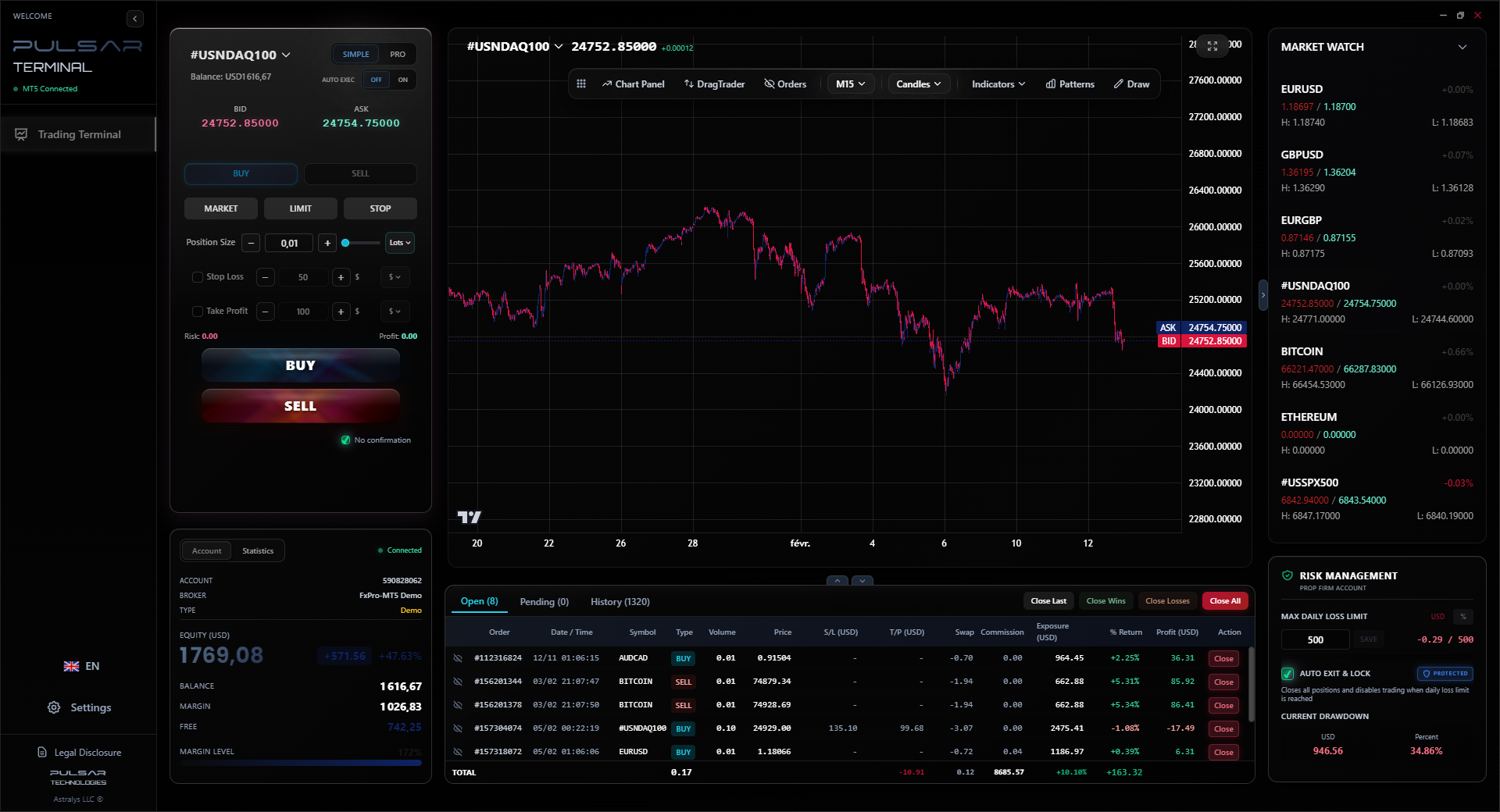
When building your own system, precise trade management is non-negotiable, and tools like Pulsar Terminal automate complex order setups directly on your MT5 charts.
Pulsar Terminal
L'outil MT5 tout-en-un : ordres glisser-déposer, multi-TP/SL, trailing stop, grid trading, Volume Profile et protection prop firm. Utilisé quotidiennement par 1 000+ traders.
“Profitable trading is boring. It's following your checklist, taking your 2% profit, and waiting. The 'club forex' hype sells excitement.”
So, should you join a 'club forex' in South Africa?
For paid signal services: Almost certainly not. The incentives are misaligned. Their goal is to keep you subscribed, not make you independent. The statistical likelihood of them having a genuine, sustainable edge they're willing to sell for R500 a month is near zero.
For trading communities: Yes, but be selective. Seek out groups that are discussion-based, not signal-based. Where the value is in collective analysis and shared psychology, not trade recommendations. A good community will tell you when to stay out of the market, which is often the best advice of all.
Your journey will be solo. Your profits will come from your discipline, your risk management, and your ability to control your emotions. A community can support that journey, but it cannot walk it for you. Start with a regulated broker, start small, focus on learning the pip definition and the price action, and build from there. The real 'club' you want to join is the small, quiet minority who understand that trading is a business of probability and patience, not get-rich-quick dreams.
FAQ
Q1Is 'Club Forex' a licensed broker or financial service provider in South Africa?
No. 'Club Forex' is not a single licensed entity. It's a generic term for forex trading groups or communities. Any group providing specific financial advice or investment management legally requires an FSCA FSP license. Most social media 'clubs' do not have this, which leaves you with no protection if you lose money following their advice.
Q2What is a realistic amount of money I need to start forex trading in South Africa?
You can technically start with R70-R150 on a micro account, but that's just for platform familiarization. To seriously practice risk management, a minimum of R1,500-R5,000 is more realistic. For treating it as a potential income stream with proper position sizing, R20,000+ is a safer starting point. Never trade with money you can't afford to lose entirely.
Q3What are the most common scams in 'club forex' groups?
Look out for: 1) Guaranteed profits or specific weekly returns. 2) Pressure to deposit more money to 'unlock' better signals. 3) Admins who only show winning trade screenshots. 4) Pushing you towards unregulated offshore brokers. 5) Upfront 'training' fees of thousands of Rands with vague promises. A real educator teaches principles, not magic bullets.
Q4Can I trade USD/ZAR with a small account?
You can, but you must be extremely careful. USD/ZAR has high volatility and wide spreads (often 50-80 pips). On a small account, this spread is a huge hurdle. A 50-pip spread on a R1,000 account using excessive use can wipe you out quickly. It's better to practice on majors like EUR/USD first to learn mechanics before tackling ZAR pairs.
Q5How do I verify if a broker is regulated by the FSCA?
Go directly to the FSCA's official website and use their 'Search for an FSP' function. Enter the broker's company name or potential FSP number. Do not rely on logos on the broker's own site. Reputable FSCA-regulated brokers operating here include IG, AvaTrade, and Exness (via its local entity).
Q6What's better for a beginner: a signal group or learning to analyze myself?
Learning to analyze yourself, 100%. Following signals makes you dependent and you never learn why a trade works or fails. Start with the free educational material from reputable brokers and platforms. Learn basic support/resistance, candlestick patterns, and one or two indicators like the RSI. This self-built knowledge is the only thing that will last.
Q7Are free Telegram or WhatsApp signal groups worth it?
Generally, no. They are often run by unqualified individuals or are used as 'bait' to later sell you a paid service. The signals are frequently late or lack any risk parameters. The chaos and constant notifications can also lead to impulsive trading. Your time is better spent on structured learning in a calm environment.
La leçon du Prof. Winston
Points clés:
- ✓Verify FSCA license before paying any group.
- ✓Start with at least R1,500 for real practice.
- ✓Wide spreads on ZAR pairs demand wider stops.
- ✓A 5% monthly return is elite performance.
- ✓Journal every trade to find your personal flaws.
Cet article vous a-t-il été utile ?
Cliquez sur une étoile
Analyses Trading Hebdo
Analyses et stratégies hebdo gratuites. Pas de spam.
À propos de l'auteur
David van der Merwe
Trader des Marchés Émergents
Trader basé à Johannesbourg avec 11 ans d'expérience sur les devises des marchés émergents. Spécialisé dans les paires ZAR, le trading régulé par la FSCA et l'analyse du marché sud-africain.
Commentaires
Avertissement sur les risques
Le trading d'instruments financiers comporte des risques importants et peut ne pas convenir à tous les investisseurs. Les performances passées ne garantissent pas les résultats futurs. Ce contenu est fourni à titre éducatif uniquement et ne constitue pas un conseil en investissement. Effectuez toujours vos propres recherches avant de trader.
Vous aimerez aussi

Cara Trading Forex Sukses: 7 Prinsip dari Trader Profesional
Cara trading forex sukses dengan 7 prinsip trader pro: manajemen modal, disiplin, journal trading, backtest. Data nyata, bukan janji profit palsu.
Jam Trading Forex Terbaik untuk Trader Indonesia: Panduan Lengkap dengan Tabel Waktu
Panduan jam trading forex untuk trader Indonesia. Tabel 4 sesi dunia, jam emas 20:00-00:00, sesi mana yang harus dihindari. Data akurat + tips dari trader berpengalaman.
Top 5 Sàn Forex Uy Tín Nhất 2026: Review Jujur dari Trader Indonesia
Top 5 sàn forex uy tín 2026 untuk trader Indonesia. Review jujur: spread, deposit, withdraw, dukungan lokal. Exness, XM, IC Markets & lebih.
Obtenir Pulsar Terminal
Tous ces calculateurs sont intégrés dans Pulsar Terminal avec des données en temps réel de votre compte MT5. Dimensionnement de position en un clic, gestion automatique des risques et calculs instantanés.
Obtenir Pulsar Terminal