


I remember the first time I tried to create a forex account back in 2012.

Olumide Adeyemi
Pionnier du Trading en Afrique de l'Ouest ·  Nigeria
☕ 10 min de lecture
Ce que vous apprendrez :
- 1Before You Click 'Sign Up': The Nigerian Reality Check
- 2Picking Your Broker: Beyond the Naira Bonuses
- 3The Sign-Up Process: Filling the Forms Correctly
- 4Funding in Naira: Getting Your Money In (And Out)
- 5Platform Setup and Placing Your First Trades
- 6Pitfalls I Fell Into (So You Don't Have To)
- 7You're Live. What Now? The Path Forward

I remember the first time I tried to create a forex account back in 2012. I was so excited I funded it with ₦150,000, picked a random broker from a flashy Instagram ad, and jumped straight into a EUR/USD trade. Two days later, my account was at ₦42,000. The spread was massive, withdrawals were a nightmare, and I realized I'd skipped the most important step: knowing what I was doing. Let me save you that headache. Setting up your account correctly isn't just paperwork, it's your first trade, and it's one you can't afford to lose.
You can't just create a forex account anywhere. In Nigeria, you're navigating a unique space. The Central Bank of Nigeria (CBN) has a complicated relationship with retail forex trading. They don't license international brokers for retail clients. What does that mean for you? You'll be using an offshore broker. This isn't inherently bad, but it shifts the responsibility of due diligence squarely onto your shoulders.
Your number one job is to verify the broker's actual regulation, not just the logos on their website. Look for licenses from top-tier authorities like the UK's FCA, Australia's ASIC, Cyprus's CySEC, or the FSCA in South Africa. These regulators enforce client fund segregation, which means your money is held separately from the broker's operating funds. If the broker goes under (it happens), your capital isn't automatically gone.

Warning: A broker offering 1:1000 use and 'guaranteed' profits is a giant red flag. Real regulated brokers have sensible use limits (often 1:30 for major pairs under ESMA rules) and are required to warn you about risks. If it sounds too good to be true on Allen Avenue, it's too good to be true online.
You also need to think about your trading style. Are you a scalper needing tight spreads and fast execution? A swing trader more concerned with swap rates? Your answers will directly impact which broker is best for you. Don't just pick the one with the biggest bonus offer.

💡 Conseil de Winston
Your first deposit isn't trading capital, it's a tuition fee. Expect to learn, not to earn.
“Setting up your account correctly isn't just paperwork, it's your first trade, and it's one you can't afford to lose.”
This is where most people get it wrong. They see an ad promising a 100% deposit bonus in Naira and sign up immediately. I made that mistake. That bonus usually comes with impossible withdrawal conditions, locking your funds in. Let's break down what actually matters.
Regulation & Reputation
Check the broker's regulatory number on the regulator's official website. Don't just trust their 'About Us' page. For Nigerian traders, brokers with strong international reputations like IC Markets, Pepperstone, and Exness are popular for good reason: they cater to an international audience and have proven track records. Read independent reviews, but be wary of sites that are just affiliate farms.
Trading Costs
This is your daily reality. Look at the spread (the difference between buy and sell price) on the pairs you'll trade, like EUR/USD or GBP/JPY. Is it fixed or variable? Variable is usually tighter. Check commission structures. Some brokers offer 'raw spread' accounts with a small commission per lot. For a high-volume scalping strategy, this can be cheaper than a wide spread with no commission.
The Nigerian-Specific Essentials
Can you fund your account in Naira? Many top brokers accept deposits via local bank transfer or popular payment gateways like Flutterwave or Paystack. What are the withdrawal times and fees? A broker might take 3-5 business days to process a withdrawal, which is standard. If they promise 'instant' withdrawals 24/7, dig deeper. Also, test their customer support. Send a pre-sign-up question and see how long they take to reply.

Example: I compared two brokers for my main account. Broker A had a 1.8 pip spread on EUR/USD and a $7 round-turn commission. Broker B had a 0.9 pip spread and a $3.5 commission. For my typical 2-lot trade, Broker B saved me $11 per trade. That adds up fast.

“High use amplifies losses just as fast as it amplifies gains. It's a tool, not a magic wand.”
This part seems boring, but errors here can freeze your account later. When you create a forex account, you're undergoing a 'Know Your Customer' (KYC) process. It's mandatory for regulated brokers.
- Visit the official website. Double-check the URL. Scammers create fake sites with similar names.
- Click 'Open Account' or 'Register'. You'll choose between a demo account and a live account. Start with a demo. Always.
- Fill in your personal details. Use your legal name exactly as it appears on your government-issued ID (International Passport or National ID card). No nicknames. Your residential address must be your current Nigerian address.
- Financial & Trading Experience. Be honest about your employment, estimated net worth, and trading experience. This determines the use they might offer you. Don't inflate your experience to get higher use; that's a fast track to a margin call.
- Account Verification. You'll need to upload two documents:
- Proof of Identity: A clear colour scan/photo of your International Passport data page or National ID card.
- Proof of Residence: A utility bill (PHCN, water) or bank statement from the last 3-6 months with your name and address. It must match the address you provided.
Approval can take from a few hours to a couple of days. Don't rush it. An accurately verified account means smooth withdrawals later.
“High use amplifies losses just as fast as it amplifies gains. It's a tool, not a magic wand.”
This is the moment of truth. You've created your account, now you need to fund it. Nigerian traders primarily use bank transfers, debit/credit cards (Visa/Mastercard), and increasingly, cryptocurrency.
Bank Transfer/Direct Deposit: The most common method. The broker will provide you with banking details (often to a UK, EU, or South African bank). You initiate a foreign exchange transfer from your Nigerian bank. You'll need the broker's beneficiary name, account number, SWIFT/BIC code, and the payment reference they provide.
The Cost Factor: Your bank will charge an international transfer fee and give you their own exchange rate for converting Naira to USD/EUR. This rate is almost always worse than the official market rate. It's a hidden cost. Always calculate the total amount in Naira it will cost you to deposit $100, for example.
Card Deposits: Faster, but many Nigerian cards have international transaction limits or might be declined. Some brokers also treat card deposits as 'non-reloadable' for withdrawal purposes, meaning you can only withdraw back to the same card.
Cryptocurrency: Growing in popularity due to speed and often lower fees. You send USDT (Tether) or another crypto from your wallet to the broker's designated wallet address. The broker converts it to USD in your trading account. Understand the volatility risk during the transfer window.

Pro Tip: For your first live account, fund it with an amount you are 100% comfortable losing completely. This is your 'tuition fee.' I started my first proper live account with just $200 (about ₦90,000 at the time). It forced me to be disciplined with my position size calculator and treat every pip seriously.
💡 Conseil de Winston
Test a broker's withdrawal process with $50 before you trust them with $5,000. A smooth exit is more important than a flashy entrance.
“Your primary job is not to make money. Your primary job is to protect your capital.”
Your account is funded. Now, the real work begins. Most brokers will offer MetaTrader 4 (MT4) or MetaTrader 5 (MT5). Download the platform directly from the broker's website or the official MetaQuotes site. Log in with the live account credentials they emailed you.
Configure Your Workspace: Before you even look at a chart, set up your risk management tools. Set your default stop-loss and take-profit levels in the platform settings. This forces you to think about risk before entering a trade. Familiarize yourself with the order ticket. Understand the difference between a Market Execution order (fills immediately at current price) and a Pending Order (sets an order to buy/sell at a future price).
Understanding the Numbers: Look at your platform. You'll see your Equity (current account value including open profit/loss), Balance (value of closed trades only), Free Margin (available funds to open new positions), and Margin Level (a critical percentage). If your Margin Level falls below 100%, you're in a margin call and risk automatic closure of positions.
Your First Practice Trades: Start with a micro lot (0.01). Pick a major pair like EUR/USD. Decide on a simple strategy. Maybe you'll buy if the price breaks above yesterday's high, with a stop-loss below the low. Use your position size calculator to ensure you're not risking more than 1-2% of your account. Execute the trade. Watch how the P&L moves. Get comfortable with the feeling.
The goal here isn't profit. It's to confirm everything works: execution speed, how stops are triggered, and that you understand the platform mechanics before you commit real strategy.
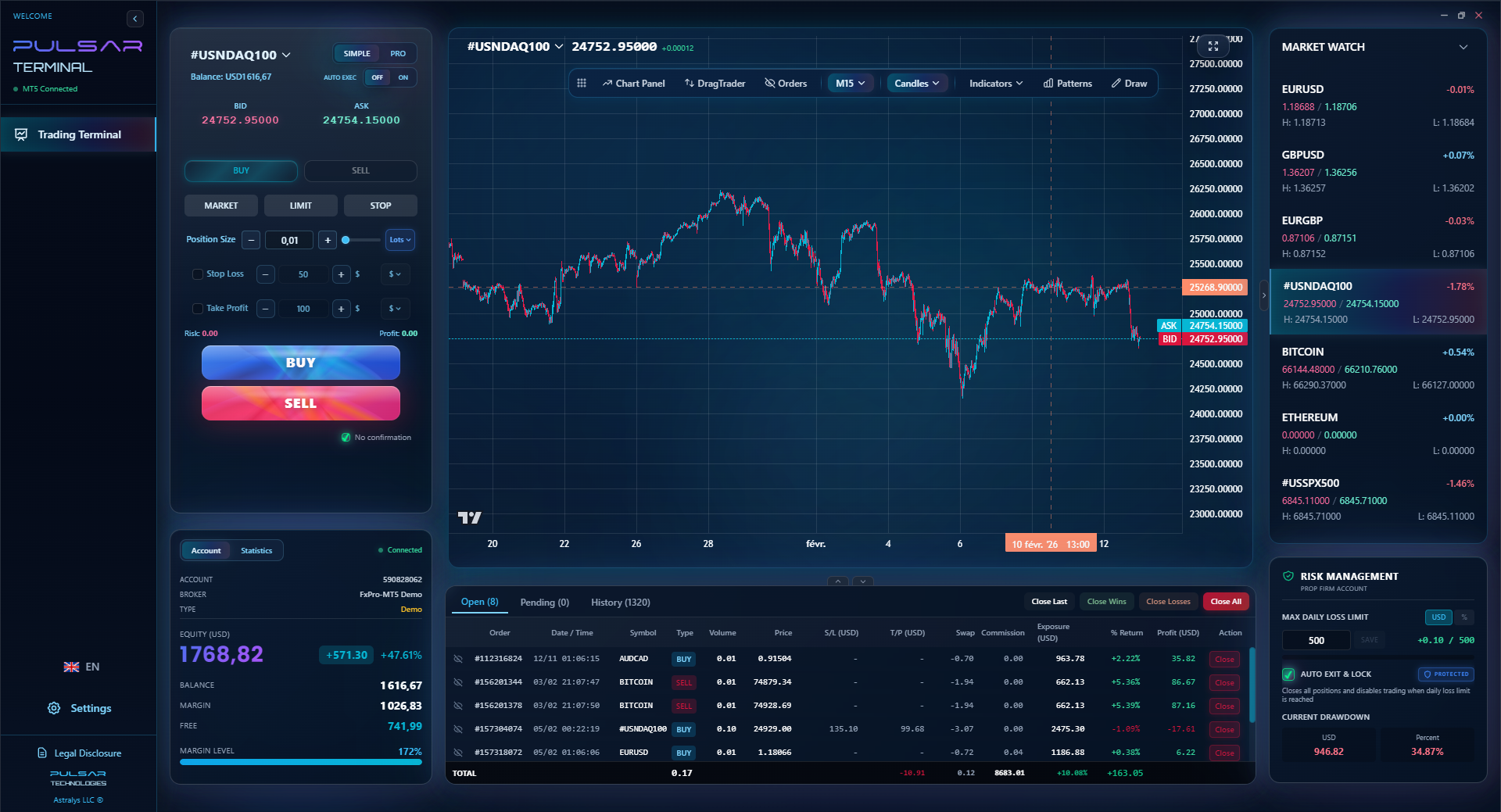
Manually moving stop-losses to breakeven is a chore; Pulsar Terminal automates it with one click, locking in risk-free trades directly on your MT5 chart.
Pulsar Terminal
L'outil MT5 tout-en-un : ordres glisser-déposer, multi-TP/SL, trailing stop, grid trading, Volume Profile et protection prop firm. Utilisé quotidiennement par 1 000+ traders.
“Your primary job is not to make money. Your primary job is to protect your capital.”
Let's talk about the ugly stuff, the mistakes that cost me money in my early years.
Mistake 1: Chasing use. My first broker offered me 1:500. I thought, 'Great! I can control more with less!' On a $200 account, that's $100,000 in buying power. A 20-pip move against me would wipe out my account. And it did. High use amplifies losses just as fast as gains. For swing trading, you rarely need more than 1:10 or 1:20.
Mistake 2: Ignoring the Spread on Exotic Pairs. I once tried trading USD/NGN on a platform. The spread was over 500 pips! I had to make 500 pips just to break even. For Nigerian traders, stick to major and minor pairs (EUR/USD, GBP/USD, USD/JPY, AUD/USD) where spreads are tight, often 1 pip or less.
Mistake 3: Not Testing Withdrawals First. I deposited $500, traded it to $700, and then couldn't withdraw. The broker demanded additional, bizarre documents. My advice? Before you deposit a significant amount, do a small test deposit (like $50), then immediately request a withdrawal of that $50. If the process is smooth and timely, you have more confidence. If it's a struggle, you've only lost $50, not your entire capital.
Mistake 4: Trading Without a Plan on Live Account. The demo account is for testing strategies. The live account is for executing a proven plan. The moment you start 'gambling' on hunches on your live account, you've blurred the line. Have a written plan for entry, exit, and risk before you log in.
💡 Conseil de Winston
If you feel a rush of excitement clicking 'buy' or 'sell', you're gambling. A real trade should feel as boring as filing a tax return.
“The trader who slowly grinds out consistent, small gains will outlast the one who blows up three accounts chasing the 'big win.'”
Creating the account is just the admin. Now, the trading begins. Your first month should be treated as an extended live test.
Journal Religiously: For every trade, record the pair, entry/exit price, lot size, the reason for entry (e.g., 'RSI divergence on H1 chart'), and your emotional state. I use a simple Google Sheet. After 20 trades, you'll see patterns. Are you losing on impulsive trades after 10 PM? Are your stop-losses too tight?
Develop a Simple, Repeatable Strategy. Don't use 10 indicators. Pick one or two you understand deeply, like the RSI indicator or MACD indicator, and learn how price action interacts with them on a specific time frame. Backtest it on your demo account. See if it would have worked over the last 3 months.
Focus on Risk, Not Reward. Your primary job is not to make money. Your primary job is to protect your capital. If you end the month with a 2% loss but you followed your rules perfectly, that's a better month than a 10% gain from reckless trades. Survival is the first objective.
Continuous Learning: The market changes. Read books, follow reputable analysts (not 'signal sellers'), and understand the macroeconomic factors that move your chosen pairs. Why does the XAU/USD (Gold) move inversely to the US dollar? Learning this context separates a gambler from a trader.
Remember, this is a marathon. The trader who slowly grinds out consistent, small gains with strict risk management will outlast the one who blows up three accounts chasing the 'big win.' Your account is your business. Manage it like one.
FAQ
Q1Is forex trading legal in Nigeria?
Yes, forex trading is legal for individuals in Nigeria. However, the Central Bank of Nigeria (CBN) does not license international brokers for retail trading. Nigerian traders legally use brokers regulated offshore (like by the FCA, ASIC). The legality is on your side as an individual investor.
Q2What is the minimum amount to create a forex account in Nigeria?
There's no single minimum. Some brokers allow you to start a live account with as little as $10 (approx ₦15,000), while others may require $100 or more. However, I strongly advise starting with a minimum of $200-$500. This allows for proper position sizing and risk management without being wiped out by a single small loss.
Q3Can I use my Nigerian debit card to fund my forex account?
Sometimes, but not always. Many Nigerian Visa/Mastercard debit cards have restrictions on international merchant transactions. Some brokers accept them, others don't. Bank transfer is the most reliable method, though slower. Cryptocurrency deposits are becoming a very common and fast alternative.
Q4How long does it take to verify my forex account?
With a reputable broker, verification typically takes 1 to 3 business days once you've uploaded clear copies of your ID and proof of address. If your documents are unclear or don't match your application details, it can take longer. Always ensure your documents are clear and valid.
Q5What's the difference between a demo account and a live account?
A demo account uses virtual money. It's for learning the platform and testing strategies risk-free. A live account uses your real money and connects to the real market. The key difference is psychology. You'll feel the emotional pressure with real money, which is why you must practice discipline on demo first.
Q6Which is better for Nigerians, MT4 or MT5?
Both are excellent. MT4 is incredibly popular, has more custom indicators, and is perfect for forex and CFD trading. MT5 is newer, can handle more asset classes (like stocks), and has more built-in indicators and timeframes. For a pure forex trader starting out, MT4 is simpler and has vast community support. Most brokers offer both.
Q7How do I withdraw my profits to my Nigerian bank account?
You initiate a withdrawal request in your broker's client portal. They will process it, usually via the same method you deposited (bank transfer back to your Nigerian account). The funds are converted from USD/EUR to Naira by your bank upon receipt. The process can take 3-7 business days. Expect to receive the Naira equivalent at your bank's own exchange rate.
La leçon du Prof. Winston
Points clés:
- ✓Verify broker regulation on the official regulator's website, not their own.
- ✓Start with a demo account for at least 2 months of consistent practice.
- ✓Your first live deposit should be money you are 100% prepared to lose.
- ✓Never risk more than 2% of your account on a single trade.
- ✓Test withdrawal functionality with a small amount before large deposits.
Cet article vous a-t-il été utile ?
Cliquez sur une étoile
Analyses Trading Hebdo
Analyses et stratégies hebdo gratuites. Pas de spam.
À propos de l'auteur
Olumide Adeyemi
Pionnier du Trading en Afrique de l'Ouest
L'un des formateurs de trading forex les plus actifs au Nigeria. 8 ans d'expérience de trading depuis Lagos. Spécialisé dans les stratégies à petit capital et les challenges de prop firms pour les traders africains.
Commentaires
Avertissement sur les risques
Le trading d'instruments financiers comporte des risques importants et peut ne pas convenir à tous les investisseurs. Les performances passées ne garantissent pas les résultats futurs. Ce contenu est fourni à titre éducatif uniquement et ne constitue pas un conseil en investissement. Effectuez toujours vos propres recherches avant de trader.
Vous aimerez aussi

Cara Trading Forex Sukses: 7 Prinsip dari Trader Profesional
Cara trading forex sukses dengan 7 prinsip trader pro: manajemen modal, disiplin, journal trading, backtest. Data nyata, bukan janji profit palsu.
Jam Trading Forex Terbaik untuk Trader Indonesia: Panduan Lengkap dengan Tabel Waktu
Panduan jam trading forex untuk trader Indonesia. Tabel 4 sesi dunia, jam emas 20:00-00:00, sesi mana yang harus dihindari. Data akurat + tips dari trader berpengalaman.
Top 5 Sàn Forex Uy Tín Nhất 2026: Review Jujur dari Trader Indonesia
Top 5 sàn forex uy tín 2026 untuk trader Indonesia. Review jujur: spread, deposit, withdraw, dukungan lokal. Exness, XM, IC Markets & lebih.
Obtenir Pulsar Terminal
Tous ces calculateurs sont intégrés dans Pulsar Terminal avec des données en temps réel de votre compte MT5. Dimensionnement de position en un clic, gestion automatique des risques et calculs instantanés.
Obtenir Pulsar Terminal