


Let's be honest.

Olumide Adeyemi
Pionnier du Trading en Afrique de l'Ouest ·  Nigeria
☕ 11 min de lecture
Ce que vous apprendrez :
- 1Why Most Daily Analysis Is Trash (And What to Do Instead)
- 2The Nigerian Trader's Morning Routine (2026 Edition)
- 3Tools You Actually Need (Forget the Fancy Indicators)
- 4Reading the Naira to Trade the Dollar (The Indirect Edge)
- 5Turning Analysis Into Trades: The Execution Plan
- 6Common Pitfalls (And How I've Fallen Into Every One)
- 7Putting It All Together: A Sample Day in 2026
Let's be honest. Most 'daily forex analysis' you see online is recycled garbage. A few lines about support and resistance, a vague prediction, and a call to action. For a Nigerian trader dealing with a volatile Naira and real money, it's worse than useless - it's dangerous. I've blown accounts following that nonsense. This guide isn't about giving you daily predictions. It's about teaching you how to build your own daily analysis routine that actually works with the Nigerian market in 2026, cutting through the noise to find real, actionable setups.
The internet is flooded with 'experts' publishing daily forecasts. The problem? They're writing for a global audience, not for you sitting in Lagos or Port Harcourt. They ignore the specific liquidity crunches around month-ends when companies scramble for dollars. They don't factor in CBN policy announcements that can move USD/NGN by 5% in an hour.
I learned this the hard way in early 2024. I was following a popular European analyst's daily EUR/USD calls. He was right about the Euro's direction, but his entry points were based on London session liquidity. When I executed the same trade during our market hours, the spread on my broker was triple what he quoted, and a sudden CBN circular wiped out my stop loss before the London open even happened. I lost $420 on a trade that was 'technically' correct.
The fix? You must become the source. Your daily forex analysis should start with local context, then layer on the global picture. Don't let some guy in another time zone dictate your trading day.

Warning: If your daily analysis doesn't first ask 'What is the Naira doing today and why?', you're already behind. Even if you trade EUR/USD, shifts in USD/NGN sentiment can ripple into dollar strength globally.
Start your day by checking the official and parallel market rates for the Naira. This isn't for trading USD/NGN directly (that's a whole other beast), but for gauging dollar demand pressure. Then, and only then, open your charts to the majors.
“Your daily forex analysis should start with local context, then layer on the global picture.”
Your first 30 minutes are sacred. This isn't about finding a trade immediately. It's about gathering intelligence. Here's my exact routine, refined after 12 years and adapting to the 2024-2026 CBN reforms.
Step 1: The Macro Pulse (5 mins)
I open three tabs:
- A reliable financial news site filtered for 'Nigeria CBN' and 'Forex'.
- The website of the Financial Markets Dealers Quotations (FMDQ) for official NAFEX rates.
- A trusted parallel market tracker (you know the ones). I'm looking for discrepancies. A widening gap between official and parallel often signals impending volatility, as it did dramatically in 2024.
Step 2: The Global Dashboard (10 mins)
I then check the global landscape. Did the US Fed say something overnight that strengthened the dollar? What's the price of Brent Crude? (This is huge for Nigeria's FX reserves). I use an economic calendar to see what's scheduled for the day - US CPI, ECB speeches. I note the times. A major US data release at 1:30 PM GMT will happen during our late afternoon. Liquidity will dry up just before it, then go crazy.
Step 3: Chart Review & Level Setting (15 mins)
Now I open my platform. I'm not drawing 50 lines. I'm looking for three things on the pairs I trade (usually EUR/USD, GBP/USD, and XAU/USD):
- Where did price close yesterday? This tells me the short-term sentiment.
- What are the clear, obvious highs and lows from the past week? These are my potential support and resistance areas. I draw horizontal lines there.
- Is price currently near one of these levels? If it's sitting right under resistance, I know to be cautious about buying.
This whole process gives me a map for the day. I know where the local landmines (CBN news) might be, where the global fireworks (economic data) are scheduled, and where price might react on my charts. I then use my position size calculator to determine my risk for the day before I even see a setup.

💡 Conseil de Winston
Your first loss is your best loss. If a trade hits your stop immediately after entry, your analysis was likely wrong on timing. Taking that small, planned loss is a sign of discipline, not failure. Re-enter only if a new, clearer signal forms.
“Clean your charts. Analysis and execution are separate mindsets.”
Brokers love to show you platforms with 200 indicators. You need about four. I've paid for every tool under the sun, and I keep coming back to the basics.
- Price Action & Horizontal Lines: Your primary tool. The market respects previous price extremes. Drawing these levels is the core of my swing trading and intraday analysis.
- A Simple Moving Average (SMA): I use the 50-period and 200-period on the 4-hour chart to define the broader trend. Is price above or below the 200 SMA? That's my simple trend filter. No need to overcomplicate it.
- The RSI Indicator: Not for overbought/oversold signals - that's a trap. I use the RSI indicator to look for divergence. When price makes a new high but RSI makes a lower high, it can signal weakening momentum. This saved me from buying a false GBP/USD breakout last month.
- Volume (if your broker provides real data): In Nigeria, with many using brokers like Exness or IC Markets, you might get tick volume, which is a proxy. A spike in volume at a key level confirms the move is real.

Pro Tip: Clean your charts. I have one template for analysis: a clean candlestick chart with a few horizontal lines and two SMAs. My trading template has my entry and stop-loss tools ready. Analysis and execution are separate mindsets.
Forget the 'magic' system. The CBN's move to the Bloomberg EFEMS in late 2024 made price action cleaner and more technical for the official market. Your analysis tools should be just as transparent.
“Clean your charts. Analysis and execution are separate mindsets.”
You might not be trading USD/NGN pairs directly (the spreads can be wild), but you must understand them. The Naira is your leading indicator for dollar sentiment.
Here's the logic: When there's intense pressure on the Naira (parallel rate spiking), it often reflects a broad-based dollar shortage or strong dollar demand within Nigeria. This local demand can be a microcosm of a global trend. If the Naira is getting hammered and USD/NGN is rising sharply, it often coincides with broader US Dollar strength on the global stage. This means pairs like EUR/USD and GBP/USD are more likely to be in a downtrend.
In June 2024, I saw the parallel market gap blow out. Instead of panicking, I checked EUR/USD. It was struggling at a key resistance level on the daily chart. The Naira weakness gave me the conviction that dollar strength was the real theme. I shorted EUR/USD at 1.0720 with a tight stop. The pair sold off hard over the next two days, and I took profit at 1.0650. The Naira told the story first.
Monitor these key Naira-related events:
- CBN MPC Meeting Dates & Outcomes: Interest rate decisions directly affect carry trades and hot money flows.
- Monthly FAAC Allocations: When states get money, dollar demand can increase.
- Oil Price Movements: Up = better for reserves, can stabilize the Naira. Down = pressure.
This context turns you from a passive chart reader into an informed market participant. You're not just trading lines; you're trading the flow of money in and out of your own economy.
💡 Conseil de Winston
The parallel market rate isn't a trading signal, it's a sentiment gauge. A sudden spike doesn't mean 'sell the Naira' on your broker - it often means 'the dollar is broadly in demand.' Use it for context, not for entries.
“The Naira is your leading indicator for dollar sentiment.”
Analysis is pointless without a clear plan. Here’s how I bridge the gap. Let’s say my morning analysis shows:
- Naira is stable, no major CBN news expected.
- EUR/USD is in a weekly range, currently trading near the bottom of that range (a support area).
- The 4-hour MACD indicator is showing a potential bullish crossover.
- A major US data release is due in 4 hours.
My trade plan is NOT 'Buy EUR/USD.' It's specific:
Scenario: Buy on a bullish price action confirmation (e.g., a strong bullish engulfing candle closing above the support zone) BEFORE the US data. Entry: $1.0850 Stop Loss: $1.0820 (30 pips, below the recent swing low) Take Profit 1: $1.0880 (30 pips, partial profit) Take Profit 2: $1.0910 (60 pips, at the range midpoint) Risk: 1% of my account. Invalidation: If price slices through $1.0820 without hesitation, my analysis is wrong. I stay out.
I write this down. This discipline prevents me from moving my stop loss or turning a scalp into a 'long-term investment' as it goes against me. Managing multiple take-profit levels manually is stressful. This is where a tool that automates partial closures is a lifesaver, letting you lock in profit without babysitting the trade.

Example: On a $1,000 account, 1% risk is $10. With a 30-pip stop loss on EUR/USD, my position size is roughly $3,330 (or 0.33 standard lots). I'd use a position size calculator to get this exact. Never guess.
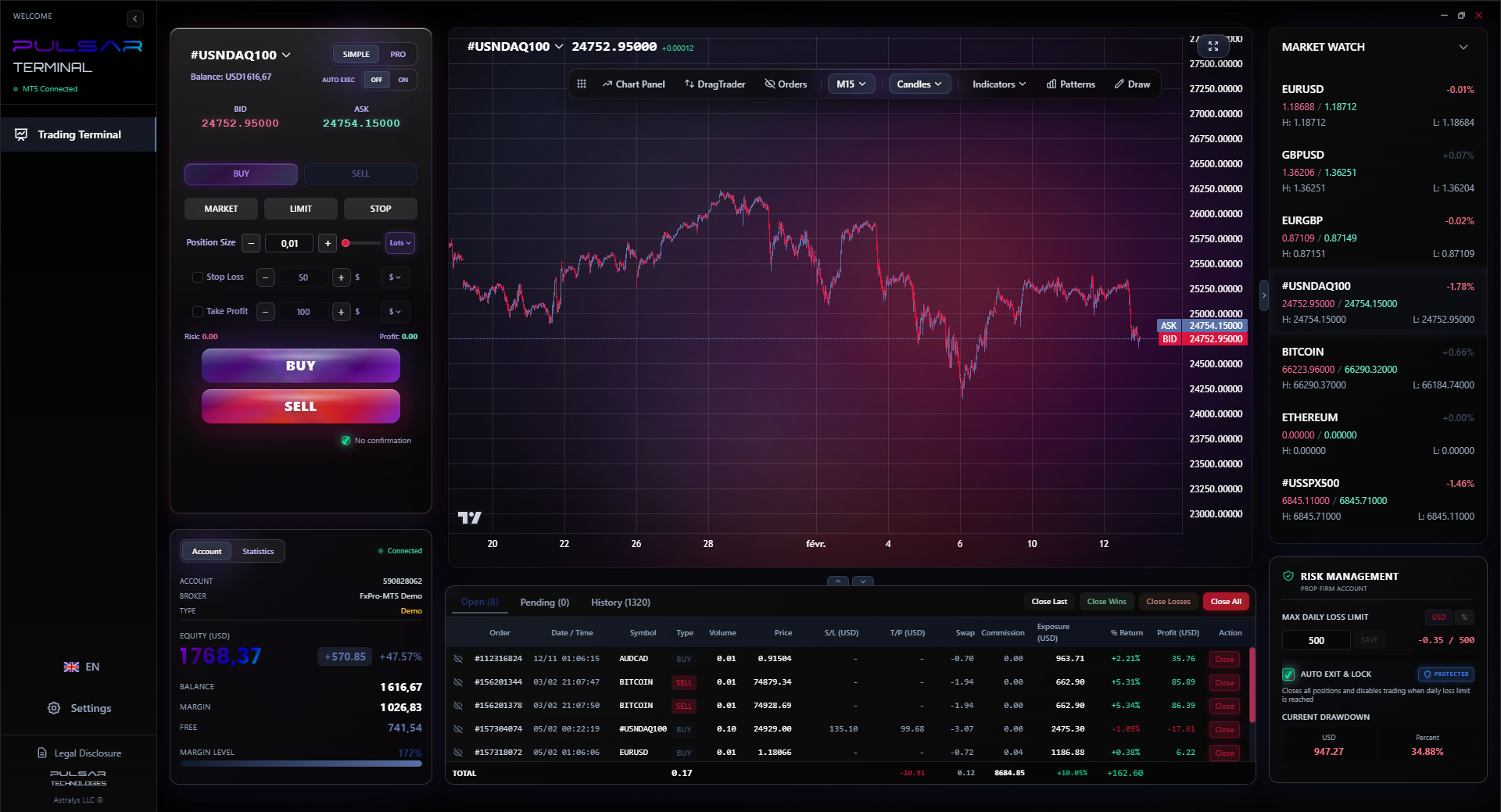
Sticking to a detailed trade plan with multiple take-profit levels is what separates pros from amateurs, and Pulsar Terminal automates this execution directly on your MT5 platform.
Pulsar Terminal
L'outil MT5 tout-en-un : ordres glisser-déposer, multi-TP/SL, trailing stop, grid trading, Volume Profile et protection prop firm. Utilisé quotidiennement par 1 000+ traders.
“The Naira is your leading indicator for dollar sentiment.”
Let's get real about mistakes. I've made them so you don't have to.
Pitfall 1: Overtrading on Thin Liquidity. The worst time to trade for us is often early afternoon (WAT), after London lunch and before New York wakes up. Spreads widen, and price can be jerked around. I've been stopped out on perfect setups because I traded during this dead zone. Now, I avoid new entries between 1 PM and 3 PM WAT unless volatility is exceptionally high.
Pitfall 2: Ignoring the Spread. That shiny 0.0 pip spread advertised by your broker? It's usually for EUR/USD at 3 PM GMT under perfect conditions. Check the spread on your platform at 9 AM WAT. It might be 2 pips. If your profit target is 10 pips, the spread just ate 20% of your potential gain. Factor it in. This is why I prefer brokers known for consistent pricing, like Pepperstone or XM, especially for a scalping strategy.
Pitfall 3: Chasing Parallel Market News. Rumors fly on WhatsApp and Twitter. 'CBN to devalue tomorrow!' Most are noise. I once bought USD/JPY on a Naira devaluation rumor, only for the CBN to issue a stabilizing statement. I was in the right instrument for the wrong reason and got whipped. Wait for official communication or confirmed price action.
Pitfall 4: Not Accounting for Payment Delays. You see a great setup, but your account is low. You make a deposit from your Nigerian bank to your international broker. It takes 3 hours to clear. The setup is gone. Plan your funding in advance, not in the heat of the moment.
💡 Conseil de Winston
The most profitable hour of your week should be spent reviewing your journal, not analyzing charts. Find your recurring mistake and fix just that one thing. Progress is incremental.
“The goal isn't to trade every day. It's to be ready for the high-probability days your analysis uncovers.”
Let's walk through a hypothetical Wednesday.
7:30 AM WAT: My routine. News check: CBN left rates unchanged yesterday, as expected. NAFEX rate is ₦1,238/USD, parallel is ₦1,255. Stable, slight gap. Oil is up 1%. US CPI data is due at 1:30 PM WAT.
7:45 AM: Chart review. Gold (XAU/USD) rallied to $2,180 but is now pulling back to $2,170. This was a prior resistance area that could now act as support. The daily trend is still up. US CPI could cause volatility.
8:30 AM: I define my plan. I will look for a bullish reaction (a bounce) off the $2,170 area in XAU/USD BEFORE the CPI data. If price just sits there, I do nothing. If it drops through $2,165, I'm out. My trade would be:
- Buy Limit: $2,171
- Stop Loss: $2,165 (60 pips)
- Take Profit 1: $2,180 (90 pips)
- Take Profit 2: $2,190 (190 pips)
- Risk: 0.5% of my account (lower due to pre-event risk).
1:00 PM: Price tapped $2,170.50 and bounced to $2,173. My buy limit wasn't hit, but the bullish reaction is there. I decide NOT to chase it. The CPI is in 30 minutes. I wait.
1:30 PM: CPI data is hot. Dollar spikes, Gold drops instantly to $2,168. My hypothetical order would have been triggered and immediately hit for a loss. By waiting, I saved my capital. The market gave me information (the weak bounce) and I listened.
3:00 PM: Post-CPI chaos settles. Gold finds a base at $2,162, a new support level. I note this for tomorrow's analysis. My job today was to not lose money. That's a win.
This is daily forex analysis in action. It's 10% finding trades and 90% managing risk, patience, and yourself. The goal isn't to trade every day. It's to be ready for the high-probability days your analysis uncovers.
FAQ
Q1What's the most important piece of daily analysis for a Nigerian trader?
The mood of the Naira. Before you even look at EUR/USD, check the official (NAFEX) and parallel market rates. A stable or strengthening Naira suggests calmer conditions. A widening gap or sharp parallel market move signals potential volatility that can affect all dollar pairs. It's your local canary in the coal mine.
Q2How much time should I spend on daily analysis?
30-45 focused minutes is enough. More than that and you're over-analyzing or chasing confirmation. The goal is to get a clear picture, set your levels, and define your plan. Then step away from the charts until your setup appears. Staring at screens all day leads to impulsive, emotional trades.
Q3I use a prop firm. Does my daily analysis change?
Absolutely, and it becomes more critical. Prop firms have strict daily loss limits. Your analysis must be tighter, and your risk management ruthless. A single bad trade can blow your challenge. Your daily focus should be on preserving capital first, finding one high-conviction setup second. Tools that help automate stop-losses and protect your daily drawdown are not just convenient; they're essential for survival.
Q4Can I rely on the analysis from my broker or Telegram groups?
No. At best, it's generic. At worst, it's a deliberate pump to create liquidity for someone else's trade. Use them for ideas, but never for your entry and exit decisions. You must do your own work. I've seen too many 'sure calls' in groups lead to a margin call for the followers.
Q5What's one tool that improved my daily analysis the most?
A trading journal. Noting down my daily analysis, my planned trades, and then what actually happened was humbling and educational. It showed me my biases (I was consistently missing sell signals) and helped me refine my process. The best tool is the one that helps you learn from yourself.
Q6How do I handle major news like US Non-Farm Payrolls?
You have two choices: 1) Be flat. Close all positions 30 minutes before the release and don't trade until the volatility settles (usually 15-30 minutes after). This is the safest. 2) If you must trade, use absurdly wide stop losses (think 50-100 pips on majors) and expect whipsaws. Most Nigerian retail accounts can't handle the second option. I choose option 1 almost every time.
Q7Is technical analysis enough, or do I need fundamental analysis too?
You need both, but in the right proportion. Fundamentals (CBN policy, oil prices, US interest rates) set the long-term direction - the 'why'. Technical analysis shows you the 'when' and 'where' to enter. Your daily analysis uses fundamentals for context (is the trend my friend today?) and technicals for precise entries. Ignoring fundamentals in Nigeria's regulated market is a sure way to get blindsided.
La leçon du Prof. Winston
Points clés:
- ✓Start your analysis with USD/NGN sentiment, not EUR/USD charts.
- ✓Spend 30 minutes planning, not 8 hours staring at screens.
- ✓Factor in real Nigerian spreads, not the broker's advertised ones.
- ✓A trading journal is more valuable than any new indicator.
Cet article vous a-t-il été utile ?
Cliquez sur une étoile
Analyses Trading Hebdo
Analyses et stratégies hebdo gratuites. Pas de spam.
À propos de l'auteur
Olumide Adeyemi
Pionnier du Trading en Afrique de l'Ouest
L'un des formateurs de trading forex les plus actifs au Nigeria. 8 ans d'expérience de trading depuis Lagos. Spécialisé dans les stratégies à petit capital et les challenges de prop firms pour les traders africains.
Commentaires
Avertissement sur les risques
Le trading d'instruments financiers comporte des risques importants et peut ne pas convenir à tous les investisseurs. Les performances passées ne garantissent pas les résultats futurs. Ce contenu est fourni à titre éducatif uniquement et ne constitue pas un conseil en investissement. Effectuez toujours vos propres recherches avant de trader.
Vous aimerez aussi

Cara Trading Forex Sukses: 7 Prinsip dari Trader Profesional
Cara trading forex sukses dengan 7 prinsip trader pro: manajemen modal, disiplin, journal trading, backtest. Data nyata, bukan janji profit palsu.
Jam Trading Forex Terbaik untuk Trader Indonesia: Panduan Lengkap dengan Tabel Waktu
Panduan jam trading forex untuk trader Indonesia. Tabel 4 sesi dunia, jam emas 20:00-00:00, sesi mana yang harus dihindari. Data akurat + tips dari trader berpengalaman.
Top 5 Sàn Forex Uy Tín Nhất 2026: Review Jujur dari Trader Indonesia
Top 5 sàn forex uy tín 2026 untuk trader Indonesia. Review jujur: spread, deposit, withdraw, dukungan lokal. Exness, XM, IC Markets & lebih.
Obtenir Pulsar Terminal
Tous ces calculateurs sont intégrés dans Pulsar Terminal avec des données en temps réel de votre compte MT5. Dimensionnement de position en un clic, gestion automatique des risques et calculs instantanés.
Obtenir Pulsar Terminal