


Here's a fact that might surprise you: in 2025, the average daily trading volume for the entire South African forex market was nearly $21.4 billion.

David van der Merwe
Trader des Marchés Émergents ·  South Africa
☕ 9 min de lecture
Ce que vous apprendrez :
Here's a fact that might surprise you: in 2025, the average daily trading volume for the entire South African forex market was nearly $21.4 billion. That's a massive, liquid ocean of money. Bitcoin's daily volume? It fluctuates wildly, but it's a fraction of that. Most new traders I meet think they're basically the same game - just clicking buttons to make money. They're wrong. The difference between forex and bitcoin isn't just about what you're trading; it's about operating in two completely separate worlds with different rules, risks, and rhythms. Let me walk you through what 12 years of trading both has taught me, specifically for our South African context.
This is the core of it. You're not just trading green and red candles; you're trading fundamentally different things.
Forex is the exchange of national currencies. You're betting on the economic health of countries. When you trade EUR/USD, you're weighing the European Central Bank against the US Federal Reserve. When you trade USD/ZAR, you're directly trading on the sentiment around South Africa's economy, our interest rates, and political stability. It's a centralized, government-backed system. The value comes from trust in institutions.
Bitcoin is a digital asset on a decentralized network. There's no central bank, no government backing it (though the FSCA now regulates the platforms). Its value is driven by adoption, technological belief, scarcity (only 21 million will ever exist), and pure market sentiment. It's more like trading a volatile, global digital commodity than a currency, despite the name.

Warning: Don't call Bitcoin 'digital forex.' It sets the wrong expectation. Forex moves on economic data; Bitcoin can rocket or crash on a single tweet from a tech billionaire. The psychology is completely different.
I learned this the hard way early on. I treated a Bitcoin trade like a forex swing trade, expecting 'normal' pullbacks. In late 2020, I bought BTC at $18,500, expecting a steady climb. It promptly dropped 25% to around $14,000 in a week. My forex-trained mind said 'cut the loss, the trend is broken.' I did. It then proceeded to rally to $64,000 over the next few months. My mistake was applying forex market logic - where such a deep, fast retracement often signals a major reversal - to an asset that operates on a different emotional frequency.

💡 Conseil de Winston
Volatility isn't your enemy; not respecting it is. A 5% move in Bitcoin requires a different position size than a 5% move in USD/ZAR. Always calculate your risk in Rands, not just percentages.
This is where it gets very local, and you can't afford to get it wrong. The regulatory landscape defines your protection, your tax bill, and what you're allowed to do.
Forex Regulation: The FSCA Guardrails
Forex trading here is wrapped in a well-established regulatory blanket. The Financial Sector Conduct Authority (FSCA) licenses all legitimate brokers as Financial Service Providers (FSPs). This means client money should be segregated, there are reporting standards, and you have a formal channel for complaints. The South African Reserve Bank (SARB) also governs how much capital you can move offshore (remember your R1 million single discretionary and R10 million foreign investment allowances).
When you choose a broker like Exness, IC Markets, or Pepperstone, you must check their FSP number on the FSCA website. It's non-negotiable.
Bitcoin Regulation: The New Frontier
Crypto regulation has evolved fast. Since October 2022, the FSCA has declared crypto assets as 'financial products.' This means the platforms you use, like VALR or Luno, must now be licensed as Crypto Asset Service Providers (CASPs). As of early 2026, over 300 have been approved. This is good - it adds a layer of security and legitimacy.
Two huge local specifics:
- Tax: SARS treats crypto as an intangible asset. Any profit from selling is subject to Capital Gains Tax (up to 18% for individuals). If you earn crypto (like from staking), it's income tax. Keep careful records.
- The May 2025 Court Ruling: This was massive. The High Court ruled crypto is not subject to SARB exchange controls. Why? Because it's not considered 'money' or 'capital' under the old laws. This clarified a grey area and made moving crypto value across borders simpler than moving Rands.

Pro Tip: For forex, your broker handles tax withholding on certain instruments. For crypto, you're 100% responsible for declaring every disposal to SARS. Use a spreadsheet or tracking app from day one.
“The High Court ruled crypto is not subject to SARB exchange controls. This clarified a grey area and made moving crypto value across borders simpler than moving Rands.”
Imagine forex as a well-organised, 24-hour-a-day weekday concert. Bitcoin is an unpredictable, never-ending festival that can have mosh pits form at 3 AM on a Sunday.
| Feature | Forex | Bitcoin |
|---|---|---|
| Trading Hours | 24/5. Closes Friday night, opens Sunday night. | 24/7/365. Never sleeps. |
| Volatility | Generally lower. Major pairs might move 0.5-1% daily. | Extremely high. 5-10% daily moves are common; 20%+ happens. |
| Liquidity | Enormous. The ZAR market alone turns over billions daily. | Varies. Deep during bull markets, can thin out in bear markets. |
| Key Drivers | Interest rates, GDP, employment data, geopolitics. | Sentiment, adoption news, regulatory headlines, tech updates. |
The liquidity difference is crucial. In forex, especially with majors like EUR/USD, you can usually get in and out at the price you see. Slippage is minimal. In Bitcoin, during a violent move, the price you click and the price you fill can be wildly different. I've seen a market order slip by over $200 in seconds during a news event.
This volatility is a double-edged sword. It creates opportunity for fast profits, but it also makes risk management your absolute number one priority. A 2% stop-loss in forex is conservative. In crypto, it can get taken out by regular market noise. You need wider stops, which means trading smaller position sizes to keep your risk in check. Always use a position size calculator.
Forex has predictable event cycles (like US Non-Farm Payrolls at 3:30 PM SA time). Bitcoin's big moves can come anytime, often when you're least expecting it. This 24/7 nature can lead to burnout if you try to watch it constantly. You have to learn to walk away.
💡 Conseil de Winston
The May 2025 court ruling on crypto and exchange controls is a game-changer for South Africans. It simplifies moving value, but it also places the full tax responsibility on you. Document every transaction.
Let's talk real Rands and cents. The cost structures are different, and your choice of platform matters.
Forex Costs in SA
Your main cost is the spread (the difference between buy and sell price) and sometimes a commission. For a major pair like EUR/USD, you can find spreads as low as 0.6 pips with a good FSCA-regulated broker. On a standard lot (100,000 units), a pip is worth about $10. So a 0.6 pip spread costs you $6 to enter the trade.
- Minimum Deposits: These vary. Some brokers like XM start at $5, others like XM or AvaTrade at $100. Local broker Khwezi Trade offers ZAR accounts from R500.
- Platform: You'll likely use MetaTrader 4 or 5. It's free from your broker.
Bitcoin/Crypto Costs in SA
Your main cost is the trading fee, usually a percentage of the trade value.
- VALR: Maker fees can be as low as -0.01% (they pay you!) to 0.05%; taker fees are 0.18%-0.35%.
- Binance: Fees start around 0.04% for a taker, can be lower.
- Luno: Simple 0.15% fee for market (taker) orders.
Let's do a quick example. You buy R10,000 of Bitcoin on VALR as a taker. At 0.25% fee, that's R25 gone immediately. To break even, the price needs to move up by 0.25%. In forex, with a 0.6 pip spread on EUR/USD, your break-even move is just 0.00006 (6 pips).
How to Start:
- Forex: Open an account with an FSCA-licensed broker, deposit via EFT, download MT5, and start practicing on a demo account.
- Bitcoin: Sign up with a FSCA-licensed CASP (VALR, Luno, AltCoinTrader), complete FICA verification, deposit ZAR via EFT, and you can buy.

Example: Buying $10,000 of EUR/USD at a 0.6 pip spread costs ~$6. Buying R10,000 of BTC at a 0.25% fee costs R25. The crypto fee is proportionally higher on smaller trades.
“You can't use the same playbook for both. The markets behave too differently.”
You can't use the same playbook for both. The markets behave too differently.
Forex often trends well based on macroeconomic themes. Strategies like swing trading over days or weeks, using fundamentals combined with technical levels, can work. Pairs can range for long periods, so mean-reversion strategies also have their place. Indicators like the MACD or RSI are commonly used on hourly or daily charts.
Bitcoin is dominated by momentum and sentiment. During a bull market, it's a 'buy the dip' mentality. In a bear market, rallies are often sold. Because it's 24/7, scalping is more common, but the volatility makes it risky. I've found pure price action and order flow analysis more useful than lagging indicators in crypto.
Here's a personal lesson. I used to trade forex breakouts from key consolidation zones. I tried the same on Bitcoin. I'd buy when it broke above a clear resistance level on the 4-hour chart. More often than not, it would fake out, reverse sharply, and stop me out. These 'liquidity grabs' are far more frequent in crypto. I had to adjust by waiting for a close and follow-through above the level, or using a wider stop placed beyond obvious liquidity pools.
Risk management is the universal key, but its application changes. In forex, you might risk 1% per trade. In a volatile crypto trade, risking 0.5% might be wiser because the chance of a random, wide-ranging wick hitting your stop is higher. Understanding the margin call rules on your chosen platform is also critical, as crypto's volatility can trigger them faster.
💡 Conseil de Winston
If you trade both markets, keep two separate trading journals. The emotional tone of a crypto trading day is different from a forex day. Don't let the frenzy of one corrupt the discipline of the other.
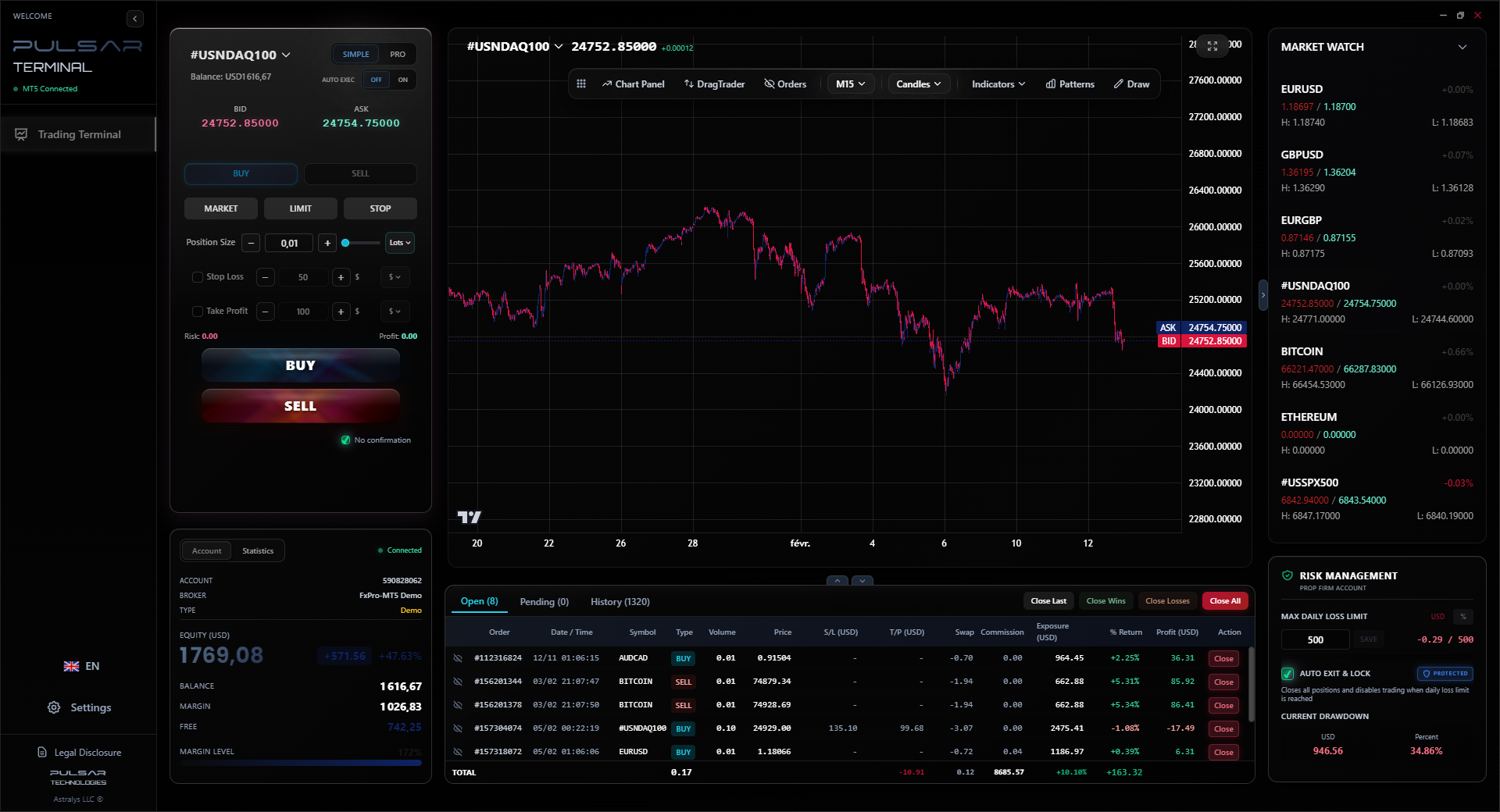
Managing multiple trades and precise exits in volatile markets is key, and tools like Pulsar Terminal automate advanced order types like multi-TP/SL and trailing stops directly on your MT5 platform.
Pulsar Terminal
L'outil MT5 tout-en-un : ordres glisser-déposer, multi-TP/SL, trailing stop, grid trading, Volume Profile et protection prop firm. Utilisé quotidiennement par 1 000+ traders.
This isn't about which is 'better.' It's about which suits your personality, schedule, and risk tolerance.
Consider Forex if:
- You prefer markets driven by tangible economic data.
- You want to trade during structured hours (you can switch off weekends).
- You have a lower risk tolerance and prefer more predictable, smaller daily moves.
- You're interested in the South African economy and trading the ZAR.
- You like using established technical analysis patterns.
Consider Bitcoin/Crypto if:
- You're comfortable with extreme volatility and higher risk for higher potential reward.
- You want 24/7 market access and don't mind the psychological pressure.
- You're tech-savvy and interested in the underlying blockchain technology.
- You believe in the long-term adoption story of digital assets.
- You can handle seeing your portfolio swing significantly in a single day.
Honestly, there's no rule against doing both. I do. I use forex for more steady, process-driven trading and allocate a smaller, separate 'risk capital' portion of my portfolio to crypto for higher-growth potential. The key is to keep the strategies and mindsets separate. Don't let the frantic energy of the crypto market seep into your forex trading discipline.
Start with a demo account for both. Get a feel for the pace. See which market 'rhythm' you naturally understand better. And never, ever risk money you can't afford to lose. That's the one universal truth in both worlds.
FAQ
Q1Is Bitcoin trading legal in South Africa?
Yes, absolutely. The FSCA regulates crypto assets as financial products. You must use a licensed Crypto Asset Service Provider (CASP) like VALR or Luno, which are fully legal and compliant with South African law, including FICA.
Q2Which is more volatile, forex or Bitcoin?
Bitcoin is significantly more volatile. While a major forex pair like EUR/USD might move 0.5-1% on a big day, Bitcoin can easily move 5-10% daily. This means greater potential profit and loss, requiring much stricter risk management.
Q3Do I pay tax on forex and Bitcoin profits in South Africa?
Yes, to both, but differently. Forex trading profits through a South African broker are typically subject to income tax. Bitcoin and other crypto profits are subject to Capital Gains Tax (up to 18% for individuals) when you dispose of them. You must declare all crypto activity to SARS.
Q4Can I trade Bitcoin on the same platform as forex (like MT5)?
Sometimes, but it's not direct. Some forex brokers offer Crypto CFDs (Contracts for Difference), which let you speculate on Bitcoin's price on MT5. However, you don't own the actual Bitcoin. To buy and hold real Bitcoin, you need a crypto exchange like VALR or Binance.
Q5What's the minimum amount needed to start trading forex vs. Bitcoin in SA?
For forex, some FSCA brokers like XM allow you to start with a $5 (approx. R90) minimum deposit. For buying actual Bitcoin, you can start with as little as R50 on an exchange like Luno. However, trading with such small amounts is very limiting and not recommended for learning proper position sizing.
Q6Are my funds safe with South African forex brokers and crypto exchanges?
With FSCA-licensed entities, your safety is significantly higher. Regulated forex brokers must segregate client funds. Licensed CASPs (crypto exchanges) must also comply with strict operational standards. Always verify the provider's FSP or CASP license number on the FSCA website before depositing any money.
Q7Can I use my South African Rand (ZAR) to trade both?
Yes. Most local forex brokers offer ZAR-denominated accounts. All major South African crypto exchanges allow you to deposit and withdraw ZAR directly via EFT. The USD/ZAR pair itself is also a major forex market you can trade.
La leçon du Prof. Winston
Points clés:
- ✓Forex is centralized & economic; Bitcoin is decentralized & sentiment-driven.
- ✓FSCA regulates both, but tax treatment differs: income tax vs. CGT.
- ✓Bitcoin's 24/7 volatility demands wider stops & smaller position sizes.
- ✓South Africans can use ZAR directly for both markets via local platforms.
Cet article vous a-t-il été utile ?
Cliquez sur une étoile
Analyses Trading Hebdo
Analyses et stratégies hebdo gratuites. Pas de spam.
À propos de l'auteur
David van der Merwe
Trader des Marchés Émergents
Trader basé à Johannesbourg avec 11 ans d'expérience sur les devises des marchés émergents. Spécialisé dans les paires ZAR, le trading régulé par la FSCA et l'analyse du marché sud-africain.
Commentaires
Avertissement sur les risques
Le trading d'instruments financiers comporte des risques importants et peut ne pas convenir à tous les investisseurs. Les performances passées ne garantissent pas les résultats futurs. Ce contenu est fourni à titre éducatif uniquement et ne constitue pas un conseil en investissement. Effectuez toujours vos propres recherches avant de trader.
Vous aimerez aussi

Cara Trading Forex Sukses: 7 Prinsip dari Trader Profesional
Cara trading forex sukses dengan 7 prinsip trader pro: manajemen modal, disiplin, journal trading, backtest. Data nyata, bukan janji profit palsu.
Jam Trading Forex Terbaik untuk Trader Indonesia: Panduan Lengkap dengan Tabel Waktu
Panduan jam trading forex untuk trader Indonesia. Tabel 4 sesi dunia, jam emas 20:00-00:00, sesi mana yang harus dihindari. Data akurat + tips dari trader berpengalaman.
Top 5 Sàn Forex Uy Tín Nhất 2026: Review Jujur dari Trader Indonesia
Top 5 sàn forex uy tín 2026 untuk trader Indonesia. Review jujur: spread, deposit, withdraw, dukungan lokal. Exness, XM, IC Markets & lebih.
Obtenir Pulsar Terminal
Tous ces calculateurs sont intégrés dans Pulsar Terminal avec des données en temps réel de votre compte MT5. Dimensionnement de position en un clic, gestion automatique des risques et calculs instantanés.
Obtenir Pulsar Terminal