


I watched my screen turn red.

Olumide Adeyemi
Pionnier du Trading en Afrique de l'Ouest ·  Nigeria
☕ 12 min de lecture
Ce que vous apprendrez :
- 1Why Economic News Moves Markets (It's Not Just Numbers)
- 2The Big Five: Economic Events That Actually Matter
- 3Three Strategies for Trading Economic News (Beyond Gambling)
- 4Practical Advice for the Nigerian Trader
- 5Essential Tools and How to Set Up Your Station
- 6Mistakes I Made (So You Don't Have To)
- 7Putting It All Together: A Sample Trade Plan

I watched my screen turn red. It was a Thursday afternoon in Lagos, and the US Core PCE Price Index data had just hit. I was long on EUR/USD, convinced the number would be soft. It wasn't. In less than a minute, my position was down ₦450,000. The spread widened to 15 pips, my stop-loss got skipped, and the liquidity vanished. That loss, back in 2022, wasn't just bad luck. It was a brutal education in the raw power of economic news forex. Here’s everything I wish I’d known before I placed that trade.
At its core, economic news forex trading is about one thing: future interest rates. Every data release is a clue for traders trying to guess what central banks will do next. A high inflation print? That pressures the central bank to hike rates. Higher rates typically strengthen a currency because they attract foreign investment seeking better returns. It's that simple, and that complex.
But here's what most new traders miss. The market doesn't react to the number. It reacts to the number relative to expectations. I learned this the hard way. In early 2023, the US NFP came out at +200k jobs. A strong number, right? The market sold the dollar. Why? Because the consensus forecast was +250k. The actual data was a miss. The price movement is all about the surprise element, the gap between whisper numbers on trading desks and the official print.
This expectation game is why you see such violent moves. Algorithms are programmed to buy or sell based on predefined thresholds versus forecasts. When the data crosses that line, thousands of orders trigger simultaneously. That's what causes the 50-pip spikes in a heartbeat, the kind that wiped out my earlier trade. Understanding this dynamic is the first step from being a victim of the news to trading it strategically.

Warning: Trading the actual news release is the most dangerous game in forex. The spreads are insane, liquidity is thin, and stops are not guaranteed. I don't recommend it for anyone with less than two years of live trading experience. Consider it advanced warfare.
“Economic news forex trading isn't about the number; it's about the gap between expectation and reality.”
The economic calendar is packed, but 80% of the major moves come from about 20% of the events. Focus your energy here.
1. Central Bank Interest Rate Decisions & Statements
This is the king. For Nigeria, the CBN's MPC meetings are crucial for USD/NGN. Globally, the US Federal Reserve (FED), European Central Bank (ECB), and Bank of England (BOE) drive the majors. The rate decision itself is often priced in. The real volatility comes from the accompanying statement and the press conference. A single changed word - 'patient' vs. 'vigilant' - can swing markets. I once caught a 120-pip move on GBP/USD not from the BOE's hold, but from their governor mentioning 'underlying inflation persistence.'
2. US Non-Farm Payrolls (NFP)
The first Friday of every month is circus day. This US jobs report is the biggest monthly volatility event for USD pairs. It's a liquidity monster. My rule? I never hold a position into NFP unless it's a long-term swing trade with a very wide stop. The scalping strategy you use on a quiet Tuesday afternoon will get annihilated at 1:30 PM WAT on NFP day.
3. Inflation Data (CPI, PCE)
This is what my ₦450k lesson was about. Consumer Price Index (CPI) and the Fed's preferred Core PCE. These reports directly dictate central bank policy. A hot print means more hikes are coming, which can turbocharge a currency.
4. GDP Growth Rates
Gross Domestic Product figures confirm or deny recession fears. A strong GDP can override weak secondary data. Watch for revisions to previous quarters too; they can be just as market-moving.
5. Geopolitical & 'Risk' Events
These aren't on a calendar, but they dominate headlines. Elections (like Nigeria's), sudden OPEC+ announcements on oil production (huge for USD/NGN), or unexpected political statements. They create a 'risk-on' or 'risk-off' mood. In risk-off, everyone buys the US dollar and Japanese yen. It's a blanket move.

Example: Let's say US CPI is forecast at 3.1% year-over-year. Actual result comes out at 3.4%. That's a significant upside surprise. Expect: USD to strengthen rapidly against most pairs, especially against yield-sensitive currencies like the Japanese Yen (USD/JPY up). Gold (XAU/USD guide) will likely sell off, as higher rates make non-yielding assets less attractive.

💡 Conseil de Winston
The market's reaction to news tells you more about its underlying health than the news itself. A currency that fails to rally on good news is weak. One that doesn't fall on bad news is strong. Watch the price action, not just the headline.
“The FOMO during a news spike is a siren song. Learning to ignore it is a trader's superpower.”
Blindly betting on red or green is a recipe for ruin. You need a plan. Here are three I've used, from safest to most aggressive.
1. The Pre-News Positioning Strategy (My Go-To) This involves analyzing the trend and sentiment before the news. If the market is already bullish on the USD due to hawkish Fed expectations, and a strong CPI print is expected, I might look to buy USD/JPY on a dip during the London session before the data. The idea is that the bullish trend is your friend, and the news is likely to reinforce it. If the news misses, my stop-loss gets hit for a small loss. If it hits or beats, the trend accelerates. This keeps me out of the chaotic first 60 seconds. It requires patience and a good read on market sentiment.
2. The Post-News Retracement Play After a big news spike, the price often 'retraces' or pulls back. It's like a rubber band stretching and then snapping back partway. Once the initial algorithmic frenzy dies down (wait 15-30 minutes), and the price starts to consolidate, I enter in the direction of the original news spike. My entry is on a small pullback towards a key RSI indicator level or a moving average. For example, if NFP beats and USD/JPY spikes 70 pips, then pulls back 25 pips, I might go long targeting a move back towards the initial high.
3. The Straddle/Volatility Strategy (High Risk) This is a pure volatility play. You place two pending orders: a buy stop above the current price and a sell stop below it, just before the news. Whichever way the market breaks, you're in. The key is to set a tight profit target (say, 20-25 pips) and a wider stop. The goal is to catch the initial explosive move and get out immediately. The huge risk? A 'whipsaw' where the price triggers both your buy and sell orders before hitting your stops, resulting in two losses. I've been caught in this. It requires a broker with lightning-fast execution and no requotes, like IC Markets or Pepperstone. You must also factor in the massively widened spread as part of your risk.
No matter the strategy, your position size calculator is your best friend. Volatility is high, so reduce your lot size. If you normally trade 0.5 lots, go down to 0.1 for a news event.

“The FOMO during a news spike is a siren song. Learning to ignore it is a trader's superpower.”
Trading from Nigeria adds unique layers. Our internet isn't always reliable, power goes out, and broker access can be fickle. Here’s how to adapt.
Internet & Power: Never trade a major news event on mobile data alone. Use a dedicated fibre line if possible, and have a UPS/inverter ready. I missed an exit once during 'Ibadan disco' (a common term for power cuts in my area) and it cost me. If your power is unstable, it's better to not be in the market at all during high-impact news.
Broker Choice: This is critical. You need a broker that offers raw spreads, handles volatility without freezing, and accepts seamless Nigerian deposits. For news trading, I've found Exness and XM to be solid for Naira-based traders. Always check their 'economic calendar' section and see if they issue warnings about widened spreads for specific events.
Local Context Matters: Don't just watch US and EU data. The Central Bank of Nigeria's (CBN) Monetary Policy Committee (MPC) decisions directly impact USD/NGN, which affects your purchasing power for foreign assets. A rate hike in Nigeria to fight inflation can temporarily strengthen the Naira, affecting your account balance if you're holding dollar profits. Also, local elections or government policy announcements can cause unexpected volatility in African FX pairs.
Mental Game: The FOMO (Fear Of Missing Out) during news is intense. You see a 100-pip candle and your brain screams 'Get in!'. Fight it. There will always be another trade. My worst losses came from chasing a move that was already over. Now, if I miss the initial breakout, I wait for the next day to assess the new trend. It's saved me countless times.
💡 Conseil de Winston
Your first loss is often your smallest. The desperate attempt to recover it during ongoing volatility is what destroys accounts. If you get stopped out on a news play, close the platform for an hour. The market will still be there.
“My worst losses came from chasing a move that was already over. Now, if I miss the initial breakout, I wait.”
You wouldn't go to battle without gear. Don't trade news without these.
1. A Reliable Economic Calendar: I use ForexFactory.com. It's free, customizable, and color-codes events by impact (red for high). Set the time zone to West Africa Time (WAT). Filter to show only high-impact events for the currencies you trade.
2. Live News Wire: The calendar gives you the time and forecast. A news wire (like Reuters Eikon or even a fast Twitter feed from reputable financial journalists) gives you the actual number the second it's released. That half-second advantage can be everything. Some brokers build this into their platforms.
3. Technical Confirmation: Never rely on news alone. Use simple technical tools to find confluent areas. I always have:
- A 200-period and 50-period Exponential Moving Average (EMA) on my chart.
- Horizontal lines at recent daily highs and lows (support/resistance).
- The MACD indicator on a slower setting (like 12,26,9) to gauge momentum. My best trades happen when a bullish news surprise hits right at a key technical support level on the daily chart. That's confluence.
4. A Trading Journal (Non-Negotiable): After every major news trade, write it down. What was the event? What was the forecast vs. actual? What was my position? Why did I enter? What was the result? Review this monthly. You'll start to see patterns in your own behavior - maybe you're great at trading CPI but terrible at GDP. Focus on your strengths.

Pro Tip: Create a pre-news checklist and stick to it. Mine is: 1) Check calendar for time/forecast. 2) Identify key technical levels above/below price. 3) Decide on strategy (Positioning, Retracement, or Avoid). 4) Calculate position size at 50% of normal. 5) Set alerts, not orders. 6) Wait. This routine removes emotion.
“My worst losses came from chasing a move that was already over. Now, if I miss the initial breakout, I wait.”
Let me be a cautionary tale. Here are my most expensive errors.
Mistake 1: Trading Without Understanding the 'Whisper Number'. The official forecast might be +200k jobs, but chatter on trading desks might suggest a number closer to +230k. If the actual print is +210k, it's a beat of the official forecast but a miss of the whisper. The market often reacts to the whisper. I learned to scan financial news headlines in the hour before the release for any last-minute analyst commentary.
Mistake 2: Placing Tight Stop-Losses Right Before News. This is a classic way to get 'stopped out' before the main move even happens. In the minutes before a release, market makers often widen spreads and hunt for liquidity. Your tight stop at 1.0850 on EUR/USD can get triggered at 1.0845 by a momentary spread widening, only for the price to then rocket to 1.0900 in your original direction. If you're going to hold into news, use a wider stop, or don't use one at all (only if you are monitoring live and accept the full risk).
Mistake 3: Adding to a Losing Position During Volatility. This is the killer. Your trade goes against you 20 pips on the news spike. 'It's overdone,' you think, and you double down. Then it goes another 30 pips against you. Now you're in a massive hole. News-driven moves can be irrational and extended. Never average down during an active news release. One loss is better than a catastrophic margin call.
Mistake 4: Ignoring Consecutive Data Releases. Sometimes, a medium-impact event follows a high-impact one 15 minutes later. You might trade the first release successfully, but then get reversed by the second. Always look at the full calendar for the day, not just the headline event.
💡 Conseil de Winston
Create a 'news volatility' rule. Reduce your standard position size by 60-70% for any trade taken within 2 hours of a high-impact event. This single rule has saved me from myself more times than any indicator.
“One loss is better than a catastrophic margin call. Never average down during an active news release.”
Let's walk through a recent, real example using the US CPI report.
The Setup: It's November 12, 2025. US CPI is due at 1:30 PM WAT. Forecast: 3.0%. Previous: 3.2%. The USD has been in a strong uptrend for two weeks on hawkish Fed talk. EUR/USD is trending down and is currently hovering near a major support level at 1.0650.
My Analysis & Plan:
- Trend: Bearish for EUR/USD (USD strength).
- News Expectation: A print at or above 3.0% should reinforce USD strength. A print below 3.0% could cause a USD sell-off.
- Key Level: 1.0650 support. A break below could lead to 1.0600.
- My Strategy: Pre-News Positioning. I will NOT trade the instant release. I will look to sell EUR/USD on a retest of a broken level after the news, provided the data is USD-positive.
The Play-By-Play:
- 1:30 PM: CPI prints at 3.1% (slight beat). USD spikes. EUR/USD drops from 1.0670 to 1.0630 in one minute.
- 1:45 PM: The initial spike settles. Price begins to retrace back up, as some traders take profit. It climbs to 1.0655 - this is the retest of the old support (now resistance) level.
- My Trigger: The price stalls at 1.0655, showing small bearish candlesticks on the 5-minute chart. The MACD indicator is rolling over below its signal line.
- My Entry: I sell at 1.0652. Stop-loss at 1.0675 (above the retest high). Take-profit target at 1.0600 (next major support).
- Result: The downtrend resumes over the next few hours. Price hits my target at 1.0600 the next day. A 52-pip gain.
Why This Worked:
- I avoided the initial, unpredictable volatility.
- I traded in the direction of the established trend, which was amplified by the news.
- I used a clear technical level (1.0650) for my entry trigger and risk management.
- My position size was 0.15 lots (reduced for volatility), risking about 0.8% of my account. The reward-to-risk ratio was nearly 2:1.
This is the disciplined approach to economic news forex. It's not about catching the very top or bottom. It's about waiting for the market to show its hand after the chaos, and then stepping in with a clear, rules-based plan. It's less exciting than gambling on the headline, but my account balance is a lot healthier for it. For managing trades like this with precision, especially setting multiple take-profit levels, having the right tools makes all the difference.

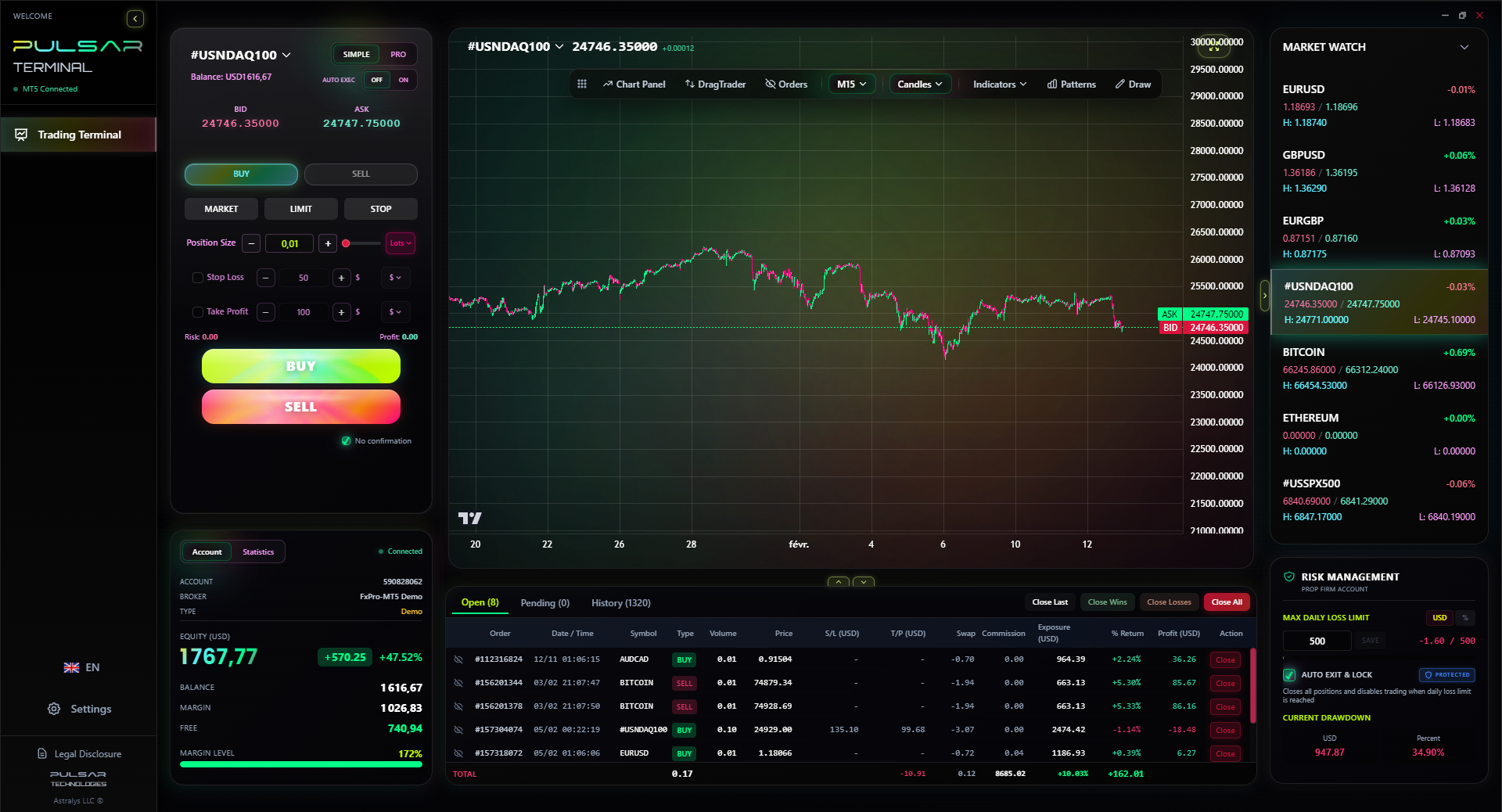
Managing multiple take-profit levels and a trailing stop on a volatile news trade is complex, but tools like Pulsar Terminal automate this directly on your MT5 chart, removing emotional decisions from the equation.
Pulsar Terminal
L'outil MT5 tout-en-un : ordres glisser-déposer, multi-TP/SL, trailing stop, grid trading, Volume Profile et protection prop firm. Utilisé quotidiennement par 1 000+ traders.
FAQ
Q1What is the best time to trade forex news in Nigeria?
The most volatile times are during European and US session overlaps with news releases. That's typically between 1:00 PM and 4:00 PM West Africa Time (WAT). This is when US data (like NFP at 1:30 PM WAT) and some European data is released. Ensure your internet and power are most stable during these hours.
Q2How much money do I need to start trading economic news?
I'd strongly advise against starting with news trading. But if you must, you need enough capital to withstand massive volatility. For a standard lot (100,000 units), a 50-pip move is $500. With a mini lot (10,000 units), it's $50. Start with a micro account (1,000 units) where a 50-pip move is $5. You need at least $500-$1000 to trade micro lots safely, using proper risk management of 1-2% per trade.
Q3Can I trade forex news on my phone?
You can, but I don't recommend it for the actual news spike. Mobile apps can lag, notifications can be delayed, and one dropped call can ruin you. Use your phone to monitor alerts and set orders, but for executing trades around high-impact news, a stable desktop computer with a wired internet connection is far superior.
Q4What is a 'pip' in forex news trading?
A pip is the smallest price move a currency pair can make, usually 0.0001 for pairs like EUR/USD. During news, understanding the pip definition is crucial because moves of 50-100 pips are common. Also, watch the 'spread' (the difference between buy and sell price), which can widen from 1 pip to 15 pips or more during news, eating into your potential profit immediately.
Q5Should I use a stop-loss when trading news?
This is a tough one. Yes, you must manage risk. However, a tight stop-loss can be hunted by widened spreads. The solution is to either: 1) Use a wider stop-loss that accounts for pre-news volatility (e.g., 30-50 pips instead of 10), or 2) Don't hold a position directly into the news if you can't monitor it live. Never trade without a risk plan.
Q6How do I know if news is 'priced in'?
If the market has been steadily trending in one direction for days or weeks in anticipation of an event (e.g., USD rising before expected hawkish Fed news), then much of the expectation is priced in. The actual news then needs to be a big surprise to move the market further. If the news simply meets expectations, you might see a 'sell the fact' reversal, where the price moves opposite the expected direction as traders take profits.
Q7Is swing trading better than news trading?
For most Nigerian traders, especially beginners, absolutely yes. Swing trading involves holding trades for days or weeks, capturing larger trends. It avoids the insane stress and technical demands of news trading. You can analyze the market in the evening when power is better, place your trade, and manage it without needing to be glued to the screen at 1:30 PM on a weekday. It's far more sustainable.
La leçon du Prof. Winston
Points clés:
- ✓Trade the reaction, not the headline. Wait 15 minutes.
- ✓Reduce position size by 60% for news volatility.
- ✓A tight stop-loss before news is just stop-loss hunting fuel.
- ✓If you can't explain the 'whisper number', don't trade.
Cet article vous a-t-il été utile ?
Cliquez sur une étoile
Analyses Trading Hebdo
Analyses et stratégies hebdo gratuites. Pas de spam.
À propos de l'auteur
Olumide Adeyemi
Pionnier du Trading en Afrique de l'Ouest
L'un des formateurs de trading forex les plus actifs au Nigeria. 8 ans d'expérience de trading depuis Lagos. Spécialisé dans les stratégies à petit capital et les challenges de prop firms pour les traders africains.
Commentaires
Avertissement sur les risques
Le trading d'instruments financiers comporte des risques importants et peut ne pas convenir à tous les investisseurs. Les performances passées ne garantissent pas les résultats futurs. Ce contenu est fourni à titre éducatif uniquement et ne constitue pas un conseil en investissement. Effectuez toujours vos propres recherches avant de trader.
Vous aimerez aussi

Cara Trading Forex Sukses: 7 Prinsip dari Trader Profesional
Cara trading forex sukses dengan 7 prinsip trader pro: manajemen modal, disiplin, journal trading, backtest. Data nyata, bukan janji profit palsu.
Jam Trading Forex Terbaik untuk Trader Indonesia: Panduan Lengkap dengan Tabel Waktu
Panduan jam trading forex untuk trader Indonesia. Tabel 4 sesi dunia, jam emas 20:00-00:00, sesi mana yang harus dihindari. Data akurat + tips dari trader berpengalaman.
Top 5 Sàn Forex Uy Tín Nhất 2026: Review Jujur dari Trader Indonesia
Top 5 sàn forex uy tín 2026 untuk trader Indonesia. Review jujur: spread, deposit, withdraw, dukungan lokal. Exness, XM, IC Markets & lebih.
Obtenir Pulsar Terminal
Tous ces calculateurs sont intégrés dans Pulsar Terminal avec des données en temps réel de votre compte MT5. Dimensionnement de position en un clic, gestion automatique des risques et calculs instantanés.
Obtenir Pulsar Terminal