


Here's a brutal truth most trading courses won't tell you: over 70% of retail traders lose money on FOMC days.

David van der Merwe
Trader des Marchés Émergents ·  South Africa
☕ 11 min de lecture
Ce que vous apprendrez :
- 1What the Heck is the FOMC and Why Should You Care?
- 2The Domino Effect: From Washington to Your Trading Account
- 3Practical FOMC Forex Strategies That Actually Work
- 4Trading USD/ZAR Around the FOMC: A Local's Perspective
- 5The Graveyard of FOMC Trades: Mistakes I've Made (So You Don't Have To)
- 6Getting Your Broker & Platform Ready for Battle
- 7What to Do After the Dust Settles
Here's a brutal truth most trading courses won't tell you: over 70% of retail traders lose money on FOMC days. They treat it like a lottery ticket, yoloing into positions right before the announcement. I was one of them. I once lost R8,500 in 90 seconds because I bet on a 'dovish' Fed that never showed up. This guide is about trading the FOMC forex market with a plan, not a prayer. We'll break down what the Fed actually does, how it ripples through to your ZAR trades, and the exact setups I use now to find an edge.
The Federal Open Market Committee, or FOMC, is the crew at the US Federal Reserve that decides monetary policy. They meet eight times a year, and their decisions are the single biggest scheduled driver of the US Dollar (USD) – and by extension, the entire forex market.
Think of it this way: the USD is the world's reserve currency. When the Fed changes the cost of borrowing dollars (interest rates) or hints at its future plans, it doesn't just affect America. It sends shockwaves everywhere. For us trading from South Africa, this is critical. The USD/ZAR pair is directly in the firing line. A strong dollar policy from the Fed can send the rand tumbling, fast.
Their main tools are the federal funds rate (the benchmark interest rate) and their balance sheet (quantitative tightening or easing). But it's not just the raw decision. It's the statement, the economic projections, and especially the press conference with the Fed Chair that follows. The market trades on the difference between what was expected and what is said. That gap is where volatility – and opportunity – is born.

Warning: Don't confuse 'hawkish' and 'dovish.' Hawkish means the Fed is focused on fighting inflation, likely to raise rates or be tough. Dovish means they're more concerned with growth, likely to hold or cut rates. Getting this wrong is a classic, expensive mistake.
“Over 70% of retail traders lose money on FOMC days. They treat it like a lottery ticket, not a planned operation.”
Let's trace the chain reaction. The Fed raises rates. This makes holding US dollars more attractive for global investors seeking yield. Capital flows into USD-denominated assets. Demand for the dollar goes up, its value appreciates.
Now, for a pair like EUR/USD, a stronger dollar means the pair goes down. For USD/ZAR, it means the pair goes up (more rand needed to buy one dollar). But here's the twist: it's never that linear. The market often 'prices in' expectations weeks in advance. I learned this the hard way during the 2022 hiking cycle. I saw the Fed was hawkish, so I bought USD/ZAR ahead of a meeting. The pair did go up... for about an hour. Then it reversed and wiped out my entire gain because the statement wasn't as aggressive as the ultra-hawkish bets some had placed. The 'buy the rumor, sell the news' adage is painfully real with the FOMC.
The Three-Phase Price Action
I've watched hundreds of these events. They typically unfold in three phases:
- The Pre-News Drift: The hour or two before the release. Volume dries up, spreads widen like crazy (your broker isn't stupid), and price often gets stuck in a tight range. This is when amateurs pile in with big, directional bets.
- The Initial Spike & Whipsaw (2-5 minutes): The news hits. Price explodes in one direction, often reverses violently, then maybe reverses again. This is pure algorithmic chaos. Trying to trade this live is like trying to catch a falling knife while blindfolded.
- The Rationalization (30 mins to 4 hours): The dust settles. Traders and algos digest the full statement, projections, and press conference. This is where the real trend for the next session often establishes itself. This is my hunting ground.
Your job isn't to predict the news. It's to have a plan for each possible market reaction. I keep a simple checklist: What if they're hawkish? What if they're dovish? What if they're neutral? I have predefined levels on my chart for each scenario. This stops me from panicking and chasing price.

💡 Conseil de Winston
The market's initial reaction to FOMC news is often a 'false prophet.' The true trend reveals itself in the hour after the Chair finishes speaking. Patience is not a virtue here; it's a profit center.
“Your job isn't to predict the news. It's to have a plan for each possible market reaction.”
Forget the 'get rich quick' nonsense. Here are the two approaches I've found sustainable over 12 years.
Strategy 1: The Patient Observer (My Preferred Method) I don't trade the announcement itself. I wait. I set my charts, mark key support and resistance levels from the previous week, and then I go make a coffee when the news drops. I come back 45-60 minutes later. By then, the initial insanity is over, and price has often retraced to a logical level. I look for a rejection or breakout from these pre-FOMC levels. For example, if USD/ZAR was stuck below 18.50 for days, and a hawkish Fed sends it spiking to 18.80, then it pulls back to 18.55 and holds... that's a potential long entry with a much better risk/reward than buying the spike.
Strategy 2: The Straddle/Strangle (Options-Style with Spot) This is for capturing the volatility without picking a direction. You don't need options. About 30 minutes before the news, you place two pending orders: a buy stop above the current range and a sell stop below it. The key is width. They need to be placed far enough away to avoid the initial whipsaw. If price makes a decisive move in one direction, one order triggers and you cancel the other. I used this in early 2023 on EUR/USD. Price was coiled at 1.0850. I placed a buy stop at 1.0900 and a sell stop at 1.0800. The Fed was dovish, price ripped through 1.0900, my buy triggered, and I rode it for a 70-pip move. The other order was cancelled. This strategy requires precise use of stop-losses and a solid position size calculator because you're admitting you don't know the direction.

Pro Tip: Turn off your charts during the press conference. The Chair's words will make you doubt your technical analysis. Write down your plan before and stick to it. The emotional whipsaw from live commentary is a portfolio killer.
Neither strategy is glamorous. They require discipline. But they're built on managing the known risk of volatility, not gambling on an outcome. For more on short-term setups, our guide on scalping strategy covers similar discipline in fast markets.
“Your job isn't to predict the news. It's to have a plan for each possible market reaction.”
Trading the rand around Fed news is a different beast. USD/ZAR is an emerging market (EM) currency pair, which means it's more volatile and sensitive to global risk sentiment than, say, EUR/USD.
A hawkish Fed doesn't just strengthen the dollar. It can trigger a 'risk-off' environment. Investors pull money out of riskier EM assets like South African bonds. This double-whammy can cause USD/ZAR to surge dramatically. I saw this in November 2022. The Fed was hawkish, and USD/ZAR ripped from around 17.20 to 17.80 in a day. It wasn't just the dollar strength, it was the flight from EM.
Conversely, a dovish Fed can lead to a 'risk-on' rally. Money flows back into EMs, boosting the rand. But be careful. Local factors – like an Eskom crisis or a worrying budget speech – can completely override the global trend. The rand can stay weak even if the dollar is falling broadly.
My USD/ZAR FOMC Checklist:
- Liquidity: Be aware that liquidity in ZAR pairs can thin out dramatically just before the news. Your spread definition is crucial here – expect it to widen from maybe 50 pips to 150+ pips on a bad day. A broker with good EM execution like Exness or IC Markets is vital.
- SA-Specific News: Is there a local SARB meeting or major data release around the same time? If so, volatility will be squared. Sometimes it's better to sit out.
- Position Size: I cut my normal position size by at least 50% for FOMC trades on USD/ZAR. The moves are bigger, so a smaller position still captures meaningful profit while protecting you from a catastrophic margin call.
Remember, you're not just trading the Fed. You're trading the global market's appetite for South African risk.
💡 Conseil de Winston
On USD/ZAR, a hawkish Fed is a double-edged sword: dollar strength plus EM outflows. Size your position as if the move will be twice what you expect on a major pair. You'll often be right.
“Trading the rand around Fed news means you're trading the global market's appetite for South African risk.”
Let me be the cautionary tale. Here’s where I’ve blown up my account over the years, so you can sidestep these traps.
Mistake 1: Trading the Headline Number Blindly. "Fed hikes by 0.50%!" That was the headline in May 2022. I immediately sold EUR/USD. What I missed? The statement removed language about future hikes being appropriate. The market saw it as a dovish hike. EUR/USD rallied 150 pips against me. The lesson: Wait for the full context. The devil is in the removed adjectives.
Mistake 2: Not Accounting for the 'Dot Plot.' This is the chart showing where each FOMC member thinks rates will be in the future. In September 2021, the rates were unchanged, but the dot plot shifted hawkish. I was flat and missed a huge dollar rally. Now, I treat the dot plot as important as the rate decision itself.
Mistake 3: Adding to a Losing Position During the Chaos. This is the killer. Your trade goes 20 pips against you in the first minute. "It'll come back," you think, and you double down. Then it goes another 30 against you. Now you're in a deep hole, emotionally hijacked, and likely to blow past your daily loss limit. Have one entry. One stop-loss. No exceptions. This is where tools that help manage trades automatically are a lifesaver for your psychology.
Mistake 4: Ignoring the Technicals Because 'Fundamentals Rule.' Even on FOMC day, price respects key levels. A hawkish Fed might not break a major weekly resistance level. I once ignored a strong resistance zone on GBP/USD at 1.3300 because the Fed was so hawkish. Price spiked to 1.3295 and reversed hard. The fundamentals provided the energy, but the technicals defined the battlefield. Always merge the two. Using an indicator like the RSI indicator on a higher timeframe can help gauge if a move is overextended even during the news.
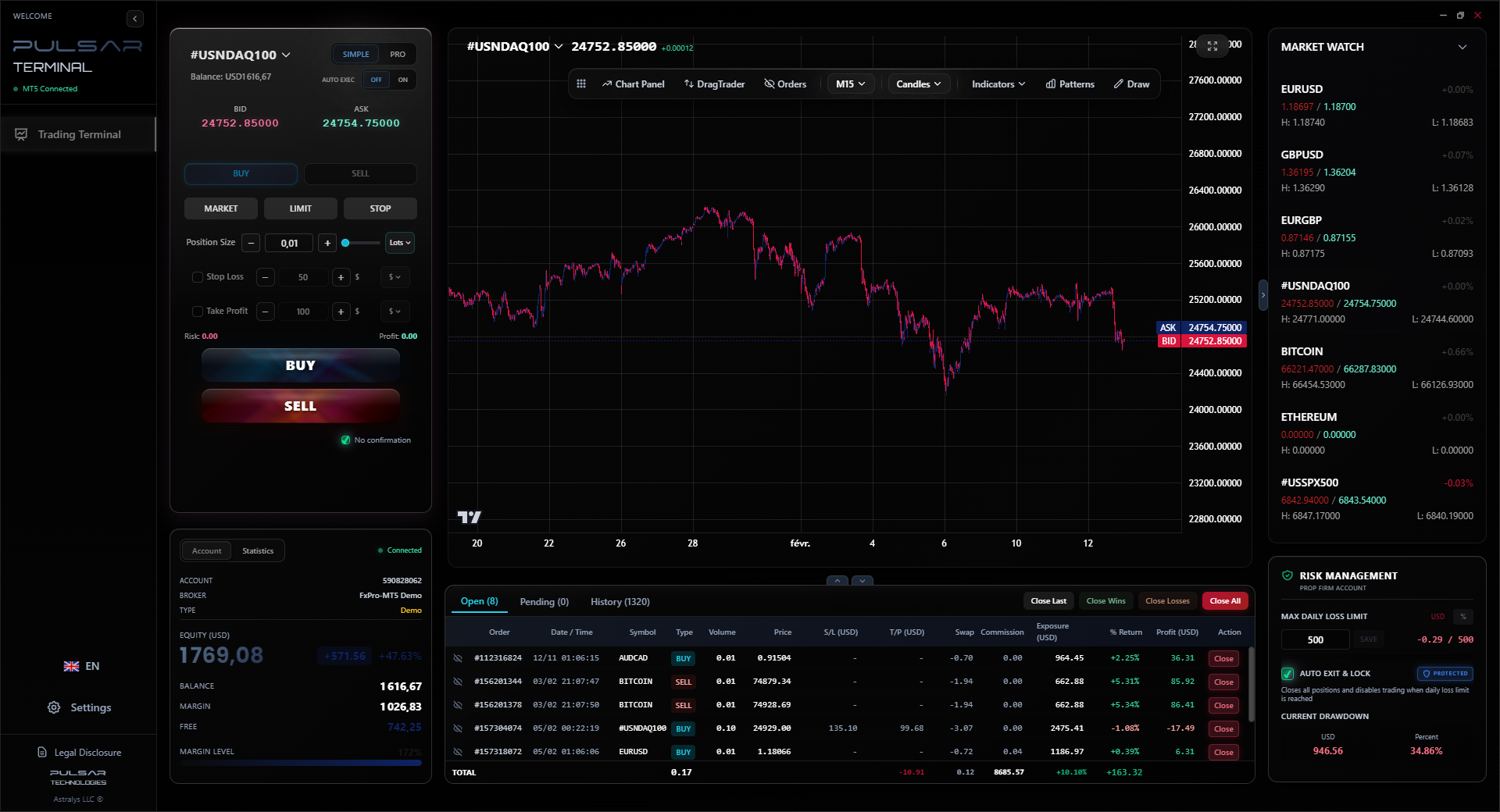
Managing multiple orders and protecting profits during FOMC chaos is nearly impossible manually, which is why tools like Pulsar Terminal that automate trailing stops and partial closures on MT5 are so valuable.
Pulsar Terminal
L'outil MT5 tout-en-un : ordres glisser-déposer, multi-TP/SL, trailing stop, grid trading, Volume Profile et protection prop firm. Utilisé quotidiennement par 1 000+ traders.
“Trading the rand around Fed news means you're trading the global market's appetite for South African risk.”
An FOMC announcement is a stress test for your broker and your trading setup. Here’s how to prepare.
Broker Execution: You need a broker known for solid execution during high volatility. Slippage (getting a worse price than you clicked) and requotes (your order being rejected) are common with low-tier brokers. I've had much better experiences with brokers like Pepperstone and XM during these events. Their Raw/ECN accounts typically have smaller, more stable spreads when it matters.
Platform Settings:
- Disable 'Confirm Before Placing Order': In the heat of the moment, that extra click can cost you 20 pips.
- Set Up One-Click Trading: If your platform supports it, get it enabled.
- Pre-Calculate Your Position Size: Know exactly what lot size corresponds to your risk (e.g., R500 risk) at your planned entry and stop-loss levels. Use our position size calculator the day before.
- Widen Your Stops: If you're trading around the event, your normal 20-pip stop on EUR/USD will get hunted and taken out by the noise. Consider using a wider stop based on the Average True Range (ATR) or key swing points, and reduce your position size accordingly to keep your monetary risk the same.
The Mental Setup: This is the most important. Schedule the event. Clear your desk. Silence your phone. Have your trading plan printed or written on a notepad next to you. Tell anyone who might interrupt you that you're unavailable. This is a surgical operation, not casual watching. Your preparation separates you from the 70% who lose.
💡 Conseil de Winston
Your pre-FOMC homework isn't predicting the outcome. It's defining the key price levels that will confirm a hawkish, dovish, or neutral interpretation. Let price tell you the story.
“The FOMC often resets the trend. The high or low from the day after the meeting becomes a major pivot point for the next month.”
The trade is closed, win or lose. Now the real work begins. This is how you turn a single event into lasting improvement.
Review Your Trade: Go through your platform's trade history. What was your actual entry vs. your planned entry? How much slippage did you get? Was your stop-loss executed where you set it? This data tells you about your broker's performance and your own execution discipline.
Analyze the Market's Narrative: Don't just look at your P&L. Read the summaries from 2-3 major financial news outlets. What is the consensus takeaway? "Fed signals pause after July hike" is a narrative that will drive price for weeks. Align your medium-term swing trading bias with this new narrative.
Update Your Market Map: The FOMC often resets the trend. Draw the new key levels established during the rationalization phase. That high or low from the day after the meeting often becomes a major pivot point for the next month. I mark these levels in a different color on my charts.
Journal the Emotional Ride: This is gold. How did you feel when your trade was in drawdown? Did you want to move your stop? Did you feel euphoric on a win and want to double up? Write it down. I've found my worst post-FOMC trades weren't from the first move, but from an overconfident or revenge trade I placed an hour later. The event isn't over when your first trade is. It's over when your emotional state has returned to baseline.
FAQ
Q1How long before the FOMC announcement should I place my trades?
If you're using pending orders (like the straddle), place them 30-60 minutes before. This avoids the worst of the pre-news spread widening. If you're waiting for the rationalization phase, don't place any trade until at least 45 minutes after the initial statement. Let the market show you its hand first.
Q2Is it better to trade major pairs like EUR/USD or exotic pairs like USD/ZAR during the FOMC?
For beginners, stick to major pairs like EUR/USD or GBP/USD. They have much higher liquidity, meaning tighter spreads and less chance of a catastrophic gap. USD/ZAR can offer bigger moves, but the wider spreads, lower liquidity, and added EM risk make it a more advanced play. Master the process on the majors first.
Q3What's the single most important piece of the FOMC announcement?
It's the combination of the policy statement and the Chair's press conference. The statement sets the stage, but the Q&A during the press conference often reveals the nuances and triggers the biggest moves. The market hangs on every hesitation or emphatic point the Chair makes.
Q4Can I use technical indicators like MACD or RSI during the FOMC release?
In the first 30 minutes, most lagging indicators like the MACD indicator are useless - they'll be based on chaotic, spiky data. They become useful again in the rationalization phase. In the immediate aftermath, pure price action (support/resistance, candlestick patterns) and volume are your best guides.
Q5My broker's spread on EUR/USD widened to 20 pips just before the news. Is this normal?
Unfortunately, yes. It's a defensive measure by brokers due to the extreme volatility and risk of gaps. This is why trading the initial spike is so difficult - you start 20 pips in the hole. Using an ECN/RAW account can mitigate this, but some widening is inevitable. Factor it into your risk management.
Q6Should I hold my swing trades through an FOMC announcement?
It depends on your risk tolerance and the size of your position. If you have a large profitable swing trade, consider taking partial profits before the event or moving your stop-loss to breakeven. The volatility can easily wipe out a week's gains. For smaller positions, you can hold, but be prepared for a wild ride and ensure your stop-loss is at a level that can withstand the noise, not just the normal daily range.
Q7Where can I find the official FOMC schedule and statements?
The Federal Reserve's website (federalreserve.gov) is the primary source. They post the calendar, statements, projections, and transcripts. For real-time analysis and summaries, trusted financial news sites like Reuters, Bloomberg, and CNBC are good, but always cross-reference with the primary source.
La leçon du Prof. Winston
Points clés:
- ✓Wait 45+ minutes after the statement for the 'rationalization' trend.
- ✓Cut your normal position size by 50% for FOMC volatility.
- ✓The Chair's press conference matters more than the headline rate decision.
- ✓USD/ZAR reacts to Fed policy AND global risk sentiment.
- ✓Always have a plan for hawkish, dovish, and neutral outcomes.
Cet article vous a-t-il été utile ?
Cliquez sur une étoile
Analyses Trading Hebdo
Analyses et stratégies hebdo gratuites. Pas de spam.
À propos de l'auteur
David van der Merwe
Trader des Marchés Émergents
Trader basé à Johannesbourg avec 11 ans d'expérience sur les devises des marchés émergents. Spécialisé dans les paires ZAR, le trading régulé par la FSCA et l'analyse du marché sud-africain.
Commentaires
Avertissement sur les risques
Le trading d'instruments financiers comporte des risques importants et peut ne pas convenir à tous les investisseurs. Les performances passées ne garantissent pas les résultats futurs. Ce contenu est fourni à titre éducatif uniquement et ne constitue pas un conseil en investissement. Effectuez toujours vos propres recherches avant de trader.
Vous aimerez aussi

Cara Trading Forex Sukses: 7 Prinsip dari Trader Profesional
Cara trading forex sukses dengan 7 prinsip trader pro: manajemen modal, disiplin, journal trading, backtest. Data nyata, bukan janji profit palsu.
Jam Trading Forex Terbaik untuk Trader Indonesia: Panduan Lengkap dengan Tabel Waktu
Panduan jam trading forex untuk trader Indonesia. Tabel 4 sesi dunia, jam emas 20:00-00:00, sesi mana yang harus dihindari. Data akurat + tips dari trader berpengalaman.
Top 5 Sàn Forex Uy Tín Nhất 2026: Review Jujur dari Trader Indonesia
Top 5 sàn forex uy tín 2026 untuk trader Indonesia. Review jujur: spread, deposit, withdraw, dukungan lokal. Exness, XM, IC Markets & lebih.
Obtenir Pulsar Terminal
Tous ces calculateurs sont intégrés dans Pulsar Terminal avec des données en temps réel de votre compte MT5. Dimensionnement de position en un clic, gestion automatique des risques et calculs instantanés.
Obtenir Pulsar Terminal