


Here's a fact that should make you pause: Nigeria's forex market turnover jumped 56.4% to $8.6 billion in 2025.

Olumide Adeyemi
Pionnier du Trading en Afrique de l'Ouest ·  Nigeria
☕ 11 min de lecture
Ce que vous apprendrez :
- 1The Nigerian Reality Check: Regulation Isn't What You Think
- 2What Actually Makes a Broker 'Good' for Nigeria?
- 3The Actual List: Brokers I've Used or Vetted Thoroughly
- 4The Real Cost of Trading: Spreads, Commissions & Hidden Fees
- 5Winning the Deposit & Withdrawal Battle
- 6Pitfalls I Fell Into (So You Don't Have To)
- 7Your Final Broker Selection Checklist
Here's a fact that should make you pause: Nigeria's forex market turnover jumped 56.4% to $8.6 billion in 2025. That's a tidal wave of money moving, and a lot of new traders jumping in. But here's the problem I see every day: most 'forex brokers list' articles are generic copy-paste jobs from people who've never placed a trade from Lagos. They don't tell you which brokers actually accept your Naira card, which ones have local support, or how to navigate the CBN's ever-changing rules. I've traded through Naira crashes, banking restrictions, and broker exits. This isn't a list. It's a survival guide.
Let's get this straight first. Forex trading is legal for you and me in Nigeria. But the regulation? It's a grey area that trips up so many new traders.
The Central Bank of Nigeria (CBN) and the Securities and Exchange Commission (SEC) are the main players. The CBN sets the big-picture FX policy - remember the move to a 'willing buyer, willing seller' model in 2023? That's them. The SEC oversees capital markets. But here's the critical gap: there are no specific, concrete rules yet for the online retail forex trading we do every day on MT5.
What does this mean for you? It means you won't find a 'CBN-regulated' retail forex broker in the way you might find an FCA-regulated one in the UK. Nigerian brokers offering these services need CBN authorization, but most of us end up trading with international firms. This isn't inherently bad, but it shifts the responsibility onto you. You must vet the broker's international license.
And then there's the taxman. The Federal Inland Revenue Service (FIRS) expects its share. Capital gains tax on trading profits is 10%. I keep a simple spreadsheet for this. It's not fun, but getting a surprise audit is worse.
The biggest practical headache? Funding your account. The CBN prohibits using official FX windows for trading. Many banks have blocked or limited Naira card transactions for international brokers. I've had deposits fail more times than I can count. This single issue makes your choice of broker more about payment rails than spreads.

Warning: Don't chase 'CBN-regulated' as a seal of safety for retail trading. It largely doesn't exist in that form yet. Your safety net is the broker's offshore regulator - think CySEC, FSCA, or ASIC.

💡 Conseil de Winston
Your first withdrawal is more important than your first deposit. Make a small profit and pull it out immediately. A broker that passes the withdrawal test is worth ten with fancy charts.
Forget the global top 10 lists. A broker good for a trader in London might be useless for you in Port Harcourt. After 12 years and burning through a few accounts myself, here's my checklist.
1. Payment Methods That Work. This is non-negotiable. Can you deposit in Naira? Do they accept local bank transfers? What about the e-wallets you actually use? If a broker only takes Visa/Mastercard, you're at the mercy of your bank's daily international limits, which can be as low as $100. Brokers with direct Naira accounts or seamless crypto on-ramps (like USDT) save you a world of stress and spread costs from converting Naira to USD yourself.
2. International Regulation You Can Trust. Since local retail regulation is thin, the broker's other license is your protection. I prioritize brokers with a physical presence and a strong license from a reputable authority like the Financial Sector Conduct Authority (FSCA) in South Africa, the Cyprus Securities and Exchange Commission (CySEC), or the Australian Securities and Investments Commission (ASIC). It's your buffer against malpractice.
3. Realistic Minimums & Costs. I see ads for '$1 minimum deposit' accounts. Sure, you can open it. But can you trade it? With a $1 account, a 2-pip spread on EUR/USD is a massive percentage of your capital. Look at the full cost structure: the spread, any commission, and swap fees. A broker with a $100 minimum but raw spreads of 0.1 pips might be cheaper in the long run than a '$1' broker with 2-pip spreads. Use a position size calculator to see the real impact.
4. Platform & Tools. MT4 and MT5 are kings here for a reason. They're familiar, stable, and support the indicators we use. But some proprietary platforms are excellent. The key is reliability during our volatile market hours. I once missed a crucial exit on GBP/USD because a web platform lagged during a news event. Never again.
5. Local Support. Does the broker have a Nigerian phone number? A Lagos office? When you have a withdrawal issue at 10 PM on a Sunday, a FAQ page isn't enough. This support is priceless.
“A broker good for a trader in London might be useless for you in Port Harcourt.”
This isn't exhaustive, but these are brokers that consistently meet the needs of Nigerian traders. I've traded with three of them personally. Data is as of early 2026 - always verify on their sites.
| Broker | Key Regulation for NG Clients | Min. Deposit (Approx.) | Naira Account? | Key Point for Nigerian Traders |
|---|---|---|---|---|
| Exness | Seychelles FSA | $10 / ₦~14k | Yes | Extremely popular here. High use offers, Naira accounts, and generally reliable local payment processing. Their Standard account spreads are decent for beginners. |
| XM | CySEC (Global) | $5 | No | Very low minimums, strong educational resources. A solid starting point for new traders. Funding via cards/e-wallets. |
| HF Markets (HotForex) | FSCA | ₦4,000 (some accounts) | Yes | Has a physical office in Lagos. Offers Naira-denominated accounts, which is a huge plus. Their Cent account is great for practicing with real money. |
| Pepperstone | CMA (Kenya) | $0 (varies) | No | Top-tier execution and tight spreads on their Razor account. They service Nigeria under their Kenyan entity, offering use up to 1:400. Excellent for scalping strategies. |
| IC Markets | ASIC / CySEC | $200 | No | My personal choice for raw spreads and execution speed. The $200 min filters out beginners, but the trading environment is professional. I've had orders filled in under 40ms during high volatility. |
| OctaFX | FSCA | $25 / ₦30k | Yes | Good all-rounder. Offers Naira deposits/withdrawals and their own OctaTrader platform alongside MT4/5. Active in local trading communities. |
| AvaTrade | FSCA | $100 | No | Known for fixed spreads, which can be a blessing during news events. Offers a wide range of platforms, including copy trading via ZuluTrade. |
| FBS | IFSC Belize | $1 | Yes | Very accessible minimums and high use options. Popular among micro-account traders. Supports Naira deposits. |

Pro Tip: The 'Key Regulation' column is crucial. It tells you which legal entity you're contracting with. A broker like Pepperstone offering services under the CMA Kenya gives you a different use and client protection framework than their ASIC entity. Always open your account through the correct regional website.
A mistake I made early on: I signed up with a well-known broker but through their offshore entity (Saint Vincent, in that case). When I had a withdrawal delay, I had almost no recourse. Now, I deliberately choose the entity with the stronger regulator, even if it means slightly higher minimums.
The advertised 'spread from 0.0 pips' is a trap if you don't read the fine print. Let me break down a real trade from my journal.
The Spread vs. Commission Model:
- Commission-Free Accounts: The broker makes money from the spread. EUR/USD might be 1.2 pips. Simple, but often more expensive for active traders.
- Raw Spread + Commission Accounts: You get spreads from 0.0 pips, but pay a commission per lot. This is usually cheaper for larger volumes.
A Real Example: Last month, I traded XAU/USD (Gold). I use an ECN-style account with IC Markets.
- Entry: $2350.10
- Spread at entry: 0.25 (that's $0.25 on gold)
- Commission: $7.00 per 100k (round turn)
- My position: 0.5 lots. So, commission = $3.50
- Total direct cost to open: $0.25 (spread) + $3.50 (commission) = $3.75
On a 'commission-free' account with another broker, the spread might have been 1.5. On 0.5 lots of gold, a 1.5 pip spread is $7.50. The 'commission-free' account cost me double.
Other Costs:
- Swap Fees (Overnight Financing): If you hold a position past 5 PM EST, you pay or receive swap. Selling USD/NGN? The swap can be massive and negative. Always check the swap calculator before holding a carry trade.
- Inactivity Fees: Some brokers charge if you don't trade for 3-6 months. Read the terms.
- Deposit/Withdrawal Fees: This is where Nigeria-specific issues hit. Your bank may charge for an international transfer. Some brokers absorb deposit fees; most don't for withdrawals. Crypto deposits are often the cheapest and fastest.

Example: To trade 1 standard lot of EUR/USD on a typical ECN account: Spread = 0.1 pips ($1), Commission = $6 (round turn). Total = $7. On a commission-free account with a 1.2 pip spread: Cost = $12. The ECN account saves you $5 per lot.
💡 Conseil de Winston
The spread isn't just a cost; it's a signal. Consistently wide spreads on a major pair like EUR/USD often mean poor liquidity or a broker skimming. If it's always 2 pips when others are at 0.8, walk away.
“The advertised 'spread from 0.0 pips' is a trap if you don't read the fine print.”
This is the most frustrating part of trading from Nigeria. I've had profits stuck for weeks. Here's what works now.
The Best Methods (2026):
- Cryptocurrency (USDT - TRC20): This is my go-to. It's fast (minutes), fees are low ($1 or less), and it bypasses bank restrictions entirely. Almost every major broker now accepts crypto. Convert your Naira to USDT on a local exchange like Binance, then send to your broker's wallet address.
- Local Bank Transfer (NGN): Brokers like Exness, HFM, and OctaFX that offer Naira accounts allow you to fund directly in NGN to a local Nigerian bank account. This is seamless and feels normal. The broker handles the FX conversion.
- E-Wallets (Skrill, Neteller): Reliable, but funding them with Naira can sometimes be an issue. Good for smaller amounts. Withdrawals back to them are quick.
The Problematic Methods:
- Direct Visa/Mastercard: Hit or miss. Many Nigerian banks block these transactions for 'forex trading' or have very low limits. Even if it works for deposit, some brokers can only withdraw back to the same card, which can fail.
- International Bank Wire: Expensive ($25-$50 fees), slow (3-7 business days), and requires you to have already converted Naira to USD, which eats into your capital.
My Withdrawal Rule: Always withdraw using the same method you deposited with. It's smoother and reduces anti-money laundering checks. And never let your balance get too high in a broker you haven't fully tested on withdrawals. Start small, withdraw your profits, test the system.
We learn more from losses than wins. Here are three expensive lessons.
Pitfall 1: Chasing the Highest use. Early on, I was dazzled by brokers offering 1:2000 use. I thought, "With $100, I can control $200,000!" I did exactly that on a EUR/USD trade. A 5-pip move against me, which is nothing, wiped out 50% of my account. use is a tool, not a goal. Most professional traders use far less. Now, I rarely exceed 1:30, even on my most confident swing trading ideas.
Pitfall 2: Ignoring the 'Spike' Risk During Nigerian News. When major CBN announcements or inflation data hits, liquidity can dry up for a second. Spreads on USD/NGN and even major pairs can widen violently from 5 pips to 50 pips. I had a stop-loss order filled at a horrific price during a Naira devaluation rumor because of this. If you're trading around volatile times, use limit orders instead of market orders, or just step away.
Pitfall 3: Not Understanding the Margin Call. I thought a margin call was a warning. It's not. It's often the point where your broker automatically closes your worst losing position to protect themselves. My first major blow-up happened because I was 'waiting for it to come back' and didn't add funds or close manually. The platform did it for me at the absolute low. Know your broker's margin call policy (usually at 50% or 100% of required margin) and use a stop-loss on every single trade, no exceptions.
💡 Conseil de Winston
Never use your maximum available use. If your broker offers 1:500, configure your MT5 to limit it to 1:50. This single discipline has saved more accounts than any indicator.
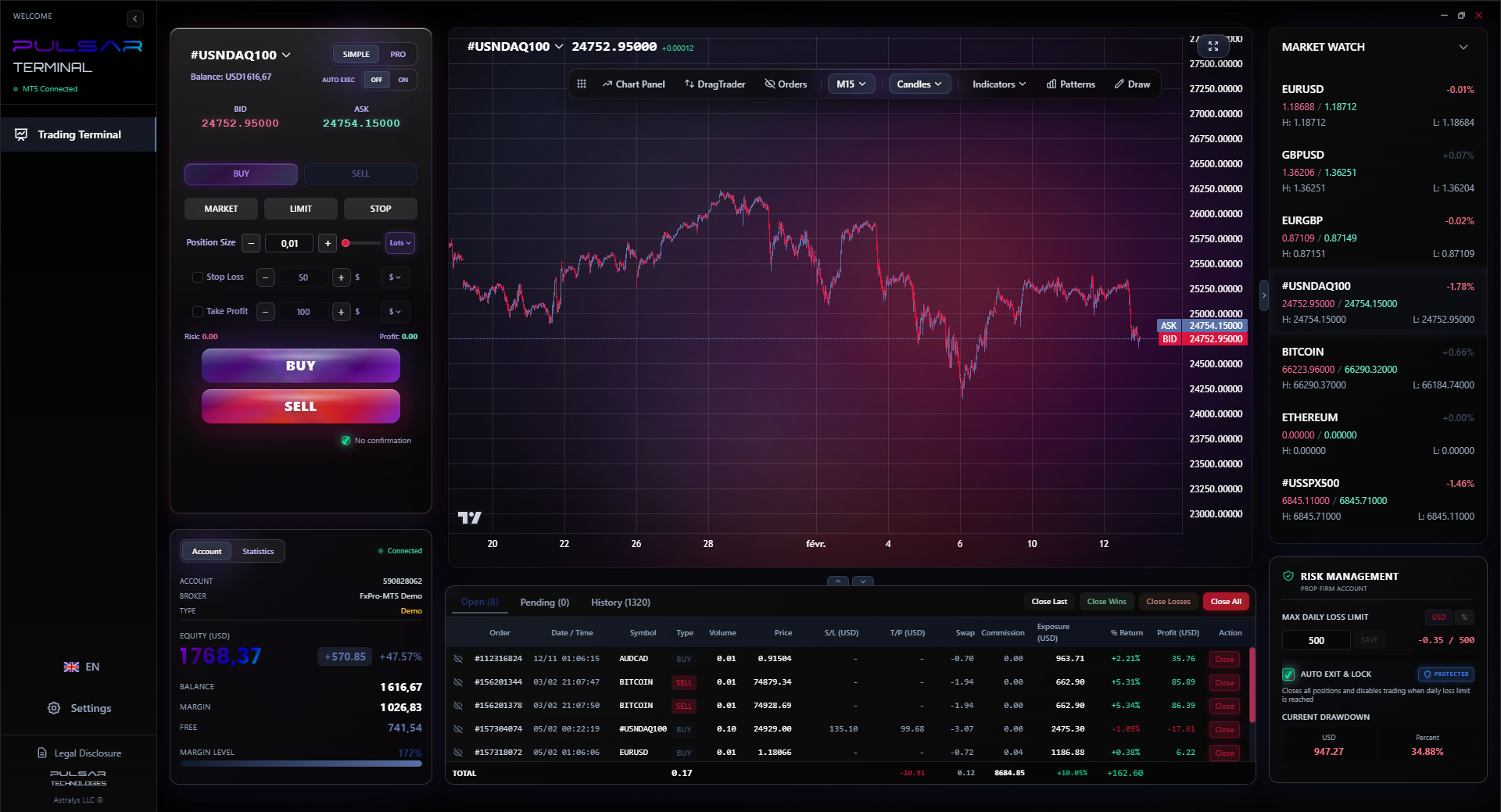
Managing risk from those high-leverage pitfalls is a full-time job, which is why I use Pulsar Terminal to automate my stop-loss and breakeven moves directly on my MT5 charts.
Pulsar Terminal
L'outil MT5 tout-en-un : ordres glisser-déposer, multi-TP/SL, trailing stop, grid trading, Volume Profile et protection prop firm. Utilisé quotidiennement par 1 000+ traders.
“Your broker is your business partner. Choose one that doesn't make your life harder.”
Before you click 'Open Account', run through this.
- Regulation: Is the entity serving me regulated by a reputable authority (FSCA, CySEC, ASIC)?
- Funding: Can I deposit in Naira or USDT easily? Have I checked the minimums and fees?
- Withdrawal Test: Have I read user reviews specifically about withdrawal speed for Nigerian clients?
- Platform: Do they offer MT4/MT5 or a stable proprietary platform I like?
- Costs: For my typical trade size (e.g., 0.1 lots), is the commission or spread model cheaper? Use their published averages.
- Customer Support: Have I tested their live chat or called their local number?
- Demo Account: Have I traded on their demo for at least a week to test execution and platform feel?
Start with a demo. Then, fund with the smallest amount you can, make a few trades, and immediately request a partial withdrawal. If that process is smooth, you've found a keeper.
Your broker is your business partner. Choose one that doesn't make your life harder. The right one on your personal forex brokers list becomes a background tool, letting you focus on what matters: your trading decisions.
FAQ
Q1Is forex trading legal and regulated in Nigeria?
Yes, forex trading is legal for individuals. However, the specific online retail trading we do (on platforms like MT5) is not yet tightly regulated by Nigerian authorities like the CBN or SEC. This is why Nigerian traders primarily use internationally regulated brokers (like those with FSCA or CySEC licenses) for protection.
Q2What is the best way to fund my forex account from Nigeria?
In 2026, the most reliable methods are: 1) Cryptocurrency (USDT), as it's fast and bypasses bank restrictions. 2) Direct Naira deposits to brokers that offer local NGN accounts (e.g., Exness, HFM). Avoid relying solely on Visa/Mastercard, as many Nigerian banks block these transactions for forex trading.
Q3Which broker has the lowest minimum deposit?
Brokers like XM and FBS offer accounts with minimum deposits as low as $5 or $1. However, remember that a very low minimum often comes with wider spreads. Focus on the total cost of trading (spread + commission) for your typical trade size, not just the entry fee.
Q4Do I pay tax on my forex trading profits in Nigeria?
Yes. The Federal Inland Revenue Service (FIRS) requires you to declare trading profits as capital gains, which are taxed at a rate of 10%. It's crucial to keep clear records of all your trades, deposits, and withdrawals for tax purposes.
Q5What use can I get as a Nigerian trader?
use offered depends on the broker and the regulator they use to service you. Under EU-like regulations (CySEC), it's capped at 1:30 for major forex pairs. Under other regulators (like Seychelles FSA or Kenya's CMA), you can find use up to 1:1000 or even 1:2000. High use is extremely risky and not recommended for beginners.
Q6Can I use MetaTrader 5 (MT5) in Nigeria?
Absolutely. MT4 and MT5 are the most widely used trading platforms in Nigeria. Almost every international broker offers them. Some brokers also provide excellent proprietary platforms, but MT5's advanced features and stability make it a favorite among serious traders.
Q7How do I choose between a commission-free and a raw spread account?
It comes down to your trade size and frequency. If you trade small volumes (under 0.5 lots) infrequently, a commission-free account with a slightly wider spread might be simpler. If you trade larger volumes or are an active trader (like scalping), a raw spread account with a per-lot commission is almost always cheaper. Do the math for your specific strategy.
La leçon du Prof. Winston
Points clés:
- ✓Funding is your #1 filter: Prioritize brokers with Naira accounts or seamless crypto deposits.
- ✓Regulation is offshore: Your safety is the broker's FSCA or CySEC license, not a local one.
- ✓Test withdrawals first: A smooth exit proves more than a flashy platform.
- ✓Real cost = Spread + Commission + Swap: Calculate this per lot before you trade.
- ✓use above 1:100 is a risk accelerator, not a skill multiplier.
Cet article vous a-t-il été utile ?
Cliquez sur une étoile
Analyses Trading Hebdo
Analyses et stratégies hebdo gratuites. Pas de spam.
À propos de l'auteur
Olumide Adeyemi
Pionnier du Trading en Afrique de l'Ouest
L'un des formateurs de trading forex les plus actifs au Nigeria. 8 ans d'expérience de trading depuis Lagos. Spécialisé dans les stratégies à petit capital et les challenges de prop firms pour les traders africains.
Commentaires
Avertissement sur les risques
Le trading d'instruments financiers comporte des risques importants et peut ne pas convenir à tous les investisseurs. Les performances passées ne garantissent pas les résultats futurs. Ce contenu est fourni à titre éducatif uniquement et ne constitue pas un conseil en investissement. Effectuez toujours vos propres recherches avant de trader.
Vous aimerez aussi

Cara Trading Forex Sukses: 7 Prinsip dari Trader Profesional
Cara trading forex sukses dengan 7 prinsip trader pro: manajemen modal, disiplin, journal trading, backtest. Data nyata, bukan janji profit palsu.
Jam Trading Forex Terbaik untuk Trader Indonesia: Panduan Lengkap dengan Tabel Waktu
Panduan jam trading forex untuk trader Indonesia. Tabel 4 sesi dunia, jam emas 20:00-00:00, sesi mana yang harus dihindari. Data akurat + tips dari trader berpengalaman.
Top 5 Sàn Forex Uy Tín Nhất 2026: Review Jujur dari Trader Indonesia
Top 5 sàn forex uy tín 2026 untuk trader Indonesia. Review jujur: spread, deposit, withdraw, dukungan lokal. Exness, XM, IC Markets & lebih.
Obtenir Pulsar Terminal
Tous ces calculateurs sont intégrés dans Pulsar Terminal avec des données en temps réel de votre compte MT5. Dimensionnement de position en un clic, gestion automatique des risques et calculs instantanés.
Obtenir Pulsar Terminal