


I watched my screen as the Forex Diamond EA opened its seventh consecutive losing trade on EUR/USD.

David van der Merwe
Trader des Marchés Émergents ·  South Africa
☕ 10 min de lecture
Ce que vous apprendrez :

I watched my screen as the Forex Diamond EA opened its seventh consecutive losing trade on EUR/USD. My R15,000 account was down to R11,200 in a single afternoon. The 'set-and-forget' dream I'd bought for $247 felt more like a nightmare. That was 2023. Since then, I've run this EA across three different FSCA-regulated brokers, tweaked every setting imaginable, and learned when this robot works, when it fails spectacularly, and how a South African should approach it. This isn't a sales pitch. It's my trading journal.
Forex Diamond EA is an automated trading robot for MetaTrader 4 and 5. You install it, attach it to a chart, and it supposedly trades for you. The marketing sells a fantasy: wake up to profits. The reality is a complex piece of software with specific rules.
It's not an AI. It's a set of algorithms that look for certain price patterns and correlations between currency pairs. The developer claims it uses a 'multi-currency correlation strategy' and a 'recovery system' for losing trades. I bought the single license in 2022 for $247 (about R4,500 at the time). That gets you lifetime updates, which is important because brokers change their servers and MT4 builds update.

Warning: The official sales page shows incredible backtests. Remember, a backtest is a simulation. It assumes perfect conditions - no slippage, instant order execution. Real trading with a South African internet connection and FSCA broker spreads is a different beast entirely.
My first mistake was believing the marketing. I thought it was a magic box. It's not. It's a tool, and like any tool, it works best in the right hands and in the right conditions. Understanding its logic, even basically, is the difference between blowing an account and making it work.
“The 'set-and-forget' dream I'd bought for $247 felt more like a nightmare.”
You can't run this EA with just any broker. In South Africa, you must use an FSCA-regulated broker for any real protection. I've tested it with three.
Exness was my first try. I used their MT4 Standard account. The spreads were okay for majors - around 1.2 pips on EUR/USD during London hours. The EA ran smoothly, but I noticed a problem: during high volatility (like SARB interest rate announcements), the slippage on my orders was nasty. A trade meant to enter at 1.0850 would sometimes fill at 1.0857. Over many trades, that eats profits.
I switched to IC Markets for their Raw Spread account. This is an ECN model with near-zero spreads but a commission per lot. This was better for the EA's scalping-style entries. The minimum deposit was $200 (R3,600), which was fine. The EA's performance improved noticeably with tighter spreads.
Finally, I tried XM. Their ultra-low micro account minimum ($5) let me test the EA with real money but very small risk. Their execution was reliable for an EA. The table below sums up my experience.
| Broker (FSCA Regulated) | Account Type | Avg. EUR/USD Spread | Min. Deposit | EA Performance Note |
|---|---|---|---|---|
| Exness | Standard | 1.0 - 1.5 pips | $10 (R180) | Good, watch for slippage on news |
| IC Markets | Raw Spread | 0.0 - 0.1 pips + $3.5 commission | $200 (R3,600) | Best for precise entries |
| XM | Micro | 1.7 - 2.0 pips | $5 (R90) | Reliable, good for tiny test accounts |
Funding these accounts from SA is straightforward. I use EFT (takes 1-2 days) or my Visa card (instant). Some brokers offer ZAR accounts, which saves on conversion fees. Always check the broker's own spread definition and commission structure before choosing.

💡 Conseil de Winston
An EA is a strategy codified in software. Never run a strategy live that you don't understand on paper. If you can't explain its basic logic in two sentences, you shouldn't be funding it.

“The results were boring, which was beautiful.”
Let's talk numbers. Real ones from my accounts.
Test 1: The 'Set and Forget' Disaster (2023) I deposited R15,000 with Exness. I used the EA's default 'Aggressive' settings on a $10,000 (simulated) cent account. I left it running for two weeks while I went on holiday. Big mistake. It entered a series of correlated trades on EUR/USD, GBP/USD, and AUD/USD. When the USD spiked, they all went against me. The EA's 'recovery system' kicked in, opening more trades to average down. The drawdown hit 42%. I came back to a R8,700 account. I learned the hard way that no EA should be left completely unattended.
Test 2: The Conservative Grind (2024) After that, I reset. I funded a $1,000 (R18,000) account with IC Markets. I switched the EA to its 'Conservative' mode and lowered the risk to 0.5% per trade. I also limited it to only trade during the London and New York session overlaps (2pm - 5pm SAST). This is a key scalping strategy window with good liquidity.
The results were boring, which was beautiful. Over 4 months, it made 67 trades. The win rate was about 58%. The total gain was $217, or about R3,900. That's a 21.7% return, not the 90% a month some websites promise. But the max drawdown was only 11%. This felt sustainable.

Example: My risk calculation on IC Markets. Account: $1,000. Risk: 0.5% = $5 per trade. With the EA's default stop loss of 30 pips on EUR/USD, the position size was 0.17 lots. I used a position size calculator for this every time I changed settings.
The Lesson: The Forex Diamond EA can make money, but not at the insane rates advertised. Aim for consistent, small gains. Protect your capital above all else. A 30% drawdown requires a 43% gain just to break even. That math is brutal.
“The results were boring, which was beautiful.”
The default settings will likely blow your account. Here’s what you must adjust.
Risk Management is Everything
RiskPercent is the most important setting. Never use the default 5% or 10%. For a live account, I never go above 1%. For testing, 0.5% is safer. This single setting saved my second account.
Session Filters are Non-Negotiable
The EA will try to trade 24/5 if you let it. Don't. Set StartHour and EndHour to match the most liquid sessions. I use 10:00 to 19:00 (SAST). This avoids the wild, low-volume swings of the Asian session that can trigger false signals.
The "Recovery System" – Handle with Care
This is the EA's most dangerous feature. After a loss, it can increase lot size to try and win back the money. It sounds smart but can lead to a margin call. I disable it (UseRecovery = false). It's better to take a small loss and move on than to let a robot double down on a bad idea.
Pair Selection
It works best on major pairs with low spreads. I only let it trade EUR/USD, GBP/USD, and USD/JPY. I turned off all exotics and minors. The spreads on something like USD/ZAR are far too wide for its strategy.

Pro Tip: Before going live, run the EA on a demo account for at least two full months. Note the maximum drawdown. Then, halve the risk you were using on demo for your live account. Reality is always harsher.
💡 Conseil de Winston
The cost of the EA is a sunk cost. Don't fall for the 'I need to make back the R4,570' fallacy. That money is gone. Trade the current market conditions, not your P&L.

“You are the boss of the robot. It is not your boss.”
Let's break down the total cost in Rands, because that's what matters.
- The EA License: $247 one-time fee. At an exchange rate of R18.50/$, that's R4,569.50. That's a significant upfront cost. There are cheaper EAs out there, and many free ones. You're paying for the (claimed) logic and the updates.
- Broker Spreads & Commissions: This is your ongoing cost. On a standard account with 1.5 pip spreads, if the EA trades 10 times a day (buying and selling), you're paying 15 pips in spread costs daily. On a 0.1 lot trade, that's $1.50 per day, or about R27. Over a month (20 trading days), that's R540 just in spreads.
- Swap Fees: If the EA holds trades overnight (and it sometimes does), you pay or receive swap/rollover interest. On a long EUR/USD position, you might pay a small daily fee. This can add up.
- The Opportunity Cost: Your capital is tied up. That R20,000 in your trading account isn't in a savings account or another investment.
Is it worth it? Only if the net profit (after all these costs) exceeds what you could reasonably make elsewhere, or if the value is in the automation itself freeing up your time. For me, after the initial disaster, the second test's R3,900 gain over 4 months did cover the costs and then some. But it was work, not passive income.
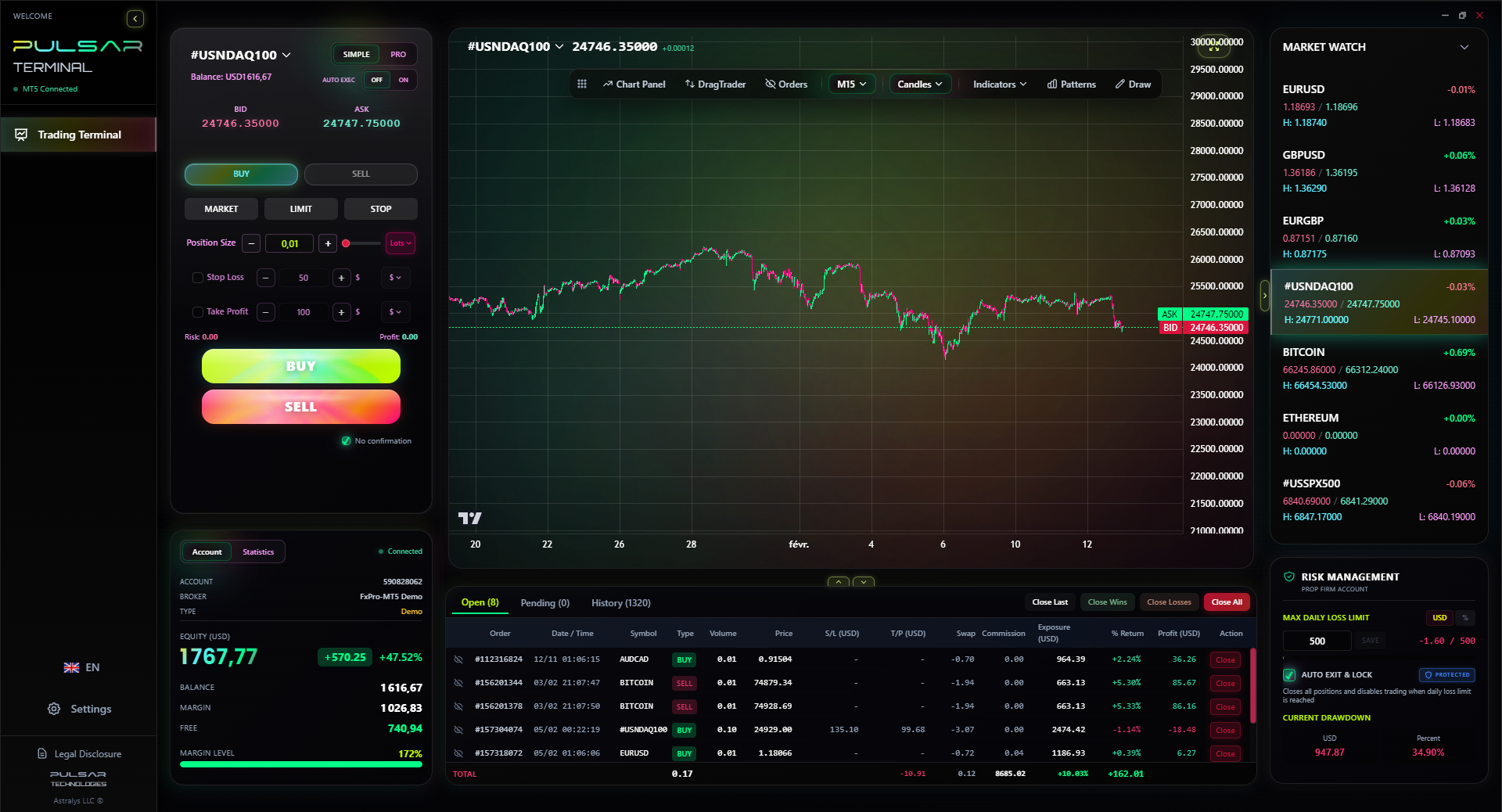
Manually tracking the EA's trades, drawdown, and session times is a chore; Pulsar Terminal's dashboard gives you a single-pane view of all your automated strategies directly on your MT5 platform.
Pulsar Terminal
L'outil MT5 tout-en-un : ordres glisser-déposer, multi-TP/SL, trailing stop, grid trading, Volume Profile et protection prop firm. Utilisé quotidiennement par 1 000+ traders.
“You are the boss of the robot. It is not your boss.”
The internet is full of lies, especially about trading robots. Here’s how I verify.
First, ignore any performance screenshot that isn't a verified Myfxbook or FXBlue link. These sites connect directly to the MT4 account and cannot be easily faked. The official Forex Diamond EA Myfxbook page shows one account with over 1,000% gain. Look closer. That gain is over 8 years. The daily gain is 0.31%. That's much more believable - and actually impressive for a fully automated system.
Second, check the drawdown. That same account shows a 30.70% max drawdown. Could you stomach seeing your account drop by a third? I couldn't. That's why I run it at lower risk.
Third, look at the broker. Is it a well-known, regulated broker, or some offshore bucket shop with a fancy name? If it's the latter, the results are meaningless.
Finally, the best verification is your own demo test. Set it up exactly as you would live. Track every trade in a spreadsheet. Note the emotional feel. If you're constantly anxious watching the drawdown on demo, you'll panic on live. This process taught me more about the MACD indicator and RSI indicator settings the EA uses than any manual did.
💡 Conseil de Winston
Your most important job as a manager of automated systems is defining the rules of engagement and, more crucially, the rules of disengagement. Know exactly what market condition will make you pull the plug.
“A 30% drawdown requires a 43% gain just to break even. That math is brutal.”
The Forex Diamond EA is not a scam, but it's also not a golden ticket. It's a moderately sophisticated automated system that requires careful configuration and constant oversight.
Who it might be for: A trader who understands basic forex concepts, has experience with MT4, and wants to automate a part of their strategy. Someone who can be disciplined with risk settings and not interfere emotionally. It can be a useful tool for a portion of a larger, diversified swing trading portfolio.
Who it's definitely not for: A complete beginner looking for 'passive income.' Someone with less than R20,000 in risk capital. Anyone who can't monitor it at least once a day to ensure it's functioning and that no unexpected news event is wreaking havoc.
My personal stance now? I still have it running on a small portion of my capital. It's one of several automated systems I use. It makes small, incremental gains. I don't rely on it. I manage it. That's the key shift in thinking: from 'user' to 'manager.' You are the boss of the robot. It is not your boss. If you go in with that mindset, a realistic budget in ZAR, and an FSCA broker like Exness or IC Markets, you might find it a useful, if expensive, assistant. Just never, ever leave it alone with the keys to your account.
FAQ
Q1Is Forex Diamond EA legal and safe to use in South Africa?
Yes, using Expert Advisors (EAs) like Forex Diamond is legal in South Africa. The safety comes from using it with an FSCA-regulated broker. The FSCA regulates the broker, not the EA itself. Your protection - like fund segregation and dispute resolution - depends on your broker being properly licensed.
Q2What is the minimum deposit I need in Rands to start with Forex Diamond EA?
You need to cover three things: the EA cost (~R4,570), a broker minimum deposit, and enough capital to trade safely. The absolute minimum broker deposit can be as low as R90 (e.g., XM's $5 account). However, to trade with sensible risk, I wouldn't start with less than R10,000 - R20,000 in your trading account. Starting too small forces you to use dangerously high risk percentages to make the EA's gains meaningful.
Q3Which South African brokers work best with this EA?
You need an FSCA-regulated broker that supports MetaTrader 4 or 5. From my tests, IC Markets (Raw Spread account) offered the best execution for its strategy due to ultra-low spreads. Exness and XM also worked reliably. The choice depends on your capital and preference for spread vs. commission pricing models.
Q4Can I really make money while I sleep with this EA?
Technically yes, but I strongly advise against it. The EA can trade while you sleep, but so can a market-moving news event. Waking up to a 30% drawdown is a real possibility. At the very least, use session filters to disable trading during off-hours and high-impact news events. Automation doesn't mean abdication of responsibility.
Q5How do the claimed 90% win rates compare to reality?
They're almost always based on perfect backtests, not live trading. In my live conservative testing, the win rate was around 58%. A high win rate can also be misleading. An EA could have a 90% win rate by taking tiny 5-pip profits but have 50-pip stop losses. One loss wipes out nine wins. Focus on the net profit and maximum drawdown, not the win rate.
Q6Do I need a VPS to run Forex Diamond EA?
It's highly recommended if you want it to trade 24/5 without interruption. A Virtual Private Server keeps your MT4 platform running online even if your home PC or internet cuts out. Many brokers offer a free VPS if you maintain a certain account balance (e.g., $5,000). For South Africans with sometimes unstable loadshedding-era internet, a VPS is a smart investment.
Q7What's the single biggest mistake South African users make with this EA?
Using the default 'Aggressive' settings with a small ZAR-denominated account. The default risk is far too high for most people. Combining that with the emotional stress of seeing your Rand balance swing wildly almost guarantees you'll panic and shut it down at the worst possible time - right at the bottom of a drawdown.
La leçon du Prof. Winston
Points clés:
- ✓Default EA settings are often account destroyers.
- ✓Realistic gains are 1-2% monthly, not 10% weekly.
- ✓Session filtering is non-negotiable for survival.
- ✓Always calculate risk in ZAR, not just percentages.
- ✓Verify all results on Myfxbook, not sales pages.
Cet article vous a-t-il été utile ?
Cliquez sur une étoile
Analyses Trading Hebdo
Analyses et stratégies hebdo gratuites. Pas de spam.
À propos de l'auteur
David van der Merwe
Trader des Marchés Émergents
Trader basé à Johannesbourg avec 11 ans d'expérience sur les devises des marchés émergents. Spécialisé dans les paires ZAR, le trading régulé par la FSCA et l'analyse du marché sud-africain.
Commentaires
Avertissement sur les risques
Le trading d'instruments financiers comporte des risques importants et peut ne pas convenir à tous les investisseurs. Les performances passées ne garantissent pas les résultats futurs. Ce contenu est fourni à titre éducatif uniquement et ne constitue pas un conseil en investissement. Effectuez toujours vos propres recherches avant de trader.
Vous aimerez aussi

Cara Trading Forex Sukses: 7 Prinsip dari Trader Profesional
Cara trading forex sukses dengan 7 prinsip trader pro: manajemen modal, disiplin, journal trading, backtest. Data nyata, bukan janji profit palsu.
Jam Trading Forex Terbaik untuk Trader Indonesia: Panduan Lengkap dengan Tabel Waktu
Panduan jam trading forex untuk trader Indonesia. Tabel 4 sesi dunia, jam emas 20:00-00:00, sesi mana yang harus dihindari. Data akurat + tips dari trader berpengalaman.
Top 5 Sàn Forex Uy Tín Nhất 2026: Review Jujur dari Trader Indonesia
Top 5 sàn forex uy tín 2026 untuk trader Indonesia. Review jujur: spread, deposit, withdraw, dukungan lokal. Exness, XM, IC Markets & lebih.
Obtenir Pulsar Terminal
Tous ces calculateurs sont intégrés dans Pulsar Terminal avec des données en temps réel de votre compte MT5. Dimensionnement de position en un clic, gestion automatique des risques et calculs instantanés.
Obtenir Pulsar Terminal