


You're probably wondering if you can really make money from forex exchange trading here in Nigeria.

Olumide Adeyemi
Pionnier du Trading en Afrique de l'Ouest ·  Nigeria
☕ 10 min de lecture
Ce que vous apprendrez :

You're probably wondering if you can really make money from forex exchange trading here in Nigeria. I get it. You see the ads promising quick wealth, but you also hear the stories of people getting burned. The truth is somewhere in the middle. It's not a magic money machine, but it is a legitimate skill you can learn. I've been trading for over 12 years, and I've seen it all from Lagos to Port Harcourt. This guide is my honest take on how to approach the forex market as a Nigerian, covering what you need to know, the common pitfalls, and how to build a plan that actually has a chance.
At its core, forex exchange trading is just betting on the price movement of one currency against another. You're buying and selling currency pairs, like the US Dollar against the Naira (USD/NGN) or the Euro against the Dollar (EUR/USD).
When you trade forex, you're not buying physical cash. You're trading contracts for difference (CFDs) on the price. If you think the base currency will get stronger against the quote currency, you buy (go long). If you think it'll get weaker, you sell (go short).
For us in Nigeria, it's especially relevant. Our economy is heavily tied to the dollar. The official rate, the black-market rate (sorry, parallel market rate), and the constant news about our reserves all create massive volatility. That volatility is both the opportunity and the risk in forex exchange trading.

Warning: Trading USD/NGN directly with international brokers is often restricted. You'll mostly trade major pairs like EUR/USD or GBP/USD, but understanding Naira dynamics is crucial for your overall market awareness.
This is the first major hurdle. Nigeria's financial regulators, like the Securities and Exchange Commission (SEC), have been tightening up on forex brokers. The days of just signing up with any random offshore company are fading. You need a broker that is properly regulated, preferably by a top-tier authority like the UK's FCA, Australia's ASIC, or Cyprus's CySEC.
Why? Because when things go wrong (and they sometimes do), you want a clear path for complaint. An unregulated broker can vanish with your money, and you'll have zero recourse. I learned this the hard way early on, losing about $500 to a "broker" that was just a fancy website.
What to Look For in a Broker
Your broker is your gateway to the market. Don't just pick the one with the flashiest ads on Instagram. Check these boxes:
- Regulation: This is non-negotiable.
- Deposit/Withdrawal Methods: They must support methods that work for you. Commonly used options for Nigerians include bank wire transfers (which can be slow), credit/debit cards, and e-wallets like Skrill, Neteller, or Sticpay. Some local payment processors are also integrating with brokers.
- Spreads and Commissions: The spread is the difference between the buy and sell price. It's your primary cost of trading. Look for tight, consistent spreads on the pairs you want to trade. A good spread definition resource can help you understand this fully.
- Platform: Most brokers offer MetaTrader 4 or 5 (MT4/MT5). It's the industry standard for a reason.
I've had decent experiences with brokers like IC Markets for their raw spreads and Pepperstone for their overall reliability. Always do your own fresh due diligence, as broker conditions change.

Pro Tip: Start with a broker's demo account. Test their platform, execution speed, and see how their spreads behave during major news events (like US Non-Farm Payrolls) before you deposit a single kobo.

💡 Conseil de Winston
Your first profitable month on a demo account is a prerequisite, not an achievement. Do it again the next month before going live.

“A good strategy might only win 40-50% of the time. The key is making your winners bigger than your losers.”
You need a plan. A real one, written down. "I'll just buy when it looks low" is a recipe for losing money. Your strategy is your rulebook, and it must answer three questions: When do I enter? When do I get out with a profit? When do I get out with a loss?
Start with One Pair and One Timeframe
Don't try to watch EUR/USD, Gold, and Bitcoin all at once. Pick one major currency pair. I always recommend EUR/USD for beginners. It's the most liquid, has tight spreads, and there's a ton of analysis available. Stick to one timeframe to analyze. If you're not trading full-time, a 4-hour or daily chart for swing trading is more manageable than a 1-minute chart for scalping.
Use Indicators as Guides, Not Oracles
Indicators help you interpret price action. Don't overload your chart. Start with one or two. The RSI indicator can help spot overbought or oversold conditions. The MACD indicator can help identify trend changes. Here's a simple example from my early days: I'd look for EUR/USD to be in an uptrend on the 4-hour chart, then wait for a pullback to a key moving average and a bullish signal on the 1-hour RSI. That was my entry trigger.
The Non-Negotiables: Stop Loss and Take Profit
This is where most new traders fail. You must know where you're wrong before you enter a trade. Your stop loss (SL) is that point. Your take profit (TP) is your goal. A common beginner method is to aim for a risk-reward ratio of at least 1:2. If you risk 50 pips, aim to make 100 pips. This means you can be wrong more than you're right and still break even. Use a position size calculator to figure out exactly how many units or lots to trade based on your stop loss and account size.

Example: Let's say you have a $1,000 account. You decide to risk 1% ($10) on a trade. Your analysis says your stop loss should be 20 pips away from your entry. Using a calculator, you'd find you need to trade a position size where each pip is worth $0.50. That way, if you hit your 20-pip stop loss, you lose $10 (20 pips * $0.50).

Trading from Nigeria isn't the same as trading from London or New York. We face specific issues you have to plan for.
Power and Internet: This is our biggest operational risk. A trade can turn against you in seconds. You need a reliable backup. A good smartphone with a stable mobile data connection (MT4/MT5 apps are excellent) is your first line of defense against power cuts. Consider a small UPS for your router and modem to keep your internet alive for a few hours.
Capital and Psychology: Starting with small capital is normal, but it messes with your head. Trying to turn 50,000 Naira into 5 million in a month will destroy you. You'll take huge, unjustified risks. I did this. I turned $200 into $1,500 in two wild weeks, felt like a genius, and then gave it all back plus another $300 in one bad day because I was overconfident and over-leveraged.
use is a Double-Edged Sword: Nigerian brokers often offer high use (like 1:500 or even 1:1000). This lets you control a large position with little money. It amplifies both gains and losses. With a $100 account and 1:500 use, a 0.2% move against you can wipe you out. I strongly suggest using no more than 1:10 or 1:20 use when you're learning. It forces you to think about position size and real risk. Getting a margin call is a brutal lesson.
The Noise: You'll be in WhatsApp groups and Telegram channels full of "signals" and gurus promising 100% weekly returns. It's almost all noise. Focus on your own plan. The best trade is often the one you don't take because it doesn't fit your rules.
💡 Conseil de Winston
If you can't explain your trade setup in one simple sentence, you don't have a setup. You have a hope.
“View forex trading as a business. Your goal in year one isn't to buy a Range Rover. It's to not blow up your account.”
Let me save you some time and money by being honest about where I stumbled.
Chasing Losses: This is the killer. You lose on a trade, you feel you have to get it back immediately. So you jump into another trade without a signal, usually with a bigger size. This is how a $100 loss becomes a $500 loss in an hour. When you hit a losing streak, the best action is to stop. Close the platform. Go for a walk. Come back tomorrow.
Trading on News Without a Plan: News events like Central Bank of Nigeria (CBN) announcements or US Fed decisions cause huge spikes. I used to try to guess the direction and jump in. It's a coin flip. Now, I either close my positions before major news or I wait for the initial volatility to settle and then trade the new, established direction.
Not Keeping a Trading Journal: If you don't record your trades, you're just guessing. My journal entry for that big loss I mentioned simply said: "Felt good after winning streak. Ignored RSI divergence. Sized up too big. Got greedy." Seeing that pattern in writing is what finally helped me fix it. Write down every trade: entry, exit, reason, and, crucially, your emotional state.
Overtrading: When you're bored or feel you 'should' be in the market, you'll find excuses to trade. This leads to taking low-probability setups. Sometimes, the market doesn't offer a clear opportunity. That's fine. Preserving your capital is a win.
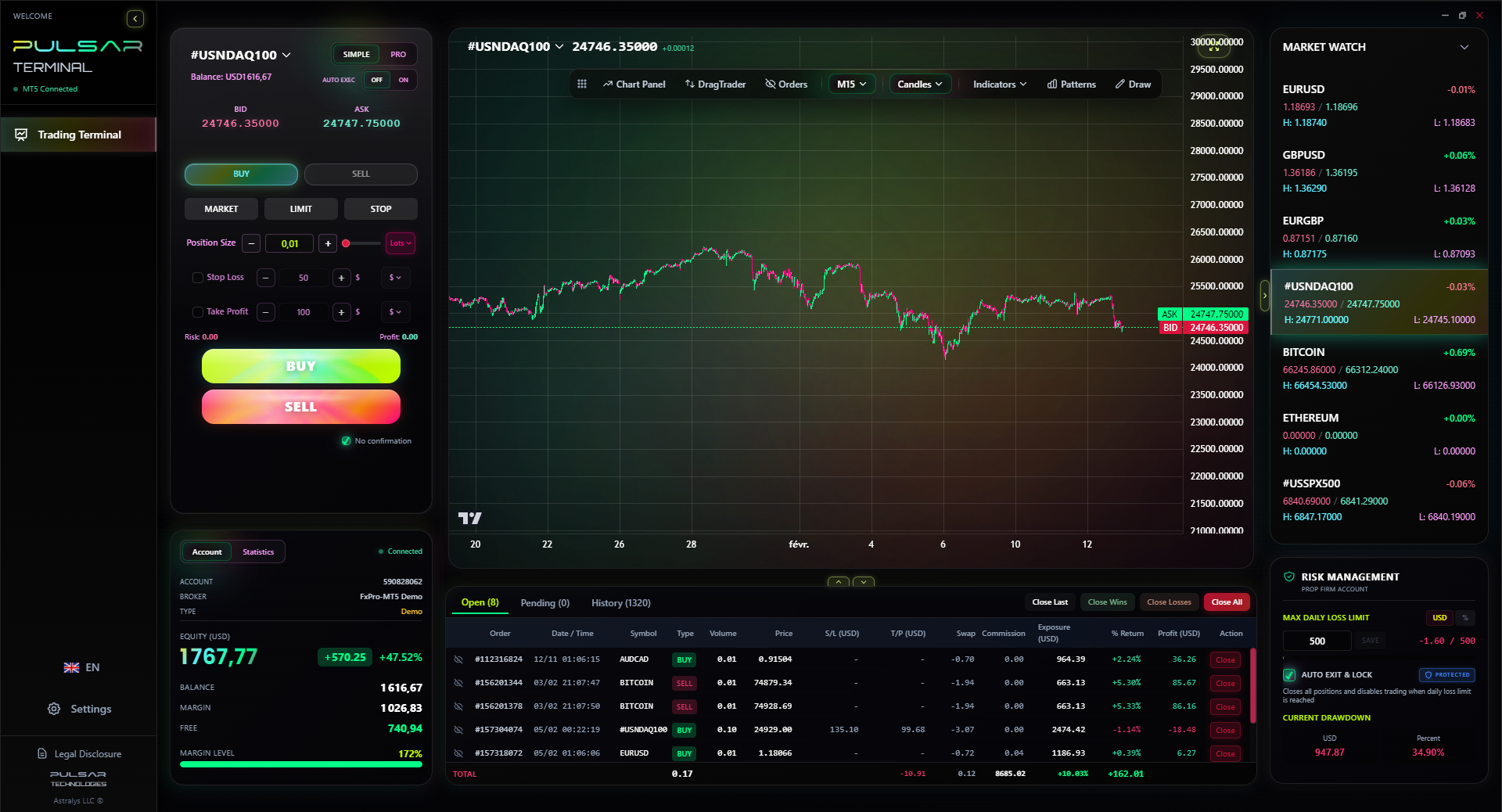
Keeping a detailed journal is key to improvement, and Pulsar Terminal's advanced trade analytics and journaling features automate this, giving you clear insights into your win rate and strategy performance directly on MT5.
Pulsar Terminal
L'outil MT5 tout-en-un : ordres glisser-déposer, multi-TP/SL, trailing stop, grid trading, Volume Profile et protection prop firm. Utilisé quotidiennement par 1 000+ traders.
Your psychology will make or break you. Technical skills are maybe 30% of the battle. The rest is managing your own brain.
Forex is a Marathon, Not a Sprint: View it as a business. Your goal in year one isn't to buy a Range Rover. It's to not blow up your account. It's to learn, refine your strategy, and achieve consistent, small gains. A 5-10% return per month on your capital is phenomenal and sustainable. Aiming for 50% will destroy you.
Embrace the Losses: You will have losing trades. A lot of them. A good strategy might only win 40-50% of the time. The key is making your winners bigger than your losers. If a loss hits your predetermined stop loss, it means your plan worked. The trade was wrong, but your risk management was right. That's a successful loss.
Detach from the Money: This is the hardest part. When you have real money on the line, fear and greed take over. Practice on a demo account until your strategy is solid, then transition to a live account with money you can truly afford to lose. Not your rent money, not your school fees. Once you're live, focus on executing your plan perfectly, not on the dollar/naira value of each pip definition.
💡 Conseil de Winston
The most important line on your chart isn't a trendline or moving average. It's your pre-planned stop loss.

“The path in forex exchange trading is about controlled, incremental progress. It's about surviving long enough to let your skills compound.”
Alright, let's put this all together into a step-by-step plan for your first month.
- Education First: Finish this guide. Then, spend a week just reading. Understand the basic terms. Don't touch a broker yet.
- Choose a Regulated Broker: Based on the criteria above, pick one. Open a demo account.
- Practice on Demo: For at least one full month, trade your demo account like it's real money. Start with tiny virtual positions. Practice your entry, stop loss, and take profit discipline. This is where you test strategies like swing trading in real market conditions without risk.
- Develop Your Simple Strategy: Based on what you learn, write down a one-page trading plan. What pair? What timeframe? What are your entry conditions? Where is your stop loss and take profit? What's your maximum risk per trade (start with 1% of demo capital)?
- Fund a Live Account: Start small. Deposit an amount that, if lost, would be disappointing but not life-altering. $100, 50,000 Naira, whatever that is for you.
- Trade Small, Journal Everything: Execute your plan with real money, but with the smallest possible position size (0.01 lots, a micro lot). Record every single trade and your thoughts.
- Review and Refine: At the end of the month, review your journal. What worked? What didn't? Tweak your plan and repeat.
The path in forex exchange trading is about controlled, incremental progress. It's about surviving long enough to let your skills compound. Avoid the hype, manage your risks fiercely, and focus on the process. Good luck.
FAQ
Q1Is forex exchange trading legal in Nigeria?
Yes, trading forex with international, regulated brokers is legal for individuals in Nigeria. However, the Central Bank of Nigeria (CBN) restricts local banks and financial institutions from facilitating payments to unregulated or certain types of offshore trading platforms. Always use a broker regulated by a reputable foreign authority like the FCA or ASIC to stay on the right side of the rules and protect your funds.
Q2How much money do I need to start forex trading in Nigeria?
You can start with a very small amount. Some brokers allow you to open a live account with as little as $10 (about 15,000 Naira). However, I strongly advise starting with at least $100-$200. This gives you enough breathing room to trade sensible position sizes and absorb a few losses while you learn. Remember, the goal with your first deposit is education and survival, not getting rich.
Q3What is the best time to trade forex in Nigeria?
The most active and liquid trading sessions overlap with Nigeria's afternoon and evening. The European session (7 AM - 4 PM GMT) is active from around 8 AM Nigerian time. The London/New York session overlap (12 PM - 4 PM GMT) is the most volatile period, happening from 1 PM to 5 PM Nigerian time. This is when you'll see the biggest moves and the tightest spreads on pairs like EUR/USD.
Q4Can I trade the Naira (USD/NGN) on forex platforms?
Generally, no. Most major international brokers do not offer the Nigerian Naira (NGN) as a tradable currency pair for retail clients due to liquidity and regulatory complexities. You will primarily be trading major pairs like EUR/USD, GBP/USD, and commodities like XAU/USD (Gold). Your profit and loss will be in USD or another major currency, which you then convert to Naira when you withdraw.
Q5How do I withdraw my profits from forex trading in Nigeria?
You withdraw using the same method you deposited with, following your broker's process. Common methods include bank wire transfer (which can take several days and may involve intermediary bank fees) or e-wallets like Skrill or Neteller (which are usually faster). The funds will be converted from your trading account currency (e.g., USD) to Naira by your bank or payment processor at their prevailing rate.
Q6What's the difference between a demo account and a live account?
A demo account uses virtual money. It's for practicing your strategy, learning the platform, and making mistakes risk-free. A live account uses your real money. The market conditions and prices are identical, but your psychology is completely different. Fear and greed are real with live funds. Never assume success on demo will instantly translate to live trading. Use the demo to build muscle memory for your plan.
La leçon du Prof. Winston
Points clés:
- ✓Risk only 1% of your capital on any single trade.
- ✓Use use of 1:10 or less while learning.
- ✓A 1:2 risk-reward ratio lets you be wrong more than right.
- ✓Demo trade for a minimum of one consistent month.
- ✓Journal every trade, especially the emotions.
Cet article vous a-t-il été utile ?
Cliquez sur une étoile
Analyses Trading Hebdo
Analyses et stratégies hebdo gratuites. Pas de spam.
À propos de l'auteur
Olumide Adeyemi
Pionnier du Trading en Afrique de l'Ouest
L'un des formateurs de trading forex les plus actifs au Nigeria. 8 ans d'expérience de trading depuis Lagos. Spécialisé dans les stratégies à petit capital et les challenges de prop firms pour les traders africains.
Commentaires
Avertissement sur les risques
Le trading d'instruments financiers comporte des risques importants et peut ne pas convenir à tous les investisseurs. Les performances passées ne garantissent pas les résultats futurs. Ce contenu est fourni à titre éducatif uniquement et ne constitue pas un conseil en investissement. Effectuez toujours vos propres recherches avant de trader.
Vous aimerez aussi

Cara Trading Forex Sukses: 7 Prinsip dari Trader Profesional
Cara trading forex sukses dengan 7 prinsip trader pro: manajemen modal, disiplin, journal trading, backtest. Data nyata, bukan janji profit palsu.
Jam Trading Forex Terbaik untuk Trader Indonesia: Panduan Lengkap dengan Tabel Waktu
Panduan jam trading forex untuk trader Indonesia. Tabel 4 sesi dunia, jam emas 20:00-00:00, sesi mana yang harus dihindari. Data akurat + tips dari trader berpengalaman.
Top 5 Sàn Forex Uy Tín Nhất 2026: Review Jujur dari Trader Indonesia
Top 5 sàn forex uy tín 2026 untuk trader Indonesia. Review jujur: spread, deposit, withdraw, dukungan lokal. Exness, XM, IC Markets & lebih.
Obtenir Pulsar Terminal
Tous ces calculateurs sont intégrés dans Pulsar Terminal avec des données en temps réel de votre compte MT5. Dimensionnement de position en un clic, gestion automatique des risques et calculs instantanés.
Obtenir Pulsar Terminal