


I stared at the forex graph on my screen, convinced I'd spotted the perfect setup.

Olumide Adeyemi
Pionnier du Trading en Afrique de l'Ouest ·  Nigeria
☕ 11 min de lecture
Ce que vous apprendrez :
- 1What Is a Forex Graph, Really?
- 2Key Elements a Nigerian Trader Must Know
- 3Common Chart Patterns in Naira Pairs
- 4Technical Indicators: The Lagging Truth
- 5Practical Chart Analysis for the Nigerian Market
- 6The Psychology of Reading Charts
- 7Tools & Platforms for Nigerian Traders
- 8Putting It All Together: A Simple Framework
I stared at the forex graph on my screen, convinced I'd spotted the perfect setup. EUR/NGN was pulling back to a 'key support level' I'd drawn. My analysis was textbook. I went all in with 5 lots, about ₦2.5 million in margin. The bounce never came. The line kept going down, slowly at first, then faster. I didn't have a stop loss because I 'knew' the market was wrong. Two hours later, my account was down 47%. The graph didn't lie; I just didn't know how to listen to it. That ₦1.1 million lesson taught me that in Nigeria's volatile market, reading the chart is survival.
Forget the fancy definitions. A forex graph is just a story. It's the collective record of every trade, every fear, and every greedy decision made by everyone in the market, from the CBN governor in Abuja to a prop trader in London. In Nigeria, where the Naira can swing 10% in a week on a single policy tweet, this story is especially dramatic.
The most common type you'll use is a candlestick chart. Each 'candle' shows the open, high, low, and close for a period (like 1 hour or 1 day). The body is coloured - often green for up, red for down. The wicks (or shadows) show the price extremes. When you're looking at USD/NGN, you're not just looking at numbers; you're watching a real-time battle between dollar demand and central bank policy.

Example: Look at a USD/NGN daily candle from June 2023. It might open at ₦460, rally to ₦480 on dollar scarcity fears (the high), crash to ₦455 on a surprise CBN intervention (the low), and close at ₦470. That long wick on top tells you sellers stepped in aggressively. That's information you can trade.
The graph itself is neutral. Your job is to interpret the narrative without letting your own story - like needing to make rent - cloud the plot. Most losses start when traders see the story they want to see, not the one being told.

💡 Conseil de Winston
A clean chart is a smart chart. If you need more than three indicators to make a decision, you don't have a strategy, you have a crutch.
Timeframes: Your Trading Horizon
This is where most people get it wrong. Are you checking the 1-minute chart or the weekly chart? They tell different stories. A scalp on GBP/NGN using a 5-minute chart might show a nice uptrend, while the daily chart screams a massive downtrend. I learned this the hard way shorting EUR/USD on a 15-minute breakdown, only to get steamrolled by the broader daily trend. Your timeframe dictates your strategy. If you're a scalping strategy enthusiast, you live on the 1M and 5M charts. If you're a swing trading patient person, the 4H and Daily are your home.
Support & Resistance: The Market's Memory
These are the price levels where the graph has historically paused or reversed. Think of them as floors and ceilings. In volatile pairs like USD/NGN, these levels can be wide zones, not precise lines. A key resistance might be the ₦1,550 level because it's where the price reversed three times last month. The graph remembers. When price approaches these levels, volume often picks up - it's where the next chapter of the story is written.
Trend Lines & Channels
Drawing a line connecting successive higher lows gives you an uptrend line. It's a visual guide to the market's momentum. In a strong Naira depreciation phase, USD/NGN will ride a clear upward channel. Trading against the trend is the fastest way to the poor house. I don't care how oversold your RSI indicator says it is; if USD/NGN is in a CBN-policy-fueled rally, buying the Naira is a suicide mission.

Warning: Nigerian markets are news-driven. A clean trend line can be obliterated in seconds by a CBN circular or a FAAC announcement. Never rely on technicals alone without knowing the economic calendar.
“A stop loss isn't a cost; it's the fee for being wrong and living to trade again.”
Patterns are the grammar of the forex graph's story. They suggest what might happen next, based on what has happened before. With Naira pairs, expect messier, more volatile patterns.
Head and Shoulders / Inverse Head and Shoulders: This is a classic reversal pattern. I caught a beautiful inverse head and shoulders on GBP/NGN on the 4-hour chart in late 2024. The 'left shoulder' formed at ₦1,820, the 'head' at ₦1,780, and the 'right shoulder' at ₦1,815. The 'neckline' was at ₦1,830. When price broke and closed above ₦1,830, I entered. The measured move target was about ₦1,880. It hit it in three days. That trade netted me ₦280,000. The pattern worked because it represented a shift in sentiment from selling to buying.
Triangles (Ascending, Descending, Symmetrical): These are consolidation patterns. Price coils into a tighter and tighter range before a breakout. A symmetrical triangle on USD/NGN often precedes a massive move, especially around month-end when demand for dollars peaks. The key is not to guess the direction but to wait for the breakout and then trade in that direction.
Double Tops and Bottoms: Another reversal signal. A double top looks like an 'M' and suggests a rally is exhausted. I remember a double top on EUR/NGN at ₦1,650. The second touch of that level had noticeably lower volume on my broker's feed (I use IC Markets for their raw spreads). That was the clue. The subsequent drop to ₦1,580 was swift.
The biggest mistake? Seeing patterns everywhere. Sometimes a squiggle is just a squiggle. Wait for the pattern to confirm itself with a clear breakout and a close beyond the key level.
Indicators are calculations plotted on or below your forex graph. They are derivatives of price, not predictors. This is critical. They LAG.
Moving Averages (MAs): The 50-period and 200-period Exponential Moving Average (EMA) are my bread and butter. They smooth out the noise. A basic rule: price above the 200 EMA = long-term uptrend. In 2023, when USD/NGN blasted through and held above its 200-day EMA, that was your signal that the old range was dead. A golden cross (50 EMA crossing above 200 EMA) on the weekly chart is a powerful, albeit late, bullish signal. I use them as dynamic support/resistance.
MACD & RSI: The MACD indicator shows momentum and trend changes. The RSI indicator measures speed and change of price movements (overbought/oversold). Here's the Nigerian reality: In a trending market like USD/NGN's 2024 rally, RSI can stay 'overbought' (above 70) for weeks. Selling just because RSI is at 80 is a great way to get ruined. I use RSI for divergence. If USD/NGN makes a new high but RSI makes a lower high, that's a warning sign the uptrend is losing steam.

Pro Tip: Don't clutter your chart. I use two EMAs (50 & 200), volume, and maybe the MACD. More than that and you're just creating confusion and conflict. The cleanest signals come from price action itself - the candles and their patterns.
💡 Conseil de Winston
The most important level on your chart is not support or resistance. It's the price where your stop loss sits. That's the line that defines your character as a trader.
“In volatile markets, simplicity isn't just elegant - it's survivable.”
Let's build a real-world analysis routine for a pair like USD/NGN or XAU/USD (Gold, a popular hedge).
Step 1: The Top-Down Analysis (Always)
- Weekly Chart: What's the macro trend? Is price above or below the key weekly MAs? This tells you the wind direction. Fighting the weekly trend is a losing game.
- Daily Chart: Zoom in. Identify the main support/resistance zones from the past few months. Where are we now relative to them?
- 4-Hour Chart: This is where I find my trade setups. Look for patterns (triangles, flags) forming at key daily levels. Check for confluence.
Step 2: Confluence is King A trade idea is strong when multiple factors agree. For example:
- Price approaches a major daily support zone.
- That zone aligns with the 200-period EMA on the 4H chart.
- The RSI indicator shows bullish divergence.
- A bullish candlestick pattern (like a hammer) forms. That's confluence. One signal alone is weak.
Step 3: The Entry, Stop Loss, and Take Profit Your forex graph must tell you all three before you click buy.
- Entry: On a confirmed breakout or bounce. Not before.
- Stop Loss: Always. Place it beyond the level that invalidates your story. If trading a bounce off support, your stop goes below that support. Use a position size calculator to ensure your risk is 1-2% of your account.
- Take Profit: Aim for the next logical resistance zone. You can use a risk-reward ratio (e.g., 1:2 – risking ₦10,000 to make ₦20,000).
I once set a 1:3 risk-reward trade on EUR/USD. My stop was 30 pips away, my target 90 pips. Price hit my target, and I made ₦45,000. The next week, I got greedy on a similar setup, skipped the pre-defined target, and watched a ₦25,000 profit turn into a ₦15,000 loss. The graph gave the same exit signal both times; I just ignored it the second time.
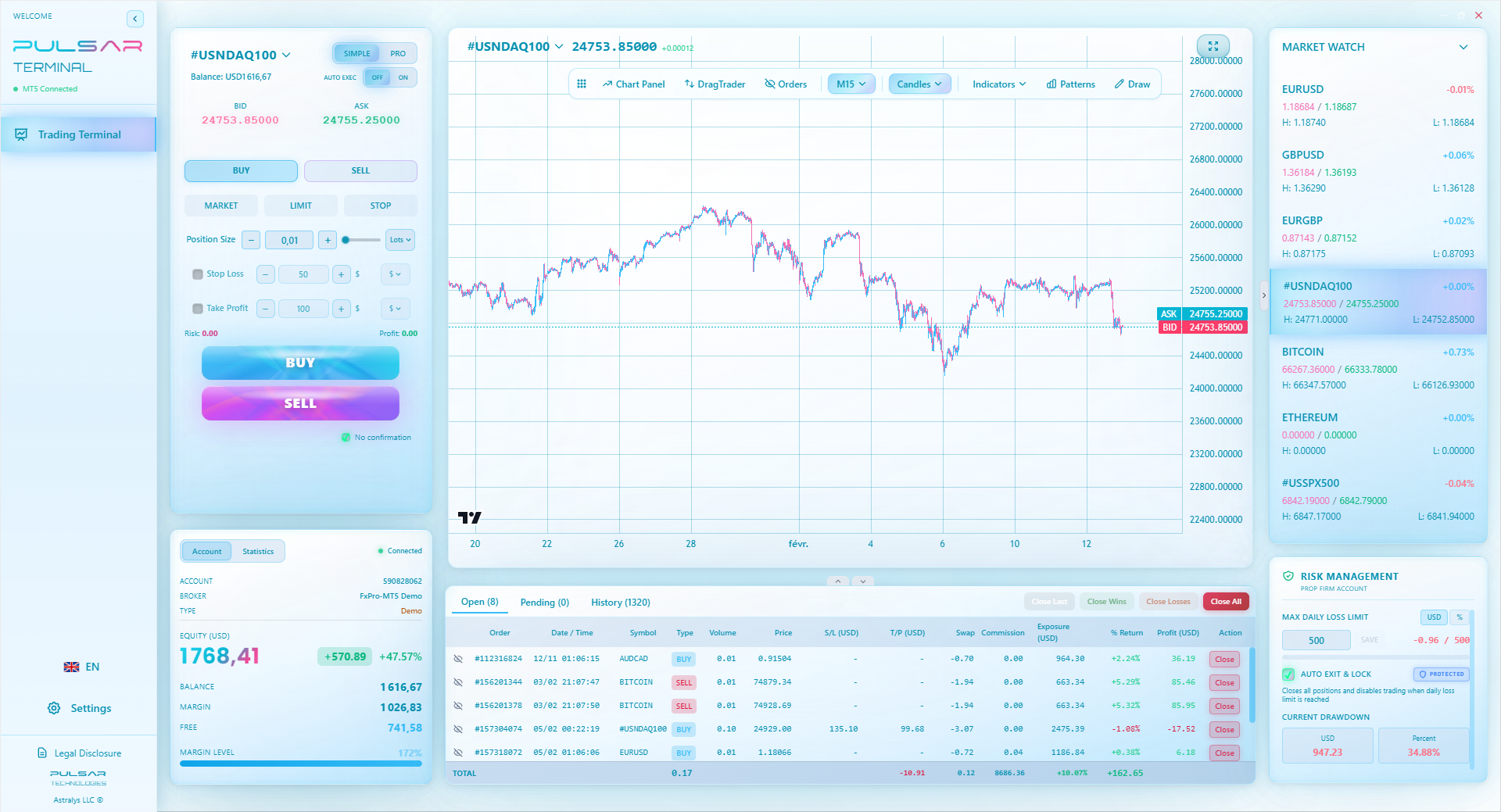
Manually moving stop losses and setting multiple take-profit levels on a volatile chart is stressful; Pulsar Terminal automates this directly on your MT5, letting you manage the trade so you can focus on reading the graph.
Pulsar Terminal
L'outil MT5 tout-en-un : ordres glisser-déposer, multi-TP/SL, trailing stop, grid trading, Volume Profile et protection prop firm. Utilisé quotidiennement par 1 000+ traders.
This is the unspoken core of trading. Your forex graph is a mirror. When you see a 'sure thing,' that's your greed talking. When you refuse to place a stop loss, that's your pride. When you close a winning trade too early, that's your fear.
Confirmation Bias: You'll see patterns that confirm your existing belief. If you're convinced the Naira will strengthen, you'll ignore every bearish candle and cling to the one tiny doji that looks hopeful. I've done it. We all have.
Revenge Trading: After a loss, you stare at the graph wanting it to give your money back. You take a bigger, sloppier trade to 'get back to even.' This is how accounts get deleted. After my big loss, I forced myself to walk away for 48 hours. No charts, no news.
Paralysis by Analysis: Too many indicators, too many timeframes, too much news. You see conflicting signals and do nothing, then kick yourself when the move happens. Simplicity cuts through this. A clean chart with clear levels reduces noise.
The graph is always right. You are the variable. Your job is to align your perception with what's actually printing on the screen, not what you hope will print.
“You don't trade the news; you trade the market's reaction to the news, which is printed on the chart.”
Your trading platform is your cockpit. The quality of your forex graph matters.
MetaTrader 4/5 (MT4/MT5): The industry standard. Most brokers like Exness, XM, and Pepperstone offer it. It's reliable, customizable, and supports automated trading (EAs). MT5 is more modern with more timeframes and built-in economic calendar.
TradingView: Excellent for analysis and idea sharing. The social features let you see what others are charting on USD/NGN. I use it for my top-down analysis before executing trades on my broker's MT5 platform. The free version is powerful enough for most.
Broker-Specific Platforms: Some like IC Markets have their own sleek platforms with advanced charting. Test them out on a demo account first.
Critical Local Factor: Data Costs & Internet Reliability Streaming real-time charts eats data. Get a stable, affordable internet plan. A chart that freezes during a CBN announcement can cost you money. Also, ensure your broker's servers are close (often in London or Johannesburg) for faster execution. A slow feed means your graph is in the past, and your trade is already late.
Pro Tip: Always test withdrawal speed with a small amount first. A broker with pretty charts but slow Naira withdrawals is a nightmare. I fund my account using local channels my broker supports, like bank transfer to a Exness Naira wallet, to avoid conversion hassles.
💡 Conseil de Winston
In Nigeria, the 'fundamental' news is just a very fast-moving technical indicator. The chart will show you the truth of its impact long before the analysts finish their reports.
Here’s my daily checklist. It keeps me disciplined.
- Market State: Check the Weekly/Daily. Trend (Up/Down/Range)?
- Key Levels: Mark today's major S/R on the 4H/Daily charts.
- Confluence Scan: On the 4H/1H charts, is any pattern or indicator aligning with those key levels?
- Plan the Trade: If A happens (e.g., bounce off ₦1,520 support with a bullish candle), I will do B (buy). My stop is at ₦1,515. My first target is ₦1,550. My risk is 1%.
- Execute & Manage: Place the trade with stop and limit orders. Do NOT move your stop loss further away. Ever. If you get stopped out, the graph told you your story was wrong. Listen.
- Review: At week's end, review your trades. Screenshot your charts. Did you follow your rules? Was your read of the graph correct?
This job is not about being right every time. It's about being disciplined every time. The forex graph is your only unbiased source of truth. In Nigeria's chaotic financial environment, that truth is your anchor. Learn its language, respect its message, and you might just survive long enough to become profitable.
FAQ
Q1What is the best timeframe for a beginner forex trader in Nigeria?
Start with the 4-hour chart. It's slow enough to avoid market noise and fast enough to see meaningful moves without waiting weeks. It filters out the chaos of lower timeframes that will trigger emotional decisions. Once you're consistently reading the 4H chart, you can explore lower timeframes for precise entries.
Q2Why does my forex graph for USD/NGN look different on TradingView vs. my broker's platform?
It's usually a data feed issue. TradingView might use a composite feed, while your broker (Exness, IC Markets, etc.) uses its own liquidity providers. Slight differences in price are normal. More importantly, the levels (support/resistance) should be similar. Always execute trades based on the graph from your broker's platform, as that's the price you're actually trading.
Q3How do I handle Naira volatility on the chart?
Widen your perspective. Use wider stop losses and profit targets measured in percentages, not fixed pip amounts. A 100-pip move on EUR/USD is big; on USD/NGN, it can happen before lunch. Use the Average True Range (ATR) indicator to gauge current volatility and set your stops at 1.5x the ATR to avoid being stopped out by normal noise.
Q4Can I rely solely on technical analysis from the forex graph in Nigeria?
No. Nigerian markets are fundamentally driven. A perfect bullish pattern can be destroyed by a CBN policy shift or a FAAC allocation announcement. Use the graph for timing and risk management, but always be aware of the economic calendar. Trade the chart, but understand the news behind it.
Q5What's the single biggest mistake Nigerians make when reading charts?
Trading without a stop loss. They see a move against them and, due to pride or hope, refuse to exit. They treat the stop loss as a cost instead of insurance. In a market that can gap (like when the CBN unified rates), not having a stop can wipe out an account instantly. Always use a stop. No exception.
Q6How much should I risk per trade based on what I see on the chart?
Never risk more than 1-2% of your trading capital on a single trade. This is non-negotiable. If your account is ₦500,000, your max risk per trade is ₦5,000-₦10,000. Use a position size calculator to figure out how many lots or units that equates to based on your stop loss distance. This lets you survive a string of losses and live to trade another day.
La leçon du Prof. Winston
Points clés:
- ✓Trade the chart you have, not the one you wish for.
- ✓Always define risk (1-2%) before reward.
- ✓Confluence of signals beats a single 'perfect' indicator.
- ✓The higher timeframe trend is your boss.
- ✓Your psychology is your biggest liability; a trading plan is its control.
Cet article vous a-t-il été utile ?
Cliquez sur une étoile
Analyses Trading Hebdo
Analyses et stratégies hebdo gratuites. Pas de spam.
À propos de l'auteur
Olumide Adeyemi
Pionnier du Trading en Afrique de l'Ouest
L'un des formateurs de trading forex les plus actifs au Nigeria. 8 ans d'expérience de trading depuis Lagos. Spécialisé dans les stratégies à petit capital et les challenges de prop firms pour les traders africains.
Commentaires
Avertissement sur les risques
Le trading d'instruments financiers comporte des risques importants et peut ne pas convenir à tous les investisseurs. Les performances passées ne garantissent pas les résultats futurs. Ce contenu est fourni à titre éducatif uniquement et ne constitue pas un conseil en investissement. Effectuez toujours vos propres recherches avant de trader.
Vous aimerez aussi

Cara Trading Forex Sukses: 7 Prinsip dari Trader Profesional
Cara trading forex sukses dengan 7 prinsip trader pro: manajemen modal, disiplin, journal trading, backtest. Data nyata, bukan janji profit palsu.
Jam Trading Forex Terbaik untuk Trader Indonesia: Panduan Lengkap dengan Tabel Waktu
Panduan jam trading forex untuk trader Indonesia. Tabel 4 sesi dunia, jam emas 20:00-00:00, sesi mana yang harus dihindari. Data akurat + tips dari trader berpengalaman.
Top 5 Sàn Forex Uy Tín Nhất 2026: Review Jujur dari Trader Indonesia
Top 5 sàn forex uy tín 2026 untuk trader Indonesia. Review jujur: spread, deposit, withdraw, dukungan lokal. Exness, XM, IC Markets & lebih.
Obtenir Pulsar Terminal
Tous ces calculateurs sont intégrés dans Pulsar Terminal avec des données en temps réel de votre compte MT5. Dimensionnement de position en un clic, gestion automatique des risques et calculs instantanés.
Obtenir Pulsar Terminal