


I lost $300 in under an hour with my first forex live account.

Olumide Adeyemi
Pionnier du Trading en Afrique de l'Ouest ·  Nigeria
☕ 10 min de lecture
Ce que vous apprendrez :
- 1What Exactly Is a Forex Live Account?
- 2Choosing a Broker in Nigeria: Regulation Isn't Optional
- 3Funding Your Account: The Nigerian Reality Check
- 4Account Types and Real Trading Costs
- 5The Psychology Shift: Demo vs. Live
- 6Your First 10 Trades With a Live Account
- 7Pitfalls Every Nigerian Trader Faces (And How to Avoid Them)
I lost $300 in under an hour with my first forex live account. I'd been crushing it on demo for months, placing perfect trades. The moment real money hit the screen, my brain short-circuited. I doubled down on a losing EUR/USD position, ignored my stop loss, and watched my deposit evaporate during a London session spike. That humbling lesson cost me a month's savings, but it taught me what a live account really is: a psychological battlefield. Let's make sure your first live trade doesn't end like mine.
A forex live account is your gateway to the actual market, where you trade real capital against other participants. It's not a simulation. When you click buy or sell, you're creating a binding contract with a broker to exchange currency at that price. The numbers on your screen represent actual profit or loss in your chosen deposit currency, usually USD.
Think of it this way: your demo account is a flight simulator. A forex live account is you in the cockpit of a real plane. The controls are identical, but the consequences of a mistake are permanent. That psychological shift is everything. Brokers report that between 74% and 89% of retail accounts lose money, and that statistic is almost entirely about live account behavior, not demo performance.
Your live account is also your financial relationship with a broker. It's where you deposit funds, it's what they use to calculate your margin and potential margin call, and it's the vehicle for all fees - spreads, commissions, swaps. Choosing the right type of live account (Standard, ECN, Zero-spread) is your first strategic decision before you even place a trade.
“A forex live account isn't a better demo account; it's a test of your character under financial fire.”
Here's the blunt truth: Nigeria doesn't have a local regulatory body licensing forex brokers for retail traders. The CBN focuses on macro FX stability, not on overseeing whether Broker XYZ treats you fairly. This means you're almost certainly going with an international broker. That's fine, but it makes your due diligence ten times more critical.
The Non-Negotiables: Real Regulation
You must pick a broker regulated by a reputable foreign authority. Top-tier licenses include the UK's Financial Conduct Authority (FCA), the Australian Securities and Investments Commission (ASIC), or the Cyprus Securities and Exchange Commission (CySEC). These bodies enforce client fund segregation, fair pricing, and dispute resolution. Don't fall for "registered in Saint Vincent" or other offshore havens with no real oversight. I learned this the hard way early on with a broker that "slipped" my stops constantly. A properly regulated broker like those we review, such as IC Markets or Pepperstone, provides a baseline of security.
The Practical Fit: Deposits and Platforms
Your broker must support payment methods that work in Nigeria. As of early 2026, some Naira debit cards are working again for international payments, but with low limits (think $500/month). The real solution for most serious traders is virtual dollar cards from fintechs like Chipper Cash or Grey. Your broker must accept these, or offer direct local bank transfer options. Platform-wise, MT4 or MT5 is standard. If you're planning on advanced swing trading or scalping, ensure their server latency is decent for your strategy.

💡 Conseil de Winston
Your first live account deposit is tuition, not investment capital. If you expect to keep it, you're not ready to trade it.
“In Nigeria, your funding method is a strategic asset. A broken payment channel can trap your profits.”
This is where theory meets the frustrating reality of our FX market. You can't just wire Naira to a USD account. Here’s what actually works, with costs.
Virtual Dollar Cards are King. I use a Chipper Cash USD virtual card. I fund it with Naira via bank transfer, they convert it at their rate (which is usually close to the parallel market rate), and I get a virtual Visa card in USD. I then use this card to deposit directly into my broker. Card creation fee: ~$2. No monthly fee. The limit is high enough for trading capital. This method has been 100% reliable for me for three years.
The Return of Naira Cards (With Limits). Some banks like Wema now allow international transactions again, capped around $500/month. Fine for a tiny starter account, useless for anything serious or for withdrawing profits.
E-wallets as a Bridge. Neteller and Skrill work. You fund them with your virtual card or bank transfer, then send to your broker. It adds a step and extra fees, but some brokers prefer it.

Warning: Never use a friend’s card or a third-party method to fund your account. When it's time to withdraw, the broker will send the money back to the original source. If that's not your account, you're in for a world of pain proving ownership. I've seen traders lose thousands this way.
Start with an amount you can afford to lose completely. My rule? Your first live deposit should be no more than what you'd comfortably spend on a high-end smartphone. Use a position size calculator religiously from day one. That first $300 I lost? It was 30% of my account on one stupid trade. Don't be me.
“In Nigeria, your funding method is a strategic asset. A broken payment channel can trap your profits.”
Brokers offer different live account types. The choice dictates your main cost: the spread. Let's break down the numbers.
| Account Type | How It Works | Best For | Real Cost Example (EUR/USD) |
|---|---|---|---|
| Standard (Spread-Only) | Broker's profit is built into the spread. No commission. | Beginners, longer-term traders. | Spread of 1.0 to 1.5 pips. Cost on 1 lot: $10-$15. |
| ECN/Raw Spread | You get interbank spreads + a fixed commission per lot. | Scalpers, high-volume traders. | Spread of 0.0 to 0.3 pips + $3.5 commission per side. Total cost: ~$7. |
| Zero-Spread | A marketing name. Usually means a fixed commission and a tiny spread. | Traders who want predictable costs. | Spread of 0.0 to 0.1 pips + a higher commission (e.g., $5-$7 per side). |
Here's my experience: I started on a Standard account with XM. The 1.2 pip spread on EUR/USD felt fine. But when I moved to a scalping strategy, that cost killed my edge. I switched to an ECN account with a 0.2 pip average spread and a $3.5 commission. My cost per trade dropped by over 50%. For a swing trading strategy where you hold for days, the swap (overnight financing) charge becomes more important than the spread.

Example: You buy 1 standard lot (100,000 units) of EUR/USD on a Standard account with a 1.3 pip spread. Each pip is worth $10. Your cost to enter the trade is 1.3 x $10 = $13. That's how much the price needs to move in your favor just for you to break even.
Don't just look at the minimum deposit. Look at the cost per trade. A $10 minimum account with a 3-pip spread is a trap.
💡 Conseil de Winston
In Nigeria, your funding method is part of your trading edge. A reliable, low-fee virtual card is as important as your trading strategy.
“The 1% risk rule isn't a suggestion. It's the price of admission to stay in the game long enough to learn.”
This is the core of the article. Your demo account is a lie. A useful lie, but a lie nonetheless. It teaches you mechanics, not psychology. When real money is on the line, fear and greed become your co-pilots.
On demo, a 50-pip loss is a number. On a live account, it's rent money. This triggers the "revenge trade" - jumping back in immediately to win it back, which almost always loses more. It also triggers "hope trading" - moving your stop loss further away because you're sure the market will turn. It won't. I've done both more times than I care to admit.
How to Bridge the Gap:
- Trade a Micro Account First: Deposit $100. Trade 0.01 lots (micro lots). The financial risk is tiny (a $1 move per pip), but the money is real. This acclimatizes your brain to live trading without catastrophic risk. Do this for at least 100 trades.
- Journal Religiously: For every live trade, note your emotional state. "Felt anxious after yesterday's loss, entered early." This data is gold.
- Use a Checklist: Before clicking buy/sell, run through a physical list: Is my stop loss set? Is my risk 1%? Am I following my plan or chasing? This creates a pause that emotion can't jump.
The goal isn't to eliminate emotion. It's to install systems so strong that emotion can't override them. Tools that automate risk management are useful here.
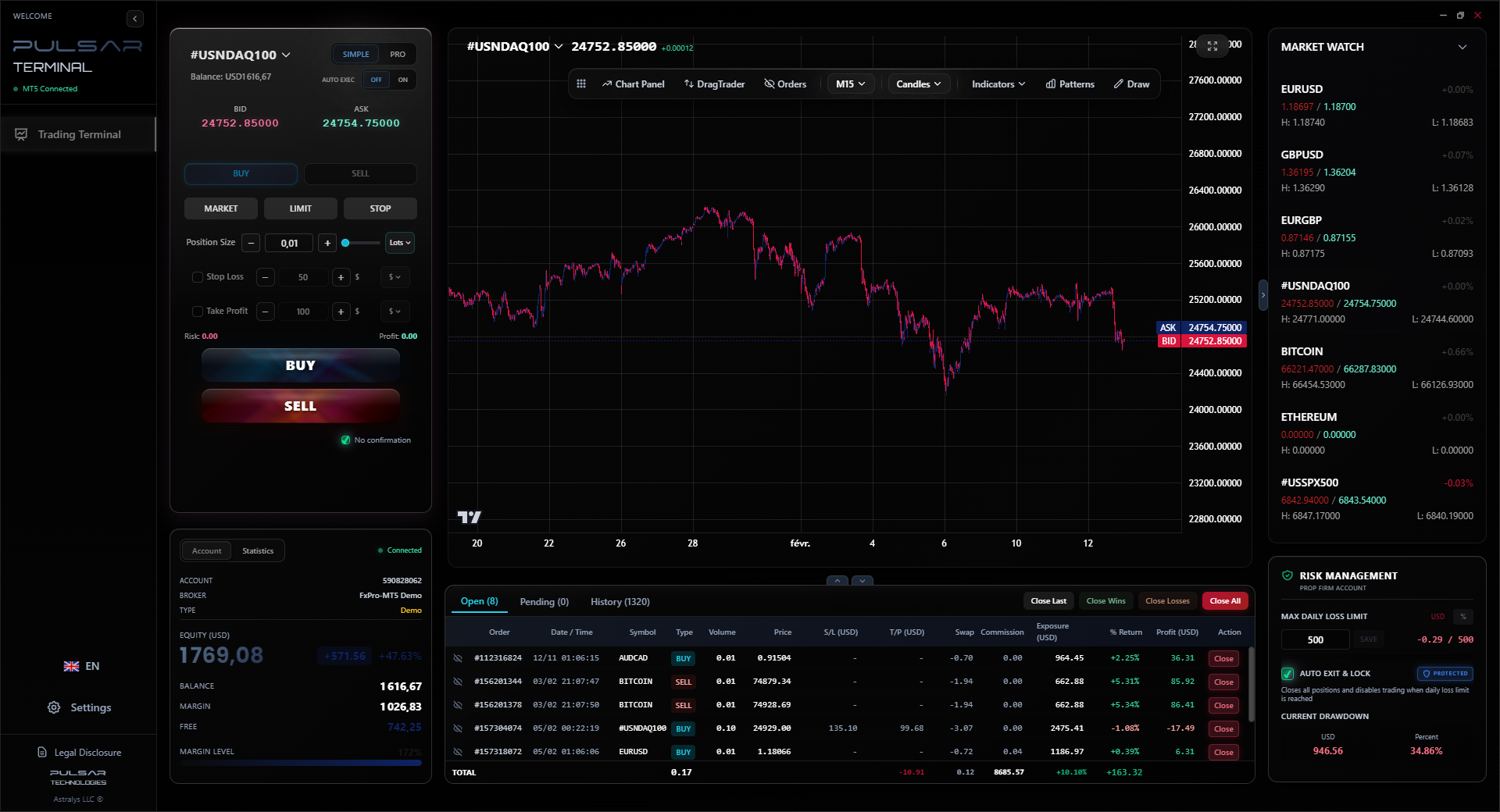
Managing the psychology of a live account is easier when your trade management is automated, which is where a tool like Pulsar Terminal for MT5 excels.
Pulsar Terminal
L'outil MT5 tout-en-un : ordres glisser-déposer, multi-TP/SL, trailing stop, grid trading, Volume Profile et protection prop firm. Utilisé quotidiennement par 1 000+ traders.
“The 1% risk rule isn't a suggestion. It's the price of admission to stay in the game long enough to learn.”
Your account is funded. The platform is open. Don't just start trading. Follow this sequence.
- Set Your use Low. I don't care if your broker offers 1:1000. Set it to 1:10 or 1:20 max. High use is a risk accelerator, not a profit tool. It's the fastest way to a margin call.
- Calculate Your Position Size. Use a calculator. If you have a $500 account and are willing to risk 1% ($5) on a trade with a 25-pip stop loss, your position size is $5 / (25 pips * $1 per pip on a micro lot) = 0.2 lots. Start with 0.01 lots anyway.
- Place a Trade on a Major Pair. Start with EUR/USD or XAU/USD. They have the tightest spreads and most predictable liquidity. Avoid exotic pairs.
- Set Stop Loss and Take Profit IMMEDIATELY. The moment the trade is open, these orders go in. No exceptions. This is non-negotiable.
- Walk Away. Seriously. Open the trade, set your orders, and close the platform for an hour. Obsessing over the screen will make you do something stupid.
Your goal for the first 10 trades is not profit. Your goal is to execute your plan perfectly, manage your risk exactly, and log your emotions. If you end up $5 down but followed your rules, that's a bigger win than a $50 profit from a reckless gamble.
💡 Conseil de Winston
If you feel your heart beat faster when you click 'buy' or 'sell', your position size is too large. Reduce it until the click feels boring.
“Your stop loss is your most important trade. It's the one that saves you from yourself.”
We face unique challenges. Here's how they manifest and how to dodge them.
Pitfall 1: The "Get-Rich-Quick" Funding Pressure. You see the Naira depreciating, you feel pressure to make life-changing money fast. This leads to over-leveraging. Solution: View trading as a skill-building business, not a lottery. Your monthly target should be a consistent percentage return, not a Naira figure to buy a car.
Pitfall 2: Ignoring the True Cost of Trading. You see "zero spread" and don't check the commission. Or you forget about swap fees on overnight positions. Solution: Know your all-in cost per trade type. Your broker's trade confirmation will show the spread, commission, and swap. Review it.
Pitfall 3: Chasing "Signal Sellers" and Prop Firm Hype. The social media guru selling signals doesn't have a verified track record. The prop firm challenge seems like free money. Remember, 89% lose. Solution: If you use a signal, back-test it first. If you try a prop firm, use the strictest risk management you've ever used. Their rules are designed to make you fail.
Pitfall 4: Technical Issues During Power/Network Outages. You have a live trade on and GOING goes dark. Solution: Always have a mobile data backup. Set stop losses on every trade so you're protected if you get disconnected. Consider a UPS for your router and PC.

Pro Tip: Your first withdrawal request is a critical test. Do a small withdrawal first ($50) using the same method you deposited with. Confirm it works smoothly and you receive the Naira equivalent without hassle before moving larger profits.
FAQ
Q1What is the minimum amount to start a forex live account in Nigeria?
Technically, you can start with as little as $10 with some brokers. Practically, I recommend a minimum of $200-$500. This allows you to trade micro lots (0.01) with proper risk management without your account being wiped out by a few bad trades or fees. Remember, the minimum isn't about what you can deposit, but what you can afford to lose while still learning.
Q2Is forex trading legal in Nigeria?
Trading forex with international brokers is a legal gray area for individuals. There's no law that specifically makes it illegal for you to open an account with a company like IC Markets or Exness. However, the CBN's restrictions on international payments make funding accounts challenging. You are not breaking Nigerian law by trading, but you have no local regulatory protection. Your safety net is the foreign regulator overseeing your chosen broker.
Q3Which broker is best for Nigerians?
There's no single "best" broker. Look for brokers with strong international regulation (FCA, ASIC, CySEC), who accept funding methods that work here (virtual USD cards, e-wallets), and offer competitive costs on the pairs you trade. We provide detailed reviews of brokers like Exness, IC Markets, and Pepperstone that are popular choices due to their low minimum deposits and flexible payment options.
Q4How do I withdraw profits to my Nigerian bank account?
The process is usually the reverse of your deposit. If you deposited with a Chipper Cash USD virtual card, you request a withdrawal back to that card. You then convert the USD to Naira within the Chipper Cash app and send it to your local bank account. Most brokers also offer direct bank wire transfers, but these can be slower and attract higher intermediary bank fees. Always do a small test withdrawal first.
Q5Why did I succeed on demo but fail on a live account?
This is universal. Demo trading removes emotion and consequence. On a live account, the fear of loss and the greed for profit distort your decision-making. You hesitate, you overtrade, you abandon your plan. The solution is to trade a micro live account to re-train your brain with real, but small, money on the line until your execution matches your demo performance.
Q6What's more important, low spreads or good regulation?
Good regulation, 100 times over. A broker with a 0.0 pip spread can manipulate your trades, refuse withdrawals, or go bankrupt with your money. A broker regulated by the FCA or ASIC must keep your funds in segregated accounts and participate in investor compensation schemes. You can't make profits if your capital isn't safe. Start with a strongly regulated broker, then find the best spreads they offer.
La leçon du Prof. Winston
Points clés:
- ✓Start live with a micro account under $500.
- ✓Use virtual USD cards for reliable funding.
- ✓Risk only 1% of capital per trade.
- ✓Choose brokers with FCA/ASIC regulation.
- ✓Set stop loss before every entry.
Cet article vous a-t-il été utile ?
Cliquez sur une étoile
Analyses Trading Hebdo
Analyses et stratégies hebdo gratuites. Pas de spam.
À propos de l'auteur
Olumide Adeyemi
Pionnier du Trading en Afrique de l'Ouest
L'un des formateurs de trading forex les plus actifs au Nigeria. 8 ans d'expérience de trading depuis Lagos. Spécialisé dans les stratégies à petit capital et les challenges de prop firms pour les traders africains.
Commentaires
Avertissement sur les risques
Le trading d'instruments financiers comporte des risques importants et peut ne pas convenir à tous les investisseurs. Les performances passées ne garantissent pas les résultats futurs. Ce contenu est fourni à titre éducatif uniquement et ne constitue pas un conseil en investissement. Effectuez toujours vos propres recherches avant de trader.
Vous aimerez aussi

Cara Trading Forex Sukses: 7 Prinsip dari Trader Profesional
Cara trading forex sukses dengan 7 prinsip trader pro: manajemen modal, disiplin, journal trading, backtest. Data nyata, bukan janji profit palsu.
Jam Trading Forex Terbaik untuk Trader Indonesia: Panduan Lengkap dengan Tabel Waktu
Panduan jam trading forex untuk trader Indonesia. Tabel 4 sesi dunia, jam emas 20:00-00:00, sesi mana yang harus dihindari. Data akurat + tips dari trader berpengalaman.
Top 5 Sàn Forex Uy Tín Nhất 2026: Review Jujur dari Trader Indonesia
Top 5 sàn forex uy tín 2026 untuk trader Indonesia. Review jujur: spread, deposit, withdraw, dukungan lokal. Exness, XM, IC Markets & lebih.
Obtenir Pulsar Terminal
Tous ces calculateurs sont intégrés dans Pulsar Terminal avec des données en temps réel de votre compte MT5. Dimensionnement de position en un clic, gestion automatique des risques et calculs instantanés.
Obtenir Pulsar Terminal