


Here's a fact that should get your attention: the four-hour window when London and New York markets overlap accounts for roughly 70% of the entire day's forex volume.

David van der Merwe
Trader des Marchés Émergents ·  South Africa
☕ 12 min de lecture
Ce que vous apprendrez :
- 1The London Session: Your Afternoon Goldmine
- 2FSCA Rules: Your Shield (and Sometimes Your Shackle)
- 3The Real Costs: It's More Than Just the Spread
- 4Brokers & Platforms: What Works on SA Connections
- 5A Simple London Session Strategy for SA Traders
- 6The Rand & Interest Rates: Your Macro Edge
- 7Mistakes I Made (So You Don't Have To)
- 8Your London Session Trading Routine (The 2026 Blueprint)
Here's a fact that should get your attention: the four-hour window when London and New York markets overlap accounts for roughly 70% of the entire day's forex volume. For a South African trader sitting in Johannesburg or Cape Town, that window opens right in your afternoon. If you're not structuring your entire trading day around the forex London session time in South Africa, you're leaving serious money on the table. I've traded through three rand cycles from this timezone, and I can tell you this session is where fortunes are made and lost before supper. Let's get you on the right side of that equation.
Forget trying to trade the sleepy Asian session from SA. The real action kicks off when London's traders have finished their coffee. The core London session runs from 10:00 AM to 7:00 PM South African Standard Time (SAST). That's when the big European banks, hedge funds, and institutional desks are fully online, creating massive liquidity.
But here's the secret sauce: the magic happens during the London-New York overlap. From 3:00 PM to 7:00 PM SAST, both financial capitals are trading simultaneously. Volume spikes, spreads on major pairs like EUR/USD often tighten, and you get clean, decisive price movements. It's the closest thing to a guaranteed volatile period you'll get.
I learned this the hard way early on. I used to try scalping strategy the USD/ZAR at 8 AM SAST. The spreads were wide, the moves were choppy, and I'd be down R500 before lunch on a bad day. Once I shifted my focus to the 3 PM - 5 PM window for EUR/USD and GBP/USD, my consistency improved overnight. The market was just easier to read.

Example: On a typical Tuesday, the average true range (ATR) for EUR/USD might be 40 pips from 1 AM to 10 AM SAST. From 3 PM to 7 PM SAST, that ATR can easily jump to 70-90 pips. That's more than double the movement in half the time.

💡 Conseil de Winston
The market's first move after the London open is often a fake-out. Wait 90 minutes for the real direction to establish itself. Patience saves pips.
Trading from South Africa means playing by the Financial Sector Conduct Authority's (FSCA) rules. They're not the strictest globally, but they've got teeth. The key thing to know is that any broker legally serving South African clients must have an FSP license and often an ODP (Over-The-Counter Derivatives Provider) authorization. This isn't optional.
Why This Matters for You
First, it's about safety. An FSCA-regulated broker must keep your funds in segregated accounts. That means if the broker goes belly-up (it happens), your trading capital is separate from their operating money. I sleep better knowing that.
Second, the rules are uniquely South African. Unlike Europe with its 1:30 use caps, the FSCA allows use up to 1:500. That's a double-edged sword. It lets you control large positions with little capital, but it also means you can blow your account faster than you can say 'margin call.' They also don't restrict bonuses or aggressive marketing, so you need to be extra critical of 'get rich quick' promises.
The Physical Presence Loophole (That's Closing)
A broker must have a local office and key staff here. This is great for accountability but can limit your choices. Some international brokers with better platforms or conditions might not bother with the FSCA hassle. You're often choosing between top-tier global tech with an offshore broker (carrying higher risk) or solid protection with a locally licensed one. My advice? Start with a licensed broker like XM or Exness that has a strong local presence. Get your bearings first.

Warning: Just because a broker's website has a '.co.za' domain and accepts ZAR deposits does NOT mean it's FSCA-regulated. Always check the FSCA's official register. I got stung years ago by a 'local' broker that was actually registered in Vanuatu. Withdrawals took months.
“The four-hour London-New York overlap is where fortunes are made and lost before supper.”
Everyone looks at the spread, but that's just the entry fee. To trade profitably in the London session from SA, you need to account for every cent that leaves your account.
Let's break down the numbers from a local perspective:
The Obvious Costs:
- Spreads: On a good ECN account during the London session, you can get EUR/USD spreads of 0.0 - 0.3 pips. On a standard account, expect 0.8 - 1.5 pips. Use a position size calculator to see how this eats into your profit on each trade.
- Commissions: Common on ECN accounts. Around $7 per lot (100,000 units) traded. That's roughly R130 per round turn on a standard lot at current rates.
- Swap Fees: Holding a GBP/USD buy position overnight during the London session might cost you $2 per lot. It adds up if you're a swing trading enthusiast.
The Hidden Local Killers:
- Currency Conversion: This is the silent account drainer. If your broker only offers USD accounts and you deposit ZAR, they'll convert it at a marked-up rate. I've seen fees of 1.5% baked into the rate. On a R10,000 deposit, that's R150 gone before you place a single trade.
- Bank Transfer Fees: Funding your account isn't free. Sending money internationally via FNB can cost R250. Nedbank charges a percentage (0.59%) plus a R112 comms fee. If you're making small, frequent deposits, these fees will murder your capital.
My Costly Lesson: In 2021, I was trading a XAU/USD guide strategy, in and out of gold multiple times a week. I was profitable on the trades themselves. But I was using a USD account and funding it with monthly EFTs. At year-end, I calculated I'd paid over R4,200 in combined bank and conversion fees. That was a full month's profit, just gone to the banks. Now I only use brokers with ZAR-denominated accounts.
You need a broker that fits the SA context: FSCA-regulated, ZAR accounts, low-fee deposits, and a platform that doesn't lag on our sometimes-shaky internet.
Based on my experience and tracking local trader forums, here’s the lay of the land:
| Broker | Key SA-Friendly Feature | London Session Spread (EUR/USD) | My Take |
|---|---|---|---|
| IC Markets | Raw spreads, great for scalpers | 0.0 - 0.2 pips on Raw Account | Top-tier execution. Their IC Markets review highlights their global reach, but ensure you use their FSCA entity. |
| Exness | Min deposit 15 ZAR, local support | 0.3 - 0.8 pips (Std) | Unbeatable for starting small. Their Exness review shows they're a local giant for a reason. |
| XM | $5 min deposit, ZAR accounts | 0.8 - 1.0 pips (Std) | Very trader-friendly, tons of educational resources. Solid all-rounder. |
| Pepperstone | cTrader & MT5, tight spreads | 0.0 - 0.3 pips on Razor | Excellent for algo traders. Their Pepperstone review notes their strong AU/UK regulation, check for FSCA status. |
Platform Choice: MetaTrader 5 (MT5) is the king here. It's more stable on slower connections than some web platforms, and every local broker supports it. The MACD indicator and RSI indicator work flawlessly on it. While cTrader is slicker, I've had more disconnection issues with it during peak load-shedding. MT5 is the workhorse.

Pro Tip: Always test your broker's platform with a demo account during the actual London session (3-5 PM SAST). That's when server load is highest. If you get requotes or lag then, it will only be worse with real money.
“Fatigue leads to ignoring your rules, and that's when the big losses happen.”
You don't need a complex system. You need a routine that exploits the session's personality. Here's what I do between 2:30 PM and 7:00 PM SAST.
2:30 PM - 3:00 PM SAST: The Prep Window I'm not trading yet. I'm analyzing. I look at the 1-hour and 4-hour charts of my two main pairs: EUR/USD and GBP/USD. I'm identifying key support/resistance levels from the Asian and early London session. I check the economic calendar for any news due at 3:00 PM or 4:00 PM SAST (UK & EU data).
3:00 PM - 5:00 PM SAST: The Execution Window This is when New York logs on and volume explodes. I trade breakouts. The early London session often creates a range. When New York volume hits, it frequently breaks that range with momentum.
- My Go-To Setup: A 15-minute chart consolidation (a tight range) after 2:30 PM SAST. I place buy-stop orders above resistance and sell-stop orders below support, with a target of 1.5x the range height. I only need one to trigger. My stop loss is on the other side of the range.
5:00 PM - 7:00 PM SAST: The Management Window Trades are on. Now it's about trailing stops and taking partial profits. The market can get manic here, especially if US data drops. I use a simple 20-period moving average on the 5-minute chart as a trailing stop guide. If price closes below it on a long trade, I'm out.
Why This Works: It's objective, it waits for the highest-probability moment (the overlap), and it manages risk first. I don't catch the very top or bottom, but I catch the meaty middle move. A typical winning trade on this might net 40-60 pips.
💡 Conseil de Winston
If you wouldn't enter the trade at 4:59 PM SAST, don't enter it at 3:01 PM. The quality of the setup matters more than the session's label.
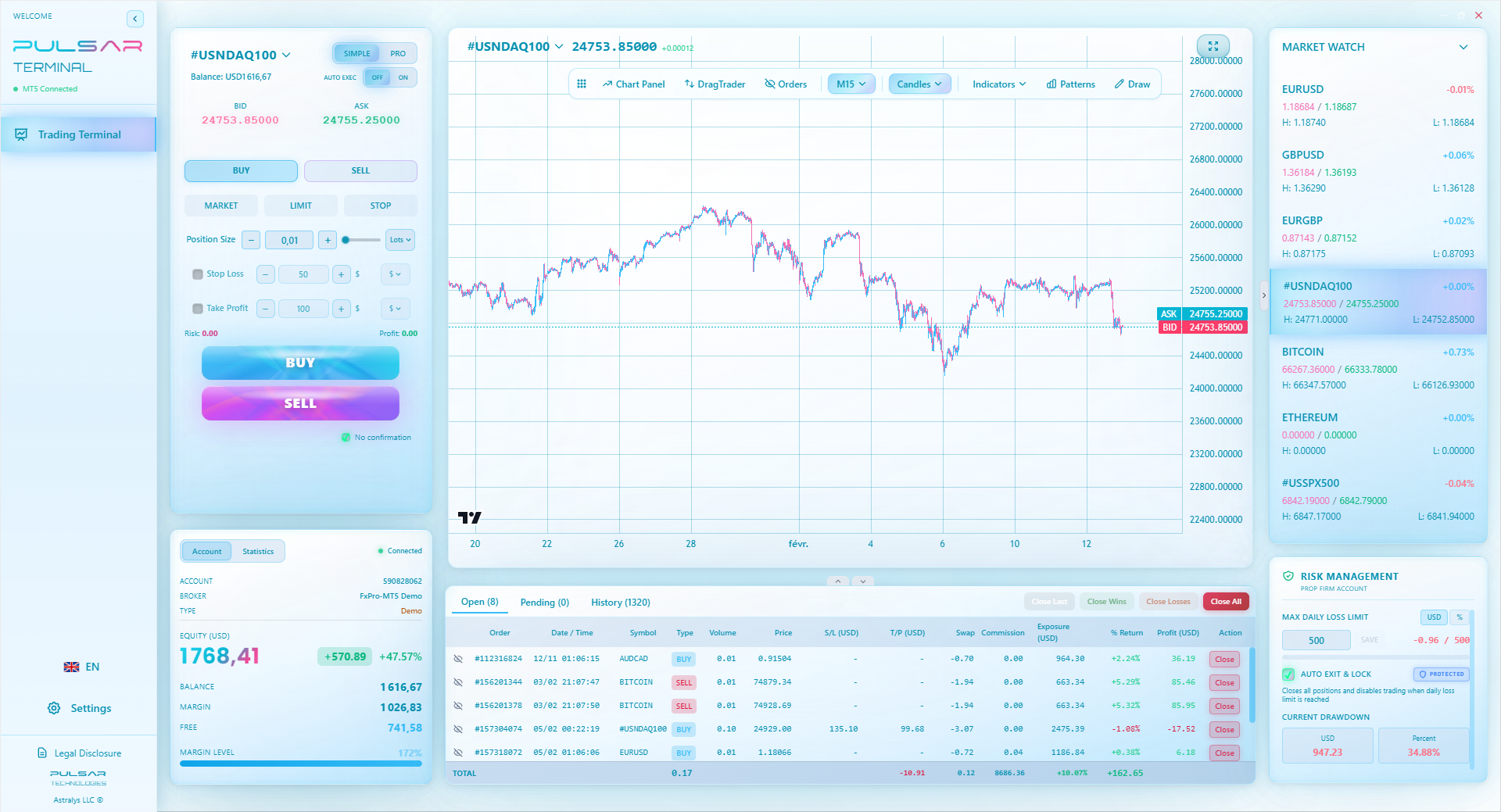
Managing multiple trades and trailing stops during the frantic London session is a headache, but tools like Pulsar Terminal automate it all directly on your MT5 platform.
Pulsar Terminal
L'outil MT5 tout-en-un : ordres glisser-déposer, multi-TP/SL, trailing stop, grid trading, Volume Profile et protection prop firm. Utilisé quotidiennement par 1 000+ traders.
Trading the London session isn't just about EUR/USD. Your home currency, the ZAR, is heavily influenced by what happens in London (a major FX hub) and by global risk sentiment. You need to watch two things:
1. The Rand's Mood: The ZAR is a risk-sensitive currency. When global markets are fearful (stocks down), the rand weakens. During the London session, watch the FTSE 100 and the DAX. If they're selling off sharply, USD/ZAR will likely be rising. In early 2026, the rand hit R16.40/$, its strongest in years, partly due to positive EU regulatory news. That strength creates a different technical environment for USD/ZAR pairs.
2. The SARB's Hand: The South African Reserve Bank has been cutting rates. Repo rate was 6.75% at end-2025, with more cuts expected. This narrowing interest rate differential with the US or EU affects swap rates. If you're holding carry trades overnight, your swap credit (or cost) is changing. A lower SA rate makes holding long ZAR positions overnight less attractive.
Practical Takeaway: Before the London session opens, glance at the USD/ZAR chart. Is it screaming 'risk-off'? If so, be cautious with long positions on commodity currencies like AUD and CAD during London, as they often move in the same risk-sensitive bucket. The London session often sets the global risk tone for the day.
“The market's first move after the London open is often a fake-out. Wait 90 minutes.”
Let's be blunt. The London session's volatility will magnify your errors. Here are the classic SA trader blow-ups:
Pitfall 1: Over-leveraging at 3:01 PM. The adrenaline hits, the market starts moving, and you think, 'Let's go big!' With 1:500 use, a 20-pip move against you on a too-large position can trigger a margin call. I once lost R8,000 in 12 minutes doing this on a GBP news spike. The rule: Your maximum risk on any single London session trade should never exceed 1% of your account. Use that position size calculator religiously.
Pitfall 2: Chasing the News. Major EU/UK news hits at 11:00 AM or 1:00 PM SAST. The spread on EUR/USD widens from 0.8 pips to 15 pips instantly. You jump in as the price rockets, paying a massive spread. The move then reverses, and you're stopped out before it even resumes its original direction. You lost on the spread alone. Wait 5 minutes after major news. Let the machines fight it out first.
Pitfall 3: Ignoring the Session Close. The London session winds down from 6:00 PM SAST. Liquidity dries up. What was a tight 2-pip spread on GBP/USD can become 8 pips. If you're trying to scalping strategy in this thin market, you're just donating money to your broker. My hard rule: No new trades after 6:30 PM SAST. Only manage existing ones.
Pitfall 4: Trading Tired. You've been at work all day, it's 4 PM, you're tired. Trading requires sharp focus. The London session demands it. If you're not 100%, switch to demo or don't trade. Fatigue leads to ignoring your rules, and that's when the big losses happen.
💡 Conseil de Winston
Your most important tool during the London session isn't an indicator; it's the 'Disconnect Internet' button. Know when to walk away.
Success is about ritual. Here's the exact routine I follow, and recommend you adapt:
10:00 AM - 2:30 PM SAST (Observation & Planning)
- Check overnight news and Asian session price action. Did it respect key levels?
- Mark clear support/resistance on my charts for EUR/USD, GBP/USD.
- Set price alerts for those levels.
- I DO NOT TRADE. This is planning time only.
2:30 PM - 3:00 PM SAST (Final Prep)
- Confirm economic calendar for next 4 hours.
- Calculate exact position sizes for my identified setups using my 1% risk rule.
- Enter pending orders if my breakout strategy is in play.
3:00 PM - 6:00 PM SAST (Active Trading)
- Monitor triggered trades. Move stops to breakeven once up 15-20 pips.
- Look for secondary opportunities if my main setup didn't trigger (e.g., a retest of a broken level).
- Avoid the urge to 'revenge trade' if a stop is hit.
6:00 PM - 7:00 PM SAST (Wind Down & Review)
- Close any remaining scalps. Consider taking partial profit on swing trading positions.
- Journal every trade: entry, exit, reasoning, emotional state.
- Shut down the platform by 7:30 PM. Your trading day is done. The New York session can continue without you.
Stick to this structure. It forces discipline and separates the planning (rational you) from the execution (in-the-moment you). The forex London session time in South Africa is a gift of liquidity and movement. Approach it with a plan, respect its power, and it can become the most profitable part of your day.
FAQ
Q1What is the exact forex London session time in South Africa?
The core London session runs from 10:00 AM to 7:00 PM South African Standard Time (SAST). The most active and liquid period, the London-New York overlap, is from 3:00 PM to 7:00 PM SAST.
Q2Is forex trading legal in South Africa?
Yes, it is completely legal. It is regulated by the Financial Sector Conduct Authority (FSCA). You must trade with an FSCA-licensed broker to ensure your funds are protected in segregated accounts and that you have legal recourse.
Q3What is the best currency pair to trade during the London session from SA?
The European majors - EUR/USD, GBP/USD, and USD/CHF - are the most liquid and have the tightest spreads during this session. They react directly to European news and liquidity. Avoid exotic pairs during this time unless you have specific expertise.
Q4Can I trade the London session with a small account in ZAR?
Absolutely. Brokers like Exness allow deposits as low as 15 ZAR. The key is to use micro or nano lots to manage your risk appropriately. A small account trading standard lots during the volatile London session will likely be wiped out quickly.
Q5How does load-shedding affect trading the London session?
It's a major risk. You need a reliable UPS/inverter for your router and computer. Also, use a broker with a reliable mobile app (like MT5 mobile) as a backup. Consider it part of your trading cost. Trading without a power backup plan is irresponsible.
Q6What use do FSCA brokers offer?
FSCA regulations allow use up to 1:500 for forex majors, which is much higher than in regions like Europe or the UK. This is not a license to use it all. Most professional traders use far less, often under 1:30, to survive volatile sessions.
Q7Should I trade USD/ZAR during the London session?
It can be active, but be cautious. Its spreads are wider than EUR/USD, and it can be influenced by local SA news and liquidity that dries up after JSE close (5 PM SAST). It's often better to focus on the more predictable, liquid majors during the core London hours.
La leçon du Prof. Winston
Points clés:
- ✓Trade the 3-7 PM SAST overlap for maximum liquidity.
- ✓Always verify FSCA registration before depositing.
- ✓Use a ZAR account to avoid 1.5% conversion fees.
- ✓Risk never more than 1% per trade, even with 1:500 use.
- ✓No new trades after 6:30 PM SAST.
Cet article vous a-t-il été utile ?
Cliquez sur une étoile
Analyses Trading Hebdo
Analyses et stratégies hebdo gratuites. Pas de spam.
À propos de l'auteur
David van der Merwe
Trader des Marchés Émergents
Trader basé à Johannesbourg avec 11 ans d'expérience sur les devises des marchés émergents. Spécialisé dans les paires ZAR, le trading régulé par la FSCA et l'analyse du marché sud-africain.
Commentaires
Avertissement sur les risques
Le trading d'instruments financiers comporte des risques importants et peut ne pas convenir à tous les investisseurs. Les performances passées ne garantissent pas les résultats futurs. Ce contenu est fourni à titre éducatif uniquement et ne constitue pas un conseil en investissement. Effectuez toujours vos propres recherches avant de trader.
Vous aimerez aussi

Cara Trading Forex Sukses: 7 Prinsip dari Trader Profesional
Cara trading forex sukses dengan 7 prinsip trader pro: manajemen modal, disiplin, journal trading, backtest. Data nyata, bukan janji profit palsu.
Jam Trading Forex Terbaik untuk Trader Indonesia: Panduan Lengkap dengan Tabel Waktu
Panduan jam trading forex untuk trader Indonesia. Tabel 4 sesi dunia, jam emas 20:00-00:00, sesi mana yang harus dihindari. Data akurat + tips dari trader berpengalaman.
Top 5 Sàn Forex Uy Tín Nhất 2026: Review Jujur dari Trader Indonesia
Top 5 sàn forex uy tín 2026 untuk trader Indonesia. Review jujur: spread, deposit, withdraw, dukungan lokal. Exness, XM, IC Markets & lebih.
Obtenir Pulsar Terminal
Tous ces calculateurs sont intégrés dans Pulsar Terminal avec des données en temps réel de votre compte MT5. Dimensionnement de position en un clic, gestion automatique des risques et calculs instantanés.
Obtenir Pulsar Terminal