


I watched the EUR/USD chart freeze at 3:30 PM SAST on the first Friday of the month.

David van der Merwe
Trader des Marchés Émergents ·  South Africa
☕ 14 min de lecture
Ce que vous apprendrez :
- 1What Exactly is the NFP Report?
- 2The Mechanics: Why This One Number Shakes the Market
- 3A South African Trader's Guide to NFP Day
- 4How Traders Blow Up on NFP (And How to Avoid It)
- 5The South African Landscape: Regulations & Broker Reality
- 6Building a Repeatable NFP Strategy
- 7What Else in the Report Matters?
- 8Putting It All Together
I watched the EUR/USD chart freeze at 3:30 PM SAST on the first Friday of the month. My heart was pounding. I had a small short position, convinced the market had priced in a strong jobs number. The headline flashed: +350K jobs added, smashing the 190K forecast. In the next 90 seconds, EUR/USD dropped 87 pips. My stop-loss was obliterated, and my account took a 4.2% hit in under two minutes. That was my first real lesson in the raw power of the Non-Farm Payrolls report. For South African traders, understanding the forex NFP meaning isn't just academic, it's survival. It's the single most predictable source of market chaos, and if you don't respect it, it will eat your capital for breakfast.
The Non-Farm Payrolls (NFP) report is the U.S. Bureau of Labor Statistics' monthly snapshot of the American job market, excluding farm workers, private household employees, and non-profit organization staff. Think of it as the headline act in a bigger show called the Employment Situation Report. It drops on the first Friday of every month at 3:30 PM South African Standard Time (that's 8:30 AM Eastern Time).
Why does the forex NFP meaning matter so much? Because jobs drive everything in a modern economy. More people working means more spending, which can fuel inflation. The Federal Reserve's entire job is to manage inflation and employment. A hot NFP number tells the Fed, "Hey, the economy can handle higher interest rates." And in forex, interest rates are king. Higher U.S. rates attract global capital, boosting demand for the Dollar. That's why pairs like USD/ZAR and EUR/USD can go absolutely berserk.
The market doesn't just react to the number itself, but to how it compares to the forecast. You'll see forecasts from Reuters, Bloomberg, and major banks. The deviation is what causes the explosion. A miss of 10K jobs might cause a ripple. A miss of 100K? That's a tidal wave. The initial move is pure, unfiltered emotion - algos and panicked humans hitting buttons. The real trend often establishes itself in the 15-60 minutes after, once the big players have had their coffee and figured out what it really means for Fed policy.

Warning: Don't confuse the headline NFP number with the unemployment rate. They're released together, but the jobs number is almost always the bigger market mover. I've seen the NFP come in strong, the unemployment rate tick up slightly, and the Dollar still rockets higher. The jobs count is the main event.

💡 Conseil de Winston
Professor Winston always said, 'Volatility is not risk, it's cost. The risk is in your position size.' On NFP day, the cost of trading (spreads, slippage) quadruples. Halve your size to keep your real risk the same.
Let's break down the chain reaction. It starts with a simple print on a screen and ends with your ZAR account balance changing.
The Interest Rate Link This is the core of the forex NFP meaning. The Fed has a dual mandate: maximum employment and stable prices. A consistently strong NFP suggests the employment box is ticked, letting them focus squarely on inflation by keeping rates higher for longer, or even hiking them. Higher interest rates in the U.S. make Dollar-denominated assets (like Treasury bonds) more attractive to global investors. To buy those assets, they need Dollars. Increased demand equals a stronger USD.
Market Sentiment and Risk A weak NFP does the opposite. It signals a slowing economy, which can push the Fed toward cutting rates to stimulate growth. Lower rates weaken the Dollar's yield appeal. But there's a twist: a disastrously weak number can also trigger a 'risk-off' panic. In a panic, everyone runs to the perceived safety of the U.S. Dollar, even if the data is bad for the U.S. economy. This is why the price action can seem contradictory sometimes.
Impact on USD/ZAR and Other Pairs For us in South Africa, USD/ZAR is the local headline pair. A strong Dollar from a hot NFP will typically push USD/ZAR higher (more Rands per Dollar). But remember, the Rand is a risk-sensitive, commodity currency. A 'risk-off' move can amplify the Dollar's strength against the ZAR. Pairs like EUR/USD and GBP/USD will generally move inversely to the Dollar's strength.
The volatility isn't just a spike, it's a regime shift. Liquidity evaporates right before the release, then returns in a violent surge. Spreads on major pairs can widen from 1 pip to 10 pips or more in a heartbeat. If your broker has a spread definition page, read it. This is when those terms matter most.

Example: On December 6, 2024, the NFP printed at +199K vs. +180K expected. USD/ZAR was trading around 18.6500. In the 5 minutes after the release, it spiked to 18.7250 - a 750 pip move. A standard lot trade would have made or lost R7,500 in those 300 seconds. That's the power we're talking about.
“The NFP doesn't create new trends out of thin air 80% of the time. It accelerates existing trends or triggers reversals at key technical junctures.”
Trading the NFP from South Africa isn't about being a hero, it's about being a tactician. Our time zone is actually a gift here - 3:30 PM is a civilized hour, not some 2 AM nightmare.
The Three Trading Approaches
-
The Sniper (Pre-News Fade): This is high-risk, high-skill. You analyze the price action in the hour before the release, looking for a clear, exaggerated move in one direction (often based on whispers or positioning). The idea is that the actual news will 'sell the fact' and reverse that move. I tried this for six months. My record? Two wins, seven losses. The losses were huge because the initial spike can run much further than you think. I don't recommend this for anyone with a heart condition or a small account.
-
The Observer (Post-News Trend): This is my method now. I do absolutely nothing for the first 5-10 minutes. Let the algos fight it out. I watch for where price stabilizes after the initial madness. Is it holding above a key pre-news level? Is it making higher lows on the 5-minute chart? That's where I look for a clean entry to ride the established trend. The move in the 30-90 minutes after the release is often more tradable and less chaotic than the first candle.
-
The Bunker (Stay Out): This is the most underrated strategy. If you're not confident, or if your account can't handle the spread widening and potential slippage, just close your positions before 3:25 PM and watch. There's no rule that says you must trade every NFP. Preserving capital is a win.
Practical Logistics for ZAR Accounts
- Check Your Broker's Policy: Some brokers increase margin requirements before major news. You don't want a surprise margin call because your usable margin got slashed.
- Mind the Spread: Assume your entry and exit costs will be 5-10 times higher than normal. Factor this into your risk.
- Use a Position Size Calculator: Seriously. If you normally risk 1% of your account, consider halving your position size for an NFP trade. The volatility is doubled or tripled, so your effective risk is amplified.

Pro Tip: Don't trade the NFP based on the unemployment rate or average hourly earnings alone. The headline NFP number is the primary driver. Use the other figures as context, but the initial market knee-jerk is almost always to the jobs count.
I've made these mistakes. My friends have made them. They are the rites of passage you want to skip.
Mistake 1: Trading Without a Plan. Going into NFP thinking, "I'll just see what happens and jump in," is a recipe for a panic trade. You must decide in advance: Are you trading the initial spike? The retracement? The follow-on trend? What are your exact entry, stop-loss, and take-profit levels? Write them down.
Mistake 2: Chasing the Initial Spike. You see USD/ZAR fly up 500 pips in 30 seconds. FOMO kicks in. You buy at the top, just as the liquidity dries up and a vicious 300-pip retracement smacks you. The first candle is a trap for the unprepared. The money is made by those who waited for the pullback and entered with the new flow.
Mistake 3: Ignoring the Technical Context. The NFP is a fundamental catalyst, but it acts within a technical framework. Is price releasing into a major weekly support or resistance zone? I once saw a huge bullish NFP reaction get completely swallowed because it hit a multi-year resistance level on the EUR/USD weekly chart. The news was good, but the chart said 'no.' The chart won.
Mistake 4: Overleveraging. This is the account killer. "It's NFP, I'll use 5x my normal size to make a big score!" That's gambling, not trading. With volatility so high, your stop-loss is much more likely to get hit with extra slippage. A scalping strategy with tight stops is particularly dangerous during NFP. The wild swings will stop you out constantly.
The core lesson? The NFP doesn't create new trends out of thin air 80% of the time. It accelerates existing trends or triggers reversals at key technical junctures. Your job is to figure out which scenario is playing out, not to predict the number itself.
“Your goal for the first few real NFPs shouldn't be to make money, but to execute your plan flawlessly.”
Trading the NFP in South Africa means operating within a specific regulatory environment. The Financial Sector Conduct Authority (FSCA) is your watchdog. Trading with an FSCA-licensed broker isn't just a good idea, it's your primary layer of protection against the wild west of offshore bucketshops.
The 30:1 use Cap Since 2021, the FSCA has enforced a 30:1 use limit for retail traders. This is a blessing in disguise, especially for news trading. It physically prevents you from taking a position so large that a 50-pip move wipes you out. On NFP day, a 50-pip move can happen in seconds. Before this rule, I saw guys using 500:1 use get obliterated on one bad trade. The cap forces a degree of sanity.
Choosing a Broker for News Trading Not all FSCA brokers are equal when it comes to high-volatility events. You need to look for two things:
- Execution Quality & Slippage: How does the broker handle orders during news? Do they guarantee no requotes? What's their historical slippage on NFP? This is where reading detailed reviews matters. A broker like IC Markets or Pepperstone has a reputation for solid ECN/STP execution during news, though slippage is always possible.
- Spreads & Commissions: Expect spreads to widen. The question is, by how much? Some brokers have 'fixed' spreads that don't widen, but they're usually much higher to begin with. Others with raw spreads from 0.0 pips will see them balloon. You need to know which model your broker uses.
Local vs. International Brokers You have great local options like Khwezi Trade (min deposit 500 ZAR) and international giants with FSCA licenses like XM (min deposit $5) or Exness. Local brokers offer easier ZAR deposits/withdrawals and local support. International brokers often provide tighter raw spreads and access to more advanced platforms like MT5. For active NFP traders, the platform's stability and order tools are critical.
Warning: The FSCA has been cracking down. In 2024, they fined a signals provider over R1 million and debarred him for 10 years for operating without a license. If you're paying for an NFP 'signal service' run by some guru on Telegram, check if they're FSCA licensed. If not, you have zero recourse when their call blows up your account.
💡 Conseil de Winston
My old mentor would draw a box on the chart representing the pre-news range. 'If price spends more than 3 minutes back inside that box after the news,' he'd say, 'the breakout has failed. Get out.' It saved me countless times.
Let's build a simple, mechanical framework you can test. This isn't about guessing the number, it's about reacting to the market's reaction.
Step 1: The Pre-News Analysis (Done by 3:00 PM SAST)
- Technical Level: Identify the key support and resistance from the past 24 hours on the 1-hour chart. Draw clear horizontal lines.
- Market Bias: What has the trend been this week? Is USD broadly stronger or weaker? Don't fight the weekly trend unless you have a very good reason.
- Positioning: Are most analysts expecting a strong or weak number? Sometimes a 'consensus' is so strong that even a 'good' number that's not 'great' can cause a reversal (a 'buy the rumor, sell the fact' event).
Step 2: The Release & Observation (3:30 - 3:40 PM)
- Do nothing. Watch the 1-minute candle. Note the high and low of the first 5-minute range.
- Determine Direction: After the initial spike and first pullback, where is price consolidating? Is it above or below the pre-news trading range midpoint?
Step 3: The Trade Entry (After 3:40 PM)
- Entry: Look for a break and retest of the high/low of the first 5-minute consolidation range. Enter on the retest.
- Stop-Loss: Place your stop-loss on the other side of that initial consolidation range. This range represents the new battle ground.
- Take-Profit: Aim for a 1:1.5 or 1:2 risk-to-reward ratio. The first target could be the next obvious technical level. Consider moving your stop to breakeven once price moves 1x your risk in your favor.
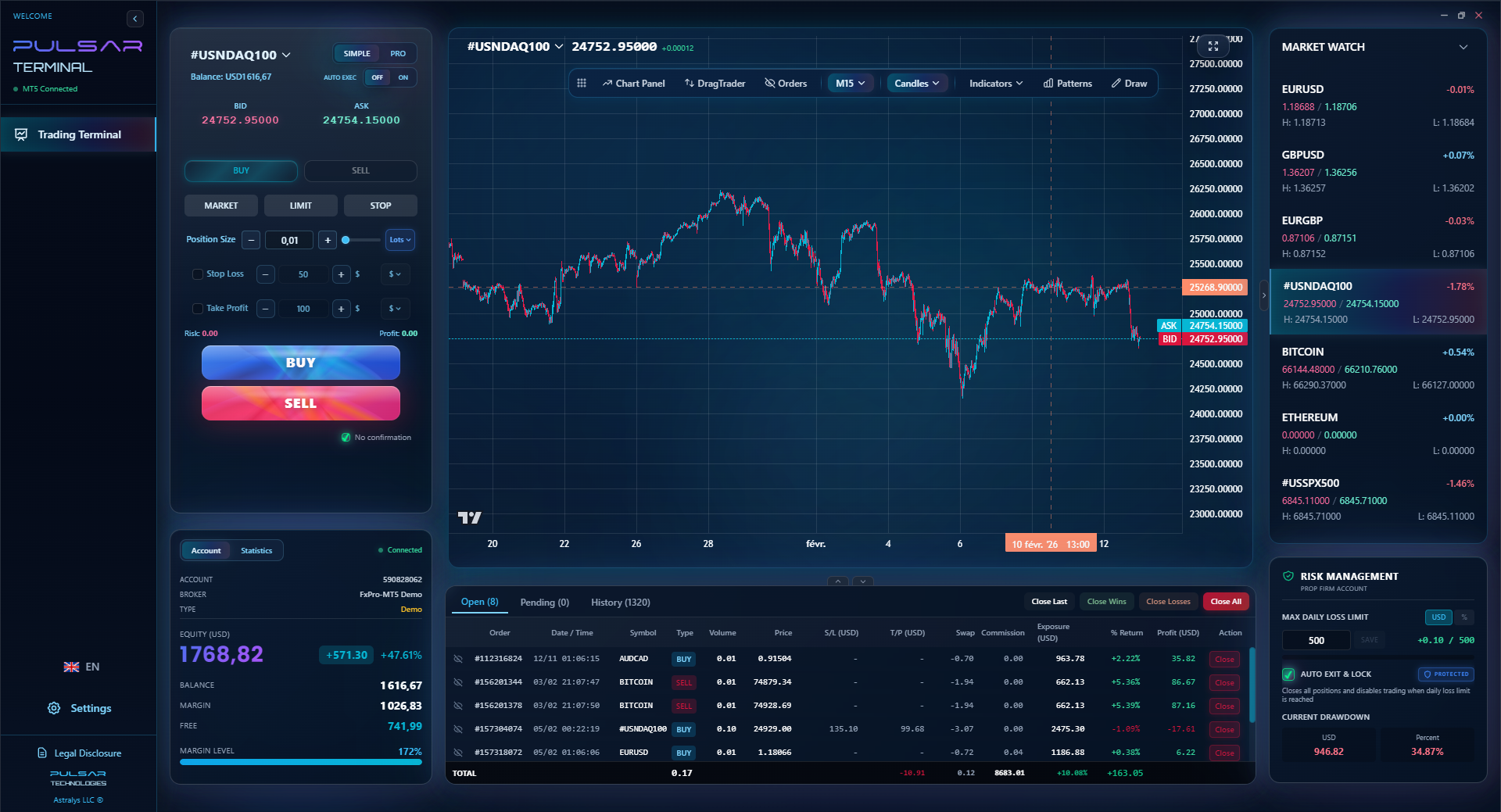
The Role of Tools This is where manual trading gets tough. Watching multiple charts, managing a stop-loss, and moving to breakeven under pressure is stressful. This is why many serious traders use tools that automate parts of the process. For instance, having a platform that lets you set a trailing stop or automatically move your stop to breakeven at a specified profit level removes emotion and human error from the equation. It lets you focus on the decision, not the mechanics.
Managing multiple take-profit levels and moving stops to breakeven under NFP pressure is nearly impossible manually, which is why tools like Pulsar Terminal that automate these processes on MT5 are essential for news traders.
Pulsar Terminal
L'outil MT5 tout-en-un : ordres glisser-déposer, multi-TP/SL, trailing stop, grid trading, Volume Profile et protection prop firm. Utilisé quotidiennement par 1 000+ traders.
“The 30:1 use cap is a blessing in disguise. It physically prevents you from taking a position so large that a 50-pip move wipes you out.”
While the NFP headline is the king, the court has other members. Ignoring them completely is a mistake.
Average Hourly Earnings (Wage Growth) This is the queen. The Fed is terrified of a wage-price spiral (where rising wages cause businesses to raise prices, causing workers to demand higher wages, and so on). A high NFP number coupled with higher-than-expected wage growth is a double-whammy for Dollar strength. It screams inflation pressure. If NFP is strong but wages are soft, the market reaction can be muted or confused.
The Unemployment Rate It gets the headlines in the mainstream press, but forex traders often see it as a lagging indicator. It can sometimes contradict the NFP. Focus on it if there's a massive surprise (like a 0.4% move), otherwise, it's secondary.
Revisions to Previous Months This is the sneaky one. The BLS often revises the previous two months' numbers. A strong headline print for this month can be completely undermined if the last two months are revised down by a combined 100K jobs. Always scan the report for the phrase "The change in total nonfarm payroll employment for [previous month] was revised..."
The smart approach is a hierarchy: 1) Headline NFP vs. Forecast, 2) Wage Growth vs. Forecast, 3) Revisions, 4) Unemployment Rate. Let the market tell you what it cares about most in the minutes after the release. Sometimes it latches onto wages, sometimes it doesn't.
Understanding the forex NFP meaning is your ticket to sitting out or participating in one of the market's most dramatic events. For the South African trader, it's a regular, scheduled test of your discipline, risk management, and emotional control.
Start by paper trading it for at least three months. Note the patterns: how often does the first spike reverse? How long does the post-news trend typically last? Get a feel for it without risking a cent.
When you go live, start small - tiny, even. Your goal for the first few real NFPs shouldn't be to make money, but to execute your plan flawlessly. Did you wait? Did you enter where you planned? Did you manage the trade according to your rules? If you did, that's a win, regardless of the P&L.
Finally, remember that no single economic report defines a currency's long-term path. The NFP is a huge monthly catalyst, but it's just one piece of data in a vast puzzle. Pair your understanding of it with solid technical analysis and sound money management, and you'll stop fearing the first Friday of the month and start seeing it for what it is: an opportunity, handled with extreme care.
FAQ
Q1What time is NFP released in South Africa?
The NFP report is consistently released at 3:30 PM South African Standard Time (SAST) on the first Friday of every month, barring public holidays.
Q2Does a high NFP number mean I should buy or sell USD/ZAR?
Generally, a significantly higher-than-expected NFP number strengthens the US Dollar, which would mean buying USD/ZAR (expecting the pair to rise). However, you must always consider the broader technical context and the market's immediate reaction, as 'sell the fact' reversals are common.
Q3What use can I use trading NFP in South Africa?
The FSCA mandates a maximum use of 30:1 for retail traders in South Africa. This applies to all trading, including NFP events. I strongly advise using less than the maximum, especially for high-volatility news trading.
Q4Is it better to trade before or after the NFP news release?
For most traders, especially beginners, it is far safer to trade after the release (the 'post-news trend'). The initial 5-10 minutes are characterized by extreme volatility, wide spreads, and unpredictable price spikes that can quickly stop out positions. Waiting for a clear direction to establish itself is a more conservative and often more profitable approach.
Q5Can I trade NFP with a small account in South Africa?
Yes, but you must be exceptionally careful. Use a micro or cent account if your broker offers one. Drastically reduce your position size - consider risking 0.5% of your account or less instead of 1%. Most importantly, be prepared for spread widening which can take a larger percentage bite out of a small account's balance.
Q6Are there other economic reports as important as NFP?
The US Consumer Price Index (CPI) inflation report is equally important, as it directly impacts Federal Reserve interest rate decisions. The Federal Open Market Committee (FOMC) interest rate decision and press conference are also major market movers. For the Euro, watch the ECB meetings; for the UK, the Bank of England meetings and CPI.
Q7What is the biggest mistake traders make during NFP?
Overleveraging and chasing the initial price spike. The combination of FOMO and excessive position size turns a normal volatile event into an account-ending disaster. The second biggest mistake is trading without a predefined plan for entry, stop-loss, and take-profit.
La leçon du Prof. Winston
Points clés:
- ✓Trade the reaction, not the prediction.
- ✓Halve your position size for news volatility.
- ✓The first 5-minute candle is a liquidity trap.
- ✓Always check for revisions to prior months.
Cet article vous a-t-il été utile ?
Cliquez sur une étoile
Analyses Trading Hebdo
Analyses et stratégies hebdo gratuites. Pas de spam.
À propos de l'auteur
David van der Merwe
Trader des Marchés Émergents
Trader basé à Johannesbourg avec 11 ans d'expérience sur les devises des marchés émergents. Spécialisé dans les paires ZAR, le trading régulé par la FSCA et l'analyse du marché sud-africain.
Commentaires
Avertissement sur les risques
Le trading d'instruments financiers comporte des risques importants et peut ne pas convenir à tous les investisseurs. Les performances passées ne garantissent pas les résultats futurs. Ce contenu est fourni à titre éducatif uniquement et ne constitue pas un conseil en investissement. Effectuez toujours vos propres recherches avant de trader.
Vous aimerez aussi

Cara Trading Forex Sukses: 7 Prinsip dari Trader Profesional
Cara trading forex sukses dengan 7 prinsip trader pro: manajemen modal, disiplin, journal trading, backtest. Data nyata, bukan janji profit palsu.
Jam Trading Forex Terbaik untuk Trader Indonesia: Panduan Lengkap dengan Tabel Waktu
Panduan jam trading forex untuk trader Indonesia. Tabel 4 sesi dunia, jam emas 20:00-00:00, sesi mana yang harus dihindari. Data akurat + tips dari trader berpengalaman.
Top 5 Sàn Forex Uy Tín Nhất 2026: Review Jujur dari Trader Indonesia
Top 5 sàn forex uy tín 2026 untuk trader Indonesia. Review jujur: spread, deposit, withdraw, dukungan lokal. Exness, XM, IC Markets & lebih.
Obtenir Pulsar Terminal
Tous ces calculateurs sont intégrés dans Pulsar Terminal avec des données en temps réel de votre compte MT5. Dimensionnement de position en un clic, gestion automatique des risques et calculs instantanés.
Obtenir Pulsar Terminal