


Most Nigerian traders get the forex open and close times completely wrong, and it costs them money every single week.

Olumide Adeyemi
Pionnier du Trading en Afrique de l'Ouest ·  Nigeria
☕ 10 min de lecture
Ce que vous apprendrez :
Most Nigerian traders get the forex open and close times completely wrong, and it costs them money every single week. They think the market is just 'open' and trade whenever they feel like it, missing the crucial windows where real money is made and getting slaughtered in the dead zones. The truth is, the forex market's 24-hour cycle isn't a flat line, it's a series of powerful waves, and your location in Lagos or Abuja puts you in a unique position to ride them. I'm going to show you exactly when to be at your screen, when to walk away, and how to use the global session overlaps to your advantage, all based on West Africa Time (WAT).
First, forget the idea of a market 'opening' like the Nigerian Stock Exchange. Forex is a decentralized beast that never sleeps from Monday morning in Sydney until Friday night in New York. For us on WAT (GMT+1), this creates a continuous, rolling schedule. The key isn't just that it's open, but who is trading and how much money is moving.
Your trading day effectively starts on Sunday night. That's when the Sydney session kicks off, but let's be honest, it's usually a snooze-fest for major pairs like EUR/USD. The real action for Nigerian traders begins in the early hours of Monday. Understanding this flow is more important than any indicator. I learned this the hard way years ago, trying to scalp the GBP/JPY at 3 AM WAT. The spreads were wide enough to drive a truck through, and a single news spike wiped out my profit for the week. I was trading in a liquidity desert.

Warning: Trading during low-liquidity sessions (like late Sydney or early Tokyo) often means wider spreads. Your broker isn't ripping you off; there's simply less competition to price the currency. This can turn a winning trade into a loser before it even starts. Always check the typical spread definition for your pair at different times.
“The London-New York overlap (2:00 PM - 6:00 PM WAT) is the Nigerian trader's golden hour.”
Here’s the practical schedule you need to pin to your wall. All times are West Africa Time (WAT).
Sydney Session (11:00 PM – 8:00 AM WAT)
The quiet opener. It kicks off the week Sunday night. Pairs like AUD/USD and NZD/USD might see some action, but volumes are low. I rarely place new trades here unless I'm managing existing positions from the previous week. It's more for analysis and planning.
Tokyo Session (1:00 AM – 10:00 AM WAT)
Asian liquidity arrives. This is where JPY pairs (USD/JPY, GBP/JPY) come alive. You'll start to see better spreads on the majors. For early risers in Nigeria, the latter half of this session (from around 7:00 AM WAT) offers the first decent trading window of the day.
London Session (9:00 AM – 6:00 PM WAT)
This is where the party starts. London is the world's largest forex hub. Liquidity floods the market at 9 AM WAT. Volatility and volume spike across all major pairs, especially EUR/USD, GBP/USD, and EUR/GBP. This is your primary trading session. Most of my profitable swing trading entries are executed between 9 AM and 12 PM WAT.
New York Session (2:00 PM – 11:00 PM WAT)
The second wave of heavy volume. When New York opens at 2 PM WAT, it overlaps with London for a glorious four hours (2 PM - 6 PM WAT). This overlap is the absolute sweet spot for Nigerian traders.

Example: My most consistent setup is watching for a breakout during the London morning (9 AM-12 PM WAT). If it holds and gets a volume confirmation as New York comes online at 2 PM WAT, that's my signal to ride the trend. The combined liquidity makes moves more decisive.

💡 Conseil de Winston
The market pays you for being a liquidity provider, not a consumer. During the London-New York overlap, you're providing almost nothing. Your edge comes from your analysis, not your presence. Trade then.
“Knowing when to stay out of the market is just as critical as knowing when to get in.”
If you only remember one thing from this guide, let it be this: The London-New York overlap (2:00 PM - 6:00 PM WAT) is your golden hour.
This is when two financial superpowers are fully online. Banks, hedge funds, and corporations on both sides of the Atlantic are executing massive orders. What does this mean for you?
- Tightest Spreads: The fierce competition between liquidity providers crushes spreads. You'll often see the EUR/USD guide pair with spreads under 1 pip on a good ECN account.
- Highest Volatility: Big money moves price. This creates the strong, clean trends and breakouts that strategies are built on.
- Reaction to News: Major economic data from both Europe and the US is digested and acted upon by the deepest pool of capital, leading to sustained moves rather than erratic spikes.
For the average Nigerian trader with a day job, this is perfect. You can finish work, get home, and the market is serving up its best opportunities. The Tokyo-London overlap (8:00 AM - 10:00 AM WAT) is also active, but it's a milder version. The volatility is there, but the volume isn't quite the same earth-shaking level.
I structure my entire day around this. Morning (during Tokyo/London) is for analysis and setting alerts. The overlap is for execution. After 6 PM WAT, I'm usually just managing trades or calling it a day.
“Knowing when to stay out of the market is just as critical as knowing when to get in.”
Knowing when to stay out is just as critical. The most dangerous time for a retail trader is often when you're bored and the charts are barely moving.
The Mid-Session Lulls: Between the end of Tokyo (10 AM WAT) and the heart of London (say, 11 AM WAT), there can be a dip in activity. Similarly, after London closes at 6 PM WAT and before New York finds its stride, things can get choppy.
The Friday Afternoon WAT Trap: After the New York close (post-11 PM WAT Friday), liquidity evaporates. However, a bigger trap is late Friday afternoon WAT. Institutional traders square their books ahead of the weekend. This can cause random, unpredictable spikes that have nothing to do with technicals. I once got stopped out of a perfectly good USD/CAD long position at 5:45 PM WAT on a Friday by a sudden 15-pip whipsaw that reversed immediately. The market was just clearing house.
Sunday Night/Monday Morning Gaps: The market closes Friday night New York time and reopens Sunday night Sydney time. Major news over the weekend can cause prices to 'gap' open. If you're holding positions over the weekend, you're accepting this risk. For scalping strategy traders, avoid the first hour after the Sydney open - it's often thin and erratic.

Pro Tip: Use the dead zones. The quiet Tokyo session or late New York session is the perfect time to do your chart analysis, plan your trades for the next London session, and set your entry orders and stops. Let the market come to you.
💡 Conseil de Winston
If you wouldn't walk into a dark, empty Lagos street at 3 AM, don't trade in a dark, empty market session. The risks are analogous and just as real.
“Your WAT timezone isn't a disadvantage; it's a strategic gift for trading the European and US sessions.”
Alright, let's talk about the messy reality of trading from Nigeria. The regulatory scene here is... creative. The SEC has flat out said online retail forex is unregulated. The CBN says you should only use CBN-licensed brokers, but let's be real, the compelling offerings are elsewhere.
This puts the onus of safety squarely on you. Most serious Nigerian traders I know (myself included) use internationally regulated brokers like those reviewed on this site: Exness review, IC Markets review, XM review, and Pepperstone review. They offer the tight spreads and reliable platforms you need to capitalize on those key session times.
Taxes: Don't kid yourself. Your trading profits are capital gains. The FIRS expects their 10%. Keep a clean record of your trades. It's not fun, but neither is a tax investigation.
Funding Your Account: This is your first practical test. International brokers typically don't accept direct Naira deposits. You'll likely be depositing in USD or EUR. Common methods are bank wire transfers (can be slow and expensive with CBN scrutiny), credit/debit cards (often the fastest), or cryptocurrencies (increasingly popular for speed and lower fees). Always check your broker's specific deposit options for Nigeria.
The Platform: This is non-negotiable. You need MetaTrader 4 or, better yet, MetaTrader 5. It's the global standard. Every strategy idea, every indicator tutorial, every MACD indicator or RSI indicator setup you learn will be based on MT4/MT5. Don't get sidetracked by a broker's proprietary platform, no matter how flashy it looks.
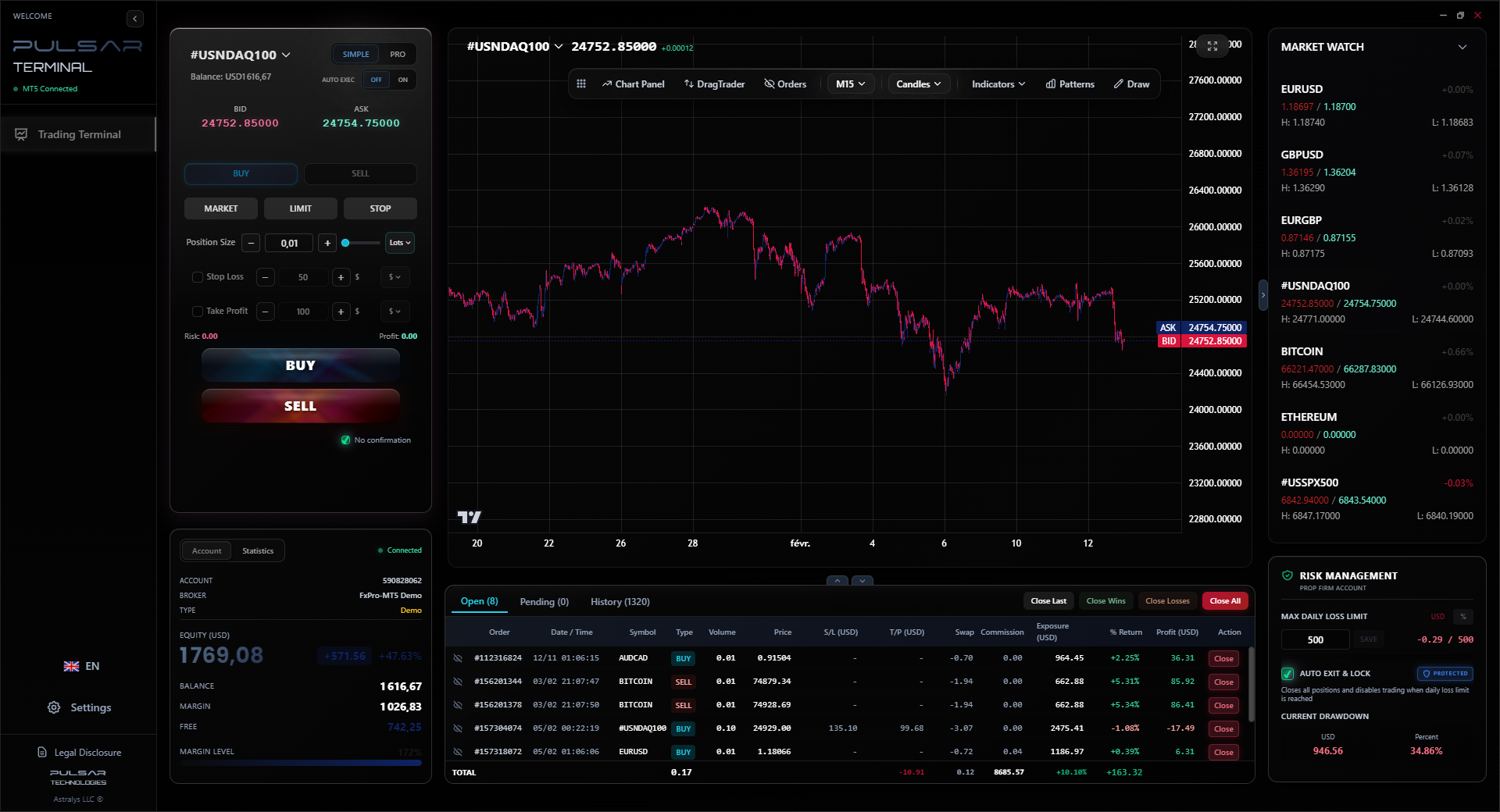
When you're trading those fast-moving session overlaps, managing multiple trades and stops manually on MT5 is a headache; Pulsar Terminal lets you drag-and-drop orders and set multi-level take-profits in seconds.
Pulsar Terminal
L'outil MT5 tout-en-un : ordres glisser-déposer, multi-TP/SL, trailing stop, grid trading, Volume Profile et protection prop firm. Utilisé quotidiennement par 1 000+ traders.
“Your WAT timezone isn't a disadvantage; it's a strategic gift for trading the European and US sessions.”
Let's make this concrete. Here’s what a focused trading day for a Lagos-based trader might look like, leveraging forex open and close times.
6:30 AM WAT: Wake up. The Tokyo session is active. I quickly check my screens for any major moves in Asia that might impact my view. I'm not trading, just observing. I scan the XAU/USD guide as gold often moves with Asian market sentiment.
8:00 AM - 9:00 AM WAT: Pre-London analysis. This is my planning hour. I mark up my charts with key support/resistance levels from the daily and 4-hour charts. I identify 2-3 potential setups for the day based on where price is relative to these levels. I calculate my position sizes using a position size calculator.
9:00 AM WAT: London open. I watch the first 15-30 minutes of volatility. I do NOT jump in immediately. Let the initial burst settle.
9:30 AM - 12:00 PM WAT: Primary execution window for London-driven moves. If one of my pre-identified setups triggers with good price action, I enter. I set my stop-loss and take-profit orders immediately.
2:00 PM WAT: New York open. I watch my existing trades. If the New York volume confirms the London move, I might consider adding to a winning position (pyramiding) with a very tight stop. This is also a second chance for entries if I missed the London move.
2:00 PM - 6:00 PM WAT: The overlap. I am most alert here. This is when big trends accelerate. I monitor my trades but avoid the temptation to overtrade. The market is giving you the gift of clarity - don't confuse it by churning.
After 6:00 PM WAT: London is closed. I review the day. I either bank profits from trades that hit their targets or tighten stops to lock in some gains on running trades. I rarely, if ever, open a brand new trade after 7 PM WAT unless it's a very specific, planned swing trade entry.
💡 Conseil de Winston
Your most important trade management tool isn't a trailing stop; it's your watch. Know when your session's edge has expired and walk away.
“The regulatory scene in Nigeria is creative. The onus of safety is squarely on you.”
To trade the sessions effectively, you need more than just a chart.
- An Economic Calendar: You must know when high-impact news (like US Non-Farm Payrolls or ECB decisions) is scheduled. Trading the London session ahead of major US news at 2:30 PM WAT is a recipe for a margin call. I use a calendar that displays events in WAT.
- Session Indicator: A simple MT4/MT5 indicator that shades the chart background for each major session (Tokyo, London, New York) in WAT. This gives you instant visual context for where price action is happening.
- A Trading Journal: Note not just your trades, but when you took them. After a few months, you'll see patterns. You might find your win rate is 60% during the London-New York overlap but drops to 30% in the late New York session. That's powerful data.
- Discipline to Log Off: The market is open 24 hours. You are not a 24-hour trader. Set your hours based on the sessions that suit your strategy and your life, and stick to them. The FOMO you feel watching a move at 11 PM WAT is a liar - the opportunity cost of being tired and unfocused tomorrow is higher.
Remember, these times aren't just a schedule; they're a rhythm. The flow of liquidity is the most powerful force in the market. Align yourself with it, and you stop fighting the current. You start riding it.
FAQ
Q1What is the best time to trade forex in Nigeria?
The absolute best time is during the London-New York session overlap, from 2:00 PM to 6:00 PM West Africa Time (WAT). This period has the highest liquidity and volatility, leading to tighter spreads and stronger, more reliable trends.
Q2Can I trade forex at night in Nigeria?
Yes, the market is open, but it's generally not advisable for most strategies. The late New York session (after 8 PM WAT) and the Asian session (late night/early morning WAT) have lower liquidity, which can mean wider spreads and choppy, unpredictable price action that's harder to trade profitably.
Q3Is forex trading legal in Nigeria?
The activity itself is not illegal, but the regulatory environment for online retail forex trading is unclear. The SEC Nigeria has stated it is currently unregulated. Most Nigerian traders use internationally regulated brokers for better protection and trading conditions.
Q4What currency pairs should I focus on as a Nigerian trader?
Stick to the major pairs, especially during the London and New York sessions. EUR/USD, GBP/USD, and USD/JPY offer the best liquidity and tightest spreads. During the Tokyo session, you can look at USD/JPY or AUD/USD.
Q5How do I handle the time difference with forex markets?
Don't fight it, use it to your advantage. Your WAT timezone is perfect for trading the European and US sessions after work. Use an economic calendar and trading platform that displays times in WAT. Focus your active trading on the 2 PM - 6 PM WAT window and use other times for planning and analysis.
Q6What is a trading session overlap and why does it matter?
An overlap is when two major financial centers (like London and New York) are both open for business. This doubles the number of participants and volume in the market, which dramatically increases liquidity and volatility. For traders, this means better order execution, lower costs (spreads), and higher-quality price trends to trade.
Q7Should I hold trades over the weekend?
I generally advise against it. The market is closed, but the world isn't. News and events can cause prices to 'gap' sharply when trading resumes Sunday night, exposing you to risk you cannot manage. If you do hold swings, ensure your position size is small enough to withstand a potential adverse gap.
La leçon du Prof. Winston
Points clés:
- ✓Trade the London-New York overlap (2-6 PM WAT) for maximum liquidity.
- ✓Avoid the dead zones: late NY session and early Sydney session.
- ✓Use internationally regulated brokers for safety and tight spreads.
- ✓Always account for the 10% Capital Gains Tax on profits.
- ✓Your platform must be MT4 or MT5 - no exceptions.
Cet article vous a-t-il été utile ?
Cliquez sur une étoile
Analyses Trading Hebdo
Analyses et stratégies hebdo gratuites. Pas de spam.
À propos de l'auteur
Olumide Adeyemi
Pionnier du Trading en Afrique de l'Ouest
L'un des formateurs de trading forex les plus actifs au Nigeria. 8 ans d'expérience de trading depuis Lagos. Spécialisé dans les stratégies à petit capital et les challenges de prop firms pour les traders africains.
Commentaires
Avertissement sur les risques
Le trading d'instruments financiers comporte des risques importants et peut ne pas convenir à tous les investisseurs. Les performances passées ne garantissent pas les résultats futurs. Ce contenu est fourni à titre éducatif uniquement et ne constitue pas un conseil en investissement. Effectuez toujours vos propres recherches avant de trader.
Vous aimerez aussi

Cara Trading Forex Sukses: 7 Prinsip dari Trader Profesional
Cara trading forex sukses dengan 7 prinsip trader pro: manajemen modal, disiplin, journal trading, backtest. Data nyata, bukan janji profit palsu.
Jam Trading Forex Terbaik untuk Trader Indonesia: Panduan Lengkap dengan Tabel Waktu
Panduan jam trading forex untuk trader Indonesia. Tabel 4 sesi dunia, jam emas 20:00-00:00, sesi mana yang harus dihindari. Data akurat + tips dari trader berpengalaman.
Top 5 Sàn Forex Uy Tín Nhất 2026: Review Jujur dari Trader Indonesia
Top 5 sàn forex uy tín 2026 untuk trader Indonesia. Review jujur: spread, deposit, withdraw, dukungan lokal. Exness, XM, IC Markets & lebih.
Obtenir Pulsar Terminal
Tous ces calculateurs sont intégrés dans Pulsar Terminal avec des données en temps réel de votre compte MT5. Dimensionnement de position en un clic, gestion automatique des risques et calculs instantanés.
Obtenir Pulsar Terminal