


Most traders in Nigeria are looking at their charts completely wrong.

Olumide Adeyemi
Pionnier du Trading en Afrique de l'Ouest ·  Nigeria
☕ 11 min de lecture
Ce que vous apprendrez :
- 1What Is Currency Strength (And Why Your Single Chart Lies)
- 2How to Calculate Strength: The Matrix Method
- 3Putting It to Work: Real Trades from Lagos
- 4Indicators, Meters, and When to Use Them
- 5Making It Part of Your Trading Routine
- 6Mistakes You're Probably Making (I Made Them Too)
- 7Why Your Broker Choice Affects Strength Trading
Most traders in Nigeria are looking at their charts completely wrong. They're staring at a single EUR/USD or GBP/NGN chart, trying to guess if it will go up or down, while missing the entire story happening right next door. That's a surefire way to get your account liquidated. The truth is, you can't know if the Naira is weak or the Dollar is strong by looking at one pair. Today, I'll show you how to read the market's true momentum by comparing currency strength, a method that saved my own trading career after a brutal 40% drawdown.
Currency strength isn't about one price going up. It's about relative power. Think of it like a wrestling match. If you only watch one wrestler, you might think he's doing great. But if you see his opponent is barely standing, you understand the real dynamic. A chart for USD/NGN going up could mean the Dollar is strong (bullish for USD). It could also mean the Naira is getting absolutely pummeled (bearish for NGN). Which is it? Looking at that single chart won't tell you.
That's the core problem. Trading a pair without knowing which currency is driving the move is like driving with a blindfold. You might get lucky for a bit, but you will crash. I learned this the hard way in 2019. I was short on GBP/USD because the chart 'looked bearish.' What I missed was that the Dollar was weak across the board that day. The Pound wasn't strong, but the Dollar was weaker. My stop got taken out for a 2.5% loss before the pair reversed and went my way. I was right on the pair's direction, but wrong on the reason, and the market didn't care.

Warning: A rising pair price does NOT automatically mean the base currency is strong. It only tells you the base is stronger than the quote currency. You need to check its strength against others.
Forget complicated formulas you'll never use. We need a practical method. The most effective one I've used is building a simple strength matrix. You don't need fancy software, just a notepad or a spreadsheet.
The 8 Majors Framework
Start with the eight major currencies: USD, EUR, GBP, JPY, CHF, CAD, AUD, NZD. For us in Nigeria, you absolutely add NGN to this list. Your matrix compares each of these against several others to find a consensus.
Here’s how it works in practice. Let's say you want to know the true strength of the US Dollar right now.
- Look at USD/JPY: Is it up or down on the 1-hour?
- Look at EUR/USD: Is it down (good for USD) or up (bad for USD)?
- Look at GBP/USD: Same check.
- Look at USD/CHF, USD/CAD, etc.
Tally the results. If USD is winning in 5 out of 7 major pairs, it's genuinely strong. If it's only up against the Yen but down against the Euro, Pound, and Franc, it's weak. That isolated move in USD/JPY is likely a Yen-specific story.

Example: On a big US inflation data day, you might see:
- EUR/USD: Down 50 pips
- GBP/USD: Down 45 pips
- USD/CHF: Up 55 pips
- USD/JPY: Up 30 pips
- AUD/USD: Down 40 pips Verdict: USD is showing broad-based strength. A long on any USD pair (except maybe against a super-strong currency) has a higher probability edge.
This manual method builds your market sense. Later, you can use tools, but doing it by hand for a few weeks trains your brain to see the market as a whole, not just isolated charts. It directly informs your position size calculator inputs - stronger conviction means you can justify a slightly larger position.

💡 Conseil de Winston
The market always tells you who's winning. Your job isn't to predict the winner, it's to listen and bet on the fighter who's already landing punches.
“Trading a pair without knowing which currency is driving the move is like driving with a blindfold.”
Let's get local. How does this apply to you trading from Abuja, Port Harcourt, or Lagos with your broker? Here are two concrete examples from my journal.
Trade 1: The Naira Devaluation Play (October 2023) The CBN was under pressure, and rumors were flying. My strength matrix showed:
- EUR/NGN: Rising sharply
- GBP/NGN: Rising sharply
- USD/NGN: Rising sharply
- But EUR/USD and GBP/USD were relatively flat.
Conclusion: This wasn't a Dollar or Euro surge. This was a concentrated Naira (NGN) weakness across the board. The trade wasn't to pick which foreign currency to buy against NGN. The trade was to sell NGN against anything. I entered a sell on USD/NGN at 780. I didn't get the absolute top, but I rode it to 950, using a wide trailing stop. The strength analysis told me the trend's root cause was solid.
Trade 2: The Fakeout Avoidance (January 2024) GBP/NGN made a nice-looking breakout to a new high on the 4-hour chart. Classic buy signal, right? I checked my matrix:
- GBP/NGN: Up
- GBP/USD: Down significantly
- GBP/JPY: Down
- GBP/AUD: Down
The British Pound was weak against almost everything. The rise in GBP/NGN was solely due to Naira weakness being even more extreme at that moment. That's a fragile reason to go long. I skipped the trade. The pair reversed the next day and fell 300 pips. Strength analysis saved me from a bad entry.
These examples show it's not just about finding trades. It's about avoiding the majority of losing ones. This mindset is critical for styles like swing trading, where you're exposed to overnight risk.
Okay, you get the concept. Manually checking 28 pairs every hour is tedious. You'll find two types of tools: Currency Strength Meters and custom indicators like the RSI indicator or MACD indicator applied to currency indices.
Currency Strength Meters: These are widgets on websites or in platforms that give each currency a score (e.g., USD: +2.5, EUR: -1.0). They're a good starting point for a snapshot. But here's the catch: they use formulas. Some weigh all pairs equally; others use complex algorithms. You don't always know their logic. I use them as a quick scan, but I never enter a trade based solely on a meter reading. Trust, but verify with your own eyes on key charts.
Custom Index Indicators: You can create a "Dollar Index" (DXY) lookalike in your platform, or indices for the Euro, etc. These plot a single line for a currency's strength. This is more visual and helpful. You can see if the Euro strength line is making a higher high while the EUR/USD price is also making a higher high. That's a confirmed, strong trend.

Pro Tip: Don't become dependent on the tool. Use a meter for a quick morning scan. Then, pick the 2-3 strongest and 2-3 weakest currencies from the meter and manually check their key pairs. This 5-minute drill confirms the story and gets you engaged with the price action.
The goal is to graduate from needing the tool constantly. After a few months, you'll glance at your watchlist and intuitively feel which currencies are in demand. This skill is more valuable than any single indicator for understanding forex pair strength.
💡 Conseil de Winston
A strong currency can still correct. A weak currency can still bounce. Strength gives you the tide's direction, not the movement of every wave. Trade with the tide.
“The simple manual method was 90% as effective as complex indices and 100% more usable.”
This isn't a standalone strategy. It's a filter. You layer it on top of whatever you already do. Here’s how to build it into your day, step by step.
Step 1: The Morning Strength Scan (5-10 mins) Before you even look for trades, run your check. Use a meter or do a quick manual tally. Write it down: "Strong: USD, JPY. Weak: AUD, NZD, NGN." This sets the day's bias. On days with strong, clear readings, be more aggressive in the direction of the trend. On messy, mixed days, either reduce size or stay out.
Step 2: Trade Selection & Direction Bias Now look for your setups. If your scan says USD strong, JPY strong, and AUD weak:
- Favorable Trades: Look for longs on USD/AUD, JPY/AUD. Be cautious with USD/JPY (two strong currencies can lead to choppy range).
- Avoid: Looking for shorts on USD/JPY or longs on AUD/anything.
Step 3: Entry Confirmation You find a nice support bounce on USD/AUD, aligning with your strength bias. Perfect. Now use your usual entry method (price action, indicator signal) to time the trade. The strength analysis gave you the high-probability direction; your entry technique gets you in.
Step 4: Risk Management Alignment Your confidence level is higher because the trade aligns with the broader flow. This might mean placing your stop a little wider (to avoid noise) because the fundamental pressure is on your side. It should NEVER mean increasing your position size beyond your risk limits. Always use your position size calculator. A good idea with strong momentum doesn't justify a 5% risk.
This framework works for scalping strategy (using shorter timeframes for the scan) and longer-term plays. It turns you from a gambler guessing on a chart into a strategist positioning with the wind at your back.
Let's be blunt about where this goes wrong, so you can skip the pain.
Pitfall 1: Overcomplicating It. You don't need a PhD. A simple tally of 5-7 major pairs for each currency is enough. I wasted months backtesting overly complex weighted indices. The simple method was 90% as effective and 100% more usable.
Pitfall 2: Ignoring Timeframes. A currency can be strong on the 1-hour chart but weak on the daily. Which matters? It depends on your trade duration. If you're a day trader, the 1-hour and 4-hour strength matter most. If you're holding for weeks, the daily and weekly are key. Always check strength on a timeframe equal to or higher than your trading chart. Mismatching this is a classic error.
Pitfall 3: Changing Your Mind Mid-Trade. You go long EUR/USD because EUR is strong. An hour later, the meter flips and shows USD is now strong. You panic and exit. This is noise. You based your trade on a higher-timeframe reading. Stick to it unless your original strength premise is clearly and sustainably broken on the TF you analyzed. Don't watch the meter tick by tick.
Pitfall 4: Forgetting the Naira. We have a unique advantage trading from Nigeria: direct exposure to NGN pairs. Most global strength meters ignore the Naira. You must manually incorporate it. When global USD strength meets local NGN weakness, the move in USD/NGN can be explosive. This is where you find asymmetric opportunities that traders in London aren't even seeing. But remember, liquidity can be thinner, so mind the spread definition and potential slippage, especially with offshore brokers like Exness review or IC Markets review that offer these pairs.
💡 Conseil de Winston
If your strength analysis is confusing, the market is confused. That's not a signal to trade. It's a signal to make a cup of tea and wait for clarity.
“When global USD strength meets local NGN weakness, the move in USD/NGN can be explosive.”
This isn't just theory. Your ability to act on strength signals depends heavily on your broker's execution. Here’s what to watch for.
Spread Stability During Volatility: When a currency is rapidly strengthening or weakening (like on news), spreads widen. A broker with a variable spread might blow out from 1 pip to 10 pips on EUR/USD. Your calculated entry or stop-loss price becomes a fantasy. You need a broker known for stable spreads, especially during London/New York overlaps. This is a key reason I prefer ECN/RAW account models from brokers like Pepperstone review or IC Markets review for this style - you pay a commission but get tighter, more consistent spreads.
Access to a Wide Range of Pairs: To build a good matrix, you need quotes for USD/CHF, GBP/JPY, AUD/CAD, etc. Some local or offshore brokers catering to Nigerians might only offer majors and USD/NGN. That's not enough. Ensure your broker provides a full suite of major, minor, and exotic crosses.
Order Execution Speed: When you see a strength divergence forming - a pair is rising but its base currency is starting to weaken on your matrix - you need to exit quickly. Slow execution or frequent requotes can turn a small loss into a large one. This is non-negotiable. Read reviews focusing on execution. XM review, for instance, often gets marks for good execution on standard accounts.
Finally, remember that trading with strength often means riding trends. Using a trailing stop is one of the best ways to capture this. If your broker's platform has clunky trailing stop functionality, it hurts your profitability. You want a platform (or a companion tool) that lets you set and forget a dynamic stop that locks in profits as the trend, driven by that underlying strength, continues.
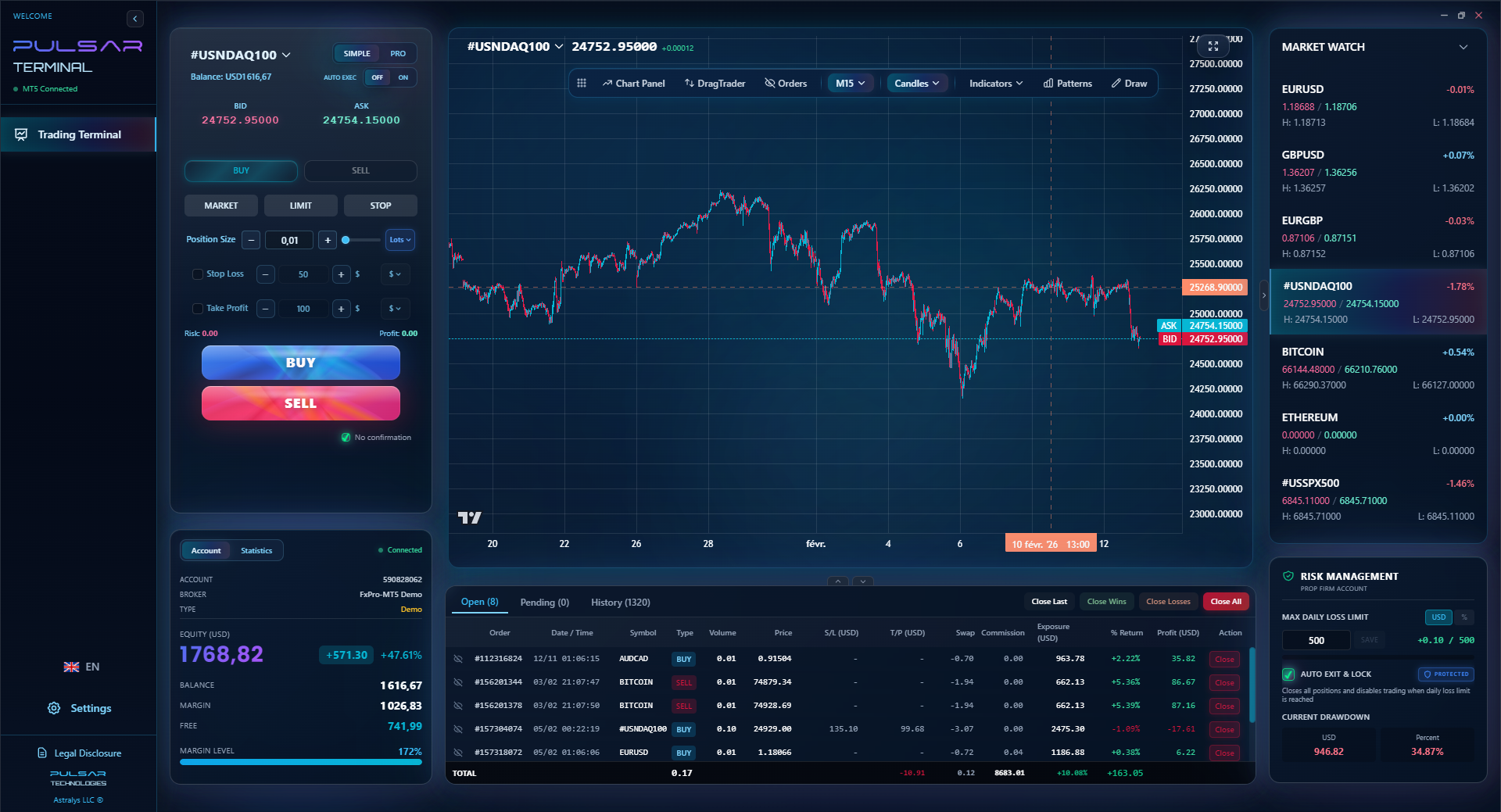
Riding trends identified by strength analysis is easier with automated trailing stops, a core feature of Pulsar Terminal that works directly on your MT5 platform.
Pulsar Terminal
L'outil MT5 tout-en-un : ordres glisser-déposer, multi-TP/SL, trailing stop, grid trading, Volume Profile et protection prop firm. Utilisé quotidiennement par 1 000+ traders.
FAQ
Q1Is there a free, reliable currency strength meter you recommend?
Yes, but with a caveat. Sites like Myfxbook and Investing.com have free meters. They're fine for a broad overview. However, never trust them blindly. Use them to identify the top 3 strongest/weakest currencies, then manually confirm by looking at the actual charts of those currencies against 2-3 others. The free meter gives you the suspect list; your chart analysis is the interrogation that confirms guilt.
Q2How often should I check currency strength for day trading?
At a minimum, check it at the start of your trading session (e.g., London open or when you start). Then, do a quick refresh every 4 hours or if you see a major, sudden move in a pair you're watching. You don't need to stare at it constantly. The higher-timeframe strength bias (1-hour, 4-hour) tends to persist for several hours. Checking too often leads to confusion and overtrading.
Q3Can I use this for trading only USD/NGN?
Absolutely, and you should. It's the most important application. Before entering a USD/NGN trade, check: Is the USD strong against EUR, GBP, JPY? And separately, is the NGN weak against other crosses like EUR/NGN? If both are true, you have a very high-conviction trend trade. If USD is weak but NGN is collapsing even faster, the trade is riskier - you're fighting the broader USD trend.
Q4Does currency strength work during high-impact news like US NFP?
It's crucial then, but volatile. Right after the news, ignore meters - spreads are wild, and prices are chaotic. Wait 5-15 minutes for the market to digest. Then, run your check. The post-news strength reading often sets the direction for the next several hours. The initial spike might be a fakeout, but the sustained strength across multiple pairs 15 minutes later shows you the real money flow.
Q5What's the biggest benefit for a struggling trader?
It kills hope-based trading. Instead of hoping your losing EUR/USD long will come back, you check Euro strength. If it's weak and getting weaker, you have objective data to cut the loss. It replaces emotion with a simple, repeatable check. This alone can prevent the catastrophic losses that lead to a margin call.
Q6Should I use different strength timeframes for entry vs. exit?
Generally, no. Keep it consistent. Use the same timeframe for strength analysis as your trade's holding period. If you enter based on 4-hour strength, use the 4-hour strength to judge when your premise is broken for your exit. Don't exit because the 5-minute strength flipped. That's noise. Consistency in your analysis timeframe is key to avoiding premature exits.
La leçon du Prof. Winston
Points clés:
- ✓Check strength on a timeframe equal to your trade horizon.
- ✓Manually verify meter readings with 2-3 key charts.
- ✓Strong vs. Weak setups have a higher probability edge.
- ✓Use strength to filter out 50% of bad trades before entry.
Cet article vous a-t-il été utile ?
Cliquez sur une étoile
Analyses Trading Hebdo
Analyses et stratégies hebdo gratuites. Pas de spam.
À propos de l'auteur
Olumide Adeyemi
Pionnier du Trading en Afrique de l'Ouest
L'un des formateurs de trading forex les plus actifs au Nigeria. 8 ans d'expérience de trading depuis Lagos. Spécialisé dans les stratégies à petit capital et les challenges de prop firms pour les traders africains.
Commentaires
Avertissement sur les risques
Le trading d'instruments financiers comporte des risques importants et peut ne pas convenir à tous les investisseurs. Les performances passées ne garantissent pas les résultats futurs. Ce contenu est fourni à titre éducatif uniquement et ne constitue pas un conseil en investissement. Effectuez toujours vos propres recherches avant de trader.
Vous aimerez aussi

Cara Trading Forex Sukses: 7 Prinsip dari Trader Profesional
Cara trading forex sukses dengan 7 prinsip trader pro: manajemen modal, disiplin, journal trading, backtest. Data nyata, bukan janji profit palsu.
Jam Trading Forex Terbaik untuk Trader Indonesia: Panduan Lengkap dengan Tabel Waktu
Panduan jam trading forex untuk trader Indonesia. Tabel 4 sesi dunia, jam emas 20:00-00:00, sesi mana yang harus dihindari. Data akurat + tips dari trader berpengalaman.
Top 5 Sàn Forex Uy Tín Nhất 2026: Review Jujur dari Trader Indonesia
Top 5 sàn forex uy tín 2026 untuk trader Indonesia. Review jujur: spread, deposit, withdraw, dukungan lokal. Exness, XM, IC Markets & lebih.
Obtenir Pulsar Terminal
Tous ces calculateurs sont intégrés dans Pulsar Terminal avec des données en temps réel de votre compte MT5. Dimensionnement de position en un clic, gestion automatique des risques et calculs instantanés.
Obtenir Pulsar Terminal