


I was staring at the USD/ZAR chart on April 7, 2026.

David van der Merwe
Trader des Marchés Émergents ·  South Africa
☕ 10 min de lecture
Ce que vous apprendrez :
- 1What Are Forex Pictures? (It's Not What You Think)
- 2The 3 Patterns South African Traders Consistently Misread
- 3How to Build Your Analysis From a Clean Slate
- 4What Misreading a Picture Actually Costs You (Real Numbers)
- 5Platforms & Tools: Getting the Right Screen in South Africa
- 6The Psychology Behind the Picture (This is the Secret)
- 7Putting It All Together: A Weekly Routine
I was staring at the USD/ZAR chart on April 7, 2026. Price was at 16.93, having just ripped down from 18.10. My screen was a mess of red candles, and I felt that familiar pit in my stomach. I'd been trying to buy the dip for a week, convinced it was oversold. The chart wasn't just showing price action, it was screaming a story about fear, geopolitics, and oil prices. That's when it clicked for me: trading isn't about predicting numbers. It's about learning to read the forex pictures the market paints every single day. Most South African traders get this completely backwards.
When you hear 'forex pictures,' you might think of fancy infographics or Instagram screenshots of Lamborghinis. Forget that. In trading, a forex picture is the complete visual story a chart tells you at any given moment. It's the combination of price action, volume, indicator alignment, and market structure that gives you context.
Think of it like this: a single candle is a word. A pattern like a head and shoulders is a sentence. The overall trend, support, resistance, and momentum together form a paragraph. Your job is to read the whole story, not get fixated on one punctuation mark. Most new traders stare at the RSI indicator flashing 'oversold' and think that's the whole picture. It's not. It's one brushstroke.
Here's the blunt truth: if you're just looking for 'buy' or 'sell' signals from an indicator, you're not reading pictures. You're reading a children's book with the words missing. The real skill is interpreting the mood, the strength of the move, and what the collective market psychology is likely to do next. This is especially critical with pairs like USD/ZAR, which can be driven by local politics, commodity prices, and global risk sentiment all at once.

💡 Conseil de Winston
A clean chart is a smart chart. If you can't explain the current market picture in one simple sentence, you don't understand it. Strip it down.
“Trading isn't about predicting numbers. It's about learning to read the forex pictures the market paints every single day.”
The False ZAR Reversal
This one burns people constantly. The Rand has a nasty habit of looking like it's reversing against the Dollar, only to slam back into its main trend. You'll see a nice-looking bullish engulfing pattern on USD/ZAR after a long drop, maybe with the MACD indicator hooking up. You buy, feeling clever. Then, the next day, some minister makes a comment about Eskom or a mining strike hits the news, and the pair tanks another 300 pips. You're stopped out. The picture you missed? The overall structure was still bearish. The 'reversal' pattern was just a pullback to a key moving average or the previous day's high. You read a sentence and ignored the paragraph.
The Liquidity Grab Around Major News
South African economic data releases (CPI, SARB rate decisions, budget speeches) create predictable pictures. Price often spikes violently through obvious technical levels just before or after the news, only to reverse completely. They're not breaking support because the data is good. They're breaking it to trigger all the stop-loss orders clustered there, scooping up cheap liquidity before the real move begins. I learned this the hard way in 2023. I had a short on USD/ZAR at 18.50, with a stop at 18.70. The CPI print was mixed. Price spiked to 18.72, took me out, and then immediately crashed to 18.20. The picture was a classic liquidity grab, but I was too focused on my P&L to see it.
The End-of-Day Squeeze on JSE Close
Keep an eye on the 5:00 PM SAST window when the JSE closes. You'll often see exaggerated moves in ZAR pairs, especially if there's institutional repositioning or hedging. A slow, ranging EUR/ZAR chart can suddenly look like it's breaking out with massive volume. It's not a new trend. It's a temporary squeeze. Trading this as a breakout is a sure way to lose money. The picture includes the time of the move, not just the price action.
“If you're just looking for 'buy' or 'sell' signals from an indicator, you're not reading pictures. You're reading a children's book with the words missing.”
Start with a naked chart. I mean it. Strip off every indicator, every trendline, every fib level. Just pure price and maybe a volume bar. This is your canvas. What's the simplest story? Is price making higher highs and higher lows? Or is it chopping sideways in a range?
Now, add one layer at a time.
- Key Levels: Draw the obvious horizontal lines where price has reacted before. Not 10 lines, two or three major ones.
- Trend Structure: Can you draw a simple ascending or descending channel? If not, it's probably ranging.
- Momentum: Only now add one oscillator, like RSI or MACD. Is it confirming the price action or diverging? A divergence is a powerful part of the forex picture, often hinting at exhaustion.

Warning: The biggest mistake is creating a messy chart with 15 indicators that all contradict each other. You'll just see what you want to see. A clear picture requires discipline. If the trend is up, the moving averages should be aligned, and pullbacks should hold key support. If they don't, your picture is changing. Don't argue with it.
Let me give you a real example from last month. GBP/ZAR was trading around 23.00. The naked chart showed a clear downtrend. I added a 200-period EMA, and price was respecting it as resistance. The RSI indicator was making lower highs (bearish divergence) while price was making a double top. That was the complete picture: trend resistance, momentum divergence, and a reversal pattern. I took a short at 22.95, with a stop above 23.15. It fell to 22.40 within two days. The trade worked because I read the whole story, not just one chapter.
“If you're just looking for 'buy' or 'sell' signals from an indicator, you're not reading pictures. You're reading a children's book with the words missing.”
This isn't theoretical. Getting the picture wrong hits your Rands directly. Let's break down a common scenario with a FSCA-regulated broker like IC Markets review or Pepperstone review.
Say you trade 1 standard lot (100,000 units) on EUR/USD. You misread a consolidation picture as a breakout and enter a long at 1.0850.
| Cost Factor | Calculation | Real Cost |
|---|---|---|
| Spread | 0.7 pips average | $7.00 |
| Commission | $7 per round turn | $7.00 |
| Loss on Trade | Stop loss hit 20 pips away | $200.00 |
| Opportunity Cost | Capital tied up in losing trade | Missed a 50-pip win elsewhere |
| Emotional Toll | Leads to revenge trading | Often 2-3x the initial loss |
That's R4,200+ gone on one bad read, before you even consider the missed opportunities. Now imagine doing that twice a week. It's unsustainable. I once had a brutal week where I misread three pictures in a row, convinced the market was 'wrong.' I blew 8% of my account. The problem wasn't the market. It was my inability to admit the picture had changed from bullish to bearish. I was trading my opinion, not the price on the screen.
Using a position size calculator religiously is the only way to survive these misreads. It limits the damage so you can live to see the next picture clearly.
💡 Conseil de Winston
The market's job is to paint the most confusing picture possible to the most people. Your job is to find the simplest, most obvious truth within the noise.
“The market doesn't care about your opinion, your mortgage, or your need to be right. It just paints pictures.”
You can't read a blurry picture. Your trading platform is your window. For most South Africans, MetaTrader 4 or 5 is the standard, offered by brokers like XM review and Exness review. It's solid, but its native charting can be basic.
The key is customization. Don't use the default garish colors. Create a clean, low-contrast theme. Grey background, white or black candles. This reduces eye strain and lets the price action stand out. The tool you use most should be the horizontal line tool to mark levels, not a fancy predictive indicator.
Payment methods matter too, because getting money in and out affects your psychology. Using a quick EFT to your broker is standard, but be aware of the SARB allowances. Funding your account shouldn't be a stressful event that makes you rush your next trade to 'make up' for transfer time. I keep a small buffer in my trading account separate from my main capital for this reason.

Pro Tip: Before you even think about a trade, do this: Zoom out on your chart. Look at the weekly, then the daily, then the 4-hour. What is the big picture? Now zoom in. Does your planned trade on the 15-minute chart align with or fight that bigger picture? If it fights it, you're probably misreading the smaller time frame's noise as a signal.
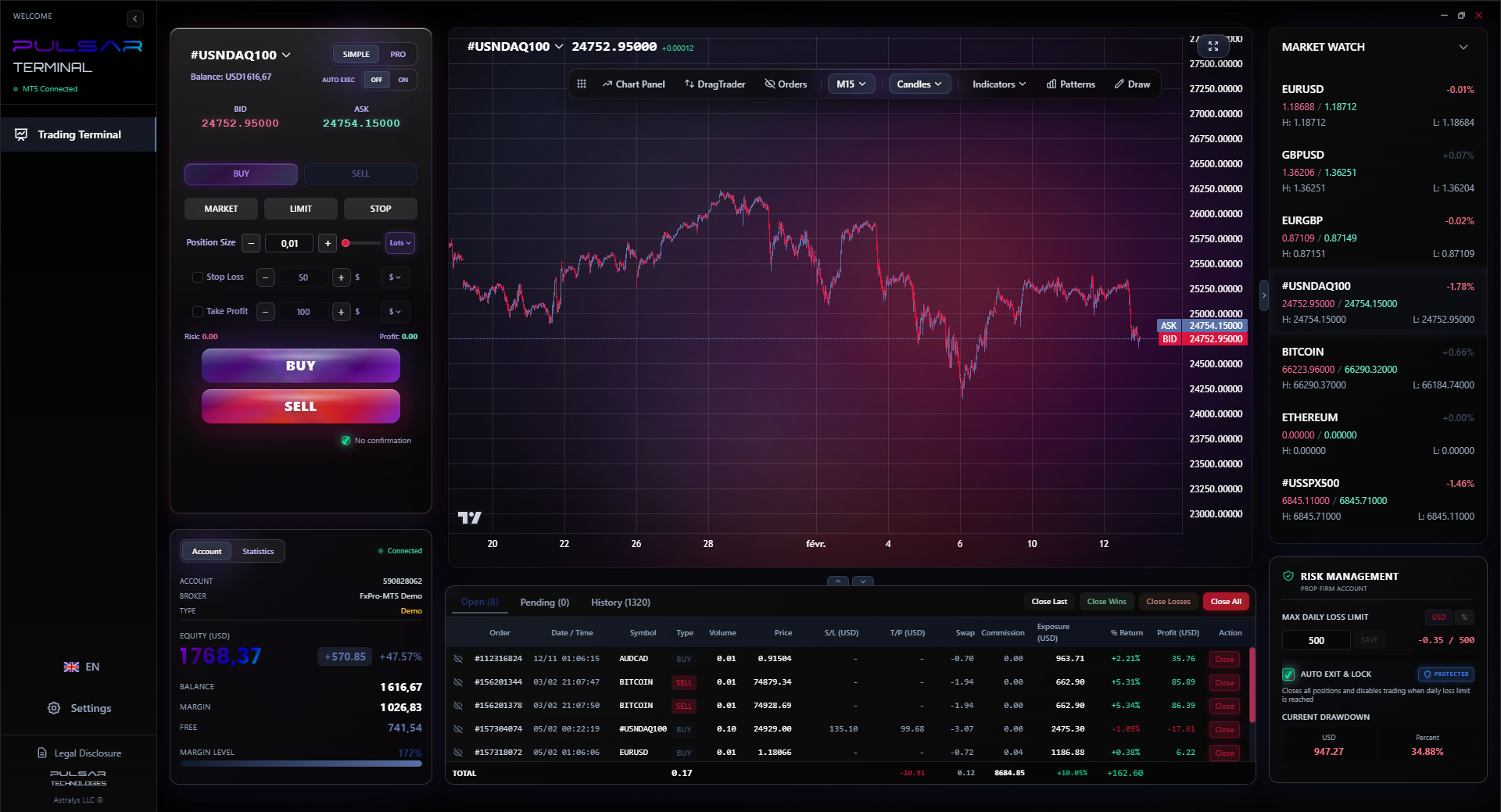
Managing a clear trade picture is one thing, but executing the plan under pressure is another. Pulsar Terminal lets you set multi-level take-profits and trailing stops directly on your MT5 chart, so your exit strategy is locked in the moment you enter, removing emotion from the equation.
Pulsar Terminal
L'outil MT5 tout-en-un : ordres glisser-déposer, multi-TP/SL, trailing stop, grid trading, Volume Profile et protection prop firm. Utilisé quotidiennement par 1 000+ traders.
“The market doesn't care about your opinion, your mortgage, or your need to be right. It just paints pictures.”
Every forex picture is a reflection of mass human emotion: greed and fear. A long, steady uptrend with small pullbacks? That's controlled greed. A violent, spiky crash? That's pure panic. A tight range? That's indecision and confusion.
Your job is twofold: first, diagnose the market's current emotion. Second, manage your own, which is trying to sabotage you. When you see a beautiful, clean breakout picture, your brain releases dopamine. You want in. That's the exact moment you must slow down. Is volume confirming it? Is it happening at a logical time, or during a thin session where it's easily manipulated?
I'll be vulnerable here. My worst losses came from seeing a picture that matched my pre-existing bias. I'd be bullish on gold, and suddenly a 5-minute XAU/USD chart would show a perfect hammer candle at support. 'See! It's reversing!' I'd jump in, ignoring the fact that on the daily chart, it was still crashing through major support like a knife through butter. I was seeing the picture I wanted, not the one that was there.
The market doesn't care about your opinion, your mortgage, or your need to be right. It just paints pictures. Your success depends entirely on how accurately you can interpret them, and whether you have the discipline to walk away when the picture is unclear. Most of the time, it is unclear. That's okay. Waiting is a position.
“Waiting for a clear picture is a position. It's often the most profitable one.”
Reading forex pictures is a skill you practice, not a trick you learn. Here's a routine that worked for me.
Sunday Night (SAST): Open your charts. No trading, just looking. Review the weekly closes on your main pairs (USD/ZAR, EUR/USD, XAU/USD guide). Identify the major weekly picture. Write down three key levels for the week.
Pre-Market (Daily): Before the London open, check the daily charts. How did price react to your weekly levels? Update the picture. Has the story changed? Plan your potential scenarios: 'If price holds here and shows this pattern, I might look for a long. If it breaks this level, I'm flat or short.'
Trade Management: When in a trade, the picture evolves. If you're in profit and price approaches a major resistance, the picture might say 'take partial profit.' Do it. Don't get greedy and turn a winner into a loser. Tools that help you manage multiple take-profit levels are useful for this reason.
Review: At week's end, look back. Were your reads correct? Where did you mess up? I keep a screenshot journal of my trade entries with a note on what picture I saw. It's painfully revealing. You start to see your own repetitive mistakes in how you interpret certain patterns.
This process turns random guessing into a structured analysis of market pictures. It removes emotion and replaces it with process. That's the only edge you have.
💡 Conseil de Winston
Your first loss is often your smallest. Misreading a picture leads to revenge trading, where you try to argue with the market. That's when the real damage happens. Walk away.
FAQ
Q1Is forex trading legal in South Africa?
Yes, it's legal for individuals. It's regulated by the Financial Sector Conduct Authority (FSCA). You must use an FSCA-licensed broker to ensure client fund protection and adhere to local rules, like the 30:1 use limit for retail traders.
Q2What is the best time frame for reading forex pictures?
There isn't one 'best' time frame. You need multiple. Start with the higher time frames (weekly/daily) to get the main story (the trend). Then use lower time frames (like the 4-hour or 1-hour) to refine your entry. Never take a trade on a small time frame picture that directly contradicts the bigger picture.
Q3How much money do I need to start trading forex in South Africa?
Technically, some brokers like Fusion Markets have no minimum deposit. But practically, you need enough to trade with proper risk management. Starting with $200-$500 (R3,600-R9,000) is common, but you should only risk 1-2% of your account per trade. A $200 account means your max risk per trade is $2-$4, which severely limits your options. Start with an amount you can afford to lose completely.
Q4What's the most important part of a forex picture?
Price action and market structure (key highs and lows). Indicators are secondary. If the price is making lower lows and lower highs, the picture is bearish. No bullish indicator reading overrides that basic fact. The trend is the most powerful part of the picture until it's broken.
Q5Why do I keep getting stopped out before the market moves in my direction?
You're probably placing stops at obvious technical levels where everyone else has theirs (like round numbers or recent swing highs/lows). The market often moves to collect these stops before reversing. Try placing your stops just beyond these obvious clusters, or use a wider stop with a smaller position size. You're likely misreading the volatility part of the picture.
Q6How are forex trading profits taxed in South Africa?
SARS views net profits from trading as income, not capital gains. You must declare your trading profits in your annual tax return and pay income tax on them. Keep detailed records of all trades, deposits, and withdrawals. Losses can be carried forward to offset future profits.
Q7Can I use automated trading (Expert Advisors) to read pictures for me?
You can, but be very careful. Most EAs are just programmed to recognize specific, simple patterns. They cannot interpret the nuanced, shifting story of a live market picture that includes news and sentiment. They often work for a while, then fail spectacularly when market conditions change. Use them as tools, not substitutes for your own understanding.
La leçon du Prof. Winston
Points clés:
- ✓Always analyze from higher to lower time frames.
- ✓Price action and structure trump all indicators.
- ✓Risk a maximum of 2% of capital on any single trade.
- ✓If the picture is unclear, do nothing. Preserve capital.
Cet article vous a-t-il été utile ?
Cliquez sur une étoile
Analyses Trading Hebdo
Analyses et stratégies hebdo gratuites. Pas de spam.
À propos de l'auteur
David van der Merwe
Trader des Marchés Émergents
Trader basé à Johannesbourg avec 11 ans d'expérience sur les devises des marchés émergents. Spécialisé dans les paires ZAR, le trading régulé par la FSCA et l'analyse du marché sud-africain.
Commentaires
Avertissement sur les risques
Le trading d'instruments financiers comporte des risques importants et peut ne pas convenir à tous les investisseurs. Les performances passées ne garantissent pas les résultats futurs. Ce contenu est fourni à titre éducatif uniquement et ne constitue pas un conseil en investissement. Effectuez toujours vos propres recherches avant de trader.
Vous aimerez aussi

Cara Trading Forex Sukses: 7 Prinsip dari Trader Profesional
Cara trading forex sukses dengan 7 prinsip trader pro: manajemen modal, disiplin, journal trading, backtest. Data nyata, bukan janji profit palsu.
Jam Trading Forex Terbaik untuk Trader Indonesia: Panduan Lengkap dengan Tabel Waktu
Panduan jam trading forex untuk trader Indonesia. Tabel 4 sesi dunia, jam emas 20:00-00:00, sesi mana yang harus dihindari. Data akurat + tips dari trader berpengalaman.
Top 5 Sàn Forex Uy Tín Nhất 2026: Review Jujur dari Trader Indonesia
Top 5 sàn forex uy tín 2026 untuk trader Indonesia. Review jujur: spread, deposit, withdraw, dukungan lokal. Exness, XM, IC Markets & lebih.
Obtenir Pulsar Terminal
Tous ces calculateurs sont intégrés dans Pulsar Terminal avec des données en temps réel de votre compte MT5. Dimensionnement de position en un clic, gestion automatique des risques et calculs instantanés.
Obtenir Pulsar Terminal