


Everyone talks about trading the Naira like it's just another currency.

Olumide Adeyemi
Pionnier du Trading en Afrique de l'Ouest ·  Nigeria
☕ 12 min de lecture
Ce que vous apprendrez :
- 1What Exactly Is the Forex Rate in Nigeria? (It's Not What You Think)
- 2How CBN Policy Actually Moves the Market (A Trader's View)
- 3Practical Ways to Trade Naira Volatility (The Proxies That Work)
- 4Brokers, Regulation, and Getting Your Money In/Out
- 5Risk Management When Everything is Volatile
- 6Mistakes I Made (So You Don't Have To)
- 7Putting It All Together: A Simple Starter Plan

Everyone talks about trading the Naira like it's just another currency. They're wrong. The Nigerian forex rate isn't just a number on a screen, it's a story of policy, scarcity, and emotion. For years, I traded it like any other pair and got burned. This guide is what I wish I'd known before I placed my first trade on USD/NGN. I'll show you how the market really works, where the real opportunities are, and how to avoid the traps that catch most local traders.
When you hear "forex rate" in Nigeria, you're probably thinking of the black market rate your Bureau de Change guy quotes. Or maybe the official CBN rate. In trading, it's different. The forex rate is the price of one currency expressed in terms of another. For us, that's usually how many Naira it takes to buy one US Dollar (USD/NGN) or one British Pound (GBP/NGN).
Here's the kicker: you can't directly trade the Naira on most international retail platforms. The NGN isn't fully convertible for speculative trading. So when we talk about trading the Nigerian forex rate, we're often talking about trading the effects of Naira volatility through other instruments. This was my first hard lesson. I spent weeks trying to find a broker offering real USD/NGN spot trading for retail clients. Most don't. The ones that do are often... questionable.
What you can trade are the proxies. When the Naira weakens, companies like MTN Nigeria or Dangote Cement (listed on the NGX) that have dollar-denominated debt see their costs rise. Their stock prices can react. Also, the price of commodities like Brent Crude (XBR/USD) moves the Naira because Nigeria's an oil exporter. You're not trading the rate itself, you're trading the ripple effects. It's a game of second-order consequences.

Warning: Be extremely wary of any "platform" offering direct spot USD/NGN trading with massive use. Many are unregulated schemes betting against you. The real, liquid interbank market for Naira isn't accessible to you and me.
So, the first step is to shift your mindset. Don't chase the direct rate. Learn to read it as a fundamental indicator for other, more tradable markets. I learned this after depositing $500 into a shady platform promising "real Naira trading." The spreads were 50 pips wide, orders mysteriously slipped, and my account was gone in two trades. A costly, but valuable, education.
“The Nigerian forex rate isn't just a number on a screen, it's a story of policy, scarcity, and emotion.”
The Central Bank of Nigeria is the biggest player in the Naira market. Their policies don't just influence the forex rate, they often dictate it in the short term. But here's the thing: the market's reaction isn't always logical. It's emotional.
Reading the MPC Announcements
I used to scour MPC (Monetary Policy Committee) statements for direct clues on interest rates. I was missing the point. The market cares about one thing: liquidity. Will the CBN inject dollars or suck them out? An MPC decision to hike rates might be intended to strengthen the Naira, but if the market interprets it as a sign of desperation, the rate can actually weaken further. I remember a specific hike in 2021. The official rate firmed slightly, but the black-market premium blew out by 15% in the following week. The trade wasn't in the direct move, it was in the divergence between official and parallel rates.
The Real Signal: FX Auctions
Forget the headlines. Watch the FX auction results. The amount demanded versus the amount supplied tells you everything about pent-up pressure. When the bid-to-cover ratio spikes (say, $1 billion bids for $200 million offered), you know devaluation pressure is building, no matter what the official rhetoric is. This is a leading indicator for import-heavy Nigerian stocks, which will start pricing in higher future costs.
A Personal Trade Example
In June 2023, ahead of a major policy announcement, I saw huge demand at the wholesale auction. The CBN was talking stability, but the numbers screamed scarcity. I didn't trade Naira (I couldn't). Instead, I shorted the ETF for Nigerian banks (tracked via a US-listed instrument) because I knew their dollar shortages would hurt quarterly results. Entry was at $7.20. I rode it down to $6.50 over six weeks. That 9.7% move was a pure play on the forex rate pressure the official data was hinting at. The key was using the CBN's own data against the official narrative.
This approach requires patience. You're not scalping here. You're building a swing trading thesis based on fundamental mismatches.

💡 Conseil de Winston
The parallel market rate tells you what happened yesterday. The CBN's FX auction bid-to-cover ratio tells you what will happen tomorrow. Watch the latter.
“You're not trading the rate itself, you're trading the ripple effects. It's a game of second-order consequences.”
Since you can't easily short the Naira directly, you need a toolbox of proxies. These are the instruments that reliably move when the forex rate shifts.
1. Nigerian Stocks (via NGX or ETFs): This is the most direct channel. Sectors react differently:
- Importers (Consumer Goods, Telecoms): Naira weakness is a killer. Their input costs soar. Look for companies with low forex reserves and high import needs. A falling Naira is a sell signal.
- Exporters (Some Agric, Cement): They earn dollars. Naira weakness boosts Naira earnings. But be careful, many also have dollar debts that offset the gain.
- Banks: A double-edged sword. They benefit from higher volatility and wider spreads on forex transactions, but suffer if their corporate clients (importers) start defaulting.
2. Commodities, Especially Oil: Nigeria's lifeblood. A rising oil price (Brent Crude) should, in theory, strengthen the Naira by bringing in more dollars. But due to structural issues (subsidies, theft), the correlation isn't perfect. Watch for dislocations. If oil rallies 10% but the Naira doesn't budge or weakens, that's a signal of severe internal dollar demand or leakage. I often use the XAU/USD (gold) pair as a hedge when I have a Naira-sensitive position, as gold often moves inversely to the dollar's strength.
3. International Stocks with High Nigeria Exposure: Companies like MTN Group or Nestle Nigeria have parent companies listed abroad. Their earnings reports will detail forex losses/gains in Nigeria. A profit warning from one of these can be a canary in the coal mine for broader Naira pressure.
4. Forex Pairs as Sentiment Gauges: You trade USD/NGN indirectly by trading broader dollar strength. If you believe the CBN is losing the battle to support the Naira, a strong trend in EUR/USD (a weakening dollar) might not materialize. Instead, you might see the dollar strengthen against all except the majors, showing a flight to quality. Tools like the MACD indicator on DXY (Dollar Index) can help confirm the broader trend.

Pro Tip: Don't trade all proxies at once. Pick one sector you understand. I started with Nigerian banks because their quarterly reports clearly break down forex revaluation gains/losses. It gave me a clean, reportable number to tie my trade thesis to.
“You're not trading the rate itself, you're trading the ripple effects. It's a game of second-order consequences.”
This is the most frustrating part of trading from Nigeria. The regulation is a grey area, and funding is a constant headache.
The Regulatory Grey Zone: The CBN wants to control forex flows. The SEC is still figuring out its role in retail forex. The result? Most reputable international brokers like Pepperstone, IC Markets, and XM accept Nigerian clients, but under their offshore licenses (e.g., ASIC in Australia, CySEC in Cyprus). They are not CBN-licensed. Is this illegal for you, the trader? The consensus among experienced traders is no, you're not breaking the law by trading with them. But the CBN doesn't make it easy to fund those accounts.
The Funding Battle: This is where you'll lose hair. Bank transfers to international brokers are often blocked or require endless paperwork proving the purpose isn't "speculative." The workarounds:
- Cryptocurrency Deposits: A lifesaver. Many brokers now accept deposits via USDT or Bitcoin. You buy crypto from a local P2P platform, send it to the broker's crypto address, and it's converted to trading capital. Withdrawals are the reverse. This is, by far, the most reliable method I've used in the last 3 years.
- International Debit/Credit Cards: Sometimes works, sometimes gets declined. It depends on your bank and the day of the week. Have a backup plan.
- E-wallets: Skrill, Neteller, etc. You still need to fund the e-wallet first, which presents the same initial hurdle.
Choosing a Broker: Given the funding issues, prioritize brokers with multiple deposit options, especially crypto. Look for low spreads on the instruments you'll actually trade (like XAU/USD or EUR/USD), not on Naira pairs you won't. Reliable customer service is non-negotiable. You need help fast when a deposit fails. I've had good execution experiences with Exness for metals and IC Markets for indices, but your mileage may vary. Always start with a small deposit to test the withdrawal process. If you can't get $50 out smoothly, you won't get $5000 out.
💡 Conseil de Winston
If you can't explain which specific quarterly report line item will prove your trade right, you're gambling, not trading. Tie your thesis to a hard number.
“Fundamentals give you the direction, technicals give you the entry. Ignoring either is a recipe for a stopped-out trade.”
Naira-related volatility isn't normal market volatility. It's policy-driven, gap-prone, and emotional. Your standard 2% risk per trade rule needs tightening.
1. Smaller Position Sizes: When trading proxies for Naira moves, I never risk more than 0.5% to 1% of my account per trade. Why? The underlying event (a CBN policy shift) can cause gaps that blow through your stop loss. A stop loss is an order, not a guarantee. I learned this in 2022 when a surprise CBN circular caused a bank stock I was short to gap down 8% at open. My stop was at 5%. It didn't matter. I lost 8%. Now, I size so that even a worst-case gap won't take out more than 2% of my total capital. Use a position size calculator religiously, then reduce the output by half for these trades.
2. Wider Stops, Fewer Trades: You're playing a fundamental story, not a 5-minute chart pattern. Give your trade room to breathe. Place your technical stop, then double the distance. The noise around these events is immense. This forces you to be more selective and only enter when your fundamental conviction is extremely high.
3. Hedge with Non-Correlated Assets: If my main thesis is a weakening Naira hurting Nigerian equities, I might have a small, uncorrelated long position elsewhere, like a major forex pair or a bond ETF. It's not a perfect hedge, but it dampens the blow if my entire portfolio is wrong on the Naira call. The goal is survival, not perfection.
4. The Margin Call Nightmare: use is a tool, but in this environment, it's a loaded gun. High use + event-driven gap = instant margin call. I never use more than 5:1 use on Naira-proxy trades. On a normal EUR/USD scalping day, I might use 20:1. On these, it's reckless. Preserving capital is the only way you stay in the game long enough to be right.
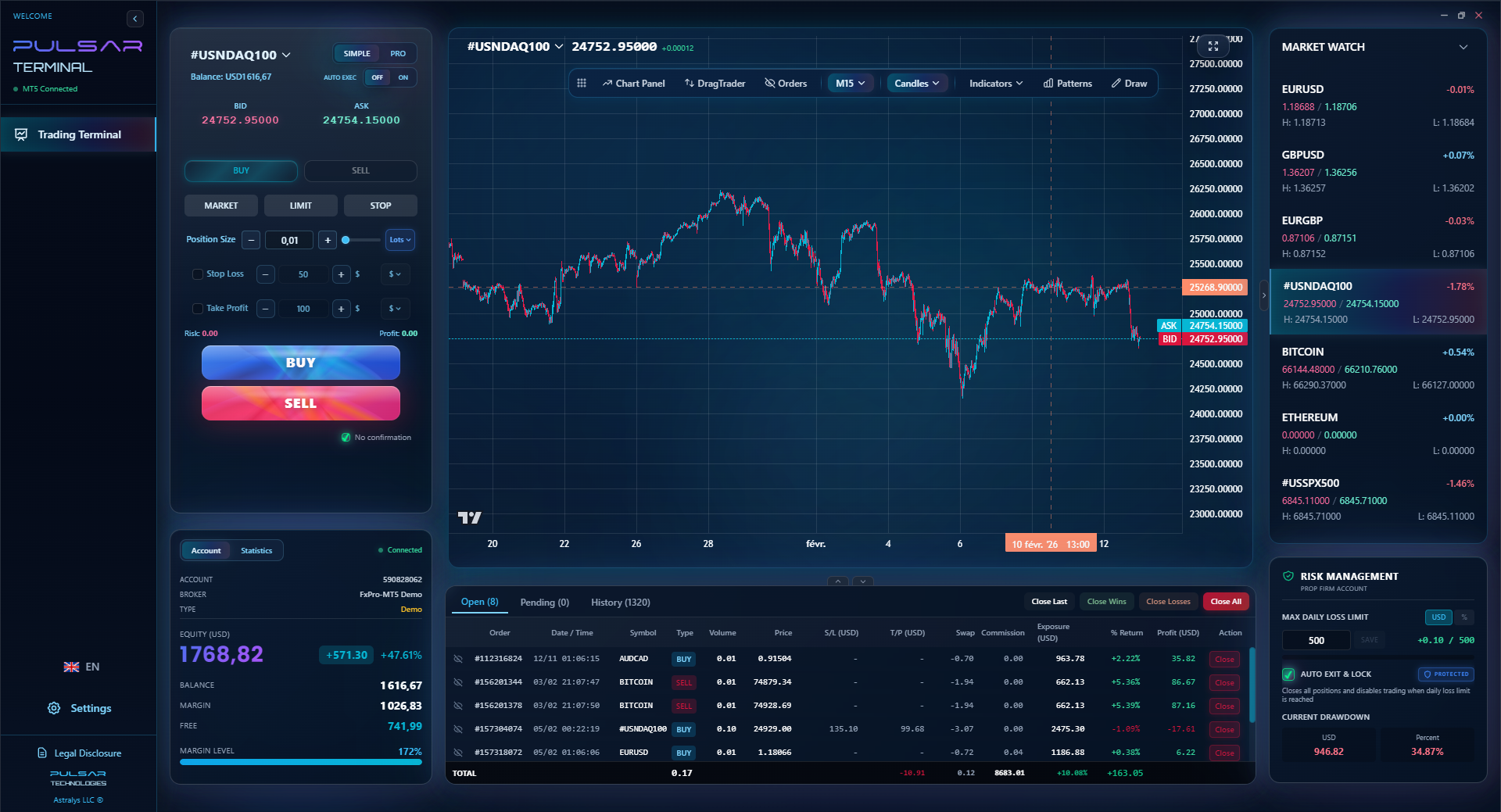
Managing multiple trades and adjusting stops in a volatile Naira-driven market is stressful, but tools like Pulsar Terminal automate partial closures and trailing stops directly on your MT5 charts.
Pulsar Terminal
L'outil MT5 tout-en-un : ordres glisser-déposer, multi-TP/SL, trailing stop, grid trading, Volume Profile et protection prop firm. Utilisé quotidiennement par 1 000+ traders.
“Fundamentals give you the direction, technicals give you the entry. Ignoring either is a recipe for a stopped-out trade.”
Let's get personal. Here are my most expensive errors trading the Nigerian forex rate story.
1. Chasing the Parallel Market Rate as an Entry Signal: I'd see the black-market rate jump 10 Naira in a day and immediately short Nigerian consumer stocks. Often, the market had already priced it in weeks ago. The parallel rate is a lagging indicator of panic, not a leading indicator of opportunity. By the time it spikes, the smart money is already positioned.
2. Ignoring Technicals Because 'Fundamentals Are King': In 2020, I was convinced a Naira devaluation was imminent. I shorted a bank stock when it was already down 25% from its highs, thinking there was more to go. I ignored the oversold reading on the RSI indicator and clear support on the chart. The stock bounced 15% on a technical rally, stopped me out, and then continued down. I was right on the story, wrong on the timing and entry. Fundamentals give you the direction, technicals give you the entry. Now I wait for my fundamental story to align with a technical trigger.
3. Underestimating Political Timing: The forex rate is a political tool. I once built a large short position ahead of an election, expecting post-election volatility to weaken the Naira. The government, however, threw everything at defending the rate for stability during the transition. The squeeze cost me months of profits. Never trade Nigerian forex volatility around major political events unless you have insider knowledge of policy plans (and you don't).
4. Not Having a Clear Exit Plan: What event proves your thesis right or wrong? Is it a specific CBN circular? A certain level of reserves? A particular inflation number? Define it before you enter. My early trades were vague: "Naira will go down." That's not a thesis. Now my journal reads: "Short XYZ bank. Thesis: Q3 earnings will show forex losses exceeding 5 billion Naira due to current spread between official and parallel rates. Exit if CBN announces a successful $1bn FX injection before earnings date." Specificity saves you from holding a losing trade out of hope.
💡 Conseil de Winston
Your first profit target in volatile markets should be to get your initial risk off the table. Move to breakeven at the first opportunity. Survival first.
“Preserving capital is the only way you stay in the game long enough to be right.”
Here's a basic framework to start trading the Nigerian forex rate narrative safely.
Step 1: Information Diet. Stop watching every news channel. Curate your sources:
- Primary: CBN website for MPC communiqués and FX auction results.
- Secondary: Reliable financial newspapers for analysis (not headlines).
- Tertiary: Earnings reports of 2-3 key Nigerian companies you understand.
Step 2: Pick One Proxy. Start with just one. Maybe it's the US-listed ETF for Nigerian stocks (NGE). Or maybe it's just monitoring the stock price of Nestle Nigeria on the NGX. Learn everything about how it reacts to forex news.
Step 3: Define Your Trade Checklist. No trade unless all boxes are ticked:
- My fundamental thesis is based on CBN data, not newspaper gossip.
- The price action on my proxy instrument shows a clear technical setup (break of support/resistance).
- My position size risks no more than 1% of my account.
- My stop loss is placed at a level that invalidates my thesis, not just a random number.
- I have defined the specific event that will make me exit a winning trade.
Step 4: Review and Adapt. Every quarter, review your trades. Did your forex rate thesis hold? Did the proxy move as expected? If not, why? Was it the wrong proxy, or wrong timing? This iterative learning is more valuable than any single winning trade.
This isn't a get-rich-quick scheme. It's a way to systematically understand and potentially profit from one of the most significant economic forces affecting your financial life in Nigeria. Trade small, learn constantly, and always protect your capital first. The market will always be there tomorrow if you do.
FAQ
Q1Is forex trading legal in Nigeria?
Yes, forex trading is legal for individuals in Nigeria. However, the regulatory environment is complex. While you can legally trade, many international brokers serving Nigerians operate under offshore licenses (like ASIC or CySEC), not direct CBN licenses. The key is to use reputable, well-regulated international brokers, not unlicensed platforms promising unrealistic Naira-based returns.
Q2Can I directly trade the USD/NGN pair?
As a retail trader, it's very difficult and often ill-advised. The liquid interbank market for Naira isn't accessible. Platforms offering it typically have enormous spreads, poor regulation, and may be operating against you. It's safer and more efficient to trade the effects of Naira volatility through proxies like Nigerian stocks, commodities, or other forex pairs.
Q3What is the best way to fund a forex trading account from Nigeria?
Currently, cryptocurrency deposits (like USDT) are the most reliable method. You buy crypto on a local P2P platform, send it to your broker's crypto address, and it's converted. International bank transfers are often blocked or delayed, and card deposits can be unreliable. Always test the withdrawal process with a small amount first.
Q4How does the CBN's official rate affect my trading?
The official rate is a policy tool, not always a market price. It affects the financials of Nigerian companies. A widening gap between the official and parallel market rates creates pressure that eventually shows up in corporate earnings (as forex losses) and stock prices. As a trader, you watch this gap for stress signals in the economy.
Q5Which forex pairs are best for Nigerian traders to start with?
Start with major pairs that have low spreads and high liquidity, like EUR/USD or GBP/USD. They allow you to learn technical analysis and risk management in a cleaner environment. Once you're proficient, you can then apply that skill to trading Naira proxies, where fundamentals play a bigger role.
Q6How much money do I need to start trading forex in Nigeria?
You can start with a very small amount, even $50 or ₦50,000, with some brokers. However, with that amount, your focus should be 100% on learning, not making money. To trade seriously while properly managing risk, a minimum of $500-$1000 is more realistic. This allows for sensible position sizing to withstand normal market volatility.
Q7What's the biggest risk when trading based on the Naira rate?
Event risk and gaps. A sudden CBN policy announcement or political decision can cause prices to jump (gap) over your stop loss, leading to a larger loss than planned. This is why position sizing is critical - you must assume your stop might not be filled at your price and size so a worst-case gap won't cripple your account.
La leçon du Prof. Winston
Points clés:
- ✓Trade Naira volatility through proxies, not direct USD/NGN.
- ✓Size positions at 0.5-1% risk for event-driven trades.
- ✓Use crypto (USDT) for reliable broker funding.
- ✓Define your exit event before you enter the trade.
- ✓The CBN's auction data is more valuable than its press statements.
Cet article vous a-t-il été utile ?
Cliquez sur une étoile
Analyses Trading Hebdo
Analyses et stratégies hebdo gratuites. Pas de spam.
À propos de l'auteur
Olumide Adeyemi
Pionnier du Trading en Afrique de l'Ouest
L'un des formateurs de trading forex les plus actifs au Nigeria. 8 ans d'expérience de trading depuis Lagos. Spécialisé dans les stratégies à petit capital et les challenges de prop firms pour les traders africains.
Commentaires
Avertissement sur les risques
Le trading d'instruments financiers comporte des risques importants et peut ne pas convenir à tous les investisseurs. Les performances passées ne garantissent pas les résultats futurs. Ce contenu est fourni à titre éducatif uniquement et ne constitue pas un conseil en investissement. Effectuez toujours vos propres recherches avant de trader.
Vous aimerez aussi

Cara Trading Forex Sukses: 7 Prinsip dari Trader Profesional
Cara trading forex sukses dengan 7 prinsip trader pro: manajemen modal, disiplin, journal trading, backtest. Data nyata, bukan janji profit palsu.
Jam Trading Forex Terbaik untuk Trader Indonesia: Panduan Lengkap dengan Tabel Waktu
Panduan jam trading forex untuk trader Indonesia. Tabel 4 sesi dunia, jam emas 20:00-00:00, sesi mana yang harus dihindari. Data akurat + tips dari trader berpengalaman.
Top 5 Sàn Forex Uy Tín Nhất 2026: Review Jujur dari Trader Indonesia
Top 5 sàn forex uy tín 2026 untuk trader Indonesia. Review jujur: spread, deposit, withdraw, dukungan lokal. Exness, XM, IC Markets & lebih.
Obtenir Pulsar Terminal
Tous ces calculateurs sont intégrés dans Pulsar Terminal avec des données en temps réel de votre compte MT5. Dimensionnement de position en un clic, gestion automatique des risques et calculs instantanés.
Obtenir Pulsar Terminal