


My screen was a blur of green and red.

David van der Merwe
Trader des Marchés Émergents ·  South Africa
☕ 9 min de lecture
Ce que vous apprendrez :
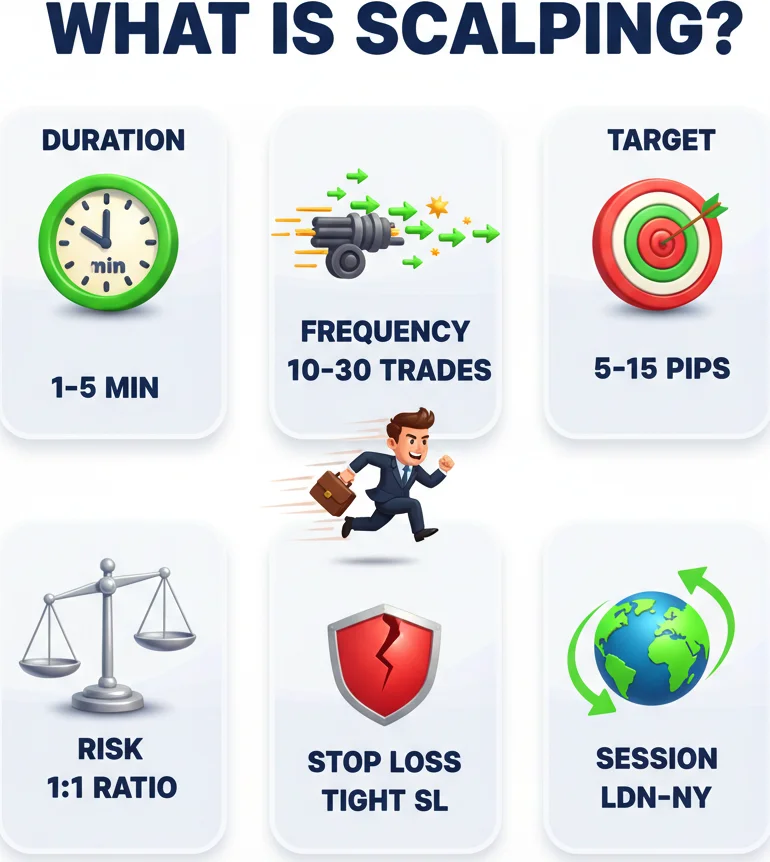
My screen was a blur of green and red. It was 3:15 PM SAST, right as London liquidity was fading and New York was just waking up. I had my cursor hovering over a sell order on EUR/USD at 1.0874. My 1-minute chart showed a clear rejection at a 15-period EMA, the RSI was curling over from 72, and price had just taken out the low of the previous three bars. I clicked, set a 7-pip stop, and a 10-pip target. Ninety seconds later, I was out at 1.0864. R287 profit, before costs. That’s scalping. It’s not glamorous, but done right, it’s a grind that can pay the bills. Let’s talk about how to do it here, with our rules, our brokers, and our unique market quirks.
Forget everything you've seen in the movies. Scalping isn't about yelling into a phone. It's a surgical approach. You're aiming to capture tiny price movements, often between 5 and 15 pips, and you're doing it over and over again. Trades last from a few seconds to a few minutes, rarely longer than 15. The goal is to stack up a series of small wins that, by the end of the day, add up to something meaningful.
The mindset is everything. You need the patience of a sniper and the discipline of a monk. One big, emotional loss can wipe out 20 careful wins. I learned that the hard way in 2019. Got frustrated after three small losses on USD/ZAR, doubled my lot size on the next setup out of irritation, and watched a 25-pip move against me in under a minute. That one trade cost me more than my entire profit target for the week. It was a brutal, but necessary, lesson in why a strict scalping strategy is built on rules, not feelings.
In South Africa, this strategy has a particular appeal. With a volatile currency like the Rand, there's often plenty of movement to exploit, especially around local data releases or SARB announcements. But that same volatility is a double-edged sword.
First thing's first: is it legal? Yes, absolutely. The Financial Sector Conduct Authority (FSCA) regulates the brokers, not your trading style. Their job is to make sure the broker you're using isn't a scam and operates fairly. So, your number one rule is to only use an FSCA-regulated broker. Trading with an unregulated offshore outfit might promise crazy use, but when things go south (and they will), you have zero recourse. I check the FSCA's website every few months to confirm my broker's status is still active.
Broker Features You Can't Compromise On
Not all regulated brokers are created equal for scalping. You need to be picky.
- Execution Speed & Slippage: This is non-negotiable. If your broker's platform hesitates for half a second, your intended 5-pip profit can become a 2-pip loss. You need a broker with a reputation for lightning-fast, reliable execution. Look for ones with local servers if possible.
- Spreads & Commissions: This is where your profit goes to die if you're not careful. Scalping with wide spreads is like trying to run a marathon in gumboots. You need the tightest spreads possible. For major pairs like EUR/USD, look for raw spread or ECN accounts where spreads can go down to 0.0 pips, but you pay a commission. For ZAR pairs, spreads will naturally be wider, but compare brokers. A 12-pip spread on USD/ZAR is very different from an 18-pip spread when your target is only 15.
- Allowed Strategies: This is critical. Some brokers, even regulated ones, have hidden clauses against "high-frequency trading" or can label you an "abusive trader" if you scalp. You need explicit confirmation that scalping is allowed. I always open a live chat and ask, saving the transcript.

Warning: A common mistake is picking a broker based on a fancy bonus offer. Most bonuses come with trading volume requirements that are impossible for a scalper to meet without taking insane risks. I always decline bonuses to keep my terms clean.
Brokers like IC Markets and Pepperstone are popular with scalpers globally for their raw spreads and fast execution, and they serve South African clients under relevant regulations. Always do your own due diligence, though.

💡 Conseil de Winston
A scalper's edge isn't in predicting the market; it's in superior trade management and cost control. Win the battle of the spread and you're halfway there.
“Your job is to execute your plan and take what the market gives you according to your rules, not to catch every pip.”
Trading your home currency feels intuitive, but scalping ZAR pairs is a different beast compared to the majors like EUR/USD or GBP/USD.
Liquidity & Spreads: USD/ZAR is liquid, but not like EUR/USD. The spread is your constant enemy. Where EUR/USD might have a 0.2 pip spread, USD/ZAR can easily sit at 10-15 pips during active hours. This means your profit target must be significantly larger than the spread to be worthwhile. A 10-pip scalp on EUR/USD is fine. A 10-pip scalp on USD/ZAR with a 12-pip spread is a guaranteed loss.
Volatility is Your Fuel: The Rand can move fast, especially when local data (CPI, unemployment, SARB rate decisions) hits. This creates opportunity, but also danger. A news spike can blow through your tight stop loss before you can blink. I never scalp in the 60 seconds before or after a major SARB announcement. It's not worth the gamble.
A Practical ZAR Scalping Session: Let's say USD/ZAR is at 18.5000. Your broker's spread is 12 pips, so the ask is 18.5012. You need a move of at least 15-20 pips in your favor just to break even on the trade. This forces you to either use wider stops and targets (which isn't really scalping anymore) or be incredibly selective with entries. I often find better, cleaner opportunities on majors like EUR/USD and then just convert my profits back to ZAR.

Pro Tip: If you insist on scalping ZAR pairs, focus on the London overlap (10:00 AM - 1:00 PM SAST) when liquidity is deepest and spreads might tighten slightly. Avoid the Asian session (2:00 AM - 8:00 AM SAST) like the plague - spreads widen to ridiculous levels.
You don't need 20 indicators. Complexity is the enemy of speed. Here’s the exact 1-minute chart setup I've used for years. It works on any liquid pair.
The Tools:
- Exponential Moving Averages: 9-period EMA (fast, red), 21-period EMA (slow, blue).
- RSI: 14-period, with levels at 30 and 70.
The Rules for a SELL Signal:
- Price must be trading below the 21-period EMA. This defines the short-term downtrend.
- Price pulls up and touches or gets very close to the 9-period EMA.
- As price touches the 9 EMA, you look at the RSI. It should be below 50 and preferably curling back down from near 45-50.
- You enter on the first 1-minute candle that closes below the low of the candle that touched the 9 EMA.
Trade Management:
- Stop Loss: Place it 5-7 pips above the recent swing high (the high of the candle that touched the 9 EMA).
- Take Profit: Aim for 8-12 pips. I use a fixed 1:1.5 risk-to-reward ratio. If my stop is 7 pips, my target is 10.5 pips away.
Real Trade Example (EUR/USD): On a Tuesday morning, price is below the 21 EMA. It rallies, and a candle's high hits the 9 EMA at 1.0950. The RSI is at 48 and turning down. I wait. The next candle closes at 1.0947, below the previous candle's low of 1.0949. I enter a sell at 1.0946.
- Stop Loss: 1.0953 (7 pips above entry).
- Take Profit: 1.0936 (10 pips below entry). Price drops, and I'm out at my target 4 minutes later. That’s it. No magic. The reverse rules apply for a buy signal. The key is waiting for the candle close for confirmation - it saves you from false breakouts. This setup leans heavily on momentum, which is why tools like the RSI indicator are so useful for confirming the move's strength.
💡 Conseil de Winston
Track your trades in a journal, but more importantly, track your *decisions*. Why did you enter? Why did you exit? The pattern of your mistakes is more valuable than the pattern of price.
“The pattern of your mistakes is more valuable than the pattern of price.”
Let's talk about the two things that end more scalping careers than bad analysis: transaction costs and your own head.
The Math of Costs: Imagine you take 20 trades in a day, averaging 0.1 lots each on EUR/USD.
- Spread Cost: If your spread is 0.5 pips, that's $0.50 per trade (0.1 lots * $1 per pip * 0.5 pips). 20 trades = $10 gone.
- Commission: On a raw account, you might pay $3.50 per lot round turn. 0.1 lots = $0.35 per trade. 20 trades = $7 gone. Total daily cost: $17. You need to make at least $17 in net profits just to break even. This is why you must use a position size calculator religiously. If your average winning trade only makes $12, you're losing money even if you win 60% of the time. I track my costs in a spreadsheet every single day.
The Psychology of the Grind: Scalping is mentally exhausting. You will have losing streaks. The temptation to "get back to even" by breaking your rules is immense. You must have a daily loss limit and stick to it. Mine is 2% of my account. Once I hit it, I shut down the platform. No arguments, no "one more trade." Similarly, have a daily profit target. When I'm up 3%, I often stop. Greed leads to giving back profits.
The worst psychological trap is watching a closed trade continue in your direction. You took 10 pips, and it runs for 40. It feels like a loss. You have to let that go. Your job is to execute your plan and take what the market gives you according to your rules, not to catch every pip. I've blown more good days by re-entering a finished trade out of FOMO than from any technical mistake.

Your workspace needs to be optimized for speed and clarity.
Platform: MetaTrader 4 or 5 is the standard for a reason. It's stable, ubiquitous, and most brokers offer it. The charting is solid for our purposes. I use MT5 because I like having more timeframes available at a glance.
Hardware & Connection:
- A reliable, fast internet connection is mandatory. Use a wired Ethernet connection if you can, not Wi-Fi.
- At least two monitors. One for your 1-minute and 5-minute charts, another for your trade terminal and maybe a higher timeframe for context.
- Keep your desktop clean. Too many charts with too many indicators will slow down your decision-making.
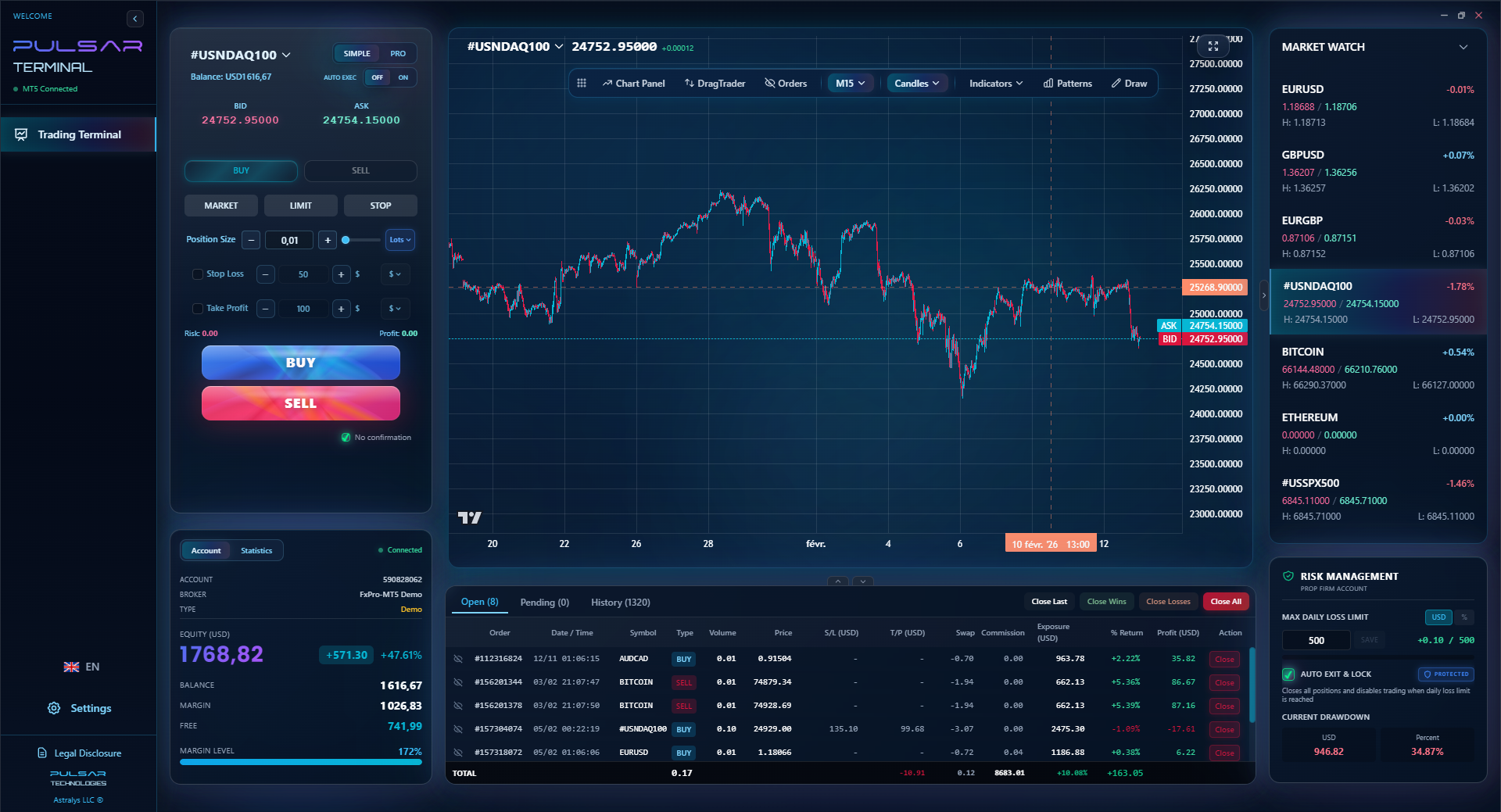
Order Management: This is where many free platforms fall short. Scalping requires quick, precise order placement. Being able to set a stop loss and take profit with one click, or to drag and modify orders directly on the chart, is a huge advantage.
Managing multiple trades and moving stops to breakeven quickly is a core part of locking in profits and protecting your capital. Doing this manually on a fast-moving 1-minute chart is stressful and error-prone.
💡 Conseil de Winston
Your first loss is often your smallest. The urge to average down or 'get back in' on a losing scalp is the quickest path to a [margin call](/en/glossary/margin-call). One and done.
When you're managing multiple fast trades on a 1-minute chart, having tools that automate stop adjustments and order placement directly on your MT5 chart can be the difference between a good day and a great one.
Pulsar Terminal
L'outil MT5 tout-en-un : ordres glisser-déposer, multi-TP/SL, trailing stop, grid trading, Volume Profile et protection prop firm. Utilisé quotidiennement par 1 000+ traders.
FAQ
Q1What is the best time of day to scalp forex in South Africa?
The London session overlap (10:00 AM to 1:00 PM SAST) is typically the best. You have high liquidity from Europe, and New York is coming online, creating consistent movement. The Asian session (overnight SAST) is the worst, with wide spreads and erratic moves.
Q2How much money do I need to start scalping forex?
You can start with a few thousand Rand, but realistically, you need enough to manage risk properly. If you start with R5,000, risking 1% per trade is R50. With a 7-pip stop loss on EUR/USD, that allows a position size of about 0.07 lots. Your profits will be small (R70-100 per win), so it's a grind. Many serious scalpers prefer to start with at least R20,000 to make the effort worthwhile after costs.
Q3Can I use scalping to pass a prop firm challenge?
It's risky. Prop firm challenges usually have strict drawdown limits and often prohibit high-frequency trading or hedging. The intense pressure of a daily loss limit can force bad decisions. If you try, you must have a strategy with an exceptionally high win rate and be prepared for the psychological toll. The automated daily loss protection in some tools is designed for this exact scenario.
Q4Is the MACD indicator good for scalping?
The standard MACD is often too slow for 1-minute charts. It lags. I prefer faster momentum indicators like the RSI or Stochastic. However, some traders use a modified, faster MACD setting (like 5,13,1) on tick charts. You can learn more about tweaking the MACD indicator for faster timeframes, but I find simpler is better.
Q5Why do I keep getting stopped out just before price reverses in my favor?
This is the scalper's curse. It usually means your stop loss is placed at an obvious level where many other traders have theirs. Try placing your stop 1-2 pips beyond a clear swing high/low, rather than at a round number. Also, ensure your profit target is realistic for the market's current volatility. A 5-pip target in a choppy, 3-pip range market will fail constantly.
Q6What's more important for a scalper, technical analysis or speed?
Speed is the foundation. If your execution is slow, the best analysis in the world is useless. However, once you have a fast, reliable broker and platform, technical analysis (and the discipline to follow it) becomes the differentiator between consistent profit and loss.
La leçon du Prof. Winston
Points clés:
- ✓Trade only with FSCA-regulated brokers that explicitly allow scalping.
- ✓Your profit target must be at least 2-3 times the spread on ZAR pairs.
- ✓Limit daily risk to 2% of your account, no exceptions.
- ✓Factor in all costs (spread + commission) before calculating profitability.
Cet article vous a-t-il été utile ?
Cliquez sur une étoile
Analyses Trading Hebdo
Analyses et stratégies hebdo gratuites. Pas de spam.
À propos de l'auteur
David van der Merwe
Trader des Marchés Émergents
Trader basé à Johannesbourg avec 11 ans d'expérience sur les devises des marchés émergents. Spécialisé dans les paires ZAR, le trading régulé par la FSCA et l'analyse du marché sud-africain.
Commentaires
Avertissement sur les risques
Le trading d'instruments financiers comporte des risques importants et peut ne pas convenir à tous les investisseurs. Les performances passées ne garantissent pas les résultats futurs. Ce contenu est fourni à titre éducatif uniquement et ne constitue pas un conseil en investissement. Effectuez toujours vos propres recherches avant de trader.
Vous aimerez aussi

Cara Trading Forex Sukses: 7 Prinsip dari Trader Profesional
Cara trading forex sukses dengan 7 prinsip trader pro: manajemen modal, disiplin, journal trading, backtest. Data nyata, bukan janji profit palsu.
Jam Trading Forex Terbaik untuk Trader Indonesia: Panduan Lengkap dengan Tabel Waktu
Panduan jam trading forex untuk trader Indonesia. Tabel 4 sesi dunia, jam emas 20:00-00:00, sesi mana yang harus dihindari. Data akurat + tips dari trader berpengalaman.
Top 5 Sàn Forex Uy Tín Nhất 2026: Review Jujur dari Trader Indonesia
Top 5 sàn forex uy tín 2026 untuk trader Indonesia. Review jujur: spread, deposit, withdraw, dukungan lokal. Exness, XM, IC Markets & lebih.
Obtenir Pulsar Terminal
Tous ces calculateurs sont intégrés dans Pulsar Terminal avec des données en temps réel de votre compte MT5. Dimensionnement de position en un clic, gestion automatique des risques et calculs instantanés.
Obtenir Pulsar Terminal