


I remember watching the USD/ZAR chart on my screen in late 2022, the pair pushing past R18.50.

David van der Merwe
Trader des Marchés Émergents ·  South Africa
☕ 13 min de lecture
Ce que vous apprendrez :
- 1The South African Forex Landscape: Rules and Realities
- 2Understanding the Local Costs of Trading
- 3Core Trading Strategies That Translate to SA
- 4Essential Resources for South African Traders
- 5Risk Management: Non-Negotiable Rules
- 6Building and Testing Your Strategy
- 7Common Pitfalls and How to Avoid Them
- 8Putting It All Together: Your Trading Routine

I remember watching the USD/ZAR chart on my screen in late 2022, the pair pushing past R18.50. My gut said 'sell,' the news was all doom, and every analyst on TV was predicting it would go higher. I went against my own rules, chased the momentum, and bought. Two days later, it reversed hard. I took a R4,200 loss on a single lot because I ignored my strategy and got caught up in the noise. That lesson, paid for in real rands, is why we're talking about real forex strategies and resources today. Not the flashy stuff, but what actually works when you're trading from Johannesburg, Cape Town, or Durban, with the FSCA watching and your own tax number on the line.
Before you even think about a strategy, you need to know the playing field. Trading here isn't the wild west. We have a solid, if sometimes strict, regulatory framework. The main referee is the Financial Sector Conduct Authority (FSCA). If your broker isn't FSCA-licensed, walk away. I don't care about their fancy bonuses. A licensed broker means your funds are segregated (their operational money can't touch your trading capital), and they have to play by clear conduct rules.
The FSCA also capped use for retail traders at 30:1 a few years back. Some moan about this, calling it restrictive. I call it a forced dose of sanity. High use is a shortcut to a margin call, especially when you're starting out. With 30:1, a 3.33% move against you wipes your margin. That's still plenty of rope to hang yourself with, trust me.
Then there's the South African Reserve Bank (SARB) and their exchange controls. This is where many traders get a nasty surprise. Want to fund an international broker account with more than R1 million? You'll need an Approval of International Transfer (AIT) from SARS. They'll want to see where the money came from. It's a hassle, but it's the law. For smaller amounts, you'll use your annual discretionary allowance, but always keep records. Every single deposit and withdrawal.

Warning: Profits from forex trading are taxable income in South Africa. SARS considers it revenue from a business or a speculative transaction. You must declare it. I know traders who didn't, got audited, and faced penalties that wiped out years of profits. Keep a detailed trade journal. It's not just a good practice, it's a tax necessity.

💡 Conseil de Winston
A strategy is just a hypothesis. The market is the lab. Your trading journal is the lab report. If the data shows your hypothesis is wrong, change it. Don't argue with the data.
Your strategy's profitability lives or dies by the costs you pay. Let's break down what it actually costs to trade here.
First, the spread. This is the difference between the buy and sell price, and it's how many brokers make their money. For a major pair like EUR/USD, you can find spreads as low as 0.0 pips on some ECN accounts (but they'll charge a commission), or an average of around 0.6 pips on a standard account. For the USD/ZAR, our home pair, expect wider spreads - often 30-50 pips or more. That's not a scam, it's a function of lower liquidity compared to the Euro or Pound.

Example: You buy 1 standard lot (100,000 units) of USD/ZAR with a 40-pip spread. At R18.50 to the dollar, each pip is worth roughly R100. So, right off the bat, you're R4,000 in the hole. Your trade needs to move 40 pips in your favor just to break even. This massively impacts which strategies are viable. Scalping USD/ZAR? Very, very tough.
Commission-based accounts can be cheaper for active traders. You might pay $5-$10 per lot traded, but get a raw, 0.0 pip spread. Do the math based on your typical position size.
Then there's the minimum deposit. This varies wildly. Some international brokers like XM let you start with $5, which is great for testing. Others want $200 or more. My advice? Start with the smallest amount you can that still lets you trade sensible position sizes. Don't throw R20,000 at a live account to 'get serious.' That's how you lose R20,000 quickly.
Finally, remember the brutal statistic: between 51% and 89% of retail accounts lose money trading CFDs. The primary reasons? Poor risk management and not accounting for the silent drain of costs. A strategy that shows a 50-pip profit in a backtest might only net you 10 pips after spreads, slippage, and commissions.
“Risk management isn't sexy. It doesn't make for good stories. But it's the difference between being a gambler and a trader.”
You can read about a hundred strategies online. Most are garbage. Here are three core approaches that I've seen work consistently for disciplined traders here, given our market quirks.
Price Action Swing Trading
This is my bread and butter. It involves reading the raw price movement on the chart - support, resistance, candlestick patterns - over a period of days or weeks. You're not staring at the screen all day. You're waiting for quality setups.
Why it works here: It's not dependent on ultra-low spreads, making it suitable for pairs like USD/ZAR. It aligns with the longer-term macroeconomic flows that often drive the Rand (think commodity prices, political risk, US interest rates). You avoid the noise of intraday scalping which gets murdered by our wider spreads.
A real trade: In early 2024, EUR/USD had been bouncing between 1.0800 and 1.0950 for weeks. It approached 1.0800 again, formed a clear bullish engulfing candlestick pattern on the daily chart right at that support. No fancy indicators, just price. I went long at 1.0825, placed a stop loss below the swing low at 1.0780 (45 pips risk), and targeted a move back to the range high. I took half profit at 1.0900 and let the rest run. It worked because I traded the range, respected the key level, and had a clear plan.
Trend Following with Moving Averages
A simple but powerful concept: identify the trend, trade in its direction. A common setup uses the 50-period and 200-period Exponential Moving Averages (EMAs) on the 4-hour or daily chart. When the 50 EMA is above the 200 EMA (a 'Golden Cross'), you look for buy opportunities on pullbacks.
Why it works: It forces discipline. You're not trying to pick tops and bottoms. In a strong trending market, like USD/ZAR's relentless climb during certain risk-off periods, this method keeps you on the right side. It's boring. It's mechanical. And it can be profitable.
Breakout Trading
This strategy aims to capture a move when price decisively breaks through a key level of support or resistance. The key word is 'decisively.' You need a clear level that price has tested and failed at multiple times.
The catch: False breakouts are everywhere. You need a filter. I often use a closing basis - waiting for a 4-hour or daily candle to close beyond the level, not just spike past it. And you must get in early; chasing a breakout that's already moved 50 pips is a sure way to buy the high.
None of these strategies require expensive software. They require patience, a charting platform (most brokers provide MT4/MT5 for free), and the discipline to follow your rules every single time.
Your toolkit is more than just a strategy. Here's what you actually need.
Brokerage Platforms: This is your gateway. You need a reliable, FSCA-licensed broker with stable execution. I've used a few over the years. Exness has a strong local presence and is popular for its variety of account types. IC Markets is a favorite for its raw spreads and excellent execution, great for the strategy-focused trader. XM and Pepperstone also have solid reputations. Do not, under any circumstance, use an unregulated 'bucket shop' that promises guaranteed profits.
Charting and Analysis: MetaTrader 4 or 5 is the industry standard and it's free. Learn it inside out. For more advanced order management and analysis, dedicated tools exist. If you're serious about managing complex trades with multiple take-profits or automated trailing stops, a platform that integrates with MT5 can be a game-saver, especially when you're not glued to the screen.
Market Data and News: You need to know what moves the Rand. Follow these:
- SARB Interest Rate Decisions: The single biggest driver for ZAR pairs.
- US Federal Reserve News: Drives the USD, which drives USD/ZAR.
- Commodity Prices: Gold (XAU/USD), platinum, coal. South Africa is a commodity exporter. Strong gold prices often support the ZAR. I always have a XAU/USD guide chart open.
- Local Political/Economic Risk: Load-shedding announcements, budget speeches, credit rating reviews. This is the 'South African premium' that gets priced in.
Educational Resources: The FSCA website has investor warnings and alerts - read them. For strategy, focus on one concept at a time. Master support and resistance before you even look at an indicator like the MACD indicator or RSI indicator.

Pro Tip: Your best resource is a trading journal. Not a notepad, a detailed spreadsheet: Entry price, exit price, position size, stop loss, take profit, the chart setup (e.g., 'daily pin bar at 200 EMA'), and most importantly, your emotional state ('FOMO buy,' 'patient entry'). Review it weekly. Your losses will teach you more than your wins.
💡 Conseil de Winston
The spread isn't a fee you pay; it's the first mile of a marathon you have to run before you even start racing for profit. Choose your race (pair) accordingly.

“Success is built on routine, not inspiration.”
This is the section where most of you will tune out. Don't. This is the only reason I'm still trading after 12 years.
Rule 1: The 1% Rule. Never, ever risk more than 1% of your total trading capital on a single trade. If you have a R50,000 account, your maximum risk per trade is R500. This isn't a suggestion. It's a law. It protects you from a string of losses wiping you out. Use a position size calculator for every single trade.
Rule 2: Stop Losses Are Not Optional. You must know where you're wrong before you enter. Place your stop loss at a technical level that invalidates your trade idea. If your analysis says 'buy if support holds,' your stop goes below that support. And then you leave it alone. Moving a stop loss further away to avoid a loss is professional suicide.
Rule 3: Use Proper use. The FSCA's 30:1 limit is a gift. I recommend new traders use 10:1 or less. On a R50,000 account with 10:1 use, you control R500,000. That's more than enough to make money if you're right, and small enough to survive being wrong.
My painful lesson: Early on, I traded USD/JPY. I was 'sure' it would reverse. I risked 5% of my account on one trade. I wasn't sure. It kept going. I didn't have a stop. I watched the loss grow to 15%, then 25%, frozen. I finally closed it, down over R12,000. That one trade took me months to emotionally and financially recover from. All because I broke these rules.
Risk management isn't sexy. It doesn't make for good stories. But it's the difference between being a gambler and a trader.

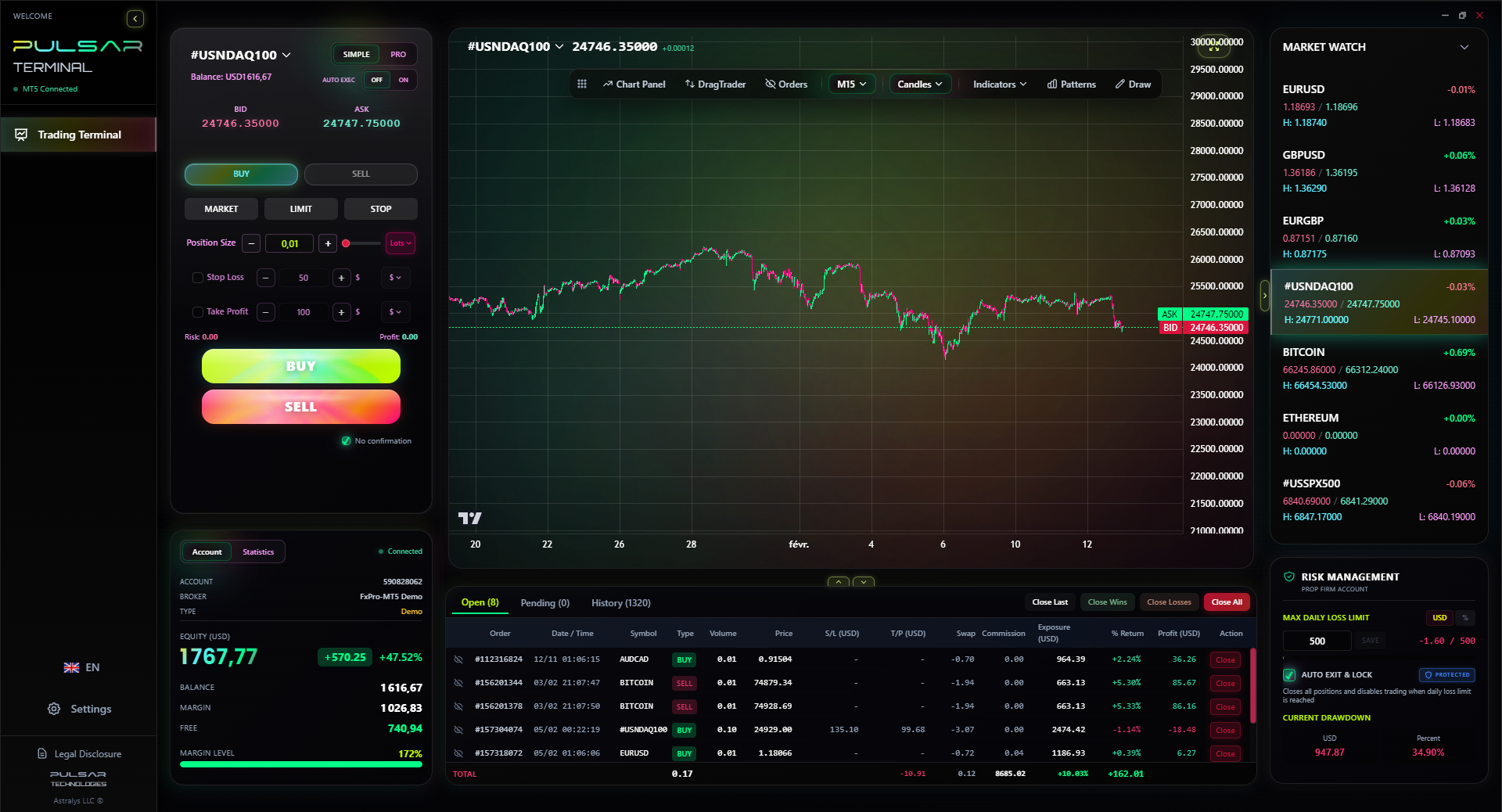
When your strategy relies on precise multi-level exits and automated risk management, a tool that integrates directly with MT5 to handle partial closures and trailing stops can turn a complex plan into a simple, executed order.
Pulsar Terminal
L'outil MT5 tout-en-un : ordres glisser-déposer, multi-TP/SL, trailing stop, grid trading, Volume Profile et protection prop firm. Utilisé quotidiennement par 1 000+ traders.
You don't 'find' a winning strategy. You build one through brutal honesty and repetition.
Step 1: Define Everything. Your strategy must answer these questions with absolute clarity:
- Market Condition: Do I trade trends, ranges, or breakouts?
- Timeframe: Am I a 4-hour chart swing trader or a 5-minute scalper?
- Entry Trigger: What exact candle pattern, indicator crossover, or price level tells me to enter? (e.g., 'Buy when price pulls back to the 20 EMA in an uptrend and the RSI indicator is above 40.')
- Stop Loss: Where does it go, exactly? (e.g., '20 pips below the entry candle's low.')
- Take Profit: Is it a fixed risk-reward (e.g., 1:2)? Or do I trail it?
Step 2: Backtest. Go back on your charts, a year or more. Go through candle by candle, and paper trade your strategy rules. Write down every result. Don't skip the losing trades. This will show you if your idea has an edge, or if you just got lucky a few times.
Step 3: Forward Test (Demo). Trade it on a demo account for at least 2-3 months, or 50 trades. Treat the demo money like real money. This tests your execution and emotional discipline.
Step 4: Go Live Small. When you have a statistically positive demo result, go live with the smallest possible capital. Your psychology changes with real money. You'll make mistakes. It's better to make a R100 mistake than a R10,000 mistake.
Your strategy is a set of rules to protect you from yourself. The market is chaotic. Your process must be rigid.
“Boring, in trading, is beautiful.”
Let's talk about the traps. I've fallen into every one of these.
Pitfall 1: Overtrading. This is the killer. No clear setup? Stay out. The market will always be there tomorrow. Boredom is not a trading signal. I used to trade 10-15 times a week, forcing setups. My best months now come from 3-5 high-quality trades.
Pitfall 2: Revenge Trading. You take a loss. You're angry. You jump right back in with a bigger position to 'make it back.' This is how accounts blow up. After a loss, close the platform. Go for a walk. Your job is to protect your capital, not your ego.
Pitfall 3: Ignoring the Macro. As a South African trading ZAR pairs, you can't just look at the charts. If SARB is hiking rates while the Fed is cutting, that's a fundamental tailwind for the ZAR. A beautiful technical setup against that fundamental tide will fail more often than not.
Pitfall 4: Chasing 'Hot Tips' or Signals. If you're paying someone else for trade signals, you've already failed. You are outsourcing your brain. You won't understand the risk, you won't know when to exit, and you'll blame them when it goes wrong. Build your own competence.
Pitfall 5: Neglecting the Spread. Entering and exiting a scalping strategy on USD/ZAR that aims for 10-pip profits when the spread is 40 pips is mathematically impossible to win at over time. Your strategy must account for the cost of doing business.
The common thread in all pitfalls? Emotion and a lack of a plan. Your pre-defined forex strategies and resources (your rules, your journal, your calculator) are the antidote.
💡 Conseil de Winston
Your two most important orders are placed before you enter the trade: the stop loss and the take profit. Everything else is just watching.
Success is built on routine, not inspiration. Here's what a professional day looks like.
Pre-Market (30 mins):
- Check the economic calendar. What's due today? SARB speech? US CPI? Note the times.
- Do a top-down analysis. Look at the daily charts of your 2-3 favorite pairs (maybe EUR/USD, USD/ZAR, and XAU/USD). What's the overall trend? Where are the key levels?
- Have a market bias, but no trade yet. 'USD looks strong, EUR/USD is approaching daily support at 1.0700.'
Trading Session:
- Switch to your preferred timeframe (e.g., 4-hour).
- Wait. This is the hardest part. Wait for price to come to your pre-identified level.
- If your setup triggers, calculate your position size based on your 1% risk and the distance to your stop loss. Place the trade, set your stop and target. Walk away.
- If no setup forms, do nothing. 'No trade' is a valid outcome for the day.
Post-Market (15 mins):
- Update your trading journal. Log every detail of any trade placed.
- Review any open trades. Do they still fit your thesis? If yes, ignore them. Don't micromanage.
- Mentally reset. The market is closed. Go live your life.
This routine removes emotion. It turns trading from a rollercoaster into a business. It's boring. And boring, in trading, is beautiful.
FAQ
Q1Is forex trading legal and safe in South Africa?
Yes, it's legal and regulated by the FSCA. It's 'safe' only if you use an FSCA-licensed broker, which ensures client fund segregation and fair conduct. The trading itself is high-risk, with most retail traders losing money. Safety comes from your knowledge and risk management, not just regulation.
Q2What is the best forex trading strategy for beginners in South Africa?
Start with simple price action swing trading on the 4-hour or daily charts. Avoid scalping, especially on ZAR pairs, due to wide spreads. Focus on one or two major pairs like EUR/USD first, where spreads are tight and information is plentiful. Master identifying support/resistance and placing stop losses before adding complexity.
Q3How much money do I need to start forex trading in South Africa?
You can start with a few hundred rands on a micro account, but realistically, you need enough to practice proper position sizing. A R5,000 - R10,000 demo account is perfect for learning. For a live account, start with an amount you can afford to lose completely - R2,000 to R5,000 - and use the FSCA's 30:1 use limit responsibly, or even use less (10:1).
Q4How are forex trading profits taxed in South Africa?
SARS views consistent trading profits as income from a business or speculative transactions, making it taxable. You must declare this income on your annual tax return. Keep careful records of all trades, deposits, and withdrawals. It's wise to consult with a tax professional who understands trading income.
Q5Can I use international brokers, or must I use a South African one?
You can use international brokers, but it is highly recommended to use one that is FSCA-licensed. This gives you local regulatory protection and simplifies deposits/withdrawals in Rands. Funding an unregulated international broker with large amounts requires SARB approval and can be a bureaucratic headache.
Q6What moves the South African Rand (ZAR) the most?
The biggest drivers are: 1) SARB interest rate decisions, 2) US Federal Reserve policy and USD strength, 3) Global commodity prices (gold, platinum), as SA is an exporter, and 4) Local political and economic risk sentiment (e.g., load-shedding, fiscal policy). A trader ignoring these fundamentals is flying blind.
Q7Why do most retail forex traders lose money?
The main reasons are a lack of a tested strategy, poor risk management (risking too much per trade), emotional trading (overtrading, revenge trading), and not accounting for the true costs of trading (spreads, commissions). They treat it like gambling, not a skilled profession requiring discipline and a business plan.
La leçon du Prof. Winston
Points clés:
- ✓Never risk more than 1% of capital per trade
- ✓FSCA regulation is a layer of safety, not a guarantee
- ✓Account for the spread, especially on ZAR pairs (30-50 pips)
- ✓Tax your profits; SARS will find them if you don't
- ✓A trading journal is your most valuable resource
Cet article vous a-t-il été utile ?
Cliquez sur une étoile
Analyses Trading Hebdo
Analyses et stratégies hebdo gratuites. Pas de spam.
À propos de l'auteur
David van der Merwe
Trader des Marchés Émergents
Trader basé à Johannesbourg avec 11 ans d'expérience sur les devises des marchés émergents. Spécialisé dans les paires ZAR, le trading régulé par la FSCA et l'analyse du marché sud-africain.
Commentaires
Avertissement sur les risques
Le trading d'instruments financiers comporte des risques importants et peut ne pas convenir à tous les investisseurs. Les performances passées ne garantissent pas les résultats futurs. Ce contenu est fourni à titre éducatif uniquement et ne constitue pas un conseil en investissement. Effectuez toujours vos propres recherches avant de trader.
Vous aimerez aussi

Cara Trading Forex Sukses: 7 Prinsip dari Trader Profesional
Cara trading forex sukses dengan 7 prinsip trader pro: manajemen modal, disiplin, journal trading, backtest. Data nyata, bukan janji profit palsu.
Jam Trading Forex Terbaik untuk Trader Indonesia: Panduan Lengkap dengan Tabel Waktu
Panduan jam trading forex untuk trader Indonesia. Tabel 4 sesi dunia, jam emas 20:00-00:00, sesi mana yang harus dihindari. Data akurat + tips dari trader berpengalaman.
Top 5 Sàn Forex Uy Tín Nhất 2026: Review Jujur dari Trader Indonesia
Top 5 sàn forex uy tín 2026 untuk trader Indonesia. Review jujur: spread, deposit, withdraw, dukungan lokal. Exness, XM, IC Markets & lebih.
Obtenir Pulsar Terminal
Tous ces calculateurs sont intégrés dans Pulsar Terminal avec des données en temps réel de votre compte MT5. Dimensionnement de position en un clic, gestion automatique des risques et calculs instantanés.
Obtenir Pulsar Terminal