


So, you made some money trading forex last year.

James Mitchell
Analyste Trading Senior
☕ 10 min de lecture
Ce que vous apprendrez :
So, you made some money trading forex last year. Congrats. Now, how much of that are you actually going to keep after the IRS takes its cut? If you're like most traders I've talked to, the whole topic of forex taxes feels like a confusing mess. Is it capital gains? Is it income? What's this 'Section 1256 election' everyone whispers about? Don't worry, we're going to sort it out. I've been through the audit process myself (not fun), and I'll walk you through exactly how the US tax code treats your trading profits, the big decision you need to make, and the common traps that can cost you real money.
This is the core of US forex taxation. The IRS basically gives you two different paths, and the one you choose (or get stuck with by default) has a massive impact on your final tax bill.
Section 988: The Default (And Usually Worse) Path This is where most retail spot forex traders land if they don't do anything. Think of trading EUR/USD on your typical MT5 platform from a broker like Exness or IC Markets. Under Section 988, every single pip of profit is treated as ordinary income. That means it gets stacked on top of your salary or other income and taxed at your marginal rate. For 2025, those rates range from 10% all the way up to 37%. The upside? Losses are also ordinary, so you can deduct them directly against your other income, which can be a lifesaver in a bad year.
Section 1256: The Election That Can Save You Money This is the secret sauce for many profitable traders. It's technically for regulated futures, but spot forex traders can 'elect' into it. Here's the magic: 60% of your net gain is treated as a long-term capital gain (taxed at lower rates, max 20%), and 40% is treated as short-term (taxed at your ordinary rate). This creates a blended tax rate that's almost always lower than your top ordinary rate.
Let me give you a real number from my own books. In 2022, I had a net trading profit of $85,000. My ordinary income tax bracket was 32%. Under Section 988, my tax would have been $27,200. By making the Section 1256 election, my blended effective rate was about 23.2%. My tax bill? $19,720. That's a $7,480 difference for filling out one extra form. You can see why this matters.

Warning: The Section 1256 election is a formal, year-long commitment. You can't pick and choose trades. It's all or nothing for your spot forex activity for the entire tax year. You need to document this election in your records before the tax year starts or before your first trade.

💡 Conseil de Winston
The Section 1256 election is a no-brainer for consistently profitable traders. The tax savings compound year after year, effectively increasing your annual return. Document the election in your trading journal on January 1st.
“Under Section 988, my tax would have been $27,200. By making the Section 1256 election, my tax bill was $19,720. That's a $7,480 difference for filling out one extra form.”
Alright, you've chosen your path. Now, how do you tell the IRS? Your broker's annual statement is your starting point, but it's rarely the final answer.
Broker Statements & The FIFO Problem Most brokers, including international ones like XM or Pepperstone, will give you an annual summary. However, the IRS requires you to match your trades using the First-In, First-Out (FIFO) method. Your broker's platform might use a different accounting method (like specific identification if you manually close tickets). This mismatch means you often can't just copy the P&L number from your broker's yearly statement onto your tax return. You have to recalculate it using FIFO. I learned this the hard way early on. My MT4 statement said I made $12,500, but after applying FIFO to my trade history, the real taxable gain was $14,100. That's a discrepancy you do not want the IRS to find.
The Forms You'll Actually Use
- For Section 988 (Ordinary Income): You report your net forex gain or loss on Schedule 1 (Form 1040), Line 8z, as 'Other Income.' It's pretty straightforward, but remember, that number needs to be your FIFO-calculated net.
- For Section 1256 (60/40 Treatment): This is a two-step process. First, you fill out Form 6781, 'Gains and Losses From Section 1256 Contracts and Straddles.' This is where you put your total net gain/loss. The form then splits it into the 60% long-term and 40% short-term portions. Those numbers flow to Schedule D (Capital Gains and Losses).

Pro Tip: Use a dedicated trade journaling software or a simple spreadsheet from day one. Log every entry and exit with date, price, and lot size. At year-end, applying FIFO becomes a sortable spreadsheet task instead of a nightmare. This record is also your proof if you get questioned.
“The wash sale rule, which cripples stock traders, generally does not apply to spot forex. It's a rare tax advantage we actually get.”
The tax code has some specific quirks for forex that are different from stocks.
The Wash Sale Rule Doesn't Apply (Usually)
This is a huge one. In the stock market, if you sell a stock for a loss and buy it back within 30 days, you can't claim the loss (a 'wash sale'). For spot forex transactions, this rule generally does not apply. You can take a loss on a EUR/USD trade and immediately re-enter the market without worrying about disallowed losses. This gives you more flexibility in your trade management and tax planning. However, be careful: this exception is for spot forex. If you're trading forex futures or options, different rules may apply.
The Mark-to-Market Election (For Active Traders)
Are you trading full-time? You might qualify as a 'trader in securities' for tax purposes. If so, you can make a Mark-to-Market (MTM) election (IRC Section 475(f)). This is a whole other level. It lets you treat all your positions as if they were sold at fair market value on the last day of the year. All gains and losses become ordinary. Why would you want this? It eliminates the $3,000 annual capital loss deduction limit and gets rid of wash sale rules entirely. But it's complex, irrevocable without IRS consent, and best done with a pro. I tried to DIY this early in my career and created a filing mess that took two years to clean up.
Foreign Account Reporting (FBAR & FATCA)
This catches a lot of people off guard. If you have an account with a non-US broker (like many popular offshore brokers), and the total value of all your foreign financial accounts exceeded $10,000 at any point in the year, you must file an FBAR (FinCEN Form 114). It's separate from your tax return. Failure to file can result in penalties that make any trading loss look like a rounding error. It's not a tax, it's a report. But ignore it at your peril.
💡 Conseil de Winston
Your broker's annual P&L is a suggestion, not gospel. The IRS requires FIFO accounting. The time you spend reconciling your own trade history is the best audit insurance you can buy.
“Prop firm payouts feel like capital gains, but the IRS sees them as self-employment income. That extra 15.3% tax is a brutal surprise if you're not ready for it.”
Your trading profits aren't the only thing getting taxed.
Proprietary Trading Firm Payouts When you pass a challenge and get a funded account, that first payout is sweet. Remember, it's not a capital gain. Prop firms typically treat you as an independent contractor. Your profit split will come with a Form 1099-NEC. This is reported as self-employment income on Schedule C. Here's the kicker: you now owe self-employment tax on top of income tax. That's an extra 15.3% for Social Security and Medicare. You can deduct business expenses (part of your home office, trading software, education), but the SE tax is a real cost. Your first $5k payout might feel like $3,800 after taxes.
Other Taxable Items
- Swap/Interest Charges: The overnight financing fees (swaps) you pay or receive are generally treated as ordinary income or expense.
- Bonuses & Deposits: That '$500 welcome bonus' from a broker? It's taxable income in the year you receive it, even if you can't withdraw it yet.
- Education & Software: These are potentially deductible business expenses if you're trading as a business, not just a hobby. Keep those receipts.
“Prop firm payouts feel like capital gains, but the IRS sees them as self-employment income. That extra 15.3% tax is a brutal surprise if you're not ready for it.”
Treat tax prep as a year-round part of your trading plan. Here’s what I do every quarter.
- Organize Your Records Now: Don't wait for the broker statement. Export your trade history every month. I use a simple Google Sheet with columns for: Date, Pair, Action (Buy/Sell), Price, Size, Close Date, Close Price, P&L. This makes FIFO calculation a breeze later.
- Reconcile with Your Broker: In January, when your broker's annual statement arrives, compare its totals to your FIFO-calculated totals. Identify and understand any differences (often due to how swaps are reported or partial closes).
- Decide on Your Election (By Dec. 31): Have you decided on the Section 1256 election for the upcoming year? You need to make that choice and document it in your records before January 1st. Write it down. "I, [Your Name], elect to treat my forex transactions under IRC Section 1256 for the tax year 2026." Put it with your tax files.
- Calculate Your Estimated Taxes: If you expect to owe more than $1,000 in tax for the year, you likely need to make quarterly estimated tax payments (Form 1040-ES). A big tax bill in April can come with underpayment penalties. I set aside 25-30% of every profitable withdrawal into a separate savings account just for taxes. Use a good position size calculator to understand your risk, and use a similar discipline for your tax savings.
- Consult a Professional (At Least Once): I'm a big DIY guy, but forex taxes are one area where a good CPA who understands trading is worth every penny. Have them review your setup, especially if you're using the Section 1256 election or thinking about Mark-to-Market. They can spot issues you'd never see.
💡 Conseil de Winston
Set up a separate, high-yield savings account and nickname it 'IRS'. Automatically transfer 30% of every single trading withdrawal into it. When tax day comes, you'll be relieved, not panicked.
“Filing an incorrect number from your broker's statement is an open invitation for an audit. Always recalculate using FIFO.”
Let's be honest, we all learn from errors. Here are the big tax blunders I've seen (or made).
Mistake 1: Ignoring the Election. For years, I just took the default Section 988 treatment because I didn't understand the alternative. I probably overpaid by tens of thousands of dollars in my early, profitable years. It's the single most expensive financial mistake of my trading career.
Mistake 2: Trusting the Broker's P&L Blindly. As I mentioned earlier, the broker's annual profit number is often wrong for IRS purposes. Filing an incorrect number is an invitation for an audit. Always recalculate using FIFO.
Mistake 3: Mixing Personal and Trading Funds. This makes tracking a nightmare and can jeopardize your ability to claim trading as a business for deduction purposes. Open a separate bank account used solely for funding your broker account and receiving withdrawals.
Mistake 4: Forgetting About State Taxes. The IRS isn't the only one who wants a piece. Most states also tax income, and they have their own rules about sourcing income. Your state might not recognize the Section 1256 election the same way, or it might tax capital gains as ordinary income. This is another area where a local CPA is crucial.
Mistake 5: Poor Record-Keeping. An audit is stressful. An audit where you have shoeboxes full of unorganized trade confirmations is a special kind of hell. Good records are your best defense. A tool that helps you manage and review trades efficiently, like a trading journal or a platform add-on that clarifies your trade history, is a tax-deductible investment in your sanity.
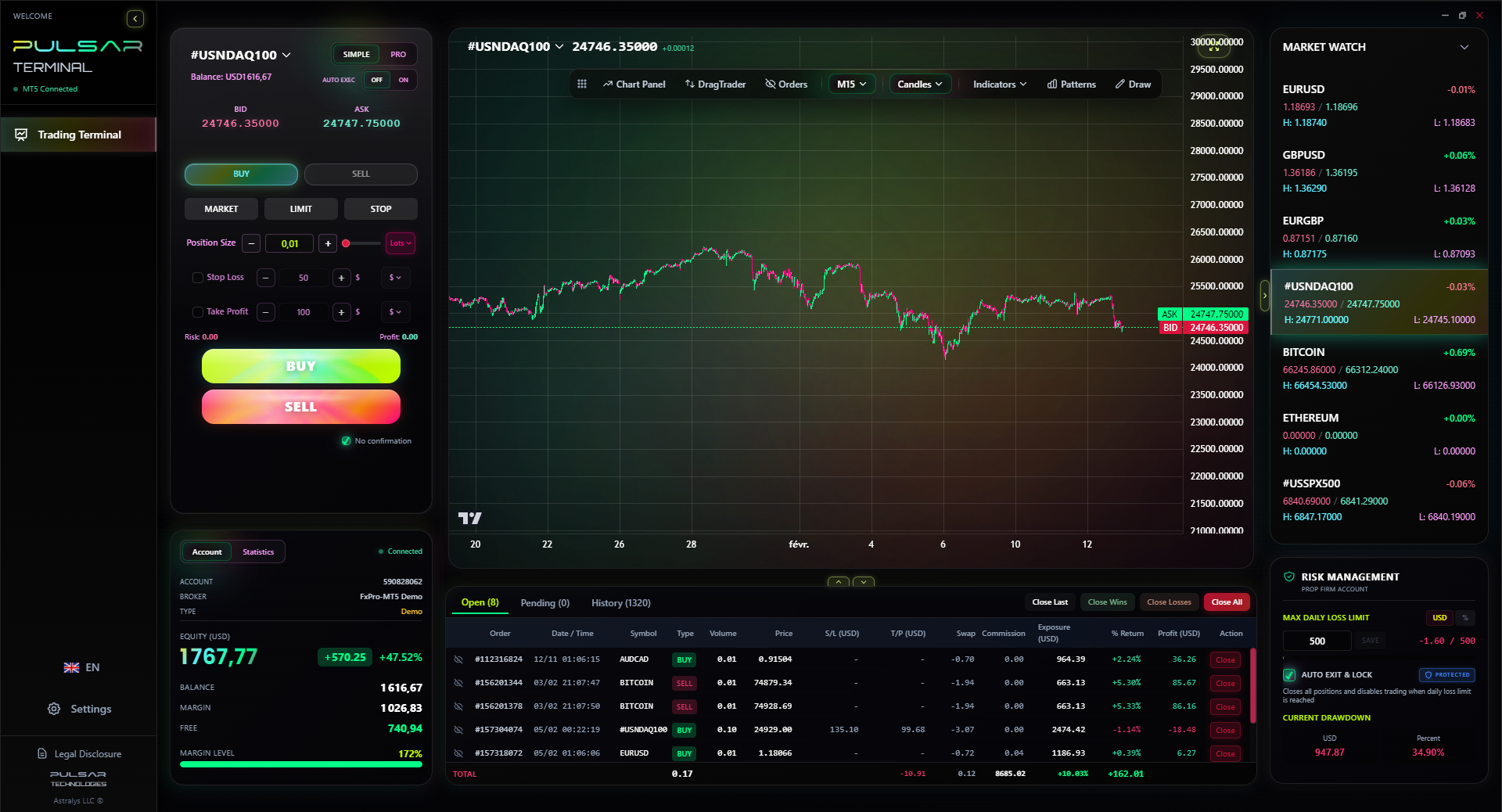
Accurate tax reporting starts with clear trade records, and tools like Pulsar Terminal help you manage and review complex trade history directly on your MT5 platform.
Pulsar Terminal
L'outil MT5 tout-en-un : ordres glisser-déposer, multi-TP/SL, trailing stop, grid trading, Volume Profile et protection prop firm. Utilisé quotidiennement par 1 000+ traders.
FAQ
Q1Do I have to pay taxes on forex trading if I lose money?
You still have to report your trading activity, even with a net loss. The good news is, that loss can be used to reduce your tax bill. Under Section 988, it deducts directly from your other income. Under Section 1256, it can offset capital gains and, with limits, other income.
Q2How does the IRS know about my forex trading?
US-regulated brokers issue tax forms (like 1099-B). For foreign brokers, the IRS receives information through international agreements (FATCA). Also, large withdrawals into your US bank account can trigger reporting. It's safer to assume they know and report accurately.
Q3Can I use trading losses to get a tax refund?
Yes, but with limits. If your net trading loss (combined with other capital losses) exceeds your gains, you can deduct up to $3,000 against your ordinary income (like wages) each year. Any remaining loss carries forward to future years. Under Section 988, losses are ordinary and not subject to the $3,000 limit, offering a bigger immediate benefit in a losing year.
Q4What's the deadline for making the Section 1256 election?
You must make the election by the due date (including extensions) of your tax return for the year before the election takes effect. Practically, to have it apply for 2026, you need to document it in your records by December 31, 2025. It's not a form you file, it's a statement you keep.
Q5Are spreads and commissions tax deductible?
Yes. The cost of the trade (the spread, any explicit commission) is factored into your gain or loss calculation. You don't deduct it separately; it's built into your entry/exit price difference. Other costs like software subscriptions or education may be deductible as business expenses if you qualify as a trader.
Q6I trade from a prop firm account. How are those profits taxed?
Prop firm payouts are typically reported as self-employment income on a 1099-NEC. You'll pay both income tax and self-employment tax (about 15.3%) on that income. Report it on Schedule C (Form 1040), where you can also deduct related expenses.
Q7What happens if I don't report my forex income?
You risk penalties, interest on unpaid taxes, and in severe cases, criminal prosecution for tax evasion. The IRS can also assess a 'fraud penalty' of 75% of the underpaid tax. It's never worth the risk. The peace of mind from filing correctly is cheaper than the alternative.
La leçon du Prof. Winston
Points clés:
- ✓Elect Section 1256 to cap your max tax rate at ~26.8%, not 37%.
- ✓Always recalculate P&L using FIFO, not your broker's summary.
- ✓Set aside 30% of profits for taxes in a separate account.
- ✓Prop firm income is subject to 15.3% self-employment tax.
- ✓The forex wash sale rule advantage is a key strategic benefit.
Cet article vous a-t-il été utile ?
Cliquez sur une étoile
Analyses Trading Hebdo
Analyses et stratégies hebdo gratuites. Pas de spam.
À propos de l'auteur
James Mitchell
Analyste Trading Senior
Basé à New York avec plus de 9 ans d'expérience en trading. Spécialisé dans les paires USD majeures, les challenges de prop firms et la réglementation financière américaine.
Commentaires
Avertissement sur les risques
Le trading d'instruments financiers comporte des risques importants et peut ne pas convenir à tous les investisseurs. Les performances passées ne garantissent pas les résultats futurs. Ce contenu est fourni à titre éducatif uniquement et ne constitue pas un conseil en investissement. Effectuez toujours vos propres recherches avant de trader.
Vous aimerez aussi

Cara Trading Forex Sukses: 7 Prinsip dari Trader Profesional
Cara trading forex sukses dengan 7 prinsip trader pro: manajemen modal, disiplin, journal trading, backtest. Data nyata, bukan janji profit palsu.
Jam Trading Forex Terbaik untuk Trader Indonesia: Panduan Lengkap dengan Tabel Waktu
Panduan jam trading forex untuk trader Indonesia. Tabel 4 sesi dunia, jam emas 20:00-00:00, sesi mana yang harus dihindari. Data akurat + tips dari trader berpengalaman.
Top 5 Sàn Forex Uy Tín Nhất 2026: Review Jujur dari Trader Indonesia
Top 5 sàn forex uy tín 2026 untuk trader Indonesia. Review jujur: spread, deposit, withdraw, dukungan lokal. Exness, XM, IC Markets & lebih.
Obtenir Pulsar Terminal
Tous ces calculateurs sont intégrés dans Pulsar Terminal avec des données en temps réel de votre compte MT5. Dimensionnement de position en un clic, gestion automatique des risques et calculs instantanés.
Obtenir Pulsar Terminal