


You're staring at a chart, lines and candles everywhere, and you're thinking, 'What am I actually supposed to be looking for?' I get it.

David van der Merwe
Trader des Marchés Émergents ·  South Africa
☕ 9 min de lecture
Ce que vous apprendrez :
You're staring at a chart, lines and candles everywhere, and you're thinking, 'What am I actually supposed to be looking for?' I get it. When I started, I felt the same way. A proper forex technical summary isn't about memorizing every single pattern. It's about building a simple, repeatable system you can trust with your hard-earned Rand. Let's break down what really matters, from the basics to the advanced stuff, and cut through the noise.
Forget the textbook definitions. Technical analysis is just the study of price action and volume to forecast future direction. It's based on one core idea: history tends to repeat itself because market psychology is pretty consistent. Fear and greed look the same on a chart from 2010 as they do today.
In South Africa, this is especially useful. We're often trading the ZAR pairs (like USD/ZAR or EUR/ZAR) against major global flows. Technicals give you a framework to understand those movements without needing a PhD in global macroeconomics. It's your map in a chaotic market.
I made a classic mistake early on. I'd see a textbook 'head and shoulders' pattern, jump in, and then watch the trade go against me. Why? I was looking at the pattern in isolation. I didn't check if the price was near a key support level, or what the overall trend was. A pattern alone is just a pretty picture. The context is what makes it tradable.

Warning: Technical analysis is not a crystal ball. It's a tool for assessing probabilities, not certainties. Never risk money on a single indicator or pattern. Always look for confluence.
“A proper forex technical summary isn't about memorizing every single pattern. It's about building a simple, repeatable system you can trust.”
You don't need to know 50 patterns. Master these five, and you'll be ahead of 90% of beginners.
1. Support and Resistance: This is the foundation. Support is where buying interest tends to come in (price bounces up). Resistance is where selling interest appears (price falls back). Draw these as horizontal lines where the price has reversed multiple times. USD/ZAR loves to find support and resistance at big, round numbers like R18.50 or R19.00.
2. Trend Lines: Connect a series of higher lows in an uptrend or lower highs in a downtrend. A break of a strong trend line often signals a potential trend change. Simple, but powerful.
3. Double Top/Bottom: A reversal pattern. A double top looks like an 'M' and suggests a move from up to down after the second peak fails. A double bottom looks like a 'W' and signals a move from down to up. I caught a beautiful double bottom on Gold (XAU/USD) in late 2022 around $1615. The second bounce held, I entered, and rode it up to $1780. That was a good month.
4. Head and Shoulders (and Inverse): Another major reversal pattern. The 'head' is the highest peak, with two lower 'shoulders' on either side. The neckline is the key. A break below it confirms the pattern. The inverse pattern signals a bullish reversal.
5. Triangles (Ascending, Descending, Symmetrical): These are continuation patterns, meaning the price typically breaks out in the direction of the prior trend. They show a period of consolidation before the next big move.

Pro Tip: Don't force patterns. If it doesn't look clear, it probably isn't a valid pattern. Wait for the price to confirm the breakout with a strong candle closing beyond the pattern's boundary.

💡 Conseil de Winston
A chart is a record of mass psychology. Your job isn't to predict the future, but to read the crowd's current emotional state and bet on it continuing or exhausting itself.
“I made a classic mistake early on. I'd see a textbook 'head and shoulders' pattern, jump in, and then watch the trade go against me. Why? I was looking at the pattern in isolation.”
Indicators are just math applied to past price. They lag. The goal is to use one or two to confirm what the price action is already telling you. Here's my stripped-down toolkit.
Trend-Following: The Moving Average
The 50-period and 200-period Exponential Moving Average (EMA) are my go-tos. I use them on the 4-hour and daily charts for swing trading. If the price is above the 50 EMA and the 50 is above the 200, the trend is likely up. It's a filter. I don't buy in a strong downtrend just because the RSI indicator is oversold.
Momentum: The RSI
The Relative Strength Index (RSI) measures the speed of price movement. Readings above 70 suggest overbought, below 30 oversold. The key? Use it for divergences. If the price makes a new high but the RSI makes a lower high, that's a bearish divergence and a potential warning the uptrend is weakening. This saved me on a EUR/USD trade last year. Price crept higher, but RSI was flatlining. I got out at 1.0950, just before it dropped 150 pips.
The MACD
The MACD indicator is a combo tool. It shows trend direction, momentum, and potential changes. Look for the MACD line (blue) to cross above the signal line (orange) for a buy signal, and below for a sell signal. Also, watch where it is relative to the zero line. A cross above zero can confirm a new uptrend.
My chart setup is clean: Candlesticks, a 50 EMA, the 200 EMA, and the RSI. That's it. Clutter leads to confusion and paralysis.

Example: On a USD/ZAR daily chart, price pulls back to the rising 50 EMA while the RSI dips to 45 (not oversold). That's a potential trend-continuation buy setup, not a reversal signal. The indicators confirm the healthy trend.
“I made a classic mistake early on. I'd see a textbook 'head and shoulders' pattern, jump in, and then watch the trade go against me. Why? I was looking at the pattern in isolation.”
This is where your forex technical summary becomes a real trading plan. Let's walk through an example.
Step 1: Identify the Higher Timeframe Trend. Open the daily chart. Is USD/ZAR above its 200 EMA? If yes, the long-term bias is up. We only look for buys or wait.
Step 2: Find a Setup on a Lower Timeframe. Switch to the 4-hour chart. We want the price to be pulling back towards a support level, which could be a previous swing low, the 50 EMA, or a horizontal support line.
Step 3: Look for Confluence. At that support level, does a bullish candlestick pattern form (like a hammer or bullish engulfing)? Is the RSI bouncing from near 40-50 (showing momentum is recovering in an uptrend)? That's confluence.
Step 4: Define Your Risk. Where is the trade wrong? That's your stop-loss. It should be placed just below the support level you're trading from. Let's say that's 50 pips away.
Step 5: Calculate Your Position Size. This is non-negotiable. If your account is R20,000 and you only risk 1% per trade, your max risk is R200. With a 50-pip stop, each pip on USD/ZAR is worth about R1 per standard lot (check your broker's specs). So, you can only trade a mini lot (0.1) where 1 pip = ~R0.80. This keeps you alive. Use a position size calculator every single time.
Step 6: Set a Take-Profit. Aim for a risk-to-reward ratio of at least 1:2. If you risk 50 pips, your first profit target should be +100 pips away, perhaps at the next resistance level.
That's the framework. It's boring. It's repetitive. And it works.
💡 Conseil de Winston
The most reliable 'indicator' is price action at a clear horizontal support or resistance level. Everything else is just commentary.
“Your initial stop-loss is sacred. If you're wrong, you're wrong. Take the small loss.”
Trading ZAR pairs adds a local flavour. The USD/ZAR, EUR/ZAR, and GBP/ZAR are highly liquid but can be volatile, especially during local political announcements or SARB interest rate decisions.
Spreads Matter More: On exotic pairs like ZAR crosses, spreads are wider. A 15-pip spread on USD/ZAR is normal. That means your trade starts 15 pips in the red. You must factor this into your risk. A scalping strategy on these pairs is very difficult and expensive. Swing trading is better suited.
Broker Choice is Critical: You need a broker with tight spreads and reliable execution. I've used both local FSCA brokers and international ones like IC Markets and Pepperstone. The key is regulation and cost. Since the FSCA capped use at 30:1 for retail traders, that's your max with a locally licensed broker. Some international brokers might offer more, but remember, higher use is a double-edged sword that can lead to a margin call faster.
Costs: Beyond the spread, know your costs. Overnight swap rates can be significant on ZAR pairs. If you're holding a sell position on USD/ZAR (earning the ZAR interest), you might get a positive swap. Holding a buy could cost you daily. Check your broker's swap sheet.
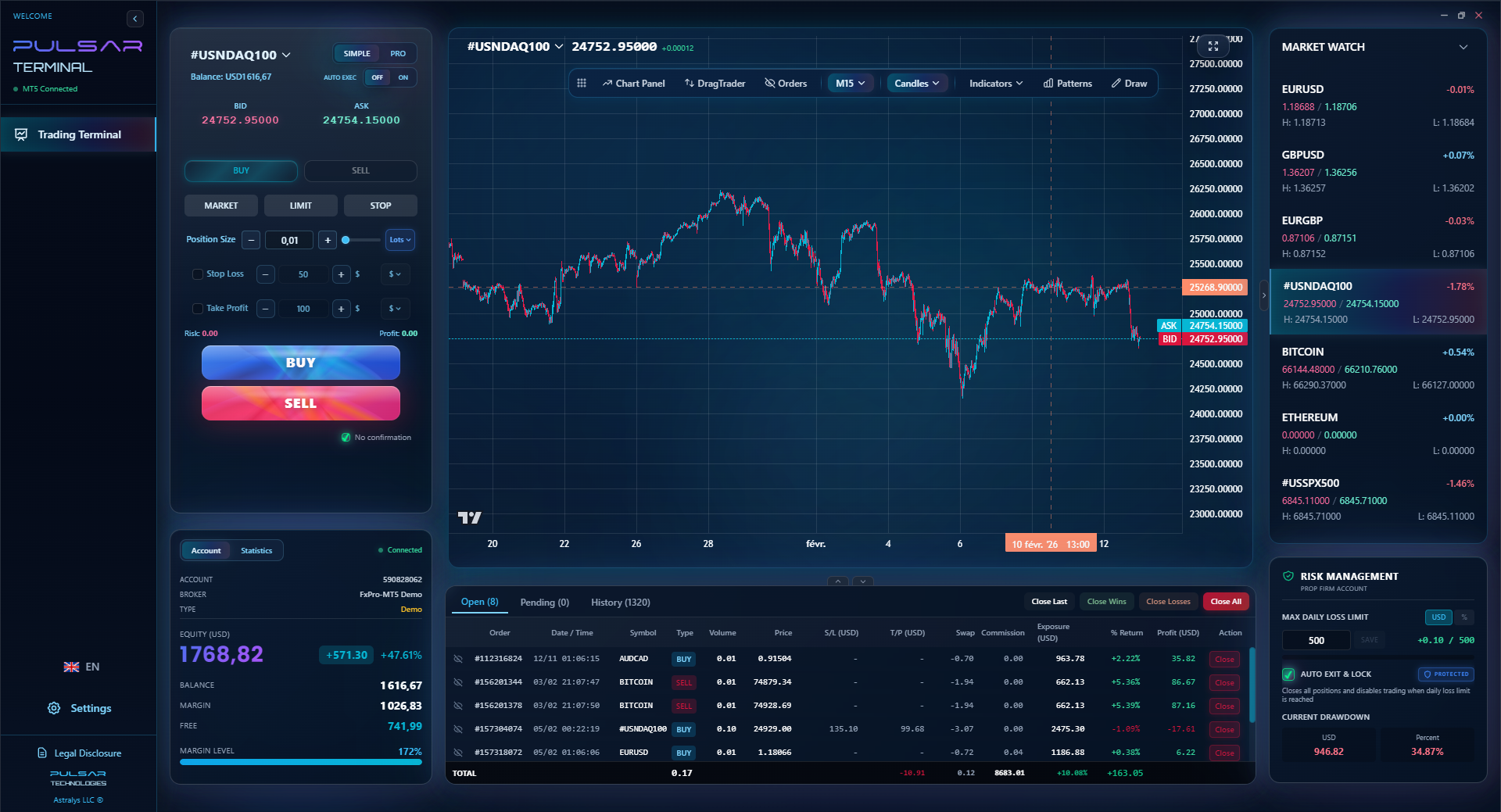
Managing multiple trades and complex stop-loss strategies by hand is error-prone; Pulsar Terminal automates trailing stops, breakeven moves, and multi-level take-profits directly on your MT5 platform.
Pulsar Terminal
L'outil MT5 tout-en-un : ordres glisser-déposer, multi-TP/SL, trailing stop, grid trading, Volume Profile et protection prop firm. Utilisé quotidiennement par 1 000+ traders.
“Your initial stop-loss is sacred. If you're wrong, you're wrong. Take the small loss.”
Let's get real. I've blown up an account. Here's how.
1. Overcomplicating Everything: I once had 12 indicators on my screen. They all gave different signals. I was frozen. Simplify.
2. Ignoring the Trend: I tried to pick the top in a raging EUR/USD bull market in 2017 because the RSI was 'overbought' for weeks. I lost 2% of my account on three separate counter-trend trades before I finally stepped away. The trend is your friend until it ends.
3. Moving Stops: I entered a GBP/ZAR trade, set a 30-pip stop. It went against me by 25 pips. I 'widened' my stop to 50 pips 'to give it room.' It hit my new stop. I broke my own rule and lost more than planned. Your initial stop-loss is sacred. If you're wrong, you're wrong. Take the small loss.
4. Not Accounting for Spread: On a volatile day, I entered a USD/ZAR trade with a 10-pip profit target. The spread was 12 pips. Even if I was right on direction, I couldn't win. Know your broker's typical spread for the pair and time of day you're trading.
5. Trading Without a Plan: Clicking buttons because you're bored or want to 'make back' a loss. That's gambling, not trading. Have a written plan for every single entry.
💡 Conseil de Winston
If you can't immediately see the trend on a daily chart, there isn't one. Stand aside. Trading confused markets is a sure way to donate your capital.
“With R5,000, risking 1% (R50) per trade with sensible stop-losses, you can actually practice a strategy without being wiped out by two bad trades.”
Consistency beats genius every time. Here's a 20-minute routine.
- Scan the Big Picture (5 mins): Open the daily charts of your 3-5 favorite pairs. Note where price is relative to the 200 and 50 EMA. What's the overall trend? Draw key horizontal support/resistance lines.
- Look for Setups (10 mins): Go to the 4-hour chart. Are there any clear patterns (triangle, double top/bottom) forming near key levels? Is there a pullback to a moving average in a trend?
- Check the Calendar (2 mins): Any major economic news (SA CPI, US Non-Farm Payrolls) due in the next 24 hours? High-impact news can blow through all technical levels. Maybe you avoid entering just before it.
- Plan Your Trades (3 mins): If you see a setup, write it down. 'Buy USD/ZAR if it bounces off 18.30 support with a bullish candle. SL: 18.25. TP1: 18.45.' If no setup, your plan is to do nothing. That's a valid plan.
This routine removes emotion. You're just following a checklist.
FAQ
Q1Is technical analysis enough for forex trading in South Africa?
It's the core of my entry and exit strategy, but it's not everything. You must combine it with solid risk management (position sizing, stop-losses) and an awareness of major South African and global economic events. A perfect head and shoulders pattern can be obliterated by a surprise SARB interest rate decision. Use technicals for your trading plan, but keep one eye on the news.
Q2What's the best time frame for a beginner to start with?
Start with the 4-hour chart. It's slow enough to avoid market noise and the stress of scalping, but fast enough to see setups develop over days, not weeks. Use the daily chart to determine the trend direction, and the 4-hour to find your entry. Avoid the 1-minute and 5-minute charts when you're learning; they're a quick way to make and lose money very fast.
Q3How much money do I realistically need to start?
While some brokers like XM or Exness offer micro accounts with deposits as low as R150, that's just to get a feel for the platform. To trade seriously with proper risk management, you need enough capital so that a standard 1-2% risk per trade is a meaningful amount. I'd say a realistic minimum is R5,000. With R5,000, risking 1% (R50) per trade with sensible stop-losses, you can actually practice a strategy without being wiped out by two bad trades.
Q4What's more important, the pattern or the volume?
For most retail forex traders, the pattern. The spot forex market is decentralized, so true volume data is hard to get (what you usually see is 'tick volume'). Focus on price action and pattern formation at key support/resistance levels. The pattern's location gives it context, which is more reliable than volume on a forex chart for us small players.
Q5How do I know if my technical strategy is working?
You need to backtest and keep a trading journal. Don't guess. Take your simple strategy (e.g., 'buy when price bounces off the 50 EMA in an uptrend on the 4H chart') and look at the past 6 months of charts. How often did it work? What was the average win vs. average loss? Then, trade it with tiny size in a demo or live account for at least 20-30 trades. Record every trade: entry, exit, why you took it, your emotional state. The journal will tell you the truth your memory will sugarcoat.
Q6Why do my trades keep getting stopped out before the price moves in my direction?
This is usually one of two things. First, your stop-loss is too tight and placed in a zone of normal market 'noise.' Widen it slightly to give the trade breathing room, but remember to reduce your position size to keep your total risk the same. Second, you might be entering too late, after the move has already happened, and placing your stop just behind the recent swing. Try entering on a pullback instead of a breakout, or wait for a bit more confirmation before jumping in.
La leçon du Prof. Winston
Points clés:
- ✓Master 5 core patterns, not 50.
- ✓Use 1-2 indicators for confirmation only.
- ✓Always define risk before profit (1:2 R:R).
- ✓The 4H chart is the beginner's sweet spot.
- ✓A trading journal is your most important tool.
Cet article vous a-t-il été utile ?
Cliquez sur une étoile
Analyses Trading Hebdo
Analyses et stratégies hebdo gratuites. Pas de spam.
À propos de l'auteur
David van der Merwe
Trader des Marchés Émergents
Trader basé à Johannesbourg avec 11 ans d'expérience sur les devises des marchés émergents. Spécialisé dans les paires ZAR, le trading régulé par la FSCA et l'analyse du marché sud-africain.
Commentaires
Avertissement sur les risques
Le trading d'instruments financiers comporte des risques importants et peut ne pas convenir à tous les investisseurs. Les performances passées ne garantissent pas les résultats futurs. Ce contenu est fourni à titre éducatif uniquement et ne constitue pas un conseil en investissement. Effectuez toujours vos propres recherches avant de trader.
Vous aimerez aussi

Cara Trading Forex Sukses: 7 Prinsip dari Trader Profesional
Cara trading forex sukses dengan 7 prinsip trader pro: manajemen modal, disiplin, journal trading, backtest. Data nyata, bukan janji profit palsu.
Jam Trading Forex Terbaik untuk Trader Indonesia: Panduan Lengkap dengan Tabel Waktu
Panduan jam trading forex untuk trader Indonesia. Tabel 4 sesi dunia, jam emas 20:00-00:00, sesi mana yang harus dihindari. Data akurat + tips dari trader berpengalaman.
Top 5 Sàn Forex Uy Tín Nhất 2026: Review Jujur dari Trader Indonesia
Top 5 sàn forex uy tín 2026 untuk trader Indonesia. Review jujur: spread, deposit, withdraw, dukungan lokal. Exness, XM, IC Markets & lebih.
Obtenir Pulsar Terminal
Tous ces calculateurs sont intégrés dans Pulsar Terminal avec des données en temps réel de votre compte MT5. Dimensionnement de position en un clic, gestion automatique des risques et calculs instantanés.
Obtenir Pulsar Terminal