


Here's a hard truth most 'gurus' in Pretoria won't tell you: over 80% of new traders in South Africa lose their first deposit within six months, often after paying thousands for a course that promised the opposite.

David van der Merwe
Trader des Marchés Émergents ·  South Africa
☕ 11 min de lecture
Ce que vous apprendrez :
- 1What You're Really Paying For: A Rand-by-Rand Breakdown
- 2FSCA Rules & The Scam Epidemic: Protecting Your Wallet
- 3Broker Reality Check: Spreads, Deposits & The ZAR Account
- 4What a Good Course Should Actually Teach You (Beyond the Hype)
- 5MT5, Demo Accounts & Making the Jump to Live
- 6Saving Your Money: Free & Low-Cost Alternatives
- 7Your Action Plan: Choosing a Path Forward
Here's a hard truth most 'gurus' in Pretoria won't tell you: over 80% of new traders in South Africa lose their first deposit within six months, often after paying thousands for a course that promised the opposite. I've seen it happen to mates in Hatfield and Centurion. The market for a forex trading course in Pretoria is a minefield of overpriced promises and outright scams, all while legitimate brokers offer better education for free. This guide cuts through the noise. We'll look at what you're really paying for, how to spot a con, and the actual skills you need to develop - not just in a classroom, but on the charts.
Let's talk numbers. In Pretoria, you'll see course prices that make your eyes water. One local outfit, Forex Masters, charges R15,000 for one-on-one training. That's a serious chunk of change. You can bring a friend and get it down to R12,000 each, or do a group session for R10,000 a head. They require a non-refundable R2,000 deposit just to book. Is it worth it?
Honestly, it depends entirely on the instructor's proven track record, not their Instagram feed. For comparison, private tutors in Pretoria average about R246 per hour, with most offering a free first lesson. That's a much lower-risk way to test the waters.
Online, the range is wild. You can find a short 'Trading Psychology' course for ZAR 179, or a massive 20-in-1 career bundle for over ZAR 2,000. Nationally, beginner courses run from R500 to R2,500, while so-called 'advanced' programs can hit R20,000. I once paid R8,000 for a weekend seminar in Sandton early in my career. The content wasn't bad, but I could have learned 90% of it from a R500 book and two weeks on a demo account. The real value was in the networking, but that's a luxury, not a necessity.

Warning: A high price tag does not equal high-quality information. Some of the most expensive courses are just slick sales funnels for 'mastermind' groups that cost even more. Always ask for verifiable, real-time trade history from the educator, not just cherry-picked screenshots.
Before you spend a cent, check what your broker offers for free. Brokers like HFM and AvaTrade, who are FSCA-regulated, pack their sites with webinars, tutorials, and articles. It's in their interest for you to be a better trader. That free material should be your absolute starting point. Then, if you need structured learning, you can make an informed choice about paying for a course.

💡 Conseil de Winston
The most expensive lesson is the one you learn by losing real money. Master the demo account first; it's the cheapest tuition you'll ever pay.
“Over 80% of new traders in South Africa lose their first deposit within six months, often after paying thousands for a course.”
This is the most critical section. Trading forex is legal here, but the space is crawling with unlicensed sharks. The Financial Sector Conduct Authority (FSCA) is our watchdog, and they've been busy. Since 2021, they've capped use for retail traders at 30:1 on regulated platforms - a good thing that prevents you from blowing up your account in seconds.
But the real drama is in the warnings. Just in the last year, the FSCA has issued alerts left and right. In January 2026, they warned against Bandile Lugayeni and JRL Forex Institute for soliciting funds without a license. In June 2025, it was Neo Forex Institute pushing signals on Instagram. In November 2025, a guy called Thashen Pillay, operating as 'Forex Ghost Trader,' was promising 10-15% monthly returns on Telegram. Sound familiar? It should.
The Red Flags You Must Memorise
If a 'course' or 'mentor' exhibits any of these, run:
- Promises of guaranteed, high monthly returns: Nothing in trading is guaranteed. Anyone who says otherwise is lying.
- Pressure to pay upfront urgently: Creating false scarcity is Sales 101.
- Operating solely on social media (Instagram, Telegram): Legitimate businesses have proper, traceable websites and FSP numbers.
- No verifiable FSCA license: You can and must check this on the FSCA's website. If they're managing money or giving specific investment advice, they need a license.
A proper forex trading course in Pretoria should educate you on self-reliance, not sell you a dependency on their signals. The FSCA can't help you if you give your money to an unlicensed entity. Stick with FSCA-regulated brokers like Exness, IC Markets, or XM for your trading account, and be deeply skeptical of anyone else asking for cash.
“A high price tag does not equal high-quality information. Some of the most expensive courses are just slick sales funnels.”
While you're learning, you need to understand the playground. Choosing a broker isn't about who has the flashiest ads on the N1. It's about cold, hard costs and security.
First, regulation is non-negotiable. As mentioned, FSCA regulation is your safety net. It means client funds are segregated, and the broker meets strict financial standards.
Let's look at real numbers for early 2026:
| Broker (FSCA Regulated) | Min. Deposit (Approx.) | Typical EUR/USD Spread | Key Note |
|---|---|---|---|
| IG | £250 (ZAR equiv.) | ~0.98 pips | Tier-1 regulator, strong platform |
| AvaTrade | R1,500 | From 0.9 pips | Fixed spreads, good for beginners |
| HFM (HotForex) | Varies | As low as 0.1 pips | 'Zero Spread' account available |
| Tickmill | $100 | Low raw spreads + commission | Popular for scalping strategies |
| Exness | Low/Varies | Competitive | Strong local presence |
Notice the minimum deposits? They range from nothing to a few thousand Rand. You do not need a big deposit to start learning. In fact, I advise against it. Start small.

Pro Tip: Open a ZAR-denominated account if your broker offers it. This saves you the hidden cost of currency conversion on every deposit and withdrawal. It's a small thing, but over a year, it adds up to a nice saving.
Spreads are your primary trading cost. A pip on EUR/USD might be worth about R1.90 on a micro lot (depending on your account size). If your broker's spread is 2 pips, you're down R3.80 before the trade even moves. That's why looking at brokers like HFM or IC Markets with tight spreads matters, especially if you're practicing a high-frequency scalping strategy. Use a position size calculator to understand these costs in Rands before you hit 'buy'.
“A high price tag does not equal high-quality information. Some of the most expensive courses are just slick sales funnels.”
Any decent forex trading course in Pretoria, online or in-person, must cover three pillars: Technicals, Fundamentals, and Psychology. Most fail on the third one.
1. Technical Analysis: This is the 'how' of reading charts. You'll learn about support/resistance, candlestick patterns, and indicators. A good course won't just tell you 'when the RSI is over 70, sell.' It will explain the logic behind the RSI indicator, its limitations, and how it fits with other tools like the MACD indicator. You should leave knowing how to draw a trendline properly, not just blindly follow someone else's.
2. Fundamental Analysis: This is the 'why.' How does the SARB's interest rate decision move the ZAR? What does a strong US jobs report do to USD/ZAR? A local course should have a module dedicated to the Rand and its key drivers.
3. Trading Psychology & Risk Management: This is where careers are made or broken. A course that spends less than 25% of its time here is a waste of money. You need to learn:
- How to calculate your position size for every single trade (not guessing).
- How to set a stop-loss and stick to it.
- What a margin call is and how to avoid it.
- How to handle a losing streak emotionally.
I learned this the hard way. In 2018, I took a perfect technical setup on GBP/JPY. The chart was beautiful. I got greedy, ignored my risk rules, and sized up way too big. A surprise news flash crashed the pair, and I watched helplessly as it hit my stop-loss, wiping out two weeks of profits. The loss wasn't in the analysis; it was in my psychology and poor position sizing. No course had prepared me for that feeling. Now, my number one rule is to never risk more than 1% of my account on any trade, full stop.
💡 Conseil de Winston
If a 'guru' can't show a verifiable, multi-year track record, they are a storyteller, not a trader. Your capital deserves better.
“The goal of your first live deposit is not to get rich. The goal is to survive and execute your plan under pressure.”
In South Africa, MetaTrader 4 (MT4) and MetaTrader 5 (MT5) are the kings. Any course worth its salt will teach you how to use one of these platforms. They're the tools of the trade, literally.
Your first step after any theoretical learning is a demo account. This is a risk-free simulation with virtual money. Don't just trade for a day. Commit to it. I tell my mentees to trade a demo account for a minimum of three months, through at least one major news event (like a SARB meeting), and aim for consistent profitability. Can you grow your virtual R10,000 to R11,000 over that period without blowing it up?

Example: Let's say you're practicing on a demo account. You see a setup on USD/ZAR. You decide to buy 1 standard lot (100,000 units) at 18.5000. If the price moves to 18.5100, that's a 100 pip move. Since 1 pip on USD/ZAR is roughly R1 (for a standard lot with a ZAR account), that's a R100 profit. Doing this math on a demo ingrains the real value of a pip.
The jump to live trading is psychological. Start with the smallest possible real amount. Many brokers let you start with $10 or $50. The goal of your first live deposit is not to get rich. The goal is to survive, to feel the real emotion of a live P&L moving, and to execute your plan under pressure. That's a skill no demo account can fully teach.
When you go live, the game changes. Suddenly, that 20-pip spread on USD/ZAR matters because it's real money. This is where tools that help you manage trades efficiently become useful. For instance, setting a multi-level take-profit or a trailing stop manually can be stressful.
Pro Tip: Trade your live micro account exactly as you traded your demo. Same strategy, same risk per trade (e.g., 1%). If you can't be consistent with R500, you won't be consistent with R50,000. The market doesn't care about the size of your wallet, only the quality of your decisions.
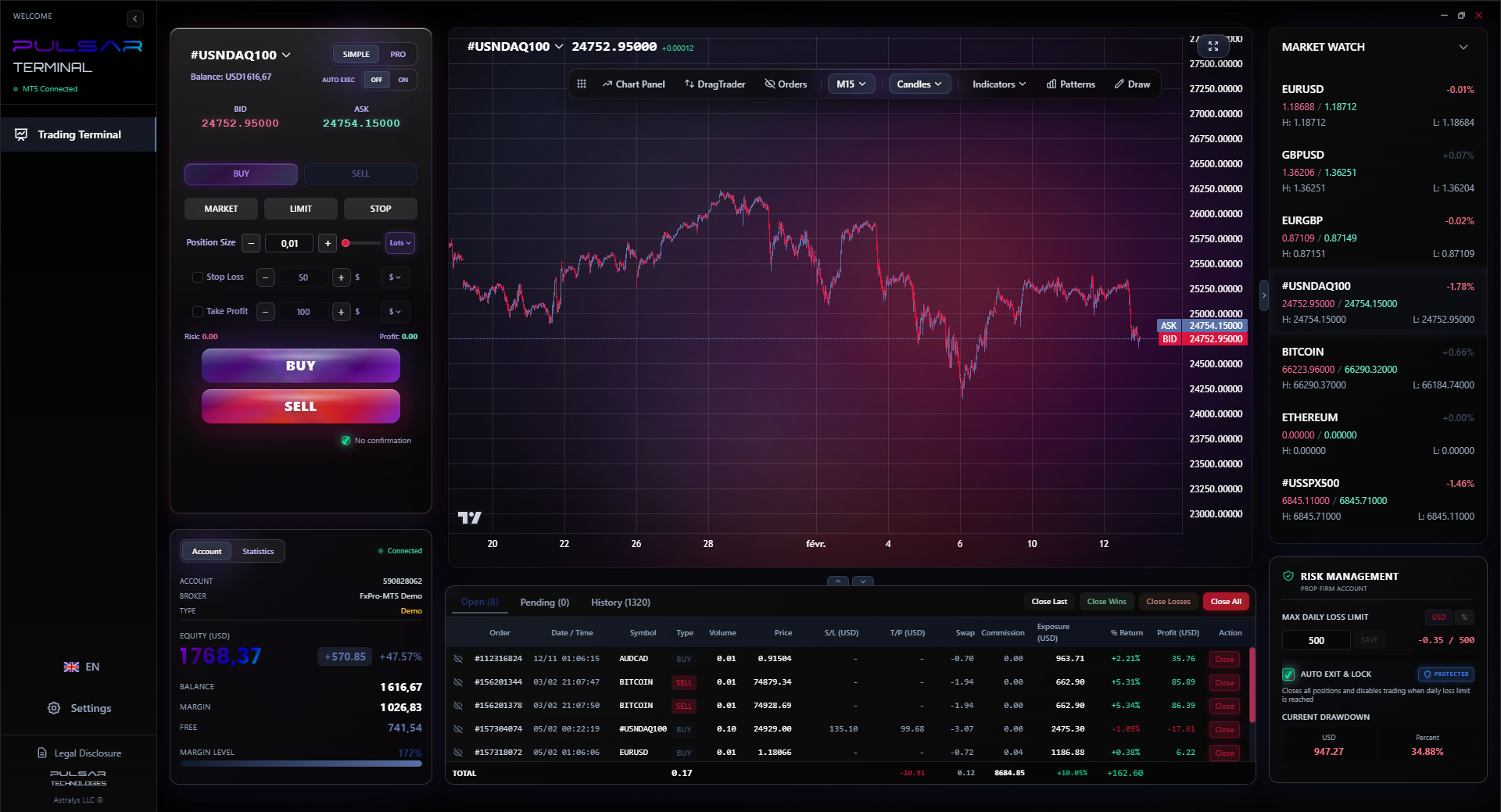
When you transition to live trading, managing multiple take-profit levels and trailing stops manually on MT5 can distract you from analysis; Pulsar Terminal automates these precise trade management tools directly on your chart.
Pulsar Terminal
L'outil MT5 tout-en-un : ordres glisser-déposer, multi-TP/SL, trailing stop, grid trading, Volume Profile et protection prop firm. Utilisé quotidiennement par 1 000+ traders.
“The goal of your first live deposit is not to get rich. The goal is to survive and execute your plan under pressure.”
You don't have to mortgage your future to learn this skill. Here's a blueprint for the self-starter in Pretoria:
- Broker Education Hub: Start with the free academy from your chosen FSCA-regulated broker. It's structured, relevant, and free.
- TradingView + YouTube: TradingView has a fantastic social charting platform. Pair it with reputable YouTube educators (look for those who discuss losses openly, not just wins). Learn to do your own chart analysis.
- Books: Read market classics. Trading in the Zone by Mark Douglas for psychology. The Candlestick Course by Steve Nison for technicals. You can get these for under R500 each.
- Community & Mentorship: This is where spending some money might help. Instead of a R15,000 course, find a legitimate, experienced trader who offers coaching at an hourly rate (that R246/hr average). Pay for a few sessions to review your trading plan and journal. This targeted feedback is gold.
- Unisa Short Course: For formal, accredited education, the Unisa Centre for Lifelong Learning has offered a 'Course in Share and Forex Trading' for around R6,500. It's academic and foundational, not a 'get-rich-quick' scheme, which is a good thing.
The path of swing trading major pairs like EUR/USD or commodities like XAU/USD is often better suited to beginners than the frenetic pace of scalping. It gives you time to think, analyse, and manage your emotions.
💡 Conseil de Winston
A ZAR account isn't just convenient; it's a strategic tool that removes hidden forex conversion costs from your profit and loss equation.
“If you can't be consistent with R500, you won't be consistent with R50,000. The market only cares about the quality of your decisions.”
Let's get practical. Here’s your checklist before you spend one Rand on education in Pretoria:
- Verified Track Record: Can the educator show a verified, multi-year statement of their live trading account? (Not a MyFxBook that can be manipulated).
- FSCA Check: If they're managing money or giving personalised advice, do they have an active FSP number? Check it on the FSCA website.
- Transparent Pricing: Is the full cost clear? Are there hidden upsells to 'VIP signal groups'?
- Focus on Risk: Does their marketing material talk as much about managing losses as it does about making profits?
- Sample Content: Will they provide a free webinar or a sample module so you can judge their teaching style?
- Your 'Why': Are you looking for a structured classroom, or are you disciplined enough to follow a self-study plan?
My final advice? Delay the big purchase. Commit to 100 hours of self-study using free resources first. Paper trade on a demo account religiously. Once you've done that, you'll be in a vastly better position to judge whether a specific forex trading course in Pretoria is offering genuine advanced insight or just repackaging the basics you already know. This game rewards patience and discipline, starting with how you choose to learn.
FAQ
Q1Is forex trading legal in Pretoria, South Africa?
Yes, it's completely legal. The key is to trade through a broker that is licensed by the Financial Sector Conduct Authority (FSCA). This regulation protects you by ensuring client funds are segregated and the broker follows strict rules.
Q2What is the average cost of a forex trading course in Pretoria?
Costs vary wildly. In-person, private courses can range from R10,000 to R20,000. Private tutoring averages R246 per hour. Online courses for South Africans can be found from as little as R179 for short courses to over R2,000 for bundles. Many brokers offer complete education for free.
Q3What is the FSCA use limit for retail traders?
The FSCA limits use to a maximum of 30:1 for retail traders using FSCA-regulated brokers. This is a protective measure to prevent excessive, rapid losses. Some international broker entities may offer higher use, but you lose the direct protection of the FSCA.
Q4What payment methods can I use with South African brokers?
Most FSCA-regulated brokers accept standard methods like Visa/Mastercard bank cards, local bank wire transfers (EFT), and e-wallets. Many also support specific South African methods like FNB Pay. Opting for a ZAR-denominated account simplifies this process.
Q5What's the single biggest red flag for a scam trading course?
Promises of guaranteed, high monthly returns (e.g., '10-15% per month, guaranteed'). Trading involves inherent risk and loss is always possible. Anyone claiming otherwise is almost certainly running a scam. The FSCA regularly issues warnings against such individuals and groups.
Q6Should I start with a demo account or a live account?
Always, always start with a demo account. Trade it seriously for a minimum of 2-3 months. The goal is to build consistency and practice your risk management with virtual money before you expose your real capital to the emotional pressures of live trading.
Q7What trading platform do most South African traders use?
MetaTrader 4 (MT4) and MetaTrader 5 (MT5) are by far the most popular platforms. They are powerful, customisable, and supported by almost every broker. Any reputable course should teach you how to use one of them.
La leçon du Prof. Winston
Points clés:
- ✓Verify FSCA registration before paying any educator or broker.
- ✓Demo trade for 3+ months before risking a single Rand.
- ✓Never risk more than 1% of your account on a single trade.
- ✓A ZAR account saves on hidden currency conversion fees.
- ✓The best initial education is often free from your broker.
Cet article vous a-t-il été utile ?
Cliquez sur une étoile
Analyses Trading Hebdo
Analyses et stratégies hebdo gratuites. Pas de spam.
À propos de l'auteur
David van der Merwe
Trader des Marchés Émergents
Trader basé à Johannesbourg avec 11 ans d'expérience sur les devises des marchés émergents. Spécialisé dans les paires ZAR, le trading régulé par la FSCA et l'analyse du marché sud-africain.
Commentaires
Avertissement sur les risques
Le trading d'instruments financiers comporte des risques importants et peut ne pas convenir à tous les investisseurs. Les performances passées ne garantissent pas les résultats futurs. Ce contenu est fourni à titre éducatif uniquement et ne constitue pas un conseil en investissement. Effectuez toujours vos propres recherches avant de trader.
Vous aimerez aussi

Cara Trading Forex Sukses: 7 Prinsip dari Trader Profesional
Cara trading forex sukses dengan 7 prinsip trader pro: manajemen modal, disiplin, journal trading, backtest. Data nyata, bukan janji profit palsu.
Jam Trading Forex Terbaik untuk Trader Indonesia: Panduan Lengkap dengan Tabel Waktu
Panduan jam trading forex untuk trader Indonesia. Tabel 4 sesi dunia, jam emas 20:00-00:00, sesi mana yang harus dihindari. Data akurat + tips dari trader berpengalaman.
Top 5 Sàn Forex Uy Tín Nhất 2026: Review Jujur dari Trader Indonesia
Top 5 sàn forex uy tín 2026 untuk trader Indonesia. Review jujur: spread, deposit, withdraw, dukungan lokal. Exness, XM, IC Markets & lebih.
Obtenir Pulsar Terminal
Tous ces calculateurs sont intégrés dans Pulsar Terminal avec des données en temps réel de votre compte MT5. Dimensionnement de position en un clic, gestion automatique des risques et calculs instantanés.
Obtenir Pulsar Terminal