


Let's be brutally honest: most of the 'forex trading details' you hear in Nigeria are marketing lies designed to get you to deposit money.

Olumide Adeyemi
Pionnier du Trading en Afrique de l'Ouest ·  Nigeria
☕ 12 min de lecture
Ce que vous apprendrez :
Let's be brutally honest: most of the 'forex trading details' you hear in Nigeria are marketing lies designed to get you to deposit money. The real details - the ones that determine if you keep your capital or blow up - are about risk, regulation, and psychology, not magic indicators. I've watched traders with great strategies lose everything because they ignored the foundational stuff. This guide strips away the hype and gives you the actual operational knowledge you need, from CBN rules to the math of survival.
This is the first detail everyone gets wrong. Yes, retail forex trading is legal for individuals in Nigeria. There's no law that says you can't open an account with an international broker and trade. But 'legal' doesn't mean 'unregulated' or 'without consequences.' The Central Bank of Nigeria (CBN) and the Securities and Exchange Commission (SEC) are watching, just not in the way you might think.
The CBN's main job is monetary stability. They control how foreign currency moves in and out of the country. This is why you hit a wall trying to fund a trading account with your Naira card - banks have limits on international transactions, and the CBN doesn't want you using official forex windows for speculation. It's a funding headache, not a trading ban.
The SEC considers online forex trading a securities activity. Their warning is clear: stay away from unregulated platforms. The crucial detail here? There's no specific Nigerian regulator for online retail forex brokers. We don't have a local version of the UK's FCA or Cyprus's CySEC. This regulatory gap is why nearly all serious Nigerian traders use international brokers regulated abroad. You're relying on a foreign government to protect your funds.

Warning: A broker offering you 'unlimited use' and operating without any offshore license is a scam waiting to happen. Your money isn't safe. Always verify a broker's license with its home regulator (like the FSCA in South Africa or CySEC in Europe) before depositing a single Naira.
So, you're trading in a legal gray area. You're allowed to do it, but you have almost zero local regulatory protection. This makes your choice of broker the most important financial decision you'll make. I've seen more people lose money to broker insolvency or manipulation than to bad trades. Do your homework.

💡 Conseil de Winston
A 'pip' is just a unit of measurement. Your obsession should be 'pip value' - how much each pip movement costs or earns you based on your lot size. That's the number that hits your bank account.
“High use isn't a feature for you; it's a risk accelerator that benefits your broker.”
Brokers advertise 'low spreads' for a reason - it's the cost you see, not the cost you feel. The real forex trading details for your P&L include hidden fees and taxes that quietly eat your profits.
Let's break down the numbers:
1. Transaction Costs:
- Spreads: This is the broker's cut. On a standard account, EUR/USD might be 0.8 pips. On a raw ECN account, it could be 0.0 pips plus a commission (e.g., $3.50 per lot). If you're a scalping strategy trader, those commissions add up fast. I once calculated that my scalping activity one month paid more in commissions than I made in net profit. A real wake-up call.
- Swap Fees: Holding a position overnight? You pay or receive interest. For Naira pairs (if your broker offers them), these can be unpredictable. Always check the swap rates in your platform's specification window.
2. The Tax Man Cometh: This is the detail nobody talks about until it's too late. The Federal Inland Revenue Service (FIRS) considers forex trading profits as capital gains, taxable at 10%. If you're trading full-time, they may see it as business income. I know traders who had a great year, withdrew a large sum, and then got a nasty letter. You need to keep careful records of all your trades, deposits, and withdrawals.
3. Funding & Withdrawal Costs: Depositing $100 via a payment processor might cost you $2 in fees. Withdrawing $100 might cost another $2. That's a 4% round-trip loss before you've even placed a trade. Using local bank transfers or P2P can be cheaper, but it adds complexity.

Example: Let's say you make a 10% return on a $1,000 account. You think you've made $100.
- Broker costs (spreads/commissions): -$15
- Withdrawal fee: -$5
- 10% Capital Gains Tax on the $80 net: -$8 Real Profit: $67 That '10% return' is actually 6.7%. Costs matter.
The lesson? You're not just trading against the market. You're trading against the house (your broker) and the government. Your edge must be large enough to cover all these leaks. Most trading strategies you find online don't account for this. They assume zero friction, which is a fantasy.
“Your goal in the first year isn't to get rich. It's to survive, learn, and keep your initial capital intact.”
Open any broker website targeting Nigeria, and you'll see the siren song: "use up to 1:3000!" "Minimum deposit $1!" This is the most dangerous set of forex trading details for new traders. It's not a feature; it's a predator's lure.
Let's look at real data from 2026:
- Exness: Offers 'unlimited' use.
- XM, HFM: use up to 1:2000.
- FXTM: Up to 1:3000.
- Minimum Deposits: As low as $0 (Fusion Markets, Pepperstone) or $1 (FBS).
This creates a perfect storm for account blow-ups. A new trader with $50 sees 1:1000 use and thinks, "Now I can trade like I have $50,000!" What they don't see is the risk. A 0.5% move against them with that use wipes out 50% of their account. It happens in seconds.
I learned this the hard way in 2015. I deposited $200 with a broker offering 1:500 use. I put on a seemingly conservative 0.5 lot trade on GBP/USD. The market moved 40 pips against me (a normal daily fluctuation). My loss was $200. Account gone in under an hour. I was so focused on the potential reward I completely ignored the position size calculator math.
The Professional's use Rule
Professionals use use as a tool for efficiency, not amplification. They might have $10,000 and use 1:10 use to control a $100,000 position. This gives them room to breathe. The Nigerian trader with $100 using 1:500 is controlling a $50,000 position with no room for error. It's not trading; it's gambling with a guaranteed loss.
A realistic starting amount for effective risk management is between $500 to $1,000. This lets you use sane use (1:10 to 1:30) and actually apply a strategy. That $1 minimum deposit is a marketing trick, not a viable trading plan. Choose a broker like IC Markets or Pepperstone for their raw spreads and reliable execution, not because they offer the highest use.
“Your goal in the first year isn't to get rich. It's to survive, learn, and keep your initial capital intact.”
Trading USD/NGN or other Naira crosses feels familiar, but it comes with unique volatility. The Naira was floated in 2016, and its value is now subject to global supply and demand - and heavily influenced by oil prices, Nigeria's main export.
This creates sharp, news-driven moves. A CBN policy announcement or a shift in crude oil prices can cause gaps and spikes that your stop-loss can't always catch. I've seen USD/NGN move 5% in a day. If you're used to the relatively smooth flow of EUR/USD, trading the Naira can be a shock.
Another critical detail: liquidity. Major pairs like EUR/USD have massive, deep markets. Naira pairs are thinner. This can lead to wider spreads, especially during off-hours or periods of local market stress. Your execution price might be worse than you expected, turning a calculated risk into a larger loss.

Pro Tip: If you trade Naira pairs, treat them with extra caution. Use a wider stop-loss to account for volatility, and reduce your position size by at least half compared to your usual major forex lot size. The emotional pull of trading your home currency is strong, but don't let it override your risk rules.
The local market is growing - turnover hit $8.6 billion in 2025 - but it's still developing. This means opportunity, but it also means less predictability. Combine this with the high use brokers offer on these pairs, and you have a recipe for quick losses. Always check the contract specifications for margin requirements and spread averages before you trade.
💡 Conseil de Winston
The spread isn't a fixed cost. It widens during major news events and market opens. If your strategy relies on tiny movements, you're not just trading the market, you're trading your broker's liquidity. Check the typical spread on your chosen pair before you base a strategy on a 5-pip target.
“You're not just trading against the market. You're trading against the house (your broker) and the government.”
All the other forex trading details are irrelevant if you ignore this one. Risk management isn't a suggestion; it's the algorithm of survival. Over 12 years, I've never met a consistently profitable trader who was sloppy with risk. I've met hundreds of blown-up traders who were geniuses at analysis but idiots with position size.
Here’s the non-negotiable framework:
1. The 1% Rule (Maximum): Never risk more than 1% of your account equity on a single trade. On a $1,000 account, that's $10. This isn't your potential loss if your stop-loss is hit; this is the maximum you allow yourself to lose.
2. Calculate Your Position Size: This is where people guess and fail. You don't decide your lot size based on a feeling. You calculate it.
Let's say your account is $1,000. Your 1% risk is $10. You want to buy EUR/USD at 1.0850, with a stop-loss at 1.0820. That's a 30-pip risk. The pip value for a standard lot (100,000 units) is $10. Your risk in dollars = (Pip Risk) x (Pip Value) x (Lot Size). We know we want to risk $10 total. $10 = 30 pips x $10 per pip per lot x (Lot Size) Lot Size = $10 / (30 * $10) = 0.033 lots.
You should trade 0.03 lots (or 3 micro lots). Not 0.1 lots because you're 'confident.' This math keeps you alive. Use a position size calculator until it's second nature.
3. Daily & Weekly Loss Limits: Set a hard stop for yourself. If you lose 3-5% of your account in a day, you stop trading. If you lose 10% in a week, you take the rest of the week off. This prevents revenge trading and emotional spiral. I set a 5% daily loss limit after a brutal Monday in 2018 where I gave back a month's profits trying to 'get back to even.'
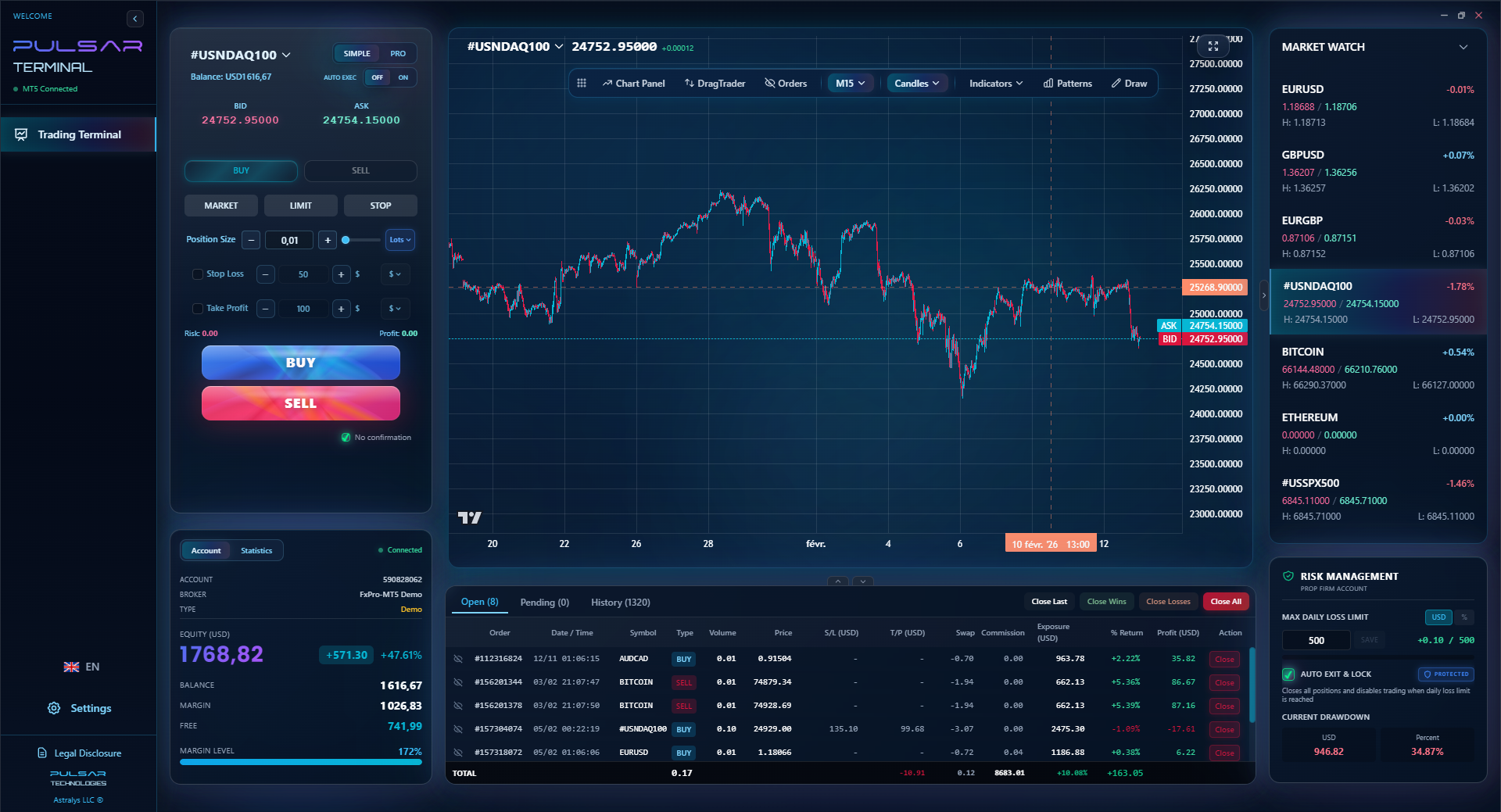
4. The Tool Gap: Most platforms like MT5 have basic risk tools. Setting a multi-level take-profit or a trailing stop that moves to breakeven at a certain point is clunky. This is where traders make manual errors. Having a tool that automates these exit plans removes emotion and ensures your rules are executed precisely, which is a massive edge.
“You're not just trading against the market. You're trading against the house (your broker) and the government.”
You can have the best plan in the world, and your brain will try to sabotage it. This is the final, brutal detail. The gap between knowing what to do and actually doing it is where accounts go to die.
The Three Execution Killers:
- Moving Stop-Losses: You place a trade, it goes against you, and your stop-loss is approaching. The pain of realizing a loss is acute. So you move your stop-loss further away, 'giving the trade room to breathe.' You've just broken your 1% rule. You're now risking 2%, 3%, 5%. One bad trade can now cripple you. I've done this. It never ends well.
- Taking Early Profits: Your trade hits half your take-profit target. Fear kicks in - "What if it reverses?" - so you close it for a small gain. Then the trade sails the rest of the way to your original target without you. You've destroyed your risk-to-reward ratio. Over time, this guarantees you'll lose because your winners are too small to cover your losers.
- Revenge Trading: After a loss, you feel the urgent need to get the money back immediately. You jump into another trade without a signal, you double your size, you ignore your rules. This is how a 2% loss turns into a 20% loss in an afternoon.
The solution isn't just 'be disciplined.' It's about building systems that protect you from yourself.
- Write Down Your Rules: Your trading plan should be a physical document. Entry criteria, exact position size formula, exit rules. Refer to it before every trade.
- Use Technology to Enforce Rules: If you struggle with moving stops or taking profits too early, look for tools that let you set your entire trade plan (entry, multiple take-profits, trailing stop, breakeven trigger) before you enter. Once it's set, it runs automatically. This removes the emotional decision-points where you usually fail.
- Keep a Trade Journal: Not just wins and losses. Write down how you felt during the trade. Were you scared? Greedy? Bored? Over time, you'll see your emotional patterns and can anticipate your own mistakes.
Mastering these forex trading details - the real, operational, psychological ones - is what separates the 90% who fund the market from the 10% who take money out of it.
💡 Conseil de Winston
Your first profit target should often be to move your stop-loss to breakeven. Securing a 'risk-free' trade psychologically frees you to let the remainder run to your full target. Most platforms make this a manual chore, which is why traders don't do it.
Sticking to your exit plan is the hardest part of trading, which is why a tool that automates multi-level take-profits, trailing stops, and breakeven moves directly on your MT5 chart is a game-saver.
Pulsar Terminal
L'outil MT5 tout-en-un : ordres glisser-déposer, multi-TP/SL, trailing stop, grid trading, Volume Profile et protection prop firm. Utilisé quotidiennement par 1 000+ traders.
“The gap between knowing what to do and actually doing it is where trading accounts go to die.”
Given all these details, here's a step-by-step path that avoids the common pitfalls:
- Education First, Money Second: Spend 3-6 months learning on a demo account. Not just clicking buttons. Practice your risk math, test your psychology, and experience drawdowns with fake money. The market isn't going anywhere.
- Choose a Regulated Broker: Pick an international broker with a strong license (like ASIC, FCA, FSCA) that accepts Nigerian clients. Exness and XM are popular for a reason - they're accessible and regulated in multiple jurisdictions. Compare their raw spreads and deposit options.
- Start with a 'Live' Minimum: Forget the $1 deposit. Save up a minimum of $500. This is your 'tuition fee.' It's enough to trade micro lots (0.01) with proper risk management and feel the real psychological pressure without being obliterated by one trade.
- Define a Simple Strategy: Start with one or two setups. Maybe price action on the 4-hour chart, or a simple MACD indicator and RSI indicator confluence on the 1-hour. Master it. Don't jump between 10 strategies.
- Implement the 1% Rule Religiously: Use a calculator for every single trade. No exceptions.
- Withdraw Profits Regularly: This is the habit of a professional. Once your account grows by 20-30%, withdraw your initial capital or a chunk of profits. It reinforces success, protects your money, and reduces emotional attachment to your trading balance.
The goal of your first year isn't to get rich. It's to survive, learn, and preserve your capital. If you can end the year with your initial $500 intact, you're in the top 30% of starters. That's a win you can build on.
FAQ
Q1Do I need to pay tax on my forex trading profits in Nigeria?
Yes. The FIRS treats forex trading profits as capital gains, taxable at 10%. If you trade full-time, it may be considered business income. You are legally required to declare this income and pay tax on your net profits. Keep detailed records of all trades, deposits, and withdrawals.
Q2What is a safe use to use as a beginner?
For a beginner, I recommend not exceeding 1:10 use. On a $500 account, that gives you $5,000 in buying power. It forces you to focus on position sizing and reduces the chance of a margin call from a normal market swing. High use (1:100+) is a risk accelerator, not a skill multiplier.
Q3Which broker is best for Nigerian traders?
There's no single 'best' broker. Look for brokers with strong international regulation (FCA, ASIC, CySEC, FSCA), low and transparent costs (check both spreads and commissions), and reliable deposit/withdrawal methods for Nigeria (like local bank transfer or P2P). IC Markets, Exness, and XM are consistently used by experienced traders here due to their reliability and Naira-friendly options.
Q4Can I really start forex trading with $10?
Technically, yes, some brokers allow it. Practically, it's almost pointless. With $10, even at high use, proper risk management is impossible. A single 1% move can wipe you out. The transaction costs (spreads) will consume a huge percentage of your capital. A realistic minimum to learn proper swing trading or risk management is $200-$500.
Q5What is the biggest mistake Nigerian forex traders make?
Ignoring position sizing and using excessive use. They focus on predicting the market's direction (which is hard) and completely neglect managing their risk (which is simple math). They turn a 30-pip loss into a 50% account loss because they traded a 1.00 lot size on a $200 account. Mastering the position size calculator is more important than any indicator.
Q6Is MetaTrader 4 or MetaTrader 5 better?
MT5 is the more modern platform. It has more timeframes, more built-in indicators, and allows trading stocks and futures alongside forex. However, MT4 is simpler, uses less computer resources, and has a larger library of custom indicators. For pure forex trading, MT4 is still excellent. Most brokers offer both. Try the demo of each and see which interface you prefer.
La leçon du Prof. Winston
Points clés:
- ✓Risk max 1% of capital per trade. No exceptions.
- ✓Calculate position size; never guess your lot size.
- ✓Real profits come after covering all fees & 10% tax.
- ✓Choose brokers for regulation, not highest use.
- ✓Start with $500+, not $10, to learn properly.
Cet article vous a-t-il été utile ?
Cliquez sur une étoile
Analyses Trading Hebdo
Analyses et stratégies hebdo gratuites. Pas de spam.
À propos de l'auteur
Olumide Adeyemi
Pionnier du Trading en Afrique de l'Ouest
L'un des formateurs de trading forex les plus actifs au Nigeria. 8 ans d'expérience de trading depuis Lagos. Spécialisé dans les stratégies à petit capital et les challenges de prop firms pour les traders africains.
Commentaires
Avertissement sur les risques
Le trading d'instruments financiers comporte des risques importants et peut ne pas convenir à tous les investisseurs. Les performances passées ne garantissent pas les résultats futurs. Ce contenu est fourni à titre éducatif uniquement et ne constitue pas un conseil en investissement. Effectuez toujours vos propres recherches avant de trader.
Vous aimerez aussi

Cara Trading Forex Sukses: 7 Prinsip dari Trader Profesional
Cara trading forex sukses dengan 7 prinsip trader pro: manajemen modal, disiplin, journal trading, backtest. Data nyata, bukan janji profit palsu.
Jam Trading Forex Terbaik untuk Trader Indonesia: Panduan Lengkap dengan Tabel Waktu
Panduan jam trading forex untuk trader Indonesia. Tabel 4 sesi dunia, jam emas 20:00-00:00, sesi mana yang harus dihindari. Data akurat + tips dari trader berpengalaman.
Top 5 Sàn Forex Uy Tín Nhất 2026: Review Jujur dari Trader Indonesia
Top 5 sàn forex uy tín 2026 untuk trader Indonesia. Review jujur: spread, deposit, withdraw, dukungan lokal. Exness, XM, IC Markets & lebih.
Obtenir Pulsar Terminal
Tous ces calculateurs sont intégrés dans Pulsar Terminal avec des données en temps réel de votre compte MT5. Dimensionnement de position en un clic, gestion automatique des risques et calculs instantanés.
Obtenir Pulsar Terminal