


You want to trade forex from Nigeria, but you're hearing a dozen different things about what's legal, what's not, and how to even get started.

Olumide Adeyemi
Pionnier du Trading en Afrique de l'Ouest ·  Nigeria
☕ 11 min de lecture
Ce que vous apprendrez :
- 1Is Forex Trading Legal in Nigeria? The Real Answer
- 2The Real Costs of Trading: It's More Than Just Spreads
- 3Picking a Broker in Nigeria: What Actually Matters
- 4How Much Money Do You Really Need to Start?
- 5Trading Around the Naira: Local Market Dynamics
- 6The Nigerian Trader's Hall of Shame: Common Mistakes I've Made
- 7Filling Out Your Actual Trading Plan
You want to trade forex from Nigeria, but you're hearing a dozen different things about what's legal, what's not, and how to even get started. Is it a free-for-all or a regulated minefield? Let me clear the air. The truth about the forex trading form in Nigeria is that it's a patchwork of indirect rules and personal responsibility. I've traded here for over a decade, seen the CBN's rules shift, and watched countless traders get tripped up by the details they ignored. This isn't about theory; it's about what you actually need to know to operate without getting your account frozen or your profits eaten by hidden costs.
This is the first question everyone asks, and the answer is more nuanced than a simple yes or no. For you, the individual retail trader using your own money on an international platform, it is legal. There's no law that says you can't. However, the regulatory framework isn't holding your hand.
The Central Bank of Nigeria (CBN) and the Securities and Exchange Commission (SEC) are the big players. The CBN's main job is managing the Naira and the official foreign exchange market. They've put strict rules on banks and Bureau de Change (BDC) operators, specifically to stop them from using official FX windows for speculative trading. This is why you can't just walk into your local bank and open a leveraged forex trading account. They're blocked from facilitating it.
The SEC regulates securities. While they have the power to license brokers who want to operate within Nigeria or manage client funds locally, their rules for everyday Joe trading CFDs on MetaTrader aren't crystal clear yet. This creates the 'lightly regulated' space we operate in. You're relying on the regulatory muscle of the broker's home country, not Nigeria's.
So, your legality hinges on two things: using your own capital for your own benefit, and picking a broker regulated by a reputable foreign authority. That's the current forex trading form you're filling out by default.

Warning: Never use a broker that isn't properly regulated offshore (think FCA, CySEC, FSCA). If they're only 'registered' in Nigeria with no other oversight, run. You have zero protection if they vanish with your deposit.
“The truth about the forex trading form in Nigeria is that it's a patchwork of indirect rules and personal responsibility.”
You look at a broker's ad: 'Trade from 0.0 pips!' Sounds great, right? Let me tell you, that's just the entry fee. The real cost of your forex trading form is a combination of several factors that will determine if you're actually profitable.
The Obvious Costs: Spreads & Commissions
Spreads vary wildly. On a standard account, expect the EUR/USD spread to be between 0.6 and 1.0 pips on average. On a raw ECN account, you might get that 0.0 pip spread, but you'll pay a commission per lot. A typical structure is $6 per round lot (100k units). Do the math: if you're scalping 10 times a day, those commissions add up fast. I made this mistake early on, chasing the lowest spread without factoring in commissions, and it turned my winning strategy into a loser.
The Silent Killer: Swap Fees
Holding a position overnight? You'll pay or receive a swap fee. This is the interest rate differential between the two currencies. If you're buying a currency with a higher interest rate than the one you're selling, you might earn a small credit. More often, you pay. On a 1-lot GBP/JPY position I held for a week back in 2022, the swap charges totaled over $45. That's a significant chunk of the potential profit gone. Always check the swap rates in your platform's specification window.
Taxes and Banking Fees
Here's the one many Nigerians forget: Capital Gains Tax. The Federal Inland Revenue Service (FIRS) expects 10% of your net trading profits. I'm not an accountant, but I keep a detailed log of all trades for this reason. Then there are withdrawal fees. Some brokers charge them, some don't. Funding with your card might incur a bank charge for international transaction. Using a domiciliary account is cleaner but comes with its own maintenance fees. When calculating your risk, use a position size calculator that lets you input commission costs for a true picture.

💡 Conseil de Winston
Your first N100,000 profit is the most dangerous. It convinces you you're a genius. Withdraw half of it. Let your ego cash a cheque your skills might not be able to cover later.
“With $1, your position size will be microscopic. A 10-pip move will earn you 10 cents. You learn nothing about real trading psychology.”
With over 300,000 retail traders here, brokers are fighting for your attention. Don't get dazzled by use offers or bonus promises. Focus on the bedrock stuff.
Regulation is non-negotiable. I only consider brokers with a top-tier license from a jurisdiction known for enforcement. My primary account has been with IC Markets for years, regulated by the ASIC in Australia. Their Seychelles entity (which serves many Nigerian clients) is also solid. Pepperstone is another excellent choice, and they're directly regulated by the CMA in Kenya, which is relevant for our region. XM and Exness are also popular here for good reason: they accept Nigerians easily and are regulated abroad.
Funding and Withdrawal Ease. Can you fund in Naira? Do they accept local payment processors like Flutterwave or Paystack? How long do withdrawals take? I once waited 12 business days for a withdrawal from a sketchy broker (lesson learned). Now, I test the withdrawal process with a small amount before committing serious capital. A good broker processes withdrawals in 24-48 hours.
Platform and Tools. MT4 and MT5 are the kings in Nigeria. Ensure your broker offers them. Also, check if they allow useful add-ons or have good mobile apps. Your trading shouldn't stop because NEPA takes light.
| Broker Consideration | What to Look For | Red Flag |
|---|---|---|
| Regulation | FCA, ASIC, CySEC, FSCA, CMA | "Registered in Nigeria" only, offshore 'ghost' licenses |
| Deposit/Withdrawal | Local payment options, < 3-day withdrawals | Only crypto deposits, 10+ day withdrawal times |
| Costs | Clear commission/spread structure, no hidden fees | "Zero cost" trading promises, unclear fee schedule |
| use | Up to 1:500 is common. More isn't better. | Offers of 1:2000+ use as a main selling point |

Pro Tip: Open demo accounts with 2-3 brokers. Test their execution speed during London open (8 AM GMT) on a volatile pair like GBP/USD. Slippage and requotes will tell you more about their service than any sales brochure.
“With $1, your position size will be microscopic. A 10-pip move will earn you 10 cents. You learn nothing about real trading psychology.”
I see this question every day. Brokers advertise "Start with $1!" Technically true. Practically, a fast track to blowing an account. Here’s the blunt truth.
With $1, your position size will be microscopic (0.001 lots, a micro lot). A 10-pip move, a decent scalp, will earn you 10 cents. One tiny spread or a moment of slippage wipes out your profit. You learn nothing about real trading psychology or money management.
My strong opinion? A realistic minimum to learn properly is $200-$500. This allows you to trade 0.01 (mini) or 0.02 lots with sane risk. For example, with $500, risking 1% ($5) on a trade with a 50-pip stop-loss lets you trade a 0.01 lot on most majors. You're in the game, feeling real P&L movement, which is crucial for learning.
Now, if you're asking, "How much do I need to make N100,000 a month from trading?" That's a different question. That's professional territory. To target $1,000 (approx. N1.5M) monthly returns with a conservative 5-10% monthly return target, you're looking at a capital base of $10,000 to $20,000. Anyone telling you they'll turn $500 into that consistently is selling a dream, not a strategy.
I started with $300 in 2013. My first year was about survival, not getting rich. I focused on protecting that capital, not multiplying it. That mindset shift is what the right starting amount allows.

Example: You start with $300. You risk 2% per trade ($6). You use a scalping strategy targeting 10-pip gains. With a 0.03 lot size, a winning trade nets you $3. After the spread (say, 1 pip cost you $0.30), you make $2.70. You need a very high win rate just to cover costs. This is the grind of small accounts.
💡 Conseil de Winston
If you can't explain your trade setup in one simple sentence ('Price bounced off the daily support with RSI oversold'), you don't have a setup. You have a hope.
“High use is a tool for experienced traders with precise risk controls, not a beginner's crutch.”
You're trading global pairs, but you live in Nigeria. Local economics directly impact your trading life, especially your psychology and cash flow.
The Naira's volatility is a backdrop to everything. When the CBN hikes interest rates (like to 26.25% in 2024) or devalues the currency, it creates a sense of urgency. I've seen traders force trades because "I need dollars," which is a guaranteed way to lose. You must separate your need for foreign currency from your trading decisions. Trade the charts, not your rent.
Payment methods are key. Using your domiciliary account is straightforward. Local processors like Interswitch are convenient but watch for fees. Cryptocurrency (USDT) has become a major channel for moving money to/from international brokers. It's fast and bypasses some banking hurdles, but introduces crypto volatility risk during the transfer window.
The market is young and tech-savvy. 94% of traders are under 35. This means there's huge energy and a hunger to learn, but also a susceptibility to get-rich-quick schemes and signal seller scams. The community is active on Telegram and WhatsApp - be careful whose advice you take.
Your edge isn't in predicting CBN policy. It's in mastering a few instruments. Focus on the major pairs like EUR/USD or commodities like XAU/USD (Gold). Their liquidity is immense, and they're less prone to the weird spikes you can see in exotic pairs.
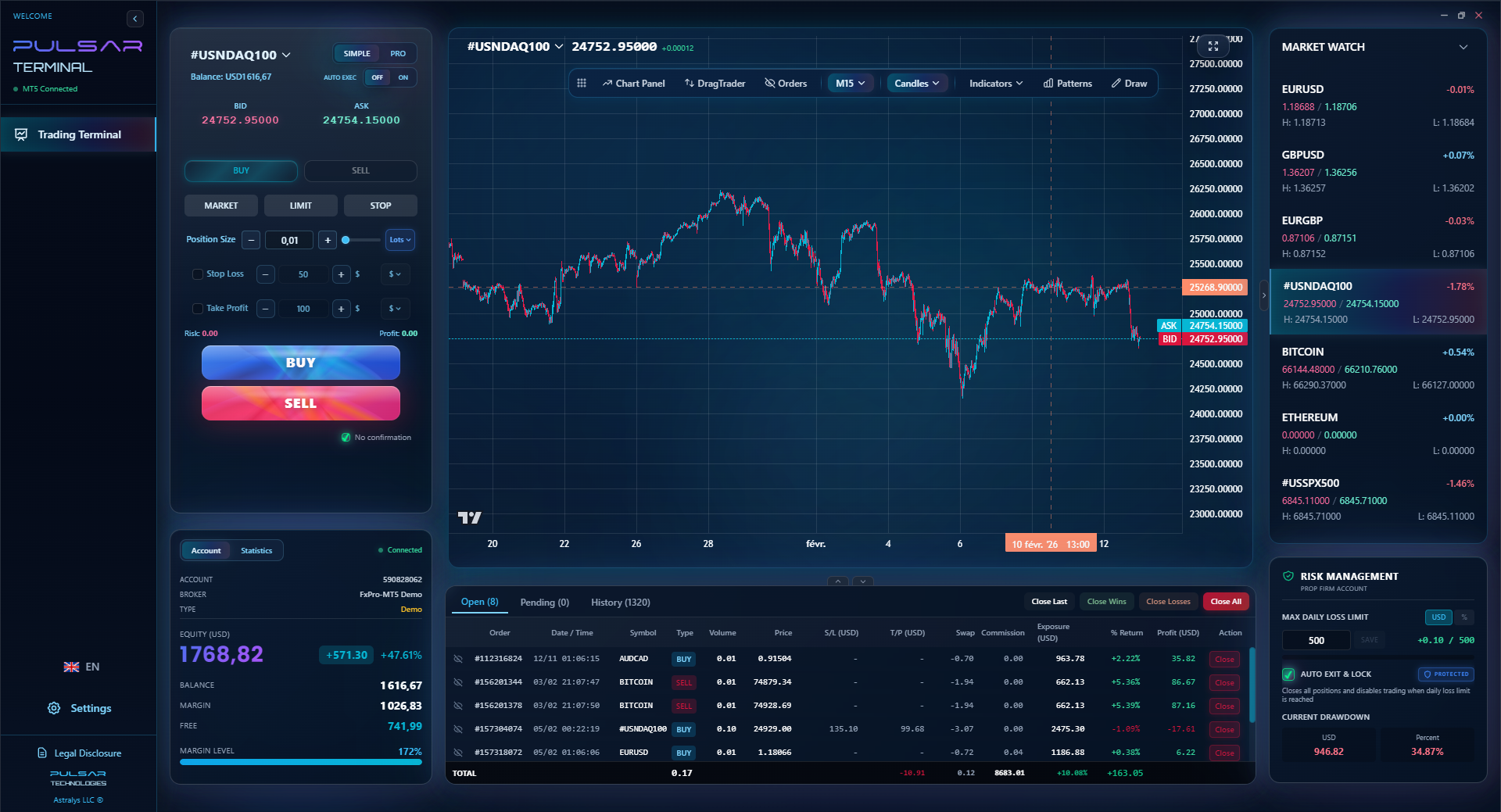
When you're managing multiple trades and strict daily loss limits, a tool like Pulsar Terminal automates your stop-loss, take-profit, and breakeven orders directly on MT5, so you can stick to your plan without emotional interference.
Pulsar Terminal
L'outil MT5 tout-en-un : ordres glisser-déposer, multi-TP/SL, trailing stop, grid trading, Volume Profile et protection prop firm. Utilisé quotidiennement par 1 000+ traders.
“High use is a tool for experienced traders with precise risk controls, not a beginner's crutch.”
Let me save you some pain and money by listing the errors I see constantly, all of which I've personally committed.
1. Chasing use: A broker offers 1:2000 use. You think, "With N50,000, I can control N100 million!" This is a suicide pact. High use magnifies losses faster than gains. I once used 1:500 on a GBP/USD trade. A 20-pip move against me (a normal market noise) wiped out 25% of my account. Stick to 1:100 or less, especially when starting.
2. Ignoring the Economic Calendar for Local News. You're in a perfect swing trading setup on USD/NGN (if you could trade it) or are long on oil stocks. Then the CBN governor gives an unscheduled speech. The Naira gyrates, causing panic across all your correlated positions. Even if you're not trading the Naira, major local events can spike volatility in other assets. Check the calendar.
3. Not Accounting for All Costs. As covered earlier, if your strategy has a 5-pip target, and your spread + commission totals 2 pips, you need to be right 67% of the time just to break even on costs alone. Most aren't that good.
4. No Written Trading Plan. Your forex trading form should be a detailed plan, not a hopeful scribble. It must include entry rules, exit rules, risk per trade (I never risk more than 1.5%), and what you'll do if you hit a drawdown. Without it, you're gambling.
5. Revenge Trading After a Loss. The market takes your money. Your ego is bruised. You jump right back in with a larger size to "make it back fast." This is how a N20,000 loss becomes a N100,000 loss in an hour. I've been there. After a loss, walk away. Close the platform. The market will be there tomorrow.
💡 Conseil de Winston
The market doesn't know you exist. It doesn't care about your rent, your dreams, or your previous losses. Trade the price, not your life.
“Your trading plan is your business plan. It's the most important form you'll ever fill out.”
This is where we get practical. Your trading plan is your business plan. It's the most important form you'll ever fill out. Here's a skeleton based on what works.
1. The Instrument List: Don't trade 28 pairs. Pick 3-5. Master them. I trade only EUR/USD, GBP/USD, and Gold. I know their average daily ranges, their typical reaction to news, and their spread behavior.
2. The Strategy Definition: Are you a scalper, a day trader, or a swing trader? Define it. My primary strategy uses the MACD indicator for trend direction and the RSI indicator for overbought/oversold levels on the 1-hour chart. I only take trades where both align. Write down your exact setup criteria.
3. Risk Management Rules: This is non-negotiable.
- Risk per Trade: Maximum 1-2% of account balance.
- Daily Loss Limit: If I lose 3% of my account in a day, I'm done. No more trades.
- Weekly Loss Limit: 7%. If hit, I take the rest of the week off to review.
- Use stop-losses on EVERY trade. No exceptions.
4. Record Keeping: You must journal. Every trade. Entry, exit, pips gained/lost, reason for entry, emotion. I review mine every Sunday. This is how you spot your own stupid patterns (like always losing on Friday afternoons).
5. Psychology & Routine: My routine: Check economic calendar at 7 AM. Analyze charts from 7:30 to 8:30 AM (before London open). No trading after 5 PM Lagos time when I'm tired. This structure prevents impulsive decisions.
Sticking to this plan is what separates the 5% who succeed from the 95% who fund the brokers' profits. It's boring. It's repetitive. And it's the only thing that works long-term.
FAQ
Q1Do I need to pay tax on my forex trading profits in Nigeria?
Yes. The Federal Inland Revenue Service (FIRS) considers forex trading profits as capital gains, which are taxable at 10%. You are responsible for declaring this income and paying the tax. Keep detailed records of all your trades, deposits, and withdrawals.
Q2Can I use a Nigerian bank account to fund my forex trading account?
You can use your Naira account to fund via debit/credit card (Visa/Mastercard) or bank transfer to the broker's payment processor. However, for larger amounts or smoother withdrawals, using a domiciliary (USD) account or a cryptocurrency like USDT is often more efficient and avoids multiple currency conversion fees.
Q3What is the best use for a beginner in Nigeria?
The best use is the lowest that allows you to execute your strategy. I recommend starting with no more than 1:50. It forces you to focus on good trade selection and proper position sizing. High use (1:500, 1:1000) is a tool for experienced traders with precise risk controls, not a beginner's crutch.
Q4Are prop firms like FTMO or The5%ers available to Nigerian traders?
Yes, many international prop firms accept Nigerian traders. They are a popular way to trade with larger capital without risking your own savings. However, you must pass their challenge first, which requires strict discipline. Be aware of their specific rules on drawdowns and trading styles.
Q5What happens if my broker goes bankrupt?
If your broker is regulated by a top-tier authority like the UK's FCA, your funds should be held in segregated client accounts. This means they are separate from the broker's operating funds. In case of broker insolvency, you may be eligible for compensation up to a certain limit (e.g., £85,000 under FCA). This protection is why regulation is critical.
Q6Is it better to trade during the London or New York session from Nigeria?
For most major currency pairs, the overlap between the London and New York sessions (12 PM - 4 PM GMT, which is 1 PM - 5 PM Nigerian time) offers the highest liquidity and volatility. This is when you'll see the clearest moves and the tightest spreads, making it ideal for many strategies.
Q7How do I avoid a margin call?
A margin call happens when your losses eat up your usable margin. To avoid it: 1) Use sensible use (as low as possible). 2) Never risk more than 1-2% per trade. 3) Always use a stop-loss. 4) Don't over-concentrate your account on one trade. 5) Monitor your account's free margin level regularly.
La leçon du Prof. Winston
Points clés:
- ✓Legal retail trading relies on offshore broker regulation, not CBN rules.
- ✓Real costs include spreads, commissions, swaps, taxes, and bank fees.
- ✓Start with $200-$500 minimum to learn real money management.
- ✓Never use use above 1:50 as a beginner.
- ✓A written trading plan is non-negotiable for survival.
Cet article vous a-t-il été utile ?
Cliquez sur une étoile
Analyses Trading Hebdo
Analyses et stratégies hebdo gratuites. Pas de spam.
À propos de l'auteur
Olumide Adeyemi
Pionnier du Trading en Afrique de l'Ouest
L'un des formateurs de trading forex les plus actifs au Nigeria. 8 ans d'expérience de trading depuis Lagos. Spécialisé dans les stratégies à petit capital et les challenges de prop firms pour les traders africains.
Commentaires
Avertissement sur les risques
Le trading d'instruments financiers comporte des risques importants et peut ne pas convenir à tous les investisseurs. Les performances passées ne garantissent pas les résultats futurs. Ce contenu est fourni à titre éducatif uniquement et ne constitue pas un conseil en investissement. Effectuez toujours vos propres recherches avant de trader.
Vous aimerez aussi

Cara Trading Forex Sukses: 7 Prinsip dari Trader Profesional
Cara trading forex sukses dengan 7 prinsip trader pro: manajemen modal, disiplin, journal trading, backtest. Data nyata, bukan janji profit palsu.
Jam Trading Forex Terbaik untuk Trader Indonesia: Panduan Lengkap dengan Tabel Waktu
Panduan jam trading forex untuk trader Indonesia. Tabel 4 sesi dunia, jam emas 20:00-00:00, sesi mana yang harus dihindari. Data akurat + tips dari trader berpengalaman.
Top 5 Sàn Forex Uy Tín Nhất 2026: Review Jujur dari Trader Indonesia
Top 5 sàn forex uy tín 2026 untuk trader Indonesia. Review jujur: spread, deposit, withdraw, dukungan lokal. Exness, XM, IC Markets & lebih.
Obtenir Pulsar Terminal
Tous ces calculateurs sont intégrés dans Pulsar Terminal avec des données en temps réel de votre compte MT5. Dimensionnement de position en un clic, gestion automatique des risques et calculs instantanés.
Obtenir Pulsar Terminal