


Let's be blunt: the biggest risk to your trading account in Nigeria isn't a bad trade.

Olumide Adeyemi
Pionnier du Trading en Afrique de l'Ouest ·  Nigeria
☕ 11 min de lecture
Ce que vous apprendrez :

Let's be blunt: the biggest risk to your trading account in Nigeria isn't a bad trade. It's a scam. I've watched more traders get wiped out by fraudsters than by any market crash. The promise of easy money from forex has created a breeding ground for con artists, and they're getting smarter. This guide isn't about finding the perfect entry; it's about making sure your broker doesn't disappear with your money before you can even place a trade. I'll show you the most common forex trading scams, how to spot them a mile away, and what you can actually do about it.
You have to understand the environment. Nigeria's huge, young, tech-savvy population is a dream target for scammers. High unemployment, a strong desire for financial independence, and the glamorous image of 'forex life' on social media create perfect conditions. The scams here aren't just one-off cons; they're sophisticated systems.
First, you have the fake investment schemes (Ponzi/pyramid schemes) dressed in forex clothing. They promise fixed daily returns of 5%, 10%, even 20%. I had a client show me a WhatsApp group where the 'CEO' was posting screenshots of massive profits every day. The client invested ₦500,000. The returns came like clockwork for two weeks. Then, the group went silent, the website vanished, and the phone numbers were disconnected. Poof. Gone.
Then there are the unregulated brokers. These are the most dangerous because they look real. They have fancy websites, local customer service numbers, and even offices in Lagos or Abuja. But if they aren't regulated by a serious authority like the SEC Nigeria or an international body like the FCA (UK) or ASIC (Australia), your money is just a guest in their bank account. They can manipulate spreads, refuse withdrawals, or simply shut down.

Warning: If a 'broker' or 'fund manager' approaches you first on WhatsApp, Instagram, or Facebook, it's a scam 99.9% of the time. Legitimate businesses don't need to hunt for clients in your DMs.
“The biggest risk to your trading account in Nigeria isn't a bad trade. It's a scam.”
Spotting these signs early can save you millions of Naira. I'm not talking about subtle hints; I'm talking about glaring sirens.
- Guaranteed Profits: Anyone who guarantees you won't lose money is lying. The market doesn't give guarantees. I once saw an ad: 'Earn ₦150,000 daily with zero risk.' That's not trading; that's fiction.
- Pressure to Deposit Quickly: 'This bonus offer ends in 2 hours!' 'Fund your account now to secure your position in our managed portfolio!' This is a classic sales tactic to bypass your rational thinking.
- Bonuses That Sound Too Good: Be wary of 100% deposit bonuses or more. These often come with impossible withdrawal conditions (like trading 100 lots before you can withdraw your own money). It's a trap to keep you trading until you lose it all.
- Difficulty Withdrawing: The first sign of a scam broker is when your withdrawal is 'processing' for weeks. Then they ask for more fees ('tax clearance', 'processing fee') to release your funds. You pay, and they ask for another fee. It never ends.
- No Physical Address or Regulated License: A P.O. Box in Victoria Island isn't enough. Check their 'license number' with the claimed regulator. I've seen brokers fake FCA license numbers. Always verify directly on the regulator's website.
- Copy-Paste Website: Many scam brokers use the same website template. If you see a site that looks eerily similar to another, but with a different name, run.
- Managed Account Promises with High Returns: 'We trade for you! 30% monthly return!' This is the most common entry point for scams. They'll show you fake Myfxbook statements. In reality, they're just using new deposits to pay 'returns' to old clients - a Ponzi scheme.
- Spreads That Are Too Good to Be True: If they offer raw spreads like 0.0 pips on EUR/USD with no commission, check their business model. How do they make money? Often, they become your counterparty and manipulate prices against you.
- Customer Service That Only Works on Deposit: Try asking a technical question before you deposit. If they're vague or unhelpful, but become super responsive the moment you talk about funding, that's a major red flag.
- The 'Prop Firm' That Isn't: Fake prop firms are exploding. They charge a huge 'challenge fee' (like ₦150,000) but set impossible profit targets and hidden rules designed for you to fail, so they keep your fee. A real prop firm's goal is to find profitable traders, not to collect failure fees.
Here’s a quick comparison table of what’s real vs. what’s a scam front:
| Feature | Legitimate Broker / Service | Likely Scam |
|---|---|---|
| Returns | Never guaranteed. Past performance shown with risk warnings. | 'Guaranteed 10% weekly profit.' |
| Regulation | Clearly displays real license (e.g., FCA, ASIC, CySEC) and you can verify it. | 'Internationally regulated' with no number, or a fake one. |
| Withdrawals | Processed in 1-5 business days to your original payment method. | 'Processing' for weeks, demands more fees. |
| Communication | Professional, through official channels. No pressure. | Aggressive DMs on social media, constant phone calls. |

💡 Conseil de Winston
A trader once told me his secret to avoiding scams: 'If it requires me to send a DM, it's not a business. It's a con.' Real opportunities don't hide in your Instagram inbox.

“If a 'broker' approaches you first on WhatsApp or Instagram, it's a scam 99.9% of the time.”
This one is personal. Early in my career, I paid $200 a month to a 'guru' on Twitter with 100k followers. His tweets were electric: 'BUY GBP/USD NOW! TP 50 pips!' He'd post the screenshot after the move. What I didn't realize was he was sending out both buy and sell signals to different groups. Whichever one hit, he'd post that screenshot as 'proof'. The losing signal group just got silence or an excuse.
These sellers prey on the desire for a shortcut. They create an illusion of insider knowledge. Their entire business model is marketing, not trading. They sell you the dream of passive income while they make their actual income from your subscription fee.
How to spot them:
- They only show winning trades, never a full, verifiable track record.
- They use vague language like 'strong buy zone' without precise entry/stop/target.
- They claim to have a 'secret indicator' or 'bank-level algorithm'.
- Their main content is a lifestyle flex: cars, watches, stacks of cash (often rented or fake).
Real traders are too busy trading and managing risk to spend all day making glamorous TikTok videos. If making money was that easy, why would they need your ₦20,000 monthly subscription? Think about it. A better use of your money is a solid position size calculator to protect your capital.
“If a 'broker' approaches you first on WhatsApp or Instagram, it's a scam 99.9% of the time.”
The most insidious scams are the ones that sell you hope wrapped in education. For ₦500,000, you get a 6-week 'forex mastery' course. The first 5 weeks are basic YouTube-level content about candlesticks and RSI indicator. The final week is the pitch: 'To truly apply this, you need to join our exclusive managed fund or use our partnered (unregulated) broker.'
The course is just a loss leader to get you into their real scam: your trading capital.
I reviewed one of these 'course' materials for a client. It was 200 pages of plagiarised content from free forums, filled with dangerous advice like 'never use a stop-loss' and 'double down when you're wrong.' This wasn't education; it was a recipe for a margin call.

Pro Tip: Before paying for any course, ask for the mentor's verified, long-term trading statement (like a 2+ year Myfxbook link). If they can't or won't provide one, they are not a trader. They are a content creator. There's a difference.
Real education focuses overwhelmingly on risk management and psychology, not magic bullet strategies. It teaches you how to use a scalping strategy or swing trading plan safely. It doesn't promise riches.
💡 Conseil de Winston
The moment you feel rushed to make a decision with your money, you are being manipulated. Legitimate financial decisions welcome your patience and due diligence.
“Real traders are too busy trading to spend all day making glamorous TikTok videos.”
This is your due diligence checklist. Don't skip a step.
Step 1: Check for Real Regulation
Go to the regulator's official website. Don't just trust the badge on the broker's site.
- FCA (UK): Register.fca.org.uk
- ASIC (Australia): connectonline.asic.gov.au
- CySEC (Cyprus): www.cysec.gov.za
- SEC Nigeria: www.sec.gov.ng
Type in the exact company name or license number. Check the details: is the company name a perfect match? Does the listed address match? Are they authorized for 'dealing on own account' or 'holding client money'?
Step 2: Test the Withdrawal Process with a Small Amount
Before you fund your main account, do this. Deposit the minimum possible amount (maybe $50). Trade it a bit, or don't. Then immediately request a withdrawal back to your bank account or card.
A legitimate broker like IC Markets, Pepperstone, or XM will process this without hassle. If there are delays, excuses, or fees, you've just saved your larger deposit. Withdraw everything and walk away.
Step 3: Research Their Reputation (The Right Way)
Google '[Broker Name] + withdrawal problem' or '[Broker Name] + scam'. Look for patterns. A few complaints are normal. Hundreds of complaints about the same issue (vanishing funds, refusal to withdraw) are a pattern. Use independent review sites and forums, but be wary of review sites that are just affiliate marketing fronts.
Step 4: Understand What You're Buying
Know the difference between a Market Maker (who may take the other side of your trade) and an ECN/STP Broker (who passes your trade to the interbank market). Neither is inherently a scam, but their models are different. Most serious traders prefer the transparency of a true ECN broker.
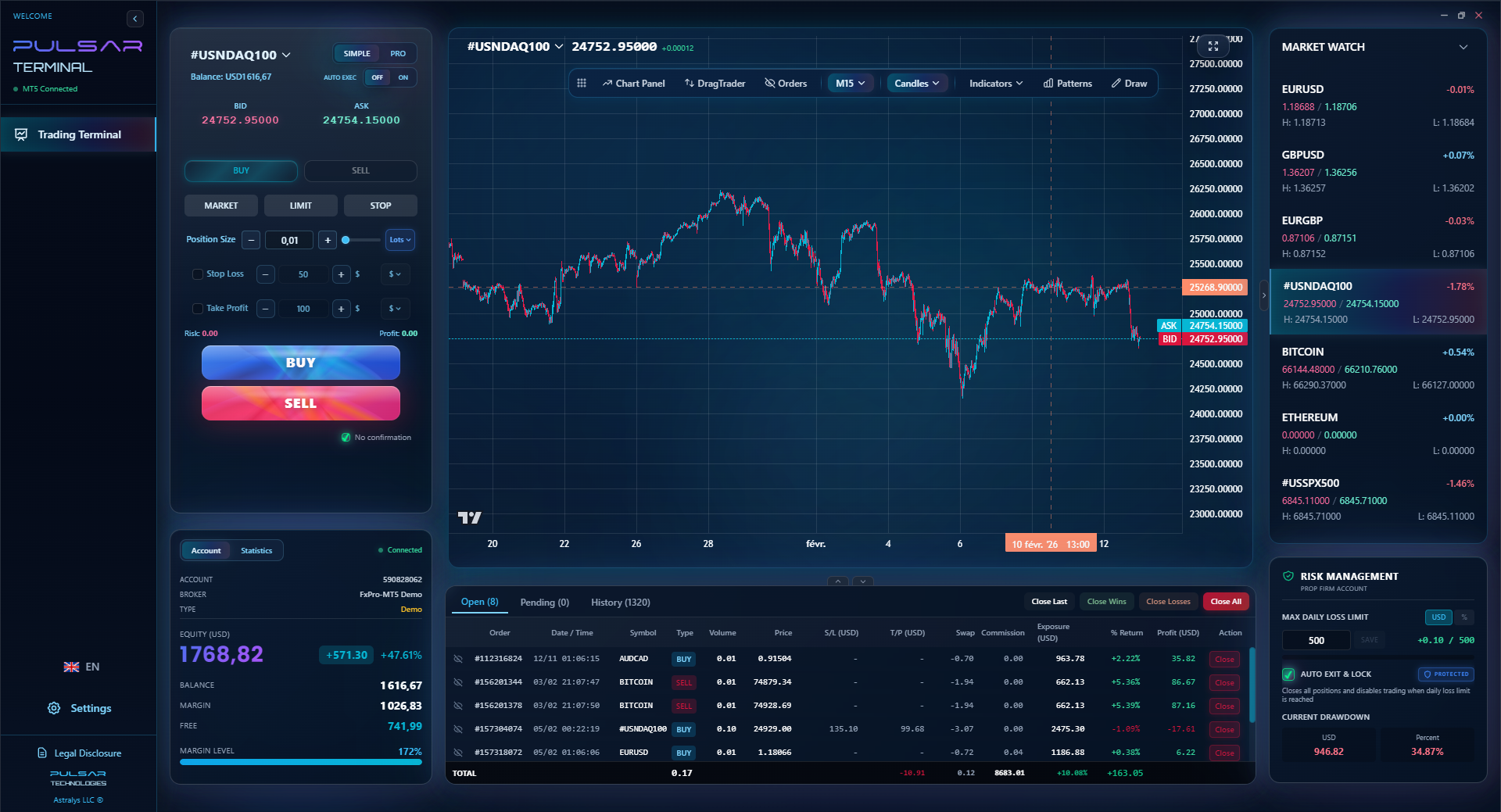
Once you've found a legitimate broker, executing trades with precision and strict risk management is key, which is where tools like Pulsar Terminal for MT5 excel.
Pulsar Terminal
L'outil MT5 tout-en-un : ordres glisser-déposer, multi-TP/SL, trailing stop, grid trading, Volume Profile et protection prop firm. Utilisé quotidiennement par 1 000+ traders.
“Real traders are too busy trading to spend all day making glamorous TikTok videos.”
First, don't feel ashamed. These people are professionals at manipulation. I've spoken to doctors, lawyers, and engineers who fell for these schemes. Your priority now is damage control and preventing it from happening again.
- Stop Sending Money: Immediately. No, they won't release your funds if you just pay 'one more fee'. That's the scam.
- Gather All Evidence: Screenshots of every conversation (WhatsApp, Facebook), transaction receipts from your bank, deposit/withdrawal records from the broker's site, the website URL, and any promotional material. Document everything with dates.
- Report to Authorities:
- SEC Nigeria: Report investment scams.
- EFCC (Economic and Financial Crimes Commission): They handle advanced fee fraud and cybercrime.
- Your Bank: Report the fraudulent transaction. They may be able to reverse it if it was recent and done via card.
- The Police: File a formal report. Get a copy.
- Manage Your Expectations: The hard truth is that recovering funds from an unregulated offshore entity is extremely difficult and often impossible. Consider the money lost. The report is more about creating a paper trail to potentially help others and for your own closure.
- Learn the Lesson: Analyze what hook got you. Was it greed (guaranteed returns)? Laziness (managed accounts)? Trust (a friend's recommendation)? Use this painful experience to build a bulletproof vetting process for the future.
The goal isn't just to get your money back (though try), it's to ensure you never have to go through this again.
💡 Conseil de Winston
Your greatest weapon against fraud is your own skepticism. Trust, but verify. Then verify again. The cost of being wrong is your capital.
“The best defense against forex scams is to become a competent trader yourself.”
The best defense against forex trading scams is to become a competent trader yourself. Scammers sell the fantasy of easy money. Real trading is the opposite: it's a difficult skill built on discipline, patience, and rigorous risk management.
Forget about 100% returns. Aim for consistency. A 10-20% annual return with strict risk management is phenomenal. Start with a demo account for at least 3-6 months. Not to 'practice winning', but to practice losing correctly. Learn how to set a stop-loss and stick to it. Learn how a spread affects your scalping strategy. Understand how news impacts XAU/USD.
When you rely on your own knowledge, you don't need a 'guru' or a 'managed account'. You become the authority on your own money. This path is slower and less glamorous than the scams promise, but it's the only one that leads to sustainable success. It turns you from a target into a professional.

Example: Let's say you start with ₦500,000. A scammer promises to double it in a month. A realistic self-taught goal might be 2% a month. In one month: Scam = you likely lose everything. Real trading = you make ₦10,000, but you still have your ₦500,000 capital to compound next month. Which outcome actually builds wealth?
Tools like Pulsar Terminal can help serious traders execute plans with precision, but no tool can replace the foundational knowledge of how markets work and how to protect yourself. Start with the basics, master your psychology, and the rest will follow.

FAQ
Q1Is forex trading itself a scam in Nigeria?
No, forex trading is a legitimate global financial market. The scam is in the fake brokers, fake educators, and fake investment schemes that surround it. Trading with a properly regulated broker is as legitimate as trading stocks.
Q2What is the most common forex scam in Nigeria right now?
The 'WhatsApp/Telegram Group' scam is rampant. You're added to a group where a 'guru' posts winning trade screenshots and pressures you to deposit into a specific unregulated broker or managed account. The profits are fake, and withdrawals are impossible.
Q3Can the SEC Nigeria help me get my money back from a scam broker?
The SEC can only act against entities they regulate. If the broker is unregistered and operating offshore, the SEC's powers are limited. You should still report it to them and the EFCC to create a record, but recovery is very difficult.
Q4Are all forex brokers not registered with the SEC scams?
Not necessarily, but your risk increases exponentially. Many reputable international brokers (like IC Markets, Pepperstone) serve Nigerian clients but are regulated abroad (e.g., ASIC, FCA). The key is that regulation must be by a credible, strict authority, not just any offshore license.
Q5I was offered a 100% deposit bonus. Is that a scam?
It's a major red flag. These bonuses almost always have restrictive terms that make withdrawing your own money nearly impossible. Legitimate brokers may offer small, reasonable welcome bonuses, but never 100%. They make money from your trading, not from trapping your deposit.
Q6How can I check if a prop firm challenge is legitimate?
Legit prop firms (like FTMO, The5%ers) are transparent about their rules, have realistic profit targets (e.g., 10% in 30 days), offer a clear refund policy on the challenge fee, and their primary goal is to find talented traders to fund. If the rules seem designed to make you fail (e.g., no stop-loss allowed, insane daily drawdown), it's a scam.
La leçon du Prof. Winston
Points clés:
- ✓Guaranteed profits are guaranteed lies.
- ✓Always verify licenses on the regulator's own website.
- ✓Test withdrawals with a small amount first.
- ✓If you feel pressured, it's a scam.
Cet article vous a-t-il été utile ?
Cliquez sur une étoile
Analyses Trading Hebdo
Analyses et stratégies hebdo gratuites. Pas de spam.
À propos de l'auteur
Olumide Adeyemi
Pionnier du Trading en Afrique de l'Ouest
L'un des formateurs de trading forex les plus actifs au Nigeria. 8 ans d'expérience de trading depuis Lagos. Spécialisé dans les stratégies à petit capital et les challenges de prop firms pour les traders africains.
Commentaires
Avertissement sur les risques
Le trading d'instruments financiers comporte des risques importants et peut ne pas convenir à tous les investisseurs. Les performances passées ne garantissent pas les résultats futurs. Ce contenu est fourni à titre éducatif uniquement et ne constitue pas un conseil en investissement. Effectuez toujours vos propres recherches avant de trader.
Vous aimerez aussi

Cara Trading Forex Sukses: 7 Prinsip dari Trader Profesional
Cara trading forex sukses dengan 7 prinsip trader pro: manajemen modal, disiplin, journal trading, backtest. Data nyata, bukan janji profit palsu.
Jam Trading Forex Terbaik untuk Trader Indonesia: Panduan Lengkap dengan Tabel Waktu
Panduan jam trading forex untuk trader Indonesia. Tabel 4 sesi dunia, jam emas 20:00-00:00, sesi mana yang harus dihindari. Data akurat + tips dari trader berpengalaman.
Top 5 Sàn Forex Uy Tín Nhất 2026: Review Jujur dari Trader Indonesia
Top 5 sàn forex uy tín 2026 untuk trader Indonesia. Review jujur: spread, deposit, withdraw, dukungan lokal. Exness, XM, IC Markets & lebih.
Obtenir Pulsar Terminal
Tous ces calculateurs sont intégrés dans Pulsar Terminal avec des données en temps réel de votre compte MT5. Dimensionnement de position en un clic, gestion automatique des risques et calculs instantanés.
Obtenir Pulsar Terminal