


Most new traders in Dhaka think the 'best' forex trading time is whenever they're free after work.

Daniel Harrington
Responsable Éditorial
☕ 10 min de lecture
Ce que vous apprendrez :
- 1Why Your Time Zone is a Secret Weapon (If You Use It Right)
- 2The Global Forex Market Sessions (Translated to BST)
- 3The Best Trading Times for BDT & Regional Pairs
- 4Matching Your Strategy to the Clock
- 5The Realistic Schedule: Juggling a Job, Sleep & Trading
- 6Essential Tools: From Simple Alarms to Advanced Terminals
- 7The Classic BD Trader Time Traps (And How to Sidestep Them)
Most new traders in Dhaka think the 'best' forex trading time is whenever they're free after work. That's a fantastic way to lose money. The market doesn't care about your 9-to-5. I've watched traders blow accounts because they traded the EUR/USD when it was dead, missing the real action in Asian pairs. This guide isn't about theory. It's about the actual clock you need to follow, the sessions that matter for BD traders, and how to structure your day around real opportunity, not convenience.
Dhaka is GMT+6. That simple fact shapes your entire trading edge. Most generic 'best time to trade' guides are written for London or New York. For you, the market opens and closes at completely different hours. The Asian session is your backyard. The Tokyo open happens at 7:00 AM Bangladesh Standard Time (BST). This is where currencies like USD/JPY, AUD/USD, and NZD/USD often see their first major moves of the day.
I learned this the hard way. Early in my career, I was trying to trade the London open (2:00 PM BST) after a full day's work. I was tired, distracted, and making emotional decisions. I switched to focusing on the Asian session before my day job began. My consistency improved overnight. The liquidity was different, the pace was more manageable, and I was fresh.
Your location isn't a disadvantage. It's a filter. It naturally pushes you towards certain sessions and instruments. The key is to lean into that, not fight it by staying up until 2 AM to catch the US close. A good position size calculator is useless if you're using it at the wrong time of day.
“Your location isn't a disadvantage. It's a filter. It naturally pushes you towards certain sessions and instruments.”
Forget GMT. Here’s the world schedule on Dhaka time. This is the map you need on your wall.
Sydney/Tokyo Session (Asian)
- Opens: ~5:00 AM BST (Sydney), 7:00 AM BST (Tokyo)
- Closes: ~2:00 PM BST
- What it means for you: This is your morning session. Volatility starts to pick up, especially in JPY pairs (USD/JPY) and the Aussie & Kiwi dollars. It's often a 'range-setting' session. Major trends from the previous US day can see reversals or continuations here. It's a great time for swing trading analysis.
London Session (European)
- Opens: 1:00 PM BST
- Overlap with Asia: 1:00 PM - 2:00 PM BST
- Peak Activity: 2:00 PM - 5:00 PM BST
- What it means for you: This is your lunchtime/early afternoon. The big money moves. Liquidity skyrockets. This is when the majority of daily forex volume happens. The EUR/USD guide becomes your bible during this window. Spreads are usually at their tightest. If you're going to trade, this 3-4 hour window is prime time.
New York Session (US)
- Opens: 7:00 PM BST
- Overlap with London: 7:00 PM - 9:00 PM BST
- What it means for you: Your evening. The London-New York overlap (7-9 PM BST) is the most volatile period of the entire 24-hour cycle. Major economic data is often released at 8:30 PM BST. This is where you can make or lose a month's profits in minutes. After 9 PM BST, liquidity drops off a cliff. Trading the late NY session alone is like trading in a ghost town.

Warning: The 'dead zone' is between 10:00 PM BST and 5:00 AM BST. This is after New York closes and before Sydney wakes up. Spreads widen, liquidity evaporates, and price can be jerked around by a single decent-sized order. Just don't do it.

💡 Conseil de Winston
Your most valuable trading tool is an alarm clock set for 12:55 PM BST. The first 15 minutes of the London open often set the tone for the entire day's trend.
“Planning your trade during chaos is a losing game.”
This is the insider knowledge. If you're trading USD/BDT, INR/BDT, or other regional crosses, the generic sessions matter less. Your market is driven by local banks and remittance flows.
Key Times for USD/BDT & Regional Crosses:
- Local Bank Hours: 10:00 AM - 4:00 PM BST. This is when Bangladeshi banks are active, setting rates and facilitating corporate flows. The most reliable quotes and liquidity occur here.
- Middle East Overlap: 9:00 AM - 1:00 PM BST overlaps with financial centers in the Gulf (like Dubai, GMT+4). This can influence flows.
- London Session Impact: From 1:00 PM BST, the global USD strength/weakness from the London session will filter through to the USD/BDT rate.
A Personal Trade: In early 2023, I noticed a consistent pattern. USD/BDT would often see a slight dip during the first hour of Dhaka bank trading (10-11 AM BST) as local demand was met, only to firm up again by midday. I set a limit order to buy on a small dip at 10:15 AM, targeting a 15-pip move by 2:00 PM. It wasn't a home run, but it was a consistent, low-stress trade that worked more often than not. The point? Find the local rhythm.
For instruments like XAU/USD guide (Gold), you need the London or New York overlap for real volume. Trading gold at 3 AM BST is a recipe for huge spreads and slippage.
“Planning your trade during chaos is a losing game.”
You wouldn't use a hammer to screw in a lightbulb. Don't use a scalping strategy in a dead session.
| Session (BST) | Recommended Strategy | Why It Works | Instruments to Focus On |
|---|---|---|---|
| 7-10 AM (Tokyo) | Breakout / Momentum | Catches the initial directional move from Tokyo open. | USD/JPY, AUD/USD, NZD/USD |
| 1-5 PM (London) | Trend Following / News Trading | Highest liquidity, strongest trends. Perfect for MACD indicator confirmation. | EUR/USD, GBP/USD, EUR/GBP |
| 7-9 PM (Ldn/NY Overlap) | Scalping strategy / Volatility | Extreme volatility from news and overlap. Quick in-and-out trades. | Major pairs, especially around news (8:30 PM BST). |
| 10 AM - 4 PM (Local) | Range Trading / Mean Reversion | USD/BDT often moves in a controlled range set by banks. | USD/BDT, other regional crosses. |
I made a classic mistake years ago. I tried to scalping strategy the GBP/USD at 11:00 AM BST. The spread was wide, and the price just chopped sideways for two hours, triggering and stopping me out repeatedly. I paid more in spreads and commissions than I could possibly make. Session dictates strategy. Always.

Pro Tip: Your first hour of trading should be analysis, not execution. Use the 7-8 AM BST window to review the overnight moves from the US, check your charts, and plan your trades for the London open. Planning during chaos is a losing game.
💡 Conseil de Winston
If you can't explain your trade setup in 30 seconds at 8 AM, you shouldn't be in it at 8 PM. Clarity beats complexity, especially when trading across time zones.
“The biggest leak for part-time traders is the 'fear of missing out' (FOMO) trade at 10:30 PM.”
Let's be blunt. You probably have a day job. Trading until 11 PM every night will burn you out and get you fired. Sustainability is more important than catching every move.
A Sample Sustainable Schedule for a Working Trader in BD:
- 6:30 AM: Wake up. Scan charts for the Asian session close and any overnight news. No trading yet.
- 7:30 - 8:30 AM: Active Trading Window 1. Focus on pre-planned setups in AUD/USD or USD/JPY from your analysis. Set orders, manage existing trades.
- 1:00 - 4:00 PM: Active Trading Window 2 (The Main Event). Your lunch break and early afternoon. This is for London session moves. This is where you concentrate your serious capital and attention.
- 7:00 - 8:30 PM: Monitoring Window. Check for any New York open volatility. If you have trades running, adjust stops (consider moving to breakeven). Maybe take one quick setup if a clear opportunity arises from news.
- After 9:00 PM: Shut it down. Close charts. The market will still be there tomorrow.
The biggest leak for part-time traders is the 'fear of missing out' (FOMO) trade at 10:30 PM. You see a spike on your phone, jump in, and then the move reverses while you're asleep, hitting your stop loss. I've lost count of how many times I've done that. Now, I use a hard stop: no new entries after 8:30 PM BST. Period. It saved my account and my sanity.
Using a broker with reliable mobile platforms and alerts, like Exness review or IC Markets review, is crucial for this lifestyle so you can check in without being chained to a desk.
“The biggest leak for part-time traders is the 'fear of missing out' (FOMO) trade at 10:30 PM.”
You can't rely on memory. You need systems.
- Session Indicator on Your Chart: This is non-negotiable. Most platforms (MT4/MT5) have free indicators that shade the chart for each session. Seeing the London open as a shaded area on your chart is a powerful visual cue.
- Phone Alarms: Set alarms for:
- 6:55 AM (5 mins before Tokyo solidifies)
- 12:55 PM (5 mins before London open)
- 7:55 PM (5 mins before NY open)
- 8:25 PM (5 mins before major US news)
- Economic Calendar with BST Timestamps: Ensure your calendar (like Forex Factory) is set to GMT+6. You should never have to convert release times.
- Broker-Specific Tools: Some brokers offer session-based tools. For example, XM review offers a 'Trading Session' widget, and Pepperstone review provides detailed market analysis timed to sessions.
Automation is the next level. Manually moving stops to breakeven or scaling out of a trade is time-consuming and emotional. Advanced trading terminals can handle these rules for you, executing them precisely based on your pre-set conditions, which is vital when you can't watch the screen every second.
💡 Conseil de Winston
Treat the 9:01 PM BST market close like your last ferry to Sadarghat. If you miss it, wait for the next one tomorrow. Trading after hours is how accounts sink.
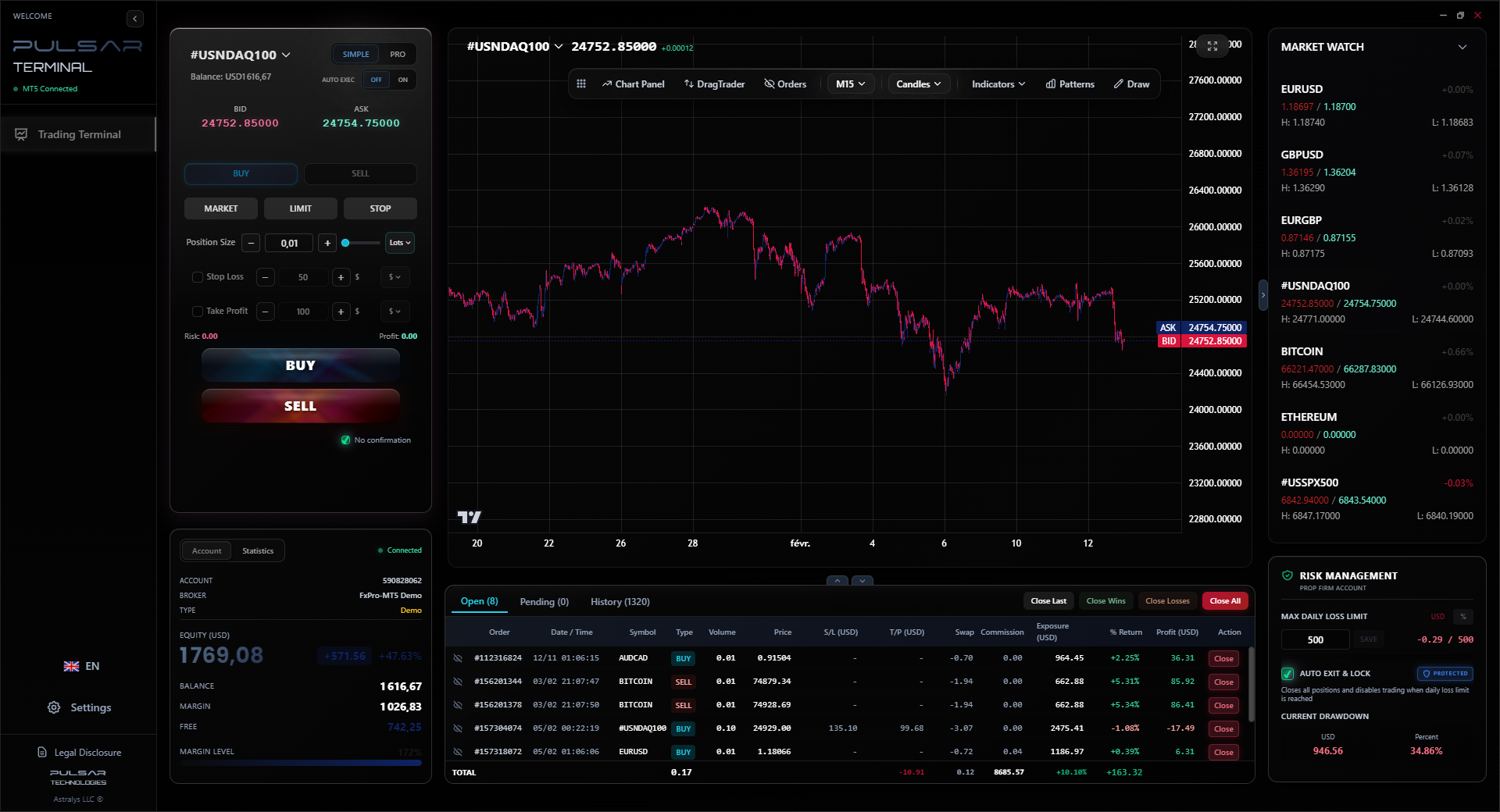
Managing trades across different sessions is exhausting, but tools like Pulsar Terminal can automate your exit strategy with multi-TP/SL and trailing stops, so you're not chained to the screen during Dhaka's late hours.
Pulsar Terminal
L'outil MT5 tout-en-un : ordres glisser-déposer, multi-TP/SL, trailing stop, grid trading, Volume Profile et protection prop firm. Utilisé quotidiennement par 1 000+ traders.
“If you can't give a news event 100% focus, don't trade it. Watching a trade go against you while you're handing out plates is a special kind of torture.”
I've fallen into every one of these. Learn from my losses.
Mistake 1: Trading the 'Ghost Session' (10 PM - 5 AM BST). The price action is fake. The spreads are criminal. The only people making money are brokers on the spread. Solution: Physically uninstall trading apps from your phone if you can't trust yourself. Use a website blocker on your computer for your broker's URL after 9 PM.
Mistake 2: Ignoring the London-New York Overlap. This is where the big daily candles are printed. Missing it means you're only trading the warm-up acts. Solution: Protect that 7-9 PM BST window in your daily schedule. Even if it's just 30 minutes of focused attention, it's better than nothing.
Mistake 3: Not Accounting for Friday Closes & Sunday Gaps. The market closes for the weekend after the NY session Friday (early Saturday BD time). News over the weekend can cause a 'gap' when it reopens Sunday 7:00 PM BST. Holding positions over the weekend is a gamble. Solution: I close all speculative positions before the NY session ends on Friday. No exceptions. The risk of a margin call from a gap is not worth the potential reward.
Mistake 4: Trading Right Before Major News During Your Work Hours. A major US jobs report at 8:30 PM BST happens during your family time or dinner. Trying to trade it while distracted is a disaster. Solution: If you can't give it 100% focus, don't trade it. Set pending orders above/below the expected volatility range before the news, or just sit it out. Watching a trade go against you while you're handing out plates is a special kind of torture.

Example: Let's say the average spread definition on EUR/USD is 0.8 pips during London, but widens to 3.5 pips at 3 AM BST. If you're scalping for a 5-pip target, you're giving away 70% of your potential profit to the spread before you even start. That's a losing business model.
FAQ
Q1What is the absolute best forex trading time in Bangladesh for beginners?
Hands down, the London session from 1:00 PM to 4:00 PM BST. The markets are most liquid, spreads are tight, and price action is cleaner and less prone to random manipulation than the late-night sessions. It's also a realistic time for someone with a day job to trade during a lunch break.
Q2Can I trade forex in Bangladesh on weekends?
No. The global interbank forex market is closed from Friday evening (NY close) until Sunday evening (BST). Some brokers might offer CFD trading on cryptocurrencies or other assets over the weekend, but major forex pairs are closed. Any platform claiming to offer real forex trading on Saturday is misleading you.
Q3I have a full-time job. What's the maximum 1-hour window I should focus on?
The first hour of the London-New York overlap: 7:00 PM to 8:00 PM BST. This one hour packs in immense volatility and volume. Dedicate this hour solely to trading: no distractions, no phone calls. Plan your trade during the day, then execute and manage in this window.
Q4How does Ramadan affect forex trading times in Bangladesh?
It doesn't affect the global market hours, but it drastically affects your capacity. Your energy and focus will be different if you're fasting. During Ramadan, I drastically reduce my position sizes and often switch to longer-term swing trades that require less screen time, rather than intense London session scalping. Listen to your body.
Q5Is the Asian session (morning in BD) good for trading EUR/USD?
Generally, no. It's often the slowest time for that pair. The EUR/USD frequently consolidates in a tight range during the Asian session (5 AM - 1 PM BST). The real moves happen when London wakes up. You're better off using the Asian session to analyze and plan your EUR/USD trades for later.
Q6What's the biggest mistake BD traders make with trading times?
Trading when they're tired, just because the market is open. The New York session starts at 7 PM BST. After a long day, your decision-making is impaired. Chasing action in the late-night (post-9 PM) 'zombie market' is the single fastest way to give your money back to the broker via wide spreads and erratic price moves.
La leçon du Prof. Winston
Points clés:
- ✓London Session (1-5 PM BST) is your primary profit window.
- ✓Never trade the 'ghost session' (10 PM - 5 AM BST).
- ✓Match your strategy to the session's liquidity.
- ✓Automate time-based tasks with alerts and tools.
- ✓Protect your sleep more fiercely than your stop-loss.
Cet article vous a-t-il été utile ?
Cliquez sur une étoile
Analyses Trading Hebdo
Analyses et stratégies hebdo gratuites. Pas de spam.
À propos de l'auteur
Daniel Harrington
Responsable Éditorial
Responsable du contenu chez The Trading Mentor. Trader expérimenté passionné par la vulgarisation des concepts de trading complexes. Couvre les sujets globaux, stratégies et guides de plateformes.
Commentaires
Avertissement sur les risques
Le trading d'instruments financiers comporte des risques importants et peut ne pas convenir à tous les investisseurs. Les performances passées ne garantissent pas les résultats futurs. Ce contenu est fourni à titre éducatif uniquement et ne constitue pas un conseil en investissement. Effectuez toujours vos propres recherches avant de trader.
Vous aimerez aussi

Cara Trading Forex Sukses: 7 Prinsip dari Trader Profesional
Cara trading forex sukses dengan 7 prinsip trader pro: manajemen modal, disiplin, journal trading, backtest. Data nyata, bukan janji profit palsu.
Jam Trading Forex Terbaik untuk Trader Indonesia: Panduan Lengkap dengan Tabel Waktu
Panduan jam trading forex untuk trader Indonesia. Tabel 4 sesi dunia, jam emas 20:00-00:00, sesi mana yang harus dihindari. Data akurat + tips dari trader berpengalaman.
Top 5 Sàn Forex Uy Tín Nhất 2026: Review Jujur dari Trader Indonesia
Top 5 sàn forex uy tín 2026 untuk trader Indonesia. Review jujur: spread, deposit, withdraw, dukungan lokal. Exness, XM, IC Markets & lebih.
Obtenir Pulsar Terminal
Tous ces calculateurs sont intégrés dans Pulsar Terminal avec des données en temps réel de votre compte MT5. Dimensionnement de position en un clic, gestion automatique des risques et calculs instantanés.
Obtenir Pulsar Terminal