


Thinking about signing up for forex trading training in Delhi? You're probably wondering if it's worth the money, if it's even legal, and if you'll actually learn how to make a profit.
Rajesh Sharma
Analyste Forex Senior ·  India
India
☕ 10 min de lecture
Ce que vous apprendrez :
- 1The Legal Maze: What You Can Actually Trade From Delhi
- 2Decoding Course Options and Real Costs
- 3Beyond the Brochure: What Makes a Training Worthwhile?
- 4The Broker Reality Check: Platforms and Costs
- 5My Personal Journey (And Costly Mistakes)
- 6Building Your Own Plan: The Self-Training Alternative
- 7Final Verdict and Your Next Steps
Thinking about signing up for forex trading training in Delhi? You're probably wondering if it's worth the money, if it's even legal, and if you'll actually learn how to make a profit. I get it. The ads promise financial freedom, but the reality for Indian traders is a lot more complicated. I've been trading for over 12 years, and I've seen countless students from Delhi get excited, then confused, then burned. Let's cut through the hype. This isn't about finding the 'best' course. It's about understanding the unique legal maze we trade in, spotting the difference between education and a sales pitch, and building skills that actually work with Indian regulations and psychology.
Before you spend a single rupee on training, you need to know the rules of the game. This is the most critical part, and most training institutes gloss over it because it's not sexy. The Reserve Bank of India (RBI) and SEBI are very clear on this.
You are legally allowed to trade currency derivatives on Indian exchanges like the NSE or BSE. That means pairs like USD/INR, EUR/INR, GBP/INR, and JPY/INR. These are futures and options contracts, not the spot forex you see in YouTube videos from the US or UK.
Trading international pairs like EUR/USD or GBP/JPY on an offshore broker's platform? That's a grey area at best, and explicitly prohibited under FEMA rules. The RBI has an 'Alert List' of unauthorized platforms for a reason. I'm not here to scare you, but to inform you. Many trainers will conveniently skip this detail when showing you their MetaTrader 5 platform running EUR/USD charts.

Warning: Using the Liberalised Remittance Scheme (LRS) to fund an international trading account for speculative forex trading is against RBI guidelines. I've known traders who had their bank accounts flagged for this. The risk is real.
The brokers you can use legally for INR pairs are the usual Indian stockbrokers: Zerodha, Angel One, Upstox, ICICI Direct, and others. For everything else, you're looking at international brokers like Exness or IC Markets, which operate in that regulatory grey zone. Any worthwhile forex trading training in Delhi must start with this honest conversation about jurisdiction and risk.
So, what are you actually paying for? Let's break down the typical offerings and their price tags. Remember, a high price doesn't equal high quality.
The Price Spectrum
You'll see everything from ₹10,000 weekend workshops to ₹1,00,000+ 'mastermind' programs. Here's the reality:
- Beginner Courses (₹10k - ₹20k): These cover the absolute basics: what is a pip, how to read a candlestick, maybe an intro to an indicator like the RSI. They're often info you can find for free, but packaged with some structure.
- Intermediate Courses (₹20k - ₹50k): This is where you get into strategy. They might teach a specific method, like a scalping strategy or price action. The value here depends entirely on the instructor's proven track record, not their salesmanship.
- Advanced/"Pro" Courses (₹50k+): These promise the 'secrets' – often proprietary indicators, direct mentorship, or signals. Be extremely skeptical. I once paid ₹65,000 for a course that promised a 'guaranteed' system. The system was just a basic Moving Average crossover with fancy branding. The only thing guaranteed was my loss.
Hidden Fees to Watch For
Ask upfront about:
- Registration fees (₹1k-₹5k)
- Certification exam fees (₹2.5k-₹3k)
- Cost of required software or data feeds (this can be a recurring monthly charge)

Pro Tip: Before enrolling, ask the institute for a verified, audited track record of their head trainer's personal trading. Not a simulated account, not a 'student's' result, but their own brokerage statement. If they hesitate, walk away.
The real value in any forex trading training in Delhi isn't in a magic indicator. It's in learning strong risk management, understanding how to use a position size calculator, and developing the discipline to follow a plan. That's what separates the 90% who lose from the 10% who survive.

💡 Conseil de Winston
A course that doesn't spend at least a full day on position sizing and stop-loss placement is teaching you to build a car without brakes. Walk away.
“The real value in any training isn't in a magic indicator. It's in learning how to lose small, win consistently, and not blow up your account.”
Forget the glossy photos and testimonials. Here’s what to look for in a genuine program.
1. Regulation-First Curriculum: Does the course dedicate serious time to Indian regulations, tax implications (like GST on brokerage, tax on trading income), and the practicalities of funding and withdrawing from both Indian and international brokers? If it doesn't, it's teaching you to drive without telling you the traffic laws.
2. Psychology Over Prediction: Any trainer who focuses on predicting the market is selling fantasy. The best training I ever had (after my expensive mistake) spent 40% of the time on market psychology and trade journaling. Learning to manage your greed and fear is more valuable than 100 technical patterns.
3. Live Market Analysis, Not Just Recorded Lectures: Can you watch the instructor analyze the live USD/INR or EUR/USD market? Do they show their thought process, including when they're wrong? I remember a session where the trainer was waiting for a setup on XAU/USD. It didn't form. Instead of forcing a trade, he said, 'No trade is a good trade today,' and ended the session. That taught me more than any winning trade call.
4. Post-Course Support: What happens after the last day? Is there a community, a mentorship check-in, or are you on your own? Learning to trade is a process, not an event.
The core of good forex trading training in Delhi should be about building a sustainable process. It's about learning how to lose small, win consistently, and not blow up your account. That's the unsexy truth no flashy ad will ever show you.
Your training will likely demo on MetaTrader 4 or 5. But which broker will you actually use? This decision impacts your costs and your odds.
For INR Pairs (Legal Route): You'll use your stock trading account. Platforms are often proprietary (like Zerodha's Kite). The spreads are built into the futures pricing. It's straightforward and fully legal.
For International Pairs (Grey Area): This is where cost matters. Spreads and commissions eat into your profits. Let's use real numbers from some commonly used international brokers:
| Broker | Account Type | Typical EUR/USD Spread | Commission (per lot) | Min. Deposit |
|---|---|---|---|---|
| IC Markets | Raw Spread | 0.0 pips | $3.50 per side | ~$200 (₹16.6k) |
| XM | Standard | 1.7 pips | None | $5 (₹415) |
| Pepperstone | Razor | 0.0 pips | AUD $3.50 per side | $200 (₹16.6k) |
See the trade-off? Low spread accounts charge commissions. 'Commission-free' accounts have wider spreads. If you're a high-volume scalping strategy user, the Raw/Razor account is cheaper. If you trade a few times a week, a standard account might be simpler.
I started with a 'commission-free' broker. My first profitable month, I made $300. But when I calculated the total spread costs on all my trades, it came to over $270. I was basically working for the broker. I switched to a low-commission model like IC Markets and my net profitability jumped immediately.

Example: You buy 1 standard lot (100,000 units) of EUR/USD. On a 'commission-free' account with a 1.8 pip spread, your cost to enter is $18 (1.8 pips * $10 per pip). On a raw account with a 0.1 pip spread and $7 total commission, your cost is $8 ($1 spread cost + $7 commission). You save $10 on that single trade entry.
💡 Conseil de Winston
The most valuable page in any trading journal is the one where you dissect your worst loss. That's where the real training happens.
“I lost ₹1,85,000 in three days. The training didn't teach risk management, only prediction.”
Let me be vulnerable. My path wasn't a straight line up. I lost money before I found my footing, and training played a big part in both the loss and the recovery.
The Mistake (2015): Freshly motivated, I enrolled in a 'premium' forex trading training in Delhi for ₹72,000. The trainer had flashy cars in his promo video. He taught a complex system involving multiple harmonic patterns and a custom indicator he sold separately for ₹15,000. I was overconfident. I funded an account with ₹2,00,000. I took a trade on GBP/JPY based on a 'perfect' pattern. The market moved against me. The system said to 'add to the position' to average down. I did. I didn't have a hard stop-loss because the trainer said 'the pattern will work.' I got a margin call. I lost ₹1,85,000 in three days. The training didn't teach risk management, only prediction.
The Turnaround (2017): Humbled and with less capital, I took a simpler, cheaper course focused on swing trading and, crucially, risk management. The core rule was never to risk more than 1% of my account on a trade. I started with ₹50,000. My first 10 trades: 6 losers, 4 winners. But my biggest loss was ₹500 (1%). My biggest win was ₹900. I was down net ₹60, but my account was intact. The psychology changed. I wasn't scared.
A Real Trade Example: In 2020, I saw a setup on USD/INR futures. Price was at 74.20, showing rejection at a key weekly level. My analysis said short. I entered at 74.18 with a stop at 74.45 (risk of 27 paise). My position size, using my position size calculator, was 150 lots (since the lot size is $1000, I was risking about 1% of my account). I took half profits at 73.90 (28 paise profit) and let the rest run. The trade eventually hit my trailing stop at 73.50. That one trade, managed properly, netted a significant gain because my risk was defined from the start. The training that worked taught me that entry is only 20% of the battle. The 80% is management and psychology.
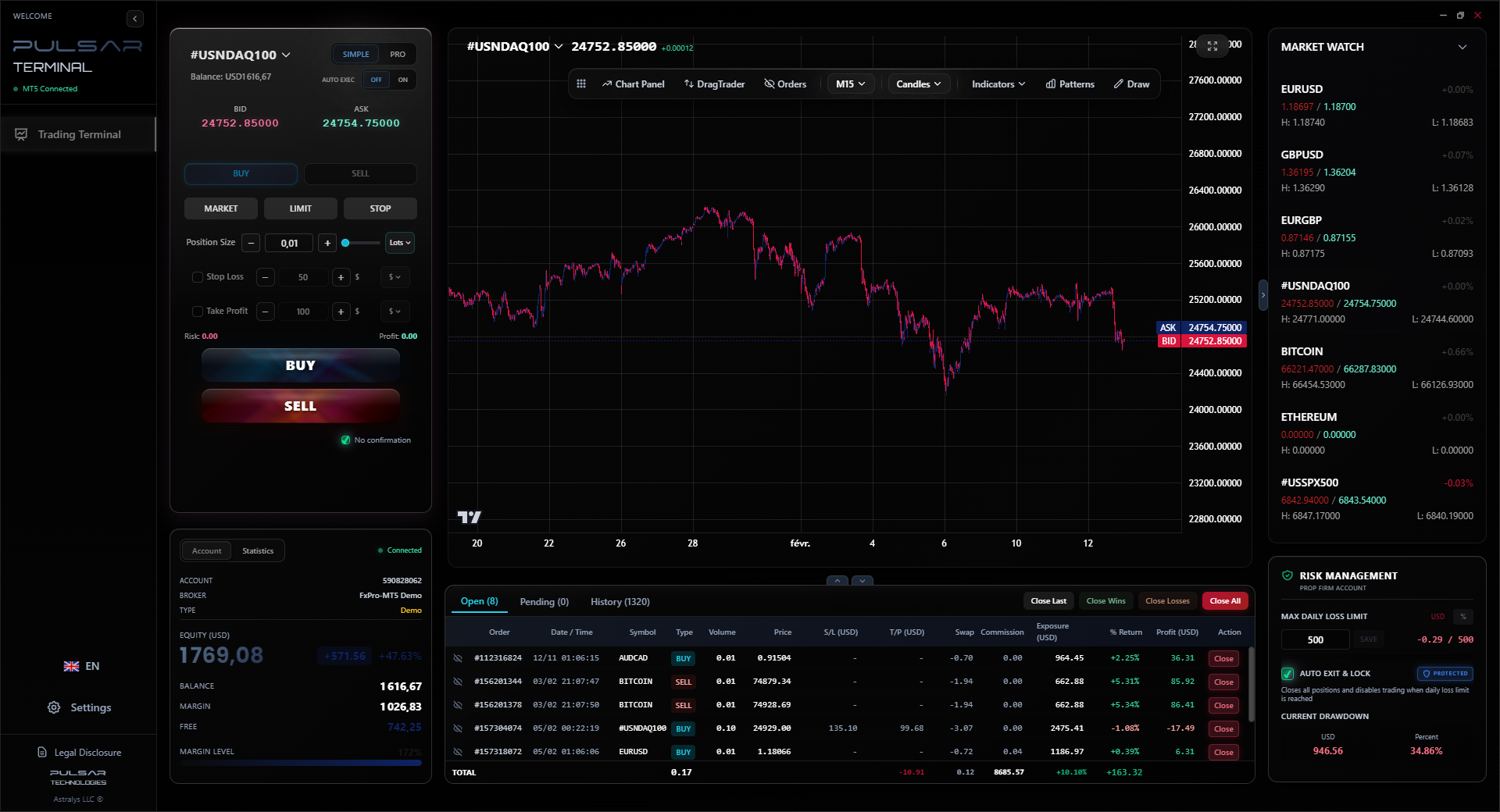
Managing complex trades with multiple profit targets and a trailing stop, like the USD/INR example I shared, is far easier with a tool that lets you set and forget those rules directly on your MT5 chart.
Pulsar Terminal
L'outil MT5 tout-en-un : ordres glisser-déposer, multi-TP/SL, trailing stop, grid trading, Volume Profile et protection prop firm. Utilisé quotidiennement par 1 000+ traders.
Formal forex trading training in Delhi isn't the only path. With discipline, you can train yourself for a fraction of the cost.
The Free/Cheap Curriculum:
- Basics: Learn about the spread, pips, and lot sizes from free broker education hubs.
- Analysis: Deep-dive into one or two indicators. Truly master the MACD indicator or RSI. Don't collect 20 of them.
- Strategy: Paper trade a simple strategy for 3-6 months. Document every trade in a journal. Why did you enter? Where was your stop? How did you feel?
- Risk Management: This is non-negotiable. Make a rule: 'I will never risk more than X% per trade' and stick to it. Use a calculator for every single trade.
The Community Angle: Join online trading communities (discord servers, Telegram groups focused on analysis, not signals). Listen to how experienced traders think. The value is in the dialogue, not the tips.
Self-training requires immense honesty. You have no one to blame but yourself. But it also means you develop a style that fits you, not a cookie-cutter system from a trainer. You learn by doing, and by losing small amounts in a demo account, not by losing lakhs in the live market trying to follow someone else's method.
💡 Conseil de Winston
If you can't explain your trade setup in one simple sentence, you don't understand it well enough to risk money on it. Complexity is the enemy of execution.
“The market will be here tomorrow. There's no rush. The biggest mistake you can make is to rush in with real money, fueled by hype.”
So, is forex trading training in Delhi worth it? It can be, but only if you choose with your eyes wide open.
Consider training IF:
- The institute is transparent about Indian regulations.
- The focus is on risk management and psychology.
- You can verify the trainer's own trading competence.
- You treat the fee as an investment in education, not a ticket to guaranteed profits.
Skip the training and go self-taught IF:
- You are highly disciplined and a self-starter.
- You are willing to spend months paper trading and studying.
- You are skeptical of 'gurus' and quick riches.
Whatever path you choose, start small. Open a demo account with a broker like XM or Pepperstone to practice international pairs, or a practice account with Zerodha for INR pairs. Apply what you learn with zero risk first.
The market will be here tomorrow. There's no rush. The biggest mistake you can make is to rush in with real money, fueled by hype from an expensive course. Get the knowledge, practice the discipline, and then, only then, commit your hard-earned capital. That's the real training no one can sell you, but everyone needs to pass.
FAQ
Q1Is forex trading legal in Delhi?
Yes, but with strict limits. Trading INR-based pairs (like USD/INR) as futures/options on Indian exchanges (NSE, BSE) is fully legal. Trading international forex pairs (like EUR/USD) on offshore platforms operates in a regulatory grey area and is not permitted under RBI's FEMA rules.
Q2How much does a good forex trading course in Delhi cost?
Prices vary wildly. Basic courses range from ₹10,000-₹20,000. More complete programs can cost ₹35,000-₹75,000. Be wary of courses over ₹1,00,000 promising 'secrets' – the value is rarely in the price tag but in the focus on risk management and legal realities.
Q3Can I use international brokers like IC Markets or XM from Delhi?
Technically, yes, many Indian traders do. However, it's important to understand that these brokers are not regulated by SEBI for this activity in India. You onboard with their offshore entity. The RBI does not approve of using the LRS to fund such accounts for speculative trading, so there is legal and financial risk involved.
Q4What is the success rate for forex traders in India?
There are no official India-specific stats, but global data is telling. Major international brokers report that between 70% and 90% of retail traders lose money. The success rate is low because most people underestimate risk management, overtrade, and let emotions drive decisions. Good training aims to beat these odds.
Q5What should I look for in a forex trading instructor?
Look for transparency. A good instructor will talk openly about losses, Indian regulations, and psychology. Ask for a verified record of their personal trading. Avoid anyone who focuses only on winning trades, uses luxury goods as marketing, or pressures you to buy expensive add-ons like 'secret' indicators.
Q6Is it better to learn forex trading online or in a classroom in Delhi?
It depends on your learning style. Classroom training offers direct interaction. However, high-quality online courses from international educators can be just as good, often cheaper, and more flexible. The key isn't the medium, but the content's focus on process, risk, and realistic market education.
La leçon du Prof. Winston
Points clés:
- ✓Legal first: Master USD/INR before touching EUR/USD.
- ✓Risk a maximum of 1% of capital per trade. No exceptions.
- ✓A ₹20,000 course on psychology beats a ₹1,00,000 course on prediction.
- ✓Your broker's spread is your first opponent. Choose wisely.
- ✓Document every trade. Your journal is your best teacher.
Cet article vous a-t-il été utile ?
Cliquez sur une étoile
Analyses Trading Hebdo
Analyses et stratégies hebdo gratuites. Pas de spam.
À propos de l'auteur
Rajesh Sharma
Analyste Forex Senior
Plus de 10 ans d'expérience sur les marchés indiens et sud-asiatiques. A débuté avec les dérivés de change du NSE avant de passer au forex international. Spécialiste des paires USD/INR et des marchés émergents.
Commentaires
Avertissement sur les risques
Le trading d'instruments financiers comporte des risques importants et peut ne pas convenir à tous les investisseurs. Les performances passées ne garantissent pas les résultats futurs. Ce contenu est fourni à titre éducatif uniquement et ne constitue pas un conseil en investissement. Effectuez toujours vos propres recherches avant de trader.
Vous aimerez aussi

Cara Trading Forex Sukses: 7 Prinsip dari Trader Profesional
Cara trading forex sukses dengan 7 prinsip trader pro: manajemen modal, disiplin, journal trading, backtest. Data nyata, bukan janji profit palsu.
Jam Trading Forex Terbaik untuk Trader Indonesia: Panduan Lengkap dengan Tabel Waktu
Panduan jam trading forex untuk trader Indonesia. Tabel 4 sesi dunia, jam emas 20:00-00:00, sesi mana yang harus dihindari. Data akurat + tips dari trader berpengalaman.
Top 5 Sàn Forex Uy Tín Nhất 2026: Review Jujur dari Trader Indonesia
Top 5 sàn forex uy tín 2026 untuk trader Indonesia. Review jujur: spread, deposit, withdraw, dukungan lokal. Exness, XM, IC Markets & lebih.
Obtenir Pulsar Terminal
Tous ces calculateurs sont intégrés dans Pulsar Terminal avec des données en temps réel de votre compte MT5. Dimensionnement de position en un clic, gestion automatique des risques et calculs instantanés.
Obtenir Pulsar Terminal