


Over 70% of Nigerian traders who sign up with a forex broker will blow their first account within six months.

Olumide Adeyemi
Pionnier du Trading en Afrique de l'Ouest ·  Nigeria
☕ 10 min de lecture
Ce que vous apprendrez :
- 1What You're Actually Signing Up For
- 2The Nigerian Trader's Reality
- 3Broker Websites: Reading Between the Lines
- 4The Trading Platform: MT4 vs. MT5 & Beyond
- 5The Hidden Costs: It's More Than the Spread
- 6Red Flags & Green Lights: How to Vet a Site
- 7My Current Shortlist for Nigerian Traders (2026)
- 8What to Do in Your First 48 Hours on a New Site

Over 70% of Nigerian traders who sign up with a forex broker will blow their first account within six months. It's not just about skill, it's about picking the right battlefield. The website you choose dictates your costs, your tools, and , your survival. Let's cut through the marketing fluff and look at what these platforms actually offer someone trading from Lagos, Abuja, or Port Harcourt.
When you hear 'forex trading website,' you're really talking about two connected things: the broker's client portal and the trading platform. The portal (like your Exness or IC Markets personal area) is where you deposit, withdraw, and manage your account. The platform (almost always MT4 or MT5) is where the actual trading happens. Most beginners get this confused.
I've seen traders spend weeks comparing spreads on broker websites, only to realize the platform's execution is so slow it costs them more in slippage than they saved. Your broker's website is just the front door. The real work happens on the charts. The best forex trading websites integrate these two parts seamlessly, giving you clear reporting on your portal and stable, fast trade execution on the platform.

Warning: A flashy website with promises of 500:1 use means nothing if their withdrawal process takes two weeks and requires you to send a notarized utility bill to Cyprus. Always test the deposit and withdrawal process with a small amount first.
Trading from Nigeria isn't the same as trading from London or Sydney. Our unique challenges start with funding. The CBN's policies on FX flows aren't aimed at retail traders, but they sure affect us. In 2023, I had a $2,000 withdrawal from a well-known broker get stuck for 18 days because my bank flagged it. The broker had sent it, but our local systems created the bottleneck.
Payment Methods That Actually Work
Forget what works globally. Here's what works here, right now:
- Local Bank Transfer: Still the most reliable for larger amounts, but expect delays (1-5 business days) and possible questions from your bank.
- Cryptocurrency (USDT): This has become my primary method. Deposits are near-instant, and withdrawals to my Binance wallet take under an hour. The spread on converting Naira to USDT is your main cost.
- Debit Cards: Hit or miss. Some banks block international merchant transactions to 'forex' companies. GTBank has been more consistent for me than Zenith for card deposits.
Your choice of forex trading websites must hinge on their Nigerian-friendly payment rails. A broker with tight spreads is useless if you can't fund your account. I prioritize brokers with direct Naira deposit options or seamless crypto gateways.

Pro Tip: Always keep a screenshot or transaction ID when you deposit. When you contact support (and you will), having that reference number ready saves hours of back-and-forth.

💡 Conseil de Winston
Your broker's website is a shop window. Judge them by their back office - the withdrawal process. That's where their true colors show.
“Your broker's website is just the front door. The real work happens on the charts.”
Let's be honest, every broker website screams 'tight spreads' and 'fast execution.' Your job is to decode the marketing. Here's a real comparison based on my accounts and student experiences over the last year.
| Feature | What the Website Says | What It Actually Means (For You) |
|---|---|---|
| Spreads from 0.0 pips | "Ultra-low latency trading" | Usually on a separate 'Raw' or 'ECN' account that charges a commission per lot. Your total cost = spread + commission. Calculate it. |
| use up to 1:2000 | "Trade with more power" | This is a risk trap, not a benefit. A 1:500 use means a 0.2% move against you can wipe out your margin. I never use above 1:30 for swing trading. |
| No Deposit/Withdrawal Fees | "Keep more of your profits" | Often true for deposits, but some hit you with a $20-30 fee on withdrawals under a certain amount. Check the Terms. |
| Instant Execution | "Get your price fast" | This can mean two things: true Market Execution (your order is filled at the next available price, maybe with slippage) or Instant Execution (your order is rejected if the price moves). Know which one you're getting. |
My biggest mistake early on? I signed up with a broker because their website advertised 'award-winning support.' When I had a margin call issue at 2 AM Nigerian time, their '24/7' support was a chatbot and an email ticket that took 48 hours to answer. The lesson? Test support with a dummy question before you deposit real money.

This is your cockpit. In Nigeria, 9 out of 10 traders use MetaTrader. It's the standard for a reason: stable, familiar, and supports automated trading (EAs). But the broker's website determines which version you get and how well it's supported.
MT4 is the old faithful. Every strategy, indicator, and EA you find online is built for it. Its order management is simple. For pure forex, especially if you're into scalping, it's often enough. MT5 is the newer, more powerful brother. It handles more asset classes (stocks, futures) and has a better backtesting engine. But, some older EAs don't work on it.
Here's the kicker: some broker websites automatically push you to MT5, but their server infrastructure for it might be worse than their MT4 setup. I have an account with a major broker where my MT5 platform disconnects during high volatility, but my MT4 on the same broker is rock solid. It's infuriating.
The platform is where you'll use tools like the RSI indicator or MACD indicator, so its reliability is non-negotiable. Download the demo from the broker's website and run it for a week during London and New York sessions. Watch for 'requotes' (price rejections) and execution speed.

Example: Let's say you're trading EUR/USD. A 1-pip spread difference might seem small. But if you're trading 2 standard lots, that's a $20 difference on entry and exit. Over 100 trades a month, that's $2,000 in extra cost. The platform's execution directly impacts the spread you actually get.
“A broker with tight spreads is useless if you can't fund your account from Lagos.”
Broker websites love to headline the spread. Smart traders know that's only part of the story. Let's break down where your money really goes.
Swap Rates (Overnight Funding): This is the interest paid or earned for holding a position past 5 PM EST. If you're buying a currency with a lower interest rate than the one you're selling, you pay swap. These rates change daily and are set by the broker. I once held a GBP/JPY sell position for two weeks, thinking my analysis was golden. I was right on direction, but the daily swap fee ate 45% of my eventual profit. I won the battle but lost the war on costs. Always check the swap calculator on your platform before holding a trade for multiple days.
Slippage: This is the difference between your expected entry price and your actual filled price. It happens during news events or slow execution. A bad forex trading website (or more accurately, their servers) can make this chronic. On a volatile day like during an NFP report, I've seen 3-5 pip slippage on some brokers, while others with better tech had less than 1 pip.
Inactivity Fees: Buried in the terms, some brokers will charge you $5-15 per month if you don't trade for 3-6 months. If you're a part-time trader, this matters.
Your first tool for managing these hidden costs should be a solid position size calculator. It forces you to account for the real distance to your stop-loss, which includes the spread and potential slippage.
💡 Conseil de Winston
A demo account tells you if the platform works. A live account with a minimum deposit tells you if the *broker* works. Do both.

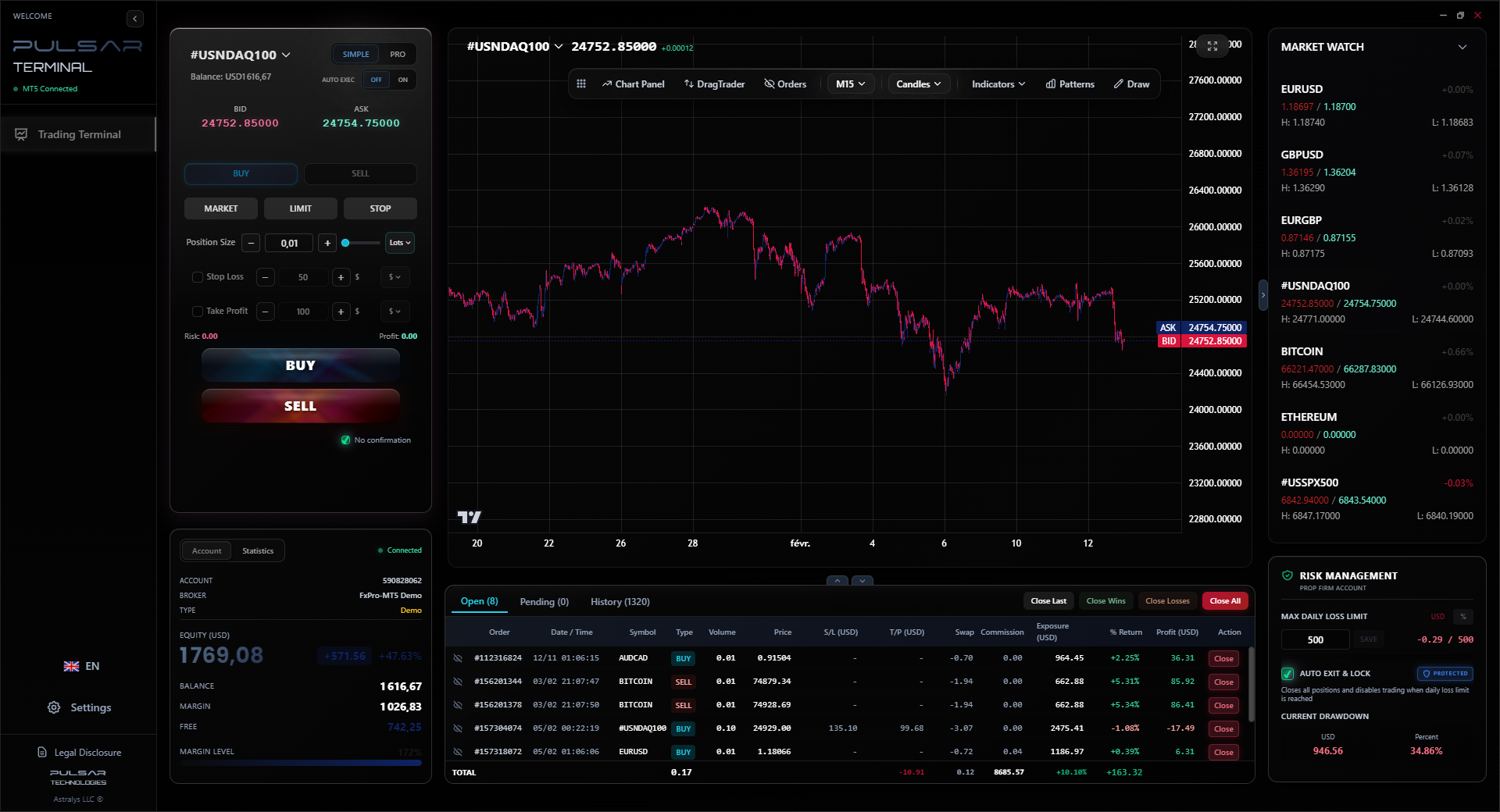
Managing multiple trades and complex exits on MT4/MT5 is clunky, but tools like Pulsar Terminal add drag-and-drop orders and multi-TP/SL management directly onto your broker's platform.
Pulsar Terminal
L'outil MT5 tout-en-un : ordres glisser-déposer, multi-TP/SL, trailing stop, grid trading, Volume Profile et protection prop firm. Utilisé quotidiennement par 1 000+ traders.
After 12 years and helping hundreds of Nigerian traders, here's my blunt checklist.
Red Flags (Walk Away):
- The website has no clear regulatory information (FCA, CySEC, ASIC) listed, or it only shows offshore regulators like St. Vincent. This is a no-go.
- The 'Contact Us' page only has a form, no physical address or phone number.
- They promise guaranteed profits or 'signals' with 90% accuracy. This is pure fantasy.
- The registration process doesn't ask for any KYC (Know Your Customer) documents. A legitimate broker will eventually ask for your ID and proof of address.
Green Lights (Good Signs):
- Clear, detailed information on spreads, commissions, and swap rates for each account type.
- Multiple, Nigeria-relevant deposit methods (local transfer, specific e-wallets).
- A detailed FAQ section that addresses African or Nigerian clients specifically.
- They offer a demo account that doesn't expire after 30 days. You want to test long-term.
- Positive, verifiable reviews from other Nigerian traders on independent forums (not just the testimonials on their own site).
I learned the hard way with a now-defunct broker. Their website was slick, registration was easy, and deposits worked. Withdrawals? Impossible. They'd ask for more documents, then more, then stop replying. I lost $1,500. The red flag was there: their only regulator was in a Caribbean island with no financial oversight reputation. I ignored it for the promise of low spreads.

“The single most important test is to deposit the minimum, then immediately try to withdraw it.”
Based on live trading, funding ease, and platform stability over the last 18 months, here are the forex trading websites I use or recommend to my serious students. This isn't sponsored, it's from my journal.
- Exness: I keep a scalping account here. Why? Their Naira deposit/withdrawal via local transfer is consistently the fastest I've used (often same-day for withdrawals). Their spreads on majors are genuinely tight, and their MT4 platform is stable. I've had issues with their customer service being slow, but the operational reliability is top-tier. Check our full Exness review for more details.
- IC Markets: This is my main swing trading account. Their Raw Spread account gives me true ECN pricing. Execution is excellent. Funding via cryptocurrency (USDT) is seamless. The downside? Withdrawals back to a Nigerian bank can be slower and involve more paperwork than Exness. Their IC Markets review details their strong international regulation.
- XM: I recommend this to absolute beginners. Why? Their educational resources are genuinely good, and their minimum deposit is low. Their platform is simple and they offer a lot of support. The trade-off? Their spreads are generally higher than the first two. For a beginner learning the ropes and trading micro-lots, that's an acceptable cost for the hand-holding. Our XM review breaks down their account types.
I also have experience with Pepperstone and FXTM. Pepperstone has fantastic tech but can be trickier to fund from Nigeria. FXTM is solid but their spreads weren't as competitive for my style. Your choice must align with your trading size, style, and patience for processing payments.
💡 Conseil de Winston
If you're spending more time frustrated with deposits and platform glitches than analyzing charts, you're on the wrong website. Your edge evaporates there.

You've picked a site and registered. Don't deposit yet. Follow this drill.
Day 1:
- Download the trading platform (MT4/5) and log into the demo account they provided.
- Place 10-20 market orders on different pairs at different times of day. Note the execution speed and any requotes.
- Test the platform's tools. Draw trendlines, use indicators, set alerts. Is it laggy?
- Contact customer support via live chat with a simple question (e.g., 'What are your swap rates for EUR/USD?'). Gauge their response time and knowledge.
Day 2:
- Make a minimum deposit. Don't go big. Use your intended funding method.
- Immediately request a withdrawal of that same amount (or a portion of it). This is the single most important test. You need to know the withdrawal process, how long it takes, and if there are any hidden fees.
- Only after that withdrawal lands back in your account should you consider funding to trade for real.
This process saved one of my students from a nightmare. He deposited $500, passed the withdrawal test, then funded $5,000. Two months later, when he needed to pull out profits for an emergency, the process was smooth because he'd already proven it worked. It's boring, but it's essential discipline. Your trading edge starts with a reliable foundation, not just a good chart pattern.

FAQ
Q1Is forex trading legal in Nigeria?
Yes, trading with internationally regulated brokers is legal for individuals. The Central Bank of Nigeria (CBN) doesn't license these brokers, but it also doesn't prohibit you from using them. The key is that you're engaging with a company outside Nigeria, regulated by a reputable foreign authority like the UK's FCA or Cyprus's CySEC.
Q2What is the minimum amount I need to start trading forex in Nigeria?
You can start with as little as $10-$50 on some brokers. But realistically, I tell my students not to trade live with less than $200. Why? With a small account, your position size becomes so tiny that trading psychology goes out the window, and you're more likely to over-use to see meaningful gains. Start with a demo, then fund with an amount you can afford to lose without it affecting your life.
Q3Which is better for Nigerian traders, MT4 or MT5?
For pure forex beginners, MT4 is simpler and has more community support (indicators, EAs). MT5 is more powerful for advanced analysis and trading other assets. The real answer depends on your broker's server quality for each platform. Test both on a demo. Most Nigerian traders still use MT4, and there's nothing wrong with that.
Q4How do I avoid forex scams in Nigeria?
Avoid any 'broker' or 'investment manager' that contacts you first via WhatsApp or Instagram promising guaranteed returns. Never use a broker that isn't clearly regulated by a major international body. Check the regulator's website to confirm the license. Finally, if they offer returns that sound too good to be true (e.g., '20% monthly guaranteed'), they are a scam. Period.
Q5Why do my card deposits keep failing?
Many Nigerian banks have restrictions on international transactions to merchant categories associated with forex or trading. It's not the broker's fault, it's your bank's policy. The most reliable methods right now are direct local bank transfers (to the broker's Nigerian partner bank) or funding with cryptocurrency like USDT.
Q6What is a pip, and why does it matter when choosing a broker?
A pip is the smallest price move a currency pair can make, usually 0.0001 for pairs like EUR/USD. It matters because broker costs are quoted in pips. A '1 pip spread' means you start a trade 1 pip in the red. A difference of 0.5 pips might seem small, but it adds up significantly over dozens of trades, directly eating into your profit.
Q7Can I trade Gold (XAU/USD) on these platforms?
Absolutely. Most international brokers offer CFDs on Gold (XAU/USD). It's one of the most popular instruments after major forex pairs. The trading principles are the same, but be aware the volatility can be higher and the spreads are usually wider than EUR/USD. We have a dedicated XAU/USD guide that covers the specifics.
La leçon du Prof. Winston
Points clés:
- ✓Test withdrawals before large deposits.
- ✓Real cost = Spread + Commission + Slippage.
- ✓Prioritize Nigeria-friendly payment methods.
- ✓use above 1:30 is a risk trap.
- ✓MT4 is still king for forex in Nigeria.
Cet article vous a-t-il été utile ?
Cliquez sur une étoile
Analyses Trading Hebdo
Analyses et stratégies hebdo gratuites. Pas de spam.
À propos de l'auteur
Olumide Adeyemi
Pionnier du Trading en Afrique de l'Ouest
L'un des formateurs de trading forex les plus actifs au Nigeria. 8 ans d'expérience de trading depuis Lagos. Spécialisé dans les stratégies à petit capital et les challenges de prop firms pour les traders africains.
Commentaires
Avertissement sur les risques
Le trading d'instruments financiers comporte des risques importants et peut ne pas convenir à tous les investisseurs. Les performances passées ne garantissent pas les résultats futurs. Ce contenu est fourni à titre éducatif uniquement et ne constitue pas un conseil en investissement. Effectuez toujours vos propres recherches avant de trader.
Vous aimerez aussi

Cara Trading Forex Sukses: 7 Prinsip dari Trader Profesional
Cara trading forex sukses dengan 7 prinsip trader pro: manajemen modal, disiplin, journal trading, backtest. Data nyata, bukan janji profit palsu.
Jam Trading Forex Terbaik untuk Trader Indonesia: Panduan Lengkap dengan Tabel Waktu
Panduan jam trading forex untuk trader Indonesia. Tabel 4 sesi dunia, jam emas 20:00-00:00, sesi mana yang harus dihindari. Data akurat + tips dari trader berpengalaman.
Top 5 Sàn Forex Uy Tín Nhất 2026: Review Jujur dari Trader Indonesia
Top 5 sàn forex uy tín 2026 untuk trader Indonesia. Review jujur: spread, deposit, withdraw, dukungan lokal. Exness, XM, IC Markets & lebih.
Obtenir Pulsar Terminal
Tous ces calculateurs sont intégrés dans Pulsar Terminal avec des données en temps réel de votre compte MT5. Dimensionnement de position en un clic, gestion automatique des risques et calculs instantanés.
Obtenir Pulsar Terminal