


You've probably seen the ads: 'Start your own forex brokerage in 30 days!' They make it sound like a license to print money.

David van der Merwe
Trader des Marchés Émergents ·  South Africa
☕ 10 min de lecture
Ce que vous apprendrez :
- 1What Exactly is a Forex White Label? (It's Not What You Think)
- 2The FSCA Rulebook: Your First and Biggest Hurdle
- 3The Real Cost Breakdown: From Dreams to Spreadsheets
- 4How Do You Actually Make Money? The Spread is King
- 5Choosing a White Label Provider: The Devil's in the Details
- 6South African Market Realities: It's a Tough Crowd
- 7The Hard Truth: Is a White Label Right for You?
You've probably seen the ads: 'Start your own forex brokerage in 30 days!' They make it sound like a license to print money. I thought the same thing about a decade ago. The reality? A forex white label is less about trading and more about running a regulated financial business. It's a massive commitment, not a side hustle. Let's cut through the marketing fluff and look at what it really takes to launch a white label in South Africa, from the FSCA's rulebook to the sobering numbers in your bank account.
Think of a white label like renting a fully-equipped restaurant kitchen. You put your name on the door, design the menu, and hire the waiters. But you don't own the stoves, the plumbing, or the supplier contracts. The kitchen owner (the white label provider) handles all that behind the scenes.
In forex terms, a white label provider gives you the trading platform (like MT4 or MT5), connects you to liquidity (the banks and institutions that provide prices), and runs the back-end servers. You get to slap your brand on everything and go find clients. Your job is marketing, customer support, and compliance. Their job is making sure the trades actually execute.
Here's the critical part most hopefuls miss: You are the broker in the eyes of the law and the client. If a client has a withdrawal issue, they call you. If the FSCA has questions, they audit you. The white label provider is your silent tech partner. This separation is why the regulatory burden falls squarely on your shoulders.

Warning: Don't confuse a white label with an Introducing Broker (IB) program. As an IB, you refer clients to an existing broker for a commission. You have no regulatory responsibility. A white label makes you the broker. It's a completely different ball game with much higher stakes and costs.
“A forex white label is less about trading and more about running a regulated financial business.”
The Financial Sector Conduct Authority (FSCA) doesn't mess around. Operating without their blessing is a criminal offense under the FAIS Act. Getting licensed is a marathon, not a sprint, and it's where most dreams hit a wall.
The Non-Negotiables
First, you need a South African company (a Pty Ltd) with a real local office. A P.O. Box won't cut it. You also need to appoint a Key Individual - someone with the certified qualifications and experience to oversee financial services. Finding and paying this person is a major early cost.
Then comes the capital. You must prove you have ZAR 5 million to ZAR 10 million (roughly $270k to $540k USD) in liquid capital sitting in a bank account. This isn't operating cash. This is a regulatory buffer that proves you can stay solvent. Seeing that number on paper has a way of focusing the mind.
The Compliance Grind
Your life will become about policies. Anti-Money Laundering (AML), Know Your Customer (KYC), client fund segregation, risk disclosures, record keeping. South Africa's 2023 FATF greylisting made regulators even stricter. Every client you onboard needs thorough vetting. Every transaction needs a trail. Your white label provider might give you tools for this, but the ultimate responsibility - and liability - is yours.
I consulted for a group trying to set this up in 2022. They budgeted for tech and marketing but completely underestimated the legal and compliance consultancy fees, which ran over ZAR 200,000 before they even submitted their application. They never launched.

Pro Tip: Many white label providers, like the one Finalto launched in 2024, offer "regulatory umbrella" support during the application. This can help, but remember: the license will be in your company's name. You can't outsource your legal duty.

💡 Conseil de Winston
If you're considering a white label, first spend six months working in the back office of a small broker. The glamour is in the front-end chart; the survival is in the back-end compliance report.
“Your realistic startup budget is $35,000 to $100,000+ just to get the doors open, plus your ZAR 5-10 million capital reserve.”
Let's talk numbers. The ads say "from $5,000." That's like saying you can buy a car "from $500" - technically true, but what you get is a wreck. Here’s what a functional, compliant white label actually costs.
Initial Setup (One-Time Costs)
- White Label Package Fee: $15,000 - $50,000. This gets you the branded platform and basic integration.
- Legal & Compliance Setup: $10,000 - $25,000. For lawyers to help with your FSCA application and draft your terms.
- Company Formation & Office: $2,000 - $10,000.
Monthly Running Costs (The Burn Rate)
- Platform & Hosting Fee: $3,000 - $15,000+. This is your biggest fixed monthly bill.
- Liquidity Feed Access: $1,000 - $5,000+ per extra data feed (for exotics or specific indices).
- Staff: At minimum, a compliance officer and a support agent. You're looking at ZAR 50,000+ per month in salaries.
- Payment Processing: Fees for integrating local methods like EFT, Ozow, or PayFast.
So, your realistic startup budget is $35,000 to $100,000+ just to get the doors open, plus your ZAR 5-10 million capital reserve. Then you need enough cash to cover 12-24 months of operating costs before you hopefully break even. This is why a proper position size calculator is as vital for your brokerage's survival as it is for a trader's.

Example: Let's say you choose a mid-tier setup: $30k initial fee, $8k/month platform cost. With two staff and other overheads, your monthly burn is around ZAR 150,000 ($8k). You need 100 active clients trading 10 lots per month just to cover costs, before you pay yourself a cent. Acquiring those clients in a crowded market? That's another R50,000-R100,000 a month in marketing.
“Your realistic startup budget is $35,000 to $100,000+ just to get the doors open, plus your ZAR 5-10 million capital reserve.”
Your primary revenue is the spread - the difference between the bid and ask price you show your clients. Your white label provider gives you a "raw" spread from their liquidity pool. You add a mark-up. That mark-up is your income.
For example, if the raw EUR/USD spread is 0.1 pips, you might show your clients 1.1 pips. You keep that 1 pip. If a client trades 1 standard lot (100,000 units), 1 pip is about $10. So, that single trade earns you $10.
You can also charge commissions per lot, or offer fixed spreads with a wider built-in profit. Some providers use a revenue-sharing model, taking a cut of your mark-up. You need to understand this model inside out because it dictates your pricing strategy. Charge too much and clients go to Exness or IC Markets. Charge too little and you can't pay your $8k monthly platform bill.
A painful lesson from my past: I once advised a startup that focused only on the raw spread from their provider (0.0 pips!). They bragged about it in their marketing. They forgot to add a sustainable mark-up. After six months, they had happy clients but were bleeding R100k a month on operations. They went under. Your spread isn't just revenue, it's your lifeline.
You also need to offer popular local pairs like USD/ZAR. With the rand's wild swings - it hit almost 20 to the dollar in 2025 - managing risk on these pairs is a job in itself. A good XAU/USD guide shows how to analyze a commodity, but running the book for it is another level of complexity.
💡 Conseil de Winston
Your first hire shouldn't be a marketing guru. It should be a relentlessly detail-oriented compliance officer. They will save you from fines that can shut you down before you even start.
“You are the broker in the eyes of the law and the client. The white label provider is your silent tech partner.”
This is your most important business decision. It's not just about cost.
| What to Look For | Why It Matters |
|---|---|
| FSCA Experience | Do they have a track record of helping brokers get licensed in SA? Do they understand the ODP (Over-the-Counter Derivative Provider) requirements? |
| Platform Choice | Most South African traders want MT4/MT5 or cTrader. Can they provide a fully branded version? |
| Liquidity Depth | Are they connected to top-tier banks (like Barclays, Citi) or just to a single prime broker? This affects spread stability, especially during news events. |
| Back-Office & Reporting | You need tools for client management, profit/loss reports, and FSCA audit trails. Is it included or an extra cost? |
| Local Payment Integration | Can they seamlessly connect to South African EFT, debit cards, and digital wallets? |
| Risk Management Tools | Can you set overall exposure limits, margin call policies, and margin call rules? This protects you from a single client blowing up. |
Ask for references. Talk to other brokers using their service. Find out about downtime history and support response times. A platform glitch during a SARB interest rate announcement will flood your support line and destroy trust.
Your provider should feel like a partner, not a vendor. If they only talk about price and not about how to help you run a compliant, profitable business, walk away.
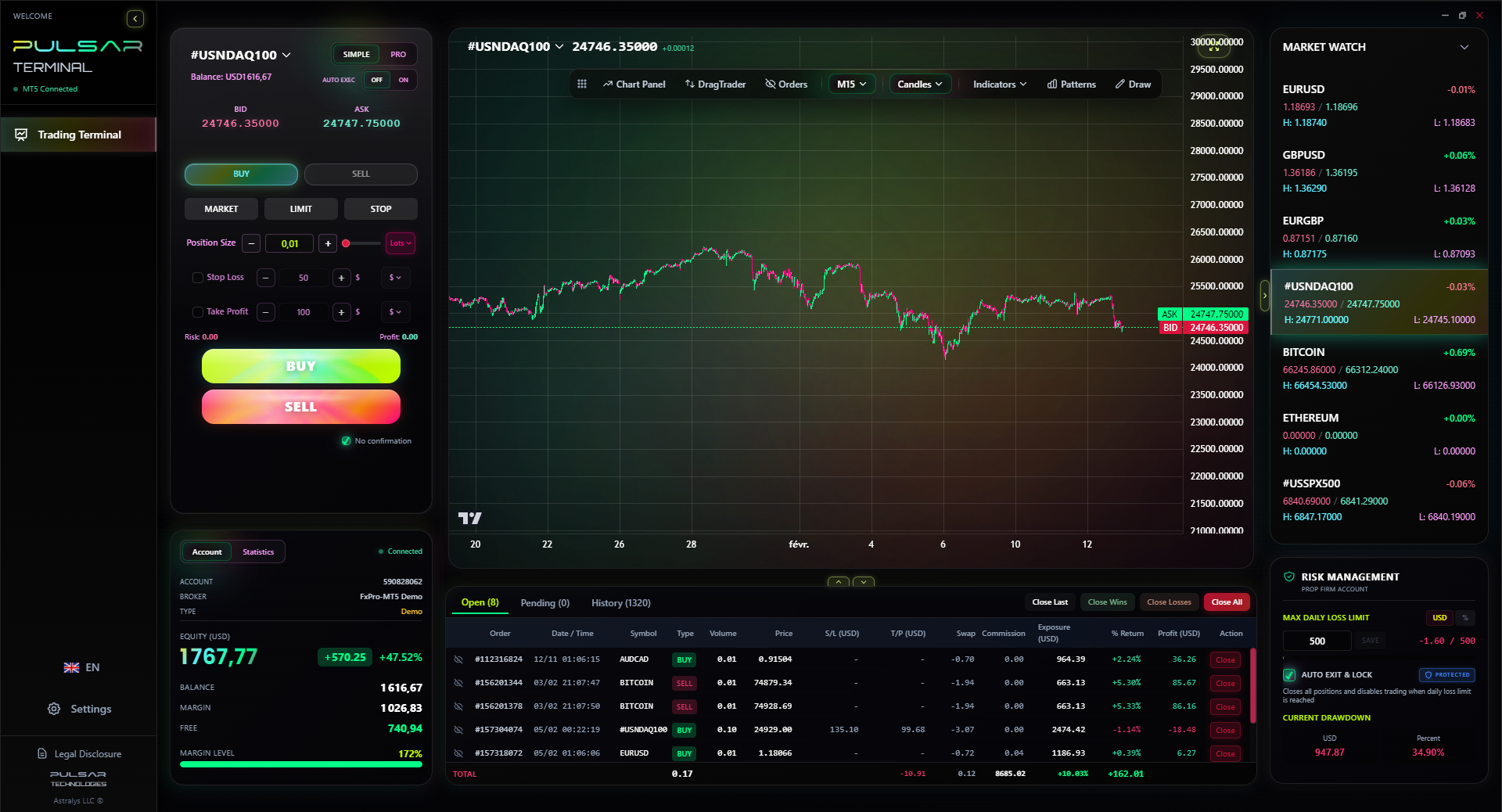
Managing complex client risk and executing multi-level trades requires professional-grade tools, which is why platforms like Pulsar Terminal build advanced order and risk management features directly into MT5.
Pulsar Terminal
L'outil MT5 tout-en-un : ordres glisser-déposer, multi-TP/SL, trailing stop, grid trading, Volume Profile et protection prop firm. Utilisé quotidiennement par 1 000+ traders.
“You are the broker in the eyes of the law and the client. The white label provider is your silent tech partner.”
You're not launching into a vacuum. South African traders are savvy, price-sensitive, and have plenty of options.
Your Competition: You're up against established FSCA-regulated brokers like FP Markets, FxPro, and Tickmill. They have huge marketing budgets. They offer minimum deposits as low as R70 and spreads from 0.0 pips. To compete, you need a niche. Maybe it's exceptional ZAR-based customer service, education in local languages, or specializing in scalping strategy accounts with ultra-fast execution.
Payment Headaches: You must offer instant, low-cost deposits and withdrawals. EFT is a must. Integrating with providers like Ozow or Peach Payments is complex but necessary. If funding an account takes 3 days, you've lost the client.
The Prop Firm Wave: The rise of prop trading firms has changed the game. Many traders now use prop firm challenges as a "demo account with a payout." They might be less inclined to deposit their own capital with a new, unknown broker. Understanding this dynamic is key to your marketing message.
I learned this the hard way helping a friend launch. We spent thousands on Google Ads targeting "forex trading." We got clicks, but no conversions. The traders clicking were comparison-shopping for the lowest spread on EUR/USD. We had no unique angle. We were just another generic broker, and we failed.
💡 Conseil de Winston
Before you look at a single provider's brochure, get a formal, written cost estimate from a lawyer specializing in FSCA applications. That number will tell you if you're really in the game.
“Think of it as starting a bank, not a trading account.”
Let's be brutally honest. A forex white label is NOT for:
- A successful retail trader wanting to "scale up."
- Someone looking for a passive investment.
- Anyone without at least ZAR 10-15 million in accessible capital to cover reserves and 2 years of losses.
It IS for:
- An established financial services business looking to add CFDs to its product suite.
- A marketing or fintech company with a large, engaged audience it can monetize.
- A team with serious experience in finance, compliance, and operations, backed by patient investors.
Think of it as starting a bank, not a trading account. Your skill set needs to shift from reading MACD indicator divergences to managing payroll, regulatory audits, and liquidity provider contracts.
If you're still determined, start by talking to the FSCA and a specialized financial lawyer. Then, and only then, talk to white label providers. Do it in that order. The regulator's requirements will dictate everything that follows.
For 99.9% of people reading this, the path to greater income is through improving their own trading - mastering swing trading strategies, learning proper risk management, and perhaps joining a prop firm. Building the casino is a vastly different challenge from being a good poker player.
FAQ
Q1What's the absolute minimum amount I need to start a forex white label in South Africa?
Forget the 'setup fee.' The FSCA requires a minimum capital reserve of ZAR 5 million to ZAR 10 million (about $270k-$540k USD). This must be in a bank account, untouched, as a financial guarantee. On top of that, you need at least $35,000-$50,000 for initial setup and legal fees, plus enough cash to cover 12-18 months of operating costs (easily another $100k+). The real minimum is a multi-million rand commitment.
Q2Can I get an FSCA license if I use a white label?
Yes, but the license is yours, not the white label provider's. You apply as a Financial Services Provider (FSP). The provider's infrastructure supports your application, but you are solely responsible for meeting all FSCA requirements - capital, fit-and-proper Key Individuals, compliance policies, and client fund handling. The provider is your tech supplier, not your regulatory shield.
Q3How long does it take to launch a white label brokerage?
The FSCA licensing process alone can take 6-9 months, sometimes longer if your application is incomplete. After licensing, technical setup with your provider can take 1-3 months. A realistic timeline from idea to launching your website is 9-12 months. Providers who promise a 30-day launch are talking about the tech setup only, after you already have a license.
Q4What's the difference between a white label and a prop trading firm?
A white label brokerage holds client money, executes real trades on the live market, and is heavily regulated. A prop firm typically charges a fee for a challenge; traders use the firm's capital in a simulated environment. If they pass, they get a share of profits from a funded account. The prop firm's main risk is its own capital, not client protection laws, making it a different (and often less regulated) business model.
Q5What are the biggest ongoing risks of running a white label?
- Client Default Risk: A client on margin loses more than they have, and you can't recover the debt. 2) Systemic Risk: A major market event (like a 'flash crash') causes widespread client losses that threaten your capital. 3) Operational Risk: Platform downtime, payment system failures, or a compliance breach. 4) Commercial Risk: Failing to attract enough clients to cover your high fixed costs, like the monthly platform fee.
Q6Can I offer ZAR-denominated accounts?
Absolutely, and you should. It's a key advantage. Your white label provider must be able to integrate ZAR as a base currency and settle with local liquidity providers for pairs like USD/ZAR. This allows your clients to deposit and withdraw in Rand without facing hidden forex conversion fees from you.
La leçon du Prof. Winston
Points clés:
- ✓FSCA capital requirement: ZAR 5-10 million minimum.
- ✓Total startup costs easily exceed $135,000+.
- ✓Licensing takes 6-9 months, not 30 days.
- ✓Your primary income is the spread mark-up.
- ✓You carry 100% of the regulatory risk.
Cet article vous a-t-il été utile ?
Cliquez sur une étoile
Analyses Trading Hebdo
Analyses et stratégies hebdo gratuites. Pas de spam.
À propos de l'auteur
David van der Merwe
Trader des Marchés Émergents
Trader basé à Johannesbourg avec 11 ans d'expérience sur les devises des marchés émergents. Spécialisé dans les paires ZAR, le trading régulé par la FSCA et l'analyse du marché sud-africain.
Commentaires
Avertissement sur les risques
Le trading d'instruments financiers comporte des risques importants et peut ne pas convenir à tous les investisseurs. Les performances passées ne garantissent pas les résultats futurs. Ce contenu est fourni à titre éducatif uniquement et ne constitue pas un conseil en investissement. Effectuez toujours vos propres recherches avant de trader.
Vous aimerez aussi

Cara Trading Forex Sukses: 7 Prinsip dari Trader Profesional
Cara trading forex sukses dengan 7 prinsip trader pro: manajemen modal, disiplin, journal trading, backtest. Data nyata, bukan janji profit palsu.
Jam Trading Forex Terbaik untuk Trader Indonesia: Panduan Lengkap dengan Tabel Waktu
Panduan jam trading forex untuk trader Indonesia. Tabel 4 sesi dunia, jam emas 20:00-00:00, sesi mana yang harus dihindari. Data akurat + tips dari trader berpengalaman.
Top 5 Sàn Forex Uy Tín Nhất 2026: Review Jujur dari Trader Indonesia
Top 5 sàn forex uy tín 2026 untuk trader Indonesia. Review jujur: spread, deposit, withdraw, dukungan lokal. Exness, XM, IC Markets & lebih.
Obtenir Pulsar Terminal
Tous ces calculateurs sont intégrés dans Pulsar Terminal avec des données en temps réel de votre compte MT5. Dimensionnement de position en un clic, gestion automatique des risques et calculs instantanés.
Obtenir Pulsar Terminal