


I lost ₦150,000 on a single EUR/USD trade because I didn't understand pips.

Olumide Adeyemi
Pionnier du Trading en Afrique de l'Ouest ·  Nigeria
☕ 11 min de lecture
Ce que vous apprendrez :
- 1What Exactly Is a Pip? (It's Not What You Think)
- 2The Basic Pip Calculation Formula (With Naira Examples)
- 3Pip Value & Lot Sizes: From Micro to Standard
- 4The Critical Step: Converting to Your Account Currency (NGN)
- 5Using Pips in Your Risk Management (This Is Non-Negotiable)
- 6Common Mistakes Nigerian Traders Make with Pips
- 7Tools, Platforms, and Automation
I lost ₦150,000 on a single EUR/USD trade because I didn't understand pips. The chart moved 25 points against me, and I thought, 'That's just a small move.' I was trading a full standard lot. That 'small move' was a $250 loss, which at the time was over ₦300,000. My mistake? I confused pips with points and had no clue what my actual risk per pip was. If you're asking 'how do I calculate pips in forex,' you're already ahead of where I was. This isn't just math. It's the difference between surviving and getting wiped out.
A pip is the smallest price move a currency pair can make, but its actual value changes depending on what you're trading and how much. For most pairs like EUR/USD or GBP/USD, one pip is a 0.0001 move. If EUR/USD goes from 1.0850 to 1.0851, that's one pip.
For pairs with the Japanese Yen (JPY), like USD/JPY, the rule changes. One pip is a 0.01 move because the Yen is worth less per unit. If USD/JPY moves from 150.00 to 150.01, that's one pip.
Here's where Nigerian traders get confused: platforms often show an extra decimal place. You might see EUR/USD quoted as 1.08501. That last digit (the '1') is a point or a pipette. Ten points equal one pip. This extra precision is good for pricing, but when you're calculating your risk, you need to think in full pips. Mistaking points for pips is a classic way to miscalculate your position size by a factor of ten.

Warning: Your broker's profit/loss display might show cents or naira, but never place a trade without knowing the pip value first. Relying solely on the P&L ticker is like driving without knowing your speed.
The real question isn't just 'how do I calculate pips in forex,' but 'what is each pip costing me?' That's where your account currency and the pair's quote currency come in, which we'll get to next.
Let's strip it down to the formula you'll use 90% of the time. You need three things: the pip size (0.0001 or 0.01), the current exchange rate, and your trade size in units.
For most pairs (EUR/USD, GBP/USD):
Pip Value = (0.0001 / Current Exchange Rate) x Trade Size in Units
For JPY pairs (USD/JPY):
Pip Value = (0.01 / Current Exchange Rate) x Trade Size in Units
This formula gives you the pip value in the pair's quote currency (the second currency). For EUR/USD, the quote currency is USD. So, the result will be in US Dollars.
A Real Example with a Standard Lot
Let's say you're trading GBP/USD at 1.2650 with a standard lot (100,000 units).
Pip Value = (0.0001 / 1.2650) x 100,000
Pip Value = (0.00007905) x 100,000
Pip Value = $7.91
So, for every pip GBP/USD moves, you gain or lose $7.91 on a standard lot. If your account is in Naira, you then need to convert that. At an exchange rate of ₦1,450/$, that one pip is worth about ₦11,475. That's not 'small change' anymore.

Example: Let's use a micro lot (1,000 units) on USD/JPY at 151.00.
Pip Value = (0.01 / 151.00) x 1,000
Pip Value = (0.000066225) x 1,000
Pip Value = $0.066 or about 6.6 US cents per pip.
This shows why trading smaller lots is safer when you're learning. The risk per pip is manageable.
Most of the time, you won't do this math manually. Your trading platform or a good position size calculator will do it. But you must understand what it's doing. I once used a calculator wrong, inputting my desired loss in pips instead of my account risk percentage. The result was a position three times too large. I got lucky and won the trade, but that kind of mistake will eventually empty your account.

💡 Conseil de Winston
If you can't instantly state the naira value of a 10-pip loss on your current trade size, you're not ready to hit the buy button. Know your numbers cold.
“Knowing how to calculate pips in forex is useless if you don't link it to risk management. This is where traders blow up.”
Your lot size is the multiplier on everything. It directly scales your profit and loss. Nigerian traders, especially those starting with smaller capital, need to get this right.
| Lot Size | Units of Base Currency | Approx. Pip Value (EUR/USD) | Risk Profile for Nigerian Traders |
|---|---|---|---|
| Standard Lot | 100,000 | ~$10.00 | High Risk. A 10-pip loss = ~$100 (₦145,000+). Only for large, professional accounts. |
| Mini Lot | 10,000 | ~$1.00 | Moderate Risk. A 30-pip stop-loss = ~$30 (₦43,500). Common for intermediate traders. |
| Micro Lot | 1,000 | ~$0.10 | Low Risk. A 50-pip loss = $5 (₦7,250). The best starting point for beginners. |
| Nano Lot | 100 | ~$0.01 | Minimal Risk. Perfect for testing strategies with real money. |
Many brokers popular in Nigeria, like Exness or XM, offer cent accounts or micro lots, which is a godsend. You can trade with real stakes without risking your rent.
Here's a personal rule I developed after my big loss: Never let a single pip risk more than 0.1% of your account balance when starting. If you have a ₦100,000 account, one pip should not cost more than ₦100. To achieve that on EUR/USD, you'd likely need to trade a micro lot or smaller. This forces discipline.
The '~$10 per pip' rule for a standard lot is a handy benchmark, but it's not exact. It assumes a 1.0000 exchange rate. As we saw in the formula, if EUR/USD is at 1.0850, the pip value is actually about $9.22. Always calculate, don't assume. This is especially true for cross pairs like EUR/GBP or GBP/JPY, where the math gets an extra step. For a detailed look at a specific instrument, check our EUR/USD guide.
This is the most overlooked step for Nigerian traders. The formula gives you a value in the quote currency (USD, JPY, etc.). But if your broker account is denominated in Naira, you need to convert that to understand your real risk.
Let's walk through a full example:
- Trade: Sell USD/CHF at 0.9000 with a mini lot (10,000 units).
- Pip Value in Quote Currency (CHF):
(0.0001 / 0.9000) x 10,000 = CHF 1.11 - Now, convert CHF to USD (if your account shows P&L in USD, which many international brokers do for Nigerian clients). You need the USD/CHF rate. Let's say it's 0.9000 (it's the inverse of our trade, roughly).
CHF 1.11 x (1 / 0.9000) = $1.23So, one pip in this USD/CHF trade is worth about $1.23. - Finally, convert to Naira. At ₦1,450/$, that pip is worth ₦1,783.50.
See the complexity? For a pair like GBP/JPY, you're converting from JPY to USD to NGN. This is why trading major pairs with USD as the quote currency (EUR/USD, GBP/USD, AUD/USD) is simpler for beginners. The pip value is already in USD, so you only do one conversion to Naira.

Pro Tip: Open a demo account with your chosen broker (IC Markets, Pepperstone, etc.) and place a 1 micro lot trade. Note the profit/loss change for a 1-pip move. That's your real, broker-calculated pip value in your account currency. Write it down for your favorite pairs.
Many brokers now offer Naira-denominated accounts, which simplifies this massively. Your profit and loss are displayed directly in Naira. However, always verify the pip value by checking the trade details. Don't just trust the display.
“The '~$10 per pip' rule is a handy benchmark, but it's not exact. Always calculate, don't assume.”
Knowing how to calculate pips in forex is useless if you don't link it to risk management. This is where traders blow up. They calculate pips but then ignore them when placing a trade.
Your trading plan should work backwards:
- Determine Your Account Risk: How much of your account are you willing to lose on this one trade? For beginners, 1% is the absolute max. On a ₦200,000 account, that's ₦2,000.
- Find Your Stop-Loss in Pips: Analyze your chart. Where is a logical level that, if hit, proves your trade idea wrong? Is it 25 pips away? 50 pips? Let's say it's 30 pips for your EUR/USD setup.
- Calculate Your Maximum Position Size:
- Max Loss in Account Currency = ₦2,000
- Stop-Loss Distance = 30 pips
- Max Pip Value Allowed = ₦2,000 / 30 pips = ₦66.67 per pip
- Convert that to USD: ₦66.67 / ₦1,450 = ~$0.046 per pip.
- We know from earlier a micro lot (1,000 units) on EUR/USD is ~$0.10 per pip. That's too big.
- You'd need a position size of about 460 units (a fraction of a micro lot) to stay within your risk. Most platforms allow this.
If you skip this, you're gambling. I've broken this rule. In 2019, I was convinced gold (XAU/USD) was going up. My stop was 100 points away (which is $10 on a micro lot). I risked 2% of my account, so I should have traded 2 micro lots. Greed took over. I traded 10 lots. Gold dropped 50 points, hit my panic threshold, and I closed for a $500 loss - 5% of my account gone in minutes. That set me back months.
Automation is your friend here. Tools that let you set your stop-loss and take-profit levels in pips and automatically calculate the position size are useful for enforcing this discipline.
Let's be blunt. These errors will cost you money.
1. Confusing Pips with Monetary Value: 'I made 50 pips!' sounds great. But 50 pips on a micro lot is $5. 50 pips on a standard lot is $500. Always state your lot size when talking about pips.
2. Ignoring the Spread Cost: The spread is your first cost. If the EUR/USD spread is 1.2 pips, you're down ₦1,740 (at $10/pip) on a standard lot the moment you enter. For a scalping strategy aiming for 5-10 pips, a 1.2-pip spread eats a huge chunk of your potential profit. You need a broker with tight spreads or you're fighting an uphill battle.
3. Forcing Large Lot Sizes for Small Accounts: You have ₦50,000 and want to make ₦10,000 a day. To make that in 10 pips, you'd need a pip value of ₦1,000, which requires a massive, reckless position size. This leads to a margin call. Be realistic. Consistent 1-2% gains are how you grow.
4. Not Adjusting for Volatility: A 50-pip stop on EUR/JPY is not the same as a 50-pip stop on EUR/CHF. Some pairs move 100 pips a day, others move 50. Use the Average True Range (ATR) indicator to see the typical pip movement and set your stops accordingly. A 20-pip stop on a volatile pair like GBP/JPY is likely to get hit by noise.
5. Tax Amnesia: Remember, profits are taxable. The FIRS expects 10% on your gross gains. If you make ₦500,000 in a year, set aside ₦50,000. Factor this into your net profit calculations. Trading to make '₦100,000' means you need to aim for ₦110,000 to account for the tax.
💡 Conseil de Winston
The spread isn't a fee you see; it's a race you've already lost. If your target is only 8 pips, a 1.5-pip spread means you need a 19% move just to break even. Choose your broker and strategy accordingly.
“If you can't instantly state the naira value of a 10-pip loss on your current trade size, you're not ready to hit the buy button.”
You don't need to be a mathematician. Use the tools available.
1. Trading Platform Calculators: MT4 and MT5 have a built-in 'Trade' window that shows the estimated pip value when you set up an order. Use it. Right-click on an open order and select 'Modify or Delete Order' to see the pip value calculation.
2. Independent Position Size Calculators: Bookmark an online calculator. Input your account balance, risk percentage, stop loss in pips, and account currency. It will spit out the correct lot size. This removes emotion.
3. Advanced Trading Tools: As you graduate from basic swing trading, you'll want features like trailing stops and multiple take-profit levels. Manually moving a stop-loss for 10 trades is tedious and error-prone. Advanced tools that integrate with MT5 can automate this, letting you set a rule like 'move stop to breakeven when trade is 15 pips in profit' on every trade, which is a core risk management technique.
The goal is to make the mechanical parts of trading - calculating pips, sizing positions, managing exits - as automatic as possible. This frees your mind to focus on analysis, using indicators like the RSI or MACD effectively, and spotting good setups. The less you have to think about the arithmetic, the better your decisions will be.
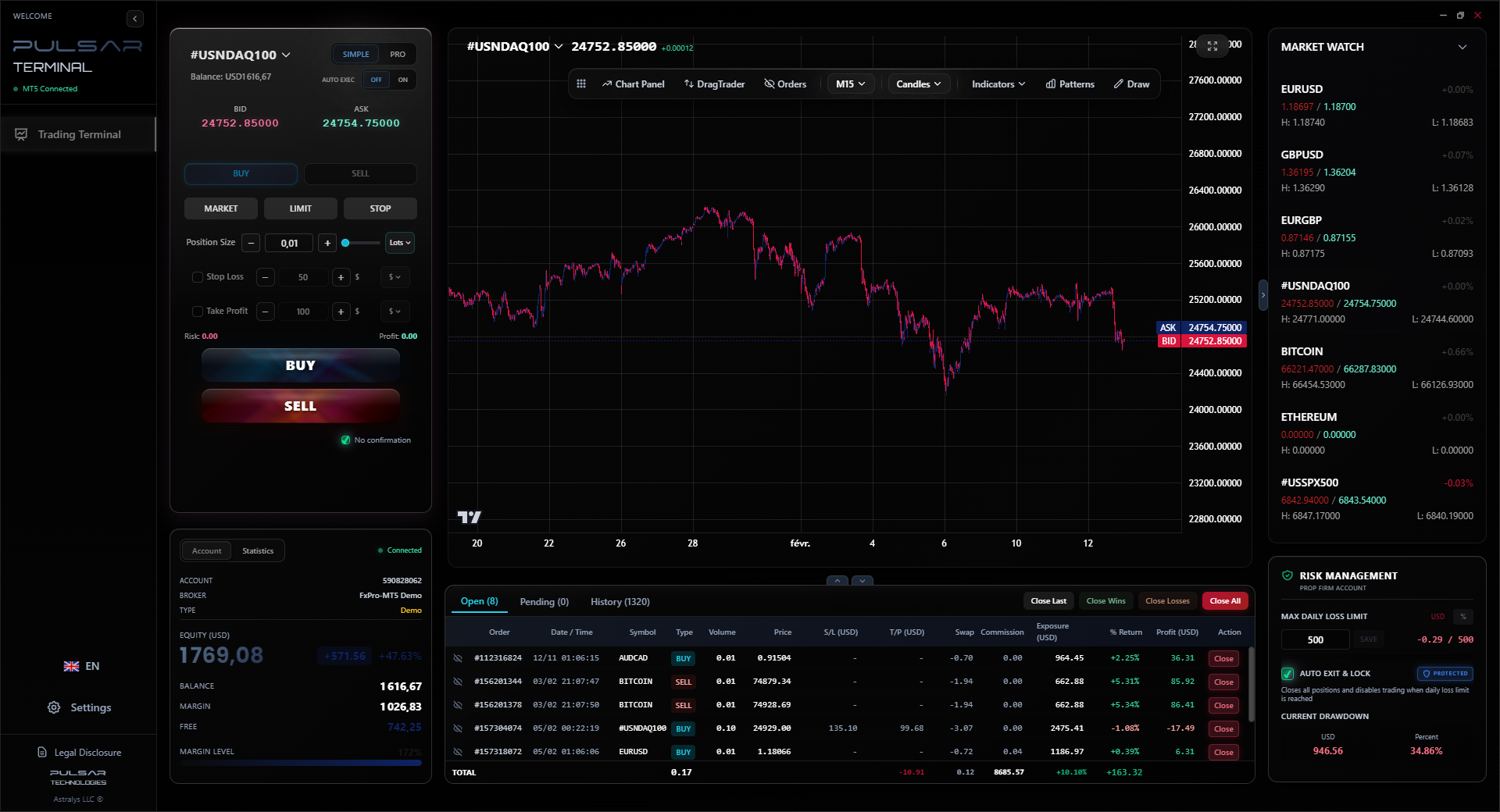
Manually calculating and adjusting stops for every trade is error-prone; Pulsar Terminal automates trailing stops and breakeven orders directly on your MT5 charts, enforcing your risk rules without emotion.
Pulsar Terminal
L'outil MT5 tout-en-un : ordres glisser-déposer, multi-TP/SL, trailing stop, grid trading, Volume Profile et protection prop firm. Utilisé quotidiennement par 1 000+ traders.
FAQ
Q1How much is 1 pip in Naira?
There's no fixed amount. It depends on the currency pair, the exchange rate, and your lot size. For example, 1 pip on a micro lot (1,000 units) of EUR/USD is worth about $0.10. At an exchange rate of ₦1,450/$, that's roughly ₦145. On a standard lot, that same pip would be about ₦14,500.
Q2Do I calculate pips differently for Gold (XAU/USD)?
Yes. Gold is quoted in US Dollars per ounce. A standard move is $0.10, which is often called 1 'point' or 10 'pips' depending on your broker's terminology. A $1.00 move in gold is typically 100 points. Always check your broker's contract specifications for the exact tick size and value per tick before trading.
Q3What's the difference between a pip and a pipette?
A pipette is one-tenth of a pip. If EUR/USD moves from 1.08500 to 1.08501, it has moved 1 pipette. Most platforms show 5 decimal places for major pairs. The 4th decimal is the pip, the 5th is the pipette. For risk calculation, always think in full pips to avoid confusion.
Q4How does use affect my pip value?
use doesn't directly change your pip value. Pip value is determined by your position size (lot size). However, use allows you to control a larger position size with less capital. This amplifies both the pip value's effect on your account and your risk. High use makes each pip more powerful, for better or worse.
Q5Why does my profit/loss in Naira fluctuate even when the price in pips hasn't moved?
This happens with cross-currency pairs. If your account is in Naira and you're trading GBP/JPY, your P&L is constantly being converted through USD/JPY and USD/NGN rates. Even if GBP/JPY is flat, changes in the USD/JPY rate will cause your Naira equity to change. It's a key reason to monitor your margin level closely.
Q6Is a 20-pip stop-loss a good rule?
No, it's a terrible rule. Your stop-loss should be based on market structure, not an arbitrary number. A 20-pip stop on EUR/USD might be perfect for a scalp, but it will get wiped out instantly on GBP/JPY during news. Use technical levels (support/resistance) and volatility measures like ATR to place logical stops.
La leçon du Prof. Winston
Points clés:
- ✓A pip's value changes with the pair, rate, and lot size.
- ✓Always convert pip value to your account currency (NGN).
- ✓Risk per trade should never exceed 1-2% of your capital.
- ✓Use a position size calculator for every single trade.
Cet article vous a-t-il été utile ?
Cliquez sur une étoile
Analyses Trading Hebdo
Analyses et stratégies hebdo gratuites. Pas de spam.
À propos de l'auteur
Olumide Adeyemi
Pionnier du Trading en Afrique de l'Ouest
L'un des formateurs de trading forex les plus actifs au Nigeria. 8 ans d'expérience de trading depuis Lagos. Spécialisé dans les stratégies à petit capital et les challenges de prop firms pour les traders africains.
Commentaires
Avertissement sur les risques
Le trading d'instruments financiers comporte des risques importants et peut ne pas convenir à tous les investisseurs. Les performances passées ne garantissent pas les résultats futurs. Ce contenu est fourni à titre éducatif uniquement et ne constitue pas un conseil en investissement. Effectuez toujours vos propres recherches avant de trader.
Vous aimerez aussi

Cara Trading Forex Sukses: 7 Prinsip dari Trader Profesional
Cara trading forex sukses dengan 7 prinsip trader pro: manajemen modal, disiplin, journal trading, backtest. Data nyata, bukan janji profit palsu.
Jam Trading Forex Terbaik untuk Trader Indonesia: Panduan Lengkap dengan Tabel Waktu
Panduan jam trading forex untuk trader Indonesia. Tabel 4 sesi dunia, jam emas 20:00-00:00, sesi mana yang harus dihindari. Data akurat + tips dari trader berpengalaman.
Top 5 Sàn Forex Uy Tín Nhất 2026: Review Jujur dari Trader Indonesia
Top 5 sàn forex uy tín 2026 untuk trader Indonesia. Review jujur: spread, deposit, withdraw, dukungan lokal. Exness, XM, IC Markets & lebih.
Obtenir Pulsar Terminal
Tous ces calculateurs sont intégrés dans Pulsar Terminal avec des données en temps réel de votre compte MT5. Dimensionnement de position en un clic, gestion automatique des risques et calculs instantanés.
Obtenir Pulsar Terminal