


You've probably heard the story: fund your account, make a few quick trades, and watch the money roll in.

Olumide Adeyemi
Pionnier du Trading en Afrique de l'Ouest ·  Nigeria
☕ 12 min de lecture
Ce que vous apprendrez :
You've probably heard the story: fund your account, make a few quick trades, and watch the money roll in. Here's the truth they don't tell you. The single biggest reason Nigerian traders blow up isn't a bad strategy - it's how they fund their account in the first place. They pick the wrong method, get killed by hidden fees, or ignore the CBN's rules until it's too late. I've seen it wipe out more accounts than any market crash. Let's set the record straight on how to fund my forex account the right way, so your capital lasts long enough for your edge to work.
First things first: trading forex is legal in Nigeria. Anyone who tells you otherwise is misinformed. The Central Bank of Nigeria (CBN) and the Securities and Exchange Commission (SEC) are the main watchdogs. But here's the critical nuance that trips people up.
While you can legally open an account with an international broker (like Exness or IC Markets), the CBN controls the pipes your money flows through. They don't regulate the broker's platform, but they absolutely regulate how Naira leaves the country. Think of it like this: you're allowed to buy a product from abroad, but the border control (CBN) decides what you can use to pay for it.
This leads to the number one funding headache: transaction limits on Naira debit cards. Your bank card has a yearly international spending limit, often set by your bank within CBN guidelines. I've had students hit a wall trying to deposit $500, only to find their card's limit for the year was already exhausted by online subscriptions and other payments. You need to check this with your bank before you pick a funding method.

Warning: Your trading profits, even from a broker based in Cyprus or Australia, are subject to Nigerian tax. The standard is a 10% Capital Gains Tax. Very few traders actually pay it, but that doesn't make it optional. The taxman is getting more sophisticated. Keep clean records.
The regulatory landscape is shifting. In late 2024, the CBN consolidated foreign exchange windows into a single official market to improve transparency. More recently, in early 2026, they've been tweaking rules for Bureau De Change (BDC) operations and diaspora remittances. These wholesale market changes trickle down. They affect dollar liquidity, which can impact the rates you get when converting Naira. Staying vaguely aware of these shifts helps you understand why some funding methods get cheaper or more expensive over time.

💡 Conseil de Winston
The funding cost is your first trade, and it's always a loss. Calculate it, accept it, and then make sure your strategy's expected profit is larger.
Every method has a trade-off: speed, cost, or convenience. Pick two. Let's break them down from best to worst for the active Nigerian trader.
Cryptocurrency (USDT): The New Standard
This is, hands down, the most efficient method for most traders in 2026. You buy USDT (Tether) on a local peer-to-peer (P2P) platform like Binance P2P or Patricia, then send it directly to your broker that supports crypto deposits (most major ones do).
Why it wins:
- Speed: Deposits are often credited in under 30 minutes.
- Cost: Lower fees than card processors or bank transfers. You pay the P2P spread and a small network fee.
- Bypasses Limits: It doesn't touch your card's international transaction limit.
The catch? You must be comfortable with crypto wallets. Always do a small test transaction first. I once sent $50 of USDT to the wrong network (ERC20 instead of TRC20) and lost it forever. A $5 test deposit would have saved me.
Debit/Credit Cards: The Easy Trap
Visa/Mastercard deposits are instant and simple. This is why brokers push them. But for Nigerians, they're a trap for anything beyond tiny accounts.
The problems:
- The Limit: You'll hit your annual international spending cap.
- The Spread: Your bank converts Naira to USD at their own terrible rate, often adding a 3-5% hidden fee on top.
- Withdrawal Hassle: Some brokers only refund to the card, which can take 7+ business days and might be rejected by your Nigerian bank.
I used my card for my first ever deposit of $200. The broker showed a $200 deposit. My bank statement showed a charge of ₦185,000. At the official rate then, that should have been about ₦160,000. I paid a 15% premium before I even placed a trade. That's a terrible way to start.
Bank Wire Transfer: The Slow Last Resort
International wire transfers work but are archaic. They involve filling forms at your bank, paying high fees (₦5,000 - ₦15,000 flat fee plus intermediary bank charges), and waiting 3-7 business days. Use this only for very large deposits where the flat fee becomes a small percentage, or if you have a domiciliary account. For funding a typical $500-$2000 account, the fees are prohibitive.
E-Wallets: The Mixed Bag
Options like Skrill, Neteller, or Sticpay exist. They act as a middleman. You fund the e-wallet (often via card or bank transfer), then send to your broker.
Pros: Faster withdrawals back to the e-wallet. Can sometimes get better FX rates than your bank. Cons: Adds another layer of fees. Not all brokers accept them. Support can be slow.

Pro Tip: Your choice of broker dictates your options. A broker like Exness has deep local payment integration. Others like IC Markets are strong globally but may rely more on crypto and cards. Check their deposit page for Nigeria specifically before you sign up.
Here’s a quick comparison table:
| Method | Speed to Deposit | Typical Fees for a $500 Deposit | Best For... |
|---|---|---|---|
| Cryptocurrency | Minutes | 1-2% (P2P spread + gas) | Most traders, tech-savvy users |
| Debit Card | Instant | 3-7% (bank FX spread) | Very small, one-time test deposits |
| Bank Wire | 3-7 business days | ₦5k-₦15k + ~$15 intermediary | Large deposits (>$5k), corps, trusts |
| E-Wallet | Minutes to Hours | 2-4% (multiple layers) | Traders who value fast broker withdrawals |
“Your first trade isn't on EUR/USD; it's the trade you make converting your Naira into trading capital.”
The advertised 'zero deposit fee' is a lie by omission. The cost is just hidden. If you don't calculate this, your trading plan's profit target is already wrong.
1. The Double Spread (The Silent Killer) This is the biggest one. When you deposit Naira to buy USD, you pay a spread. When you eventually withdraw profits and sell USD back to Naira, you pay another spread. Let's do the math with real numbers from March 2026.
You deposit ₦800,000.
- P2P Buy Rate for USDT: ₦1,620/$1
- You get: ₦800,000 / ₦1,620 = $493.83 USDT
You trade well and grow your account to $600. You withdraw $600, selling USDT back to Naira.
- P2P Sell Rate for USDT: ₦1,580/$1
- You get: $600 * ₦1,580 = ₦948,000
Your gross profit in Naira? ₦948,000 - ₦800,000 = ₦148,000.
But wait. If there was no spread, you'd use a single rate. Let's use the mid-rate of ₦1,600.
- Deposit Value at Mid-rate: ₦800,000 / ₦1,600 = $500
- Withdrawal Value at Mid-rate: $600 * ₦1,600 = ₦960,000
- Theoretical Profit: ₦160,000
The funding cost? ₦160,000 - ₦148,000 = ₦12,000 lost to spreads. That's a 7.5% tax on your profit just from moving money in and out. You must factor this into your position size calculator. If your strategy aims for a 10% return, you've lost three-quarters of it to friction.
2. Broker Conversion Fees Some brokers, if you deposit in a currency other than your account's base currency (usually USD), will convert it for you. Their rate is always worse than the market. Always deposit in your account's base currency if you can.
3. Inactivity Fees This isn't a funding cost, but it attacks your capital if you fund an account and then leave it dormant. Many brokers charge $5-$15 per month after 6-12 months of no trading. Read the fine print.
Your broker isn't just a trading platform. It's your bank for this venture. Their payment processing dictates your life. Don't just look at spreads. Look at their deposit page for Nigeria.
Key Questions to Ask:
- Do they accept direct cryptocurrency deposits? (Look for USDT, USDC, Bitcoin). This is non-negotiable for me now.
- What local payment partners do they have? Some brokers integrate with direct Naira payment gateways. This can be smoother than cards.
- What are the withdrawal processing times? "Instant" for crypto, "1-3 days" for e-wallets, "5-10 business days" for cards/bank wires. This affects your cash flow.
- Is there a minimum withdrawal amount? Needing to withdraw $100+ can be annoying for smaller profits.
Based on my experience and constant testing:
- Exness is popular here for a reason. Their local payment integration is the best, and withdrawals are reliable. Their raw spread accounts are decent for scalping.
- IC Markets is a global powerhouse with excellent execution. They fully embrace crypto deposits, which makes them a top pick for Nigerians comfortable with that route. Read our full IC Markets review.
- XM and Pepperstone are also solid, reputable choices. Check their specific Nigerian payment options as they can change. Our XM review and Pepperstone review detail their offerings.
Avoid brokers that only offer card and bank wire. You'll be fighting an uphill battle with costs and limits from day one.
💡 Conseil de Winston
If a broker makes it difficult or expensive to get your money out, they are not a broker. They are a thief with a website. Test withdrawals early.
“The advertised 'zero deposit fee' is a lie by omission. The cost is just hidden in a spread or a terrible exchange rate.”
I've lost real money learning this stuff so you don't have to.
Mistake 1: Chasing Bonus Offers. In 2018, I deposited $1,000 with a shady broker offering a 100% bonus. The catch? You had to trade an insane volume (lots) to withdraw any money, including your own deposit. I blew the account trying to hit the target. The bonus was a leash, not a gift. Lesson: Fund with brokers known for clean withdrawals, not big bonuses.
Mistake 2: Ignoring the Total Cost. In 2020, I was swing trading EUR/USD. I made a 4% return on my account in a month - about $400 on a $10k account. I was proud. Then I withdrew it. Between my bank's card conversion on the way in and the broker's processing fee on the way out, the net gain was $317. I worked for a 3.17% return, not 4%. My risk/reward was off because my base costs were wrong. Now, I always deduct a 1.5% estimated funding cost from my projected returns before I even enter a trade.
Mistake 3: Not Having a Withdrawal Plan. I used to reinvest every profit. That's how you get emotionally attached to 'play money.' Now, I have a rule: withdraw all net profits at the end of each quarter. This does three things: it locks in gains, it tests the broker's withdrawal system regularly (so I never get stuck with a huge sum), and it reminds me this is real money. The friction of the withdrawal spread is a worthwhile cost for financial sanity.

Example: My 2025 Q4 Withdrawal. Account grew from $15,000 to $18,500. Net profit: $3,500. I withdrew the full $3,500 as USDT to my Binance wallet. P2P sell spread cost me ~$50. Net to bank: ~$3,450. I sleep better knowing that profit is real and out of the market's reach.
Follow this sequence. Don't skip steps.
- Choose Your Broker: Confirm they accept a viable method for Nigeria (preferably crypto or good local partners). Open a demo, then a live account.
- Verify Your Account: Complete KYC (Know Your Customer) before funding. Upload your ID, proof of address (utility bill or bank statement). Delays here can leave your money in limbo.
- Decide on Amount: Never fund with money you can't afford to lose. Start small. Your first deposit should be an amount you're willing to pay as a 'tuition fee.' $200-$500 is sensible.
- Pick Your Method: Based on amount and speed. For $500? Crypto. For a $5,000 initial stake? Compare crypto vs. a wire transfer's flat fee.
- Calculate the True Cost: Use the P2P buy/sell rates to calculate exactly how much USD you'll get. Write this number down.
- Make a Test Deposit: Send the minimum possible amount first. For crypto, send $20. Confirm it arrives in your trading account correctly.
- Withdraw a Small Amount: Before you place your first real trade, test the withdrawal process. Try to withdraw $10-$20 back to your wallet/bank. If it works, the pipeline is clear. This peace of mind is worth the tiny fee.
- Fund Fully & Trade: Once the pipeline is tested, send the rest of your capital.
- Set Your Risk Parameters: Now that your real money is in, set your stops. Use a position size calculator. Your first trade should be at 0.5% risk, not 5%. Protect the capital you just worked so hard to get in there.
This process might take 2-3 days. That's fine. Patience here prevents weeks of frustration later.
“Withdrawing profits isn't taking money off the table. It's the moment you move fantasy numbers in a platform into real wealth.”
Funding is not a one-time event. It's a cycle. Managing withdrawals is just as critical.
Withdrawal Timing: Avoid withdrawing during major market news events (like NFP) or weekends. Some broker systems slow down. Mid-week, during calm London session hours, is usually smoothest.
Document Everything: Keep screenshots of every deposit and withdrawal request, with transaction IDs. If there's a dispute, you have evidence. I have a simple folder for each year with these records.
Tax Records: Maintain a simple spreadsheet: Date, Amount Deposited (in USD and Naira equivalent at time), Amount Withdrawn, Net Profit/Loss. This is your source data for that 10% Capital Gains Tax. Even if you don't pay it quarterly, you need the annual figure.
The Psychology of Withdrawal: Withdrawing profits feels like you're taking money off the table. It is. That's the point. It breaks the casino mentality and reinforces that this is a business. Schedule your profit withdrawals and stick to the schedule.
Finally, remember that your trading platform tools should help you protect that deposited capital. Using a trailing stop or a breakeven function is a basic way to lock in profits and manage risk automatically, which is the whole point of getting the money in there safely to begin with.
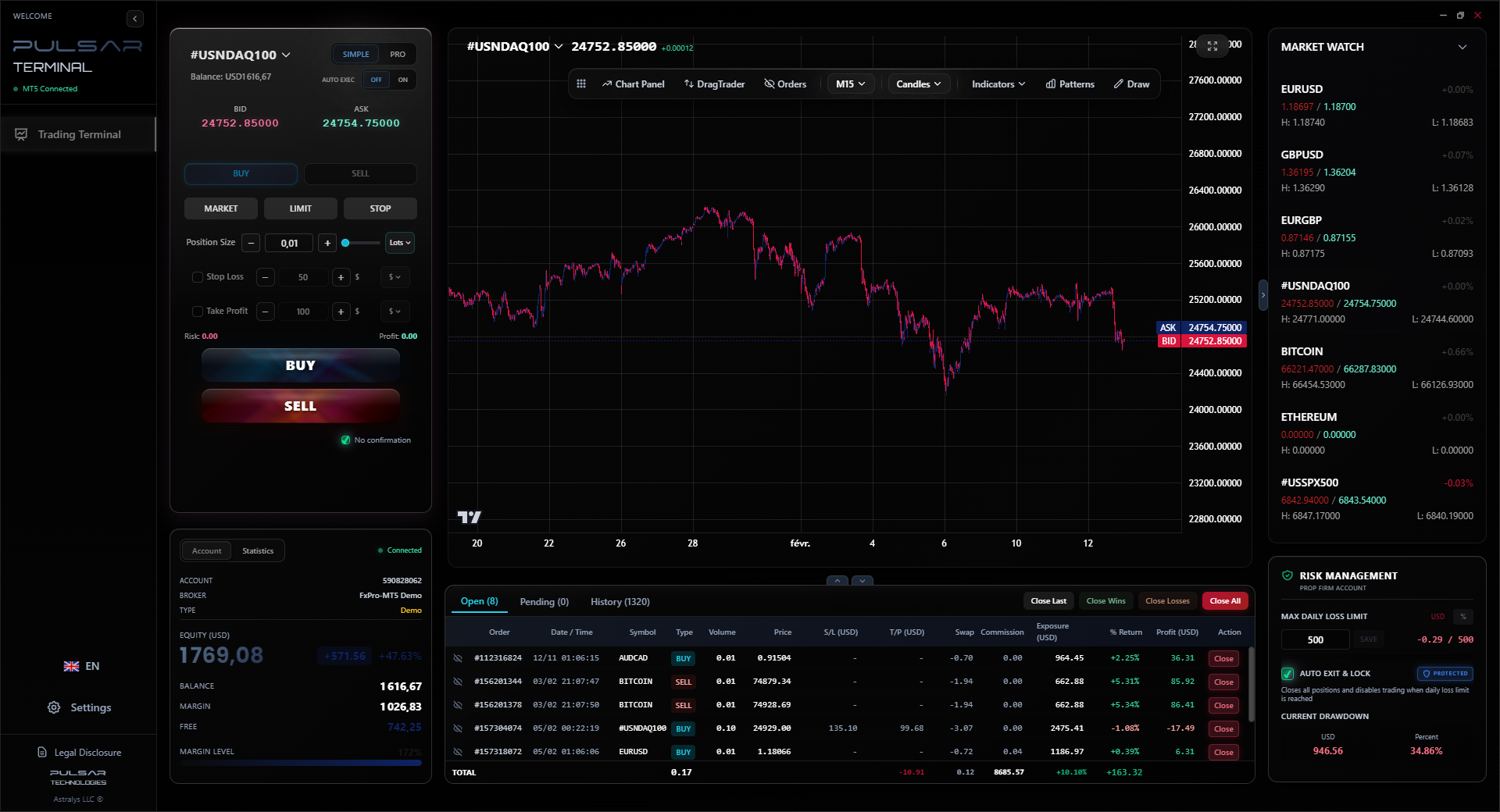
Once your capital is safely funded, protecting it requires precise order management, which tools like Pulsar Terminal for MT5 automate with features like trailing stops and breakeven functions.
Pulsar Terminal
L'outil MT5 tout-en-un : ordres glisser-déposer, multi-TP/SL, trailing stop, grid trading, Volume Profile et protection prop firm. Utilisé quotidiennement par 1 000+ traders.
FAQ
Q1What is the cheapest way to fund my forex account in Nigeria?
Using cryptocurrency (USDT) via a peer-to-peer platform is almost always the cheapest. You pay only the P2P buy/sell spread (typically 1-2%) and a tiny network gas fee. It bypasses bank card international limits and high wire transfer fees.
Q2Can I use my Nigerian debit card to fund a forex account?
Yes, but I don't recommend it for serious trading. It's instant but expensive. Your bank adds a 3-7% spread on the currency conversion, and it consumes your annual international spending limit. It's only suitable for a very small test deposit.
Q3Is it legal to use Binance P2P to fund my trading account?
Yes. You are using Binance P2P as a platform to exchange Naira for USDT, a digital asset. You then transfer that USDT to your broker, which is a transaction between two digital wallets. This is a common and accepted practice. The CBN's past restrictions were on banks dealing with crypto exchanges, not on individuals holding or transferring crypto assets.
Q4How long do withdrawals take back to Nigeria?
It depends on the method. Crypto withdrawals are usually under 30 minutes to your wallet. E-wallet withdrawals (Skrill, etc.) can take 24 hours. Card or bank wire withdrawals can take 5-10 business days and may face more scrutiny from your local bank.
Q5Do I pay tax on my forex trading profits in Nigeria?
Yes, legally you do. Profits are subject to Capital Gains Tax at 10%. You are required to declare this income. While enforcement on retail traders has been limited, the law is clear, and proper record-keeping is essential.
Q6What is the minimum amount I need to start trading forex in Nigeria?
You can start with as little as $10-$20 on some brokers with micro accounts. However, for practical learning and meaningful position sizing without excessive use, I recommend a minimum of $200-$500. This allows you to risk small amounts (like $2-$5 per trade) while learning.
Q7My bank declined my card deposit to a forex broker. What should I do?
This is common. First, call your bank to confirm your international transaction limit hasn't been reached. Second, many Nigerian banks now block transactions categorized as 'brokerage' or 'trading' due to their own risk policies. Don't fight it. Switch to a different funding method like cryptocurrency. It's easier than trying to convince your bank.
La leçon du Prof. Winston
Points clés:
- ✓Crypto (USDT) is the most cost-effective funding method for Nigerians.
- ✓Factor in a 1.5-3% total cost for moving money in and out.
- ✓Test the withdrawal process before trading with serious capital.
- ✓Legal profit = Taxable profit. Keep immaculate records.
- ✓Your bank's card limit will block you before the market does.
Cet article vous a-t-il été utile ?
Cliquez sur une étoile
Analyses Trading Hebdo
Analyses et stratégies hebdo gratuites. Pas de spam.
À propos de l'auteur
Olumide Adeyemi
Pionnier du Trading en Afrique de l'Ouest
L'un des formateurs de trading forex les plus actifs au Nigeria. 8 ans d'expérience de trading depuis Lagos. Spécialisé dans les stratégies à petit capital et les challenges de prop firms pour les traders africains.
Commentaires
Avertissement sur les risques
Le trading d'instruments financiers comporte des risques importants et peut ne pas convenir à tous les investisseurs. Les performances passées ne garantissent pas les résultats futurs. Ce contenu est fourni à titre éducatif uniquement et ne constitue pas un conseil en investissement. Effectuez toujours vos propres recherches avant de trader.
Vous aimerez aussi

Cara Trading Forex Sukses: 7 Prinsip dari Trader Profesional
Cara trading forex sukses dengan 7 prinsip trader pro: manajemen modal, disiplin, journal trading, backtest. Data nyata, bukan janji profit palsu.
Jam Trading Forex Terbaik untuk Trader Indonesia: Panduan Lengkap dengan Tabel Waktu
Panduan jam trading forex untuk trader Indonesia. Tabel 4 sesi dunia, jam emas 20:00-00:00, sesi mana yang harus dihindari. Data akurat + tips dari trader berpengalaman.
Top 5 Sàn Forex Uy Tín Nhất 2026: Review Jujur dari Trader Indonesia
Top 5 sàn forex uy tín 2026 untuk trader Indonesia. Review jujur: spread, deposit, withdraw, dukungan lokal. Exness, XM, IC Markets & lebih.
Obtenir Pulsar Terminal
Tous ces calculateurs sont intégrés dans Pulsar Terminal avec des données en temps réel de votre compte MT5. Dimensionnement de position en un clic, gestion automatique des risques et calculs instantanés.
Obtenir Pulsar Terminal