


I lost ₹47,000 in a single week back in 2018 trying to trade EUR/USD through an unregulated offshore bucket shop.

Rajesh Sharma
Analyste Forex Senior ·  India
India
☕ 10 min de lecture
Ce que vous apprendrez :
I lost ₹47,000 in a single week back in 2018 trying to trade EUR/USD through an unregulated offshore bucket shop. The platform froze during a major news event, my stop-loss was ignored, and the 'support' team vanished. That painful lesson wasn't about analysis; it was about understanding the precarious legal and operational ground Indian forex traders stand on. If you want to know how to trade in forex market in India, you first need to understand what you're actually allowed to do, the very real risks of stepping outside those lines, and where the real opportunities - and traps - lie.
Let's cut through the broker marketing fluff. Forex trading in India isn't a free-for-all; it's a tightly controlled corridor with specific entry points. The Reserve Bank of India (RBI) and the Securities and Exchange Board of India (SEBI) are the gatekeepers, and the rulebook is the Foreign Exchange Management Act (FEMA).
The Golden Rule: You, as an Indian resident, are only legally permitted to trade currency pairs that include the Indian Rupee (INR) on recognized Indian exchanges like the NSE or BSE. Think USD/INR, EUR/INR, GBP/INR. That's your official, above-board playground.

Warning: Trading major pairs like EUR/USD, GBP/JPY, or even gold (XAU/USD) through an international broker's platform is, strictly speaking, a violation of FEMA for speculative purposes. The RBI has issued repeated warnings. While enforcement on individual retail traders is sporadic, it creates a fundamental risk: your funds exist in a regulatory grey area. If the broker gets flagged (many are on the RBI's Alert List) or faces issues, your legal recourse is extremely limited.
There's one emerging, legal loophole: GIFT City. The RBI has clarified that you can use the Liberalised Remittance Scheme (LRS) to invest in securities through IFSC-registered brokers there. This is the closest thing to a sanctioned path to global markets, but it's for 'securities,' not direct spot forex, and the environment is still developing.
The recent RBI crackdown in April 2026, banning banks from offering certain non-deliverable rupee derivatives, shows the regulator's intent to curb speculation. This isn't a market you can just brute-force your way into with a big deposit.

💡 Conseil de Winston
Your first ₹50,000 in trading isn't capital. It's tuition. Expect to pay it to the market to learn what the charts and the regulators won't tell you in the brochure.
“Forex trading in India isn't a free-for-all; it's a tightly controlled corridor with specific entry points.”
Your choice of broker defines your entire trading reality - legal, financial, and practical. Here’s the stark comparison.
| Aspect | SEBI-Regulated Domestic Brokers (Zerodha, Upstox, ICICI Direct) | International Offshore Brokers (IC Markets, Exness, Pepperstone) |
|---|---|---|
| Legality | Fully legal for INR pairs. | Operate in a regulatory grey area for non-INR pairs. |
| What You Can Trade | Only INR-crosses (USD/INR futures & options). | Full global suite (EUR/USD, Gold, Indices, Crypto). |
| Platform | Proprietary platforms (Kite, Upstox Pro). | MT4, MT5, cTrader. |
| Funding | Seamless via Indian bank, UPI. | Can be tricky: Intl. bank transfer, some offer INR via partners. |
| Primary Risk | Limited product choice, higher spreads on INR pairs. | Regulatory uncertainty, potential withdrawal issues. |
I've used both. For learning pure price action on the majors, I practiced on a demo with IC Markets because their raw spreads are fantastic for scalping. But my real, taxable money for INR exposure goes through a domestic broker. It's about separating practice from legally accountable investment.
Many are tempted by brokers like XM or Exness for their low minimum deposits. I get it. Starting with $5 feels risk-free. But remember, if a broker is on the RBI's Alert List, your deposit is an unsecured loan to them. I learned that the hard way in 2018.

Pro Tip: If you go the offshore route, prioritize brokers with top-tier global regulation (like ASIC) and a long track record. Check if they offer local INR deposit/withdrawal channels. It doesn't make it 'legal,' but it simplifies cash flow. Always start with a small, testable amount for your first withdrawal.
“Your choice of broker defines your entire trading reality - legal, financial, and practical.”
Forget the advertised 'zero commission' headlines. Your profitability gets chipped away from multiple angles. Let's talk real numbers.
Minimum Deposits: This is the easy part. You can start with peanuts. XM offers accounts from $5. FxPro asks for $100. Domestic brokers might have no minimum or require a few thousand rupees. This is not where you should make your decision.
The Real Killers: Spreads & Commissions On domestic platforms trading USD/INR futures, the spread might be 2-3 pips. That's wide. On an international broker's 'raw' account, you might get a 0.1 pip spread on EUR/USD but pay a $7 round-turn commission per standard lot. You must calculate the total cost per trade.
Example: A standard lot (100,000 units) trade on EUR/USD.
- Domestic (Not Available): Can't even do it.
- Offshore 'Standard' Account: 1.2 pip spread. Cost = 1.2 * $10 = $12.
- Offshore 'Raw' Account: 0.1 pip spread + $7 commission. Cost = (0.1 * $10) + $7 = $8.
The raw account is cheaper, but only if your trade size is large enough. For a 0.1 lot micro trade, the commission dominates. Use a position size calculator religiously to understand this.
The Silent Tax: Slippage & Requotes During volatile news events (like RBI announcements or US NFP), your market order might fill 5-10 pips away from the quoted price. On a 1-lot trade, that's $50-$100 gone instantly. This happens more with brokers who don't have true ECN connectivity. I've been slipped 15 pips on GBP/JPY during a Brexit headline. It feels like theft, but it's in the fine print.
Finally, taxation. Consult a CA, but generally, speculative forex trading profits are treated as business income or speculative income, taxable under IT Act slabs. Keep careful records of every trade. The taxman doesn't care about your clever MACD indicator crossover.
“Forget the advertised 'zero commission' headlines. Your profitability gets chipped away from multiple angles.”
This is your core strategic decision. You're either trading the Indian Rupee's story or the world's.
Trading USD/INR & Other INR-Crosses
The Pros: It's legal, straightforward with taxes, and you're trading your home currency. You understand the macro drivers: RBI policy, oil prices, FII flows, political stability. The Cons: Liquidity can be poor outside major contracts. Spreads are wide. The market can be heavily influenced by RBI intervention, which is unpredictable and can smash technical setups. It's not a pure free market.
I once held a short USD/INR position based on a technical breakdown, only for the RBI to step in with heavy dollar sales to support the rupee, wiping out my stop and then some. Lesson learned: in INR pairs, the central bank is the biggest whale in the pool.
Trading Global Majors (EUR/USD, XAU/USD)
The Pros: Unbeatable liquidity, razor-thin spreads, 24-hour action, and decades of clean chart data for analysis. It's a pure, deep market. The Cons: You're navigating the legal grey area. You're also trading against the world's best-funded institutions. Your 1 AM candle analysis is competing with Goldman Sachs' quant models.
My most consistent profits have come from swing trading EUR/USD on the 4H chart, precisely because it's less 'noisy' than the 5-minute INR chart. But I'm under no illusion: I'm a guest in that market, on borrowed time, from a regulatory standpoint.

Example: A typical swing trading setup on Gold (XAU/USD). Entry: $1,850 on a bounce from a key weekly support. Stop Loss: $1,820 (-$30). Take Profit: $1,900 (+$50). Risk/Reward: 1:1.67. This clarity is harder to find in the often-jumpy USD/INR market.
💡 Conseil de Winston
The spread isn't a fee, it's the house edge. In USD/INR, that edge is fat. In EUR/USD, it's razor thin. Choose your casino knowing the exact odds before you place a bet.
“Forget the advertised 'zero commission' headlines. Your profitability gets chipped away from multiple angles.”
Here’s a blunt, step-by-step framework. This is what I wish I had when I started.
- Education with Demo Money: Pick a major pair like EUR/USD. Open a demo account with a reputable international broker offering MT5. Paper trade for 3-6 months. Not 2 weeks. Your goal isn't profit; it's to string together 3 consecutive months without blowing your simulated account. Learn what a margin call feels like when it's not real money.
- Legal Allocation: Decide what portion of your risk capital you are willing to allocate to the 'grey' market. I suggest no more than 20% initially. The rest? Consider legal INR derivatives or other asset classes.
- Broker Onboarding: If proceeding offshore, fund your live account with the minimum possible amount. Do not deposit your entire capital. Immediately request a test withdrawal. If it arrives without hassle in 3-5 business days, you have a data point. If it's delayed or requires endless documents, consider it a warning.
- Strategy & Execution:
- Instrument: Stick to 1-2 major pairs. Master them.
- Timeframe: 1H or 4H for swing trading. Avoid the noise of lower timeframes unless you're a seasoned scalping machine.
- Risk Management: Never risk more than 1% of your account per trade. Use a stop-loss on every single entry, no exceptions. A tool that can automate multi-level exits and trailing stops is useful for managing psychology.
- Analysis: Combine price action (support/resistance) with one or two indicators like the RSI indicator for divergence. Don't create indicator soup.
- Journal Relentlessly: For every trade, note entry/exit, pip gain/loss, the setup, and - crucially - your emotional state. Did you panic-close? Did you move your stop-loss? This journal is your most valuable tool.
This plan forces discipline. The Indian trading environment, with its legal complexities and emotional triggers (FOMO on global moves, fear of RBI action), eats undisciplined traders for breakfast.
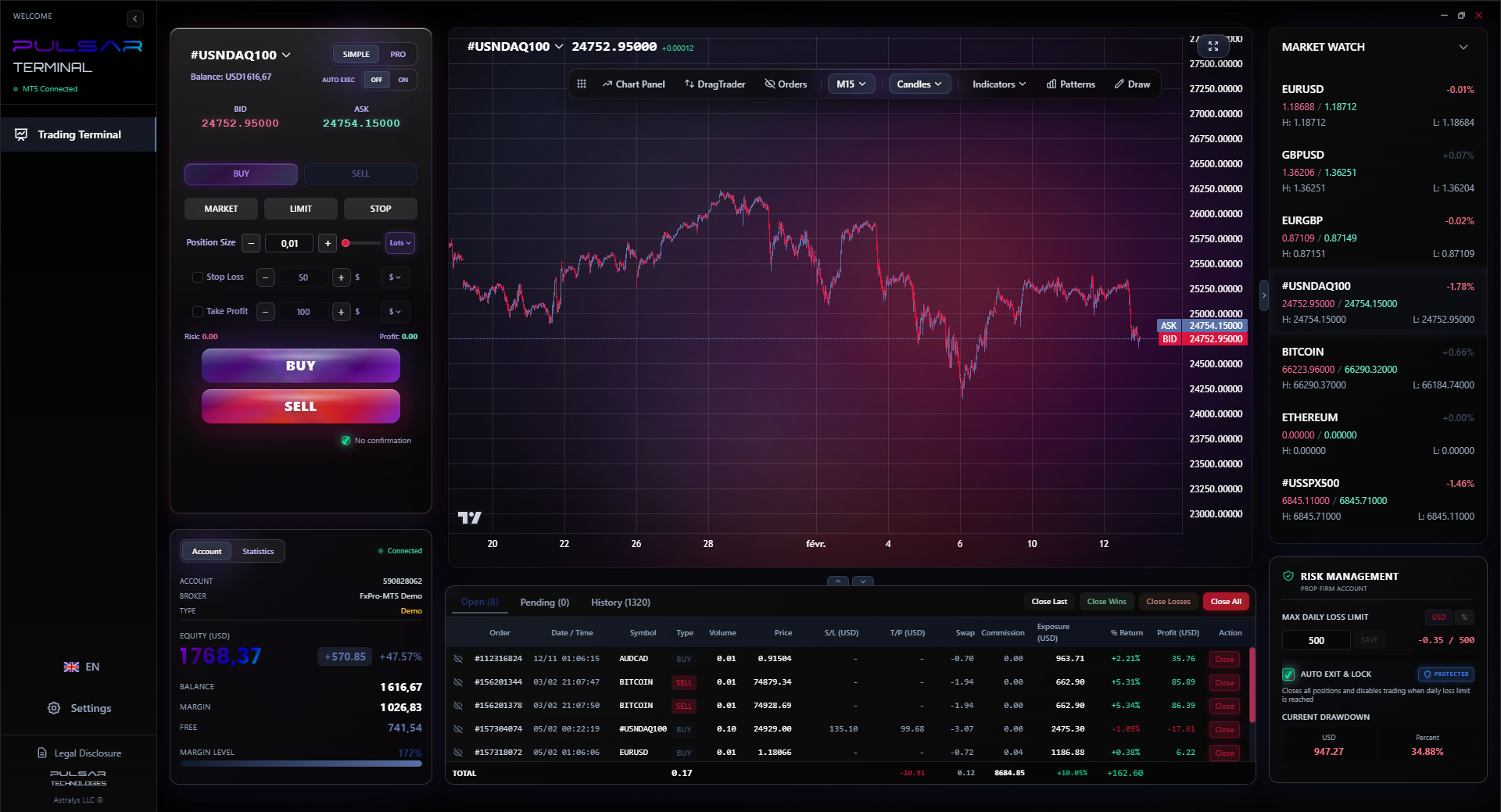
Sticking to a disciplined plan with precise stop-loss and take-profit levels is hard, especially when watching the screen; Pulsar Terminal automates this by letting you set multi-level TP/SL and trailing stops directly on your MT5 charts, so your plan executes even if you don't.
Pulsar Terminal
L'outil MT5 tout-en-un : ordres glisser-déposer, multi-TP/SL, trailing stop, grid trading, Volume Profile et protection prop firm. Utilisé quotidiennement par 1 000+ traders.
“In INR pairs, the central bank is the biggest whale in the pool.”
I've fallen into most of these. Learn from my wallet's pain.
- Chasing 'Legal' Hacks: You'll see forums discussing using international travel cards or crypto to fund offshore accounts. These are operational workarounds, not legal shields. The FEMA violation occurs when you transact in prohibited derivatives, not necessarily how you move the money. The complexity adds risk.
- Ignoring the Spread: Trading during low-liquidity hours (Asian session for EUR/USD) or around RBI announcements for USD/INR means wider spreads. Your trade can be in the red the moment it's executed. Know your market's schedule.
- Overleveraging: Offshore brokers might offer 1:500 or even 1:1000 use. This is a death trap, not an opportunity. At 1:500, a 0.2% move against you wipes out your entire margin. I never use more than 1:30, even if it's available.
- Mixing Politics with Trading: Getting emotionally invested in the rupee's strength or weakness based on patriotism or political news is a surefire way to make bad trades. The market doesn't care about your sentiments.
- Neglecting Withdrawal Reality: The smoothest part is often depositing. The test is withdrawing. Start small, document everything, and use the same method you deposited with. If a broker makes withdrawals difficult, it's a major red flag, regardless of their fancy website.
“Your first ₹50,000 in trading isn't capital. It's tuition.”
The regulatory fog might slowly lift through GIFT City (Gujarat International Finance Tec-City). This IFSC (International Financial Services Centre) is India's attempt to create an onshore, global financial hub.
What it means for you: Indian retail investors can use the LRS to invest in 'securities' listed there through SEBI-IFSC registered brokers. This is a structured, legal channel. While currently focused on equities, bonds, and funds, the potential for expanded derivative products, including more forex instruments, exists.
It's not a free pass today, but it's the direction of travel. The RBI would rather have you trading global products through a regulated, onshore conduit like GIFT City where they have oversight, rather than sending money to unregulated entities in Cyprus or the Seychelles.
For now, treat GIFT City as a promising signpost, not a current solution. Keep an eye on new product approvals there. The long-term goal for any serious Indian trader should be to migrate their activity to such a legal framework as it develops. It removes the single biggest cloud over your trading career: regulatory risk.
Your job right now is to build skill and capital preservation habits in whatever arena you choose, so you're ready when the playing field becomes clearer and more secure.
💡 Conseil de Winston
If you can't explain your trade setup and risk in one simple sentence before you click 'buy,' you're gambling, not trading. Complexity is the enemy of execution in a tense market.
FAQ
Q1Is forex trading legal in India?
Yes, but with strict limits. You can legally trade only currency pairs that include the Indian Rupee (INR), like USD/INR or EUR/INR, on Indian exchanges like NSE or BSE through SEBI-registered brokers. Trading major pairs like EUR/USD through international platforms falls into a regulatory grey area and is not permitted for speculative purposes under FEMA rules.
Q2What is the minimum amount required to start forex trading in India?
For INR pairs on domestic platforms, it can be as low as a few thousand rupees. For offshore brokers, minimum deposits can be very low (e.g., $5 with XM, $100 with FxPro), but this is just the entry fee. The real requirement is enough capital to survive losses while practicing proper risk management - never trade with money you can't afford to lose completely, especially in the grey market.
Q3Can I trade EUR/USD from India?
Technically, you can open an account with an international broker like IC Markets or Pepperstone and trade EUR/USD. However, this activity is not authorized by Indian regulators for resident individuals. You are operating in a legal grey area, assuming counterparty risk with an overseas entity, and may face challenges with deposits/withdrawals. It's the most common path, but it's not without significant legal and financial risk.
Q4How are forex trading profits taxed in India?
Profits from trading INR pairs on Indian exchanges are typically treated as speculative business income and added to your total income, taxed according to your applicable income tax slab. For trading through offshore brokers, the tax liability remains, but the reporting and compliance are more complex. You must declare foreign income. Always consult a qualified Chartered Accountant for your specific situation.
Q5What is GIFT City and how does it help forex traders?
GIFT City is an International Financial Services Centre (IFSC) in Gujarat. It provides a legal channel for Indian residents to use the Liberalised Remittance Scheme (LRS) to invest in globally traded securities through IFSC-registered brokers. While currently more focused on equities and funds, it represents a future potential pathway for Indian traders to access global markets, including forex, under a regulated Indian framework, reducing the current legal ambiguity.
Q6Which is better for beginners, trading INR pairs or global majors?
For absolute beginners focused on learning, start with a demo account on global majors like EUR/USD. The charts are cleaner, liquidity is better, and you can learn pure technical analysis. However, for your first live trades, using a domestic broker for USD/INR is safer from a legal standpoint. It lets you learn live market pressure without the added anxiety of regulatory uncertainty. Split your focus: learn on global demo, trade small and legal live.
La leçon du Prof. Winston
Points clés:
- ✓Legal trading is only INR-crosses on NSE/BSE.
- ✓Offshore brokers mean grey-area risk.
- ✓Calculate total cost: spread + commission.
- ✓Never use use above 1:30.
- ✓Test withdrawals before large deposits.
Cet article vous a-t-il été utile ?
Cliquez sur une étoile
Analyses Trading Hebdo
Analyses et stratégies hebdo gratuites. Pas de spam.
À propos de l'auteur
Rajesh Sharma
Analyste Forex Senior
Plus de 10 ans d'expérience sur les marchés indiens et sud-asiatiques. A débuté avec les dérivés de change du NSE avant de passer au forex international. Spécialiste des paires USD/INR et des marchés émergents.
Commentaires
Avertissement sur les risques
Le trading d'instruments financiers comporte des risques importants et peut ne pas convenir à tous les investisseurs. Les performances passées ne garantissent pas les résultats futurs. Ce contenu est fourni à titre éducatif uniquement et ne constitue pas un conseil en investissement. Effectuez toujours vos propres recherches avant de trader.
Vous aimerez aussi

Cara Trading Forex Sukses: 7 Prinsip dari Trader Profesional
Cara trading forex sukses dengan 7 prinsip trader pro: manajemen modal, disiplin, journal trading, backtest. Data nyata, bukan janji profit palsu.
Jam Trading Forex Terbaik untuk Trader Indonesia: Panduan Lengkap dengan Tabel Waktu
Panduan jam trading forex untuk trader Indonesia. Tabel 4 sesi dunia, jam emas 20:00-00:00, sesi mana yang harus dihindari. Data akurat + tips dari trader berpengalaman.
Top 5 Sàn Forex Uy Tín Nhất 2026: Review Jujur dari Trader Indonesia
Top 5 sàn forex uy tín 2026 untuk trader Indonesia. Review jujur: spread, deposit, withdraw, dukungan lokal. Exness, XM, IC Markets & lebih.
Obtenir Pulsar Terminal
Tous ces calculateurs sont intégrés dans Pulsar Terminal avec des données en temps réel de votre compte MT5. Dimensionnement de position en un clic, gestion automatique des risques et calculs instantanés.
Obtenir Pulsar Terminal