


I was staring at my screen in late 2024, watching the GBP/NGN pair on IG's platform.

Olumide Adeyemi
Pionnier du Trading en Afrique de l'Ouest ·  Nigeria
☕ 10 min de lecture
Ce que vous apprendrez :
I was staring at my screen in late 2024, watching the GBP/NGN pair on IG's platform. The spread was tight, the chart was clean, but my attempt to fund my account with a Nigerian debit card had just been rejected for the third time. That moment, right there, is the Nigerian trader's paradox with a giant like IG Group. The platform is world-class, but the path to using it from Lagos or Port Harcourt is paved with CBN restrictions and practical headaches. Let's cut through the hype and look at what IG Group forex really means for you, right now.
IG Group isn't some fly-by-night broker. They're a London-listed (LON: IGG) financial giant founded in 1974. They were one of the first to offer spread betting and CFDs to retail clients. For a Nigerian trader, that history means two things: immense stability and a regulatory framework that doesn't revolve around our local market.
They're regulated by top-tier authorities like the UK's Financial Conduct Authority (FCA). That's the gold standard. It means client money segregation, negative balance protection, and a complaints procedure that actually works. But here's the kicker for us: IG Group does not hold a specific license from the Central Bank of Nigeria (CBN) or the SEC to operate within Nigeria. They're an international broker that accepts clients from here. That distinction is critical - it shapes everything from how you fund your account to how you handle your 10% capital gains tax.
Their main offering for us is forex and CFD trading on a massive range of assets: majors, exotics, indices, commodities. The platform itself, especially IG's own web and mobile apps, is slick. Execution is generally fast. But you're not their primary demographic. Their rules, their support hours, their default currency pairs are built for a European or UK client. You need to adapt.

Warning: Just because IG accepts Nigerian clients doesn't mean funding is easy. The CBN's restrictions on international card transactions are your first major hurdle. You'll likely need a domiciliary account or e-wallet like Skrill.
Is It Legal to Use IG Group from Nigeria?
Yes. Trading forex with your personal funds through an international broker like IG Group is legal. The grey area isn't your activity; it's the broker's local presence. Since IG isn't CBN-licensed, you're going offshore. This is the norm for most serious Nigerian retail traders because our local forex market for online trading is, let's be honest, poorly regulated. You trade under IG's UK regulation, not Nigeria's.
The 10% Tax You Can't Avoid
Forget what the broker does or doesn't deduct. The Nigerian Federal Inland Revenue Service (FIRS) wants 10% of your gross trading profits as Capital Gains Tax. It doesn't matter if your broker is in London or Cyprus, or if your money is in a USD account. If you make money, you owe the tax. I learned this the hard way early on. I had a great quarter in 2023, netting about $8,500 on IG. I didn't set aside the tax, thinking it only applied to local brokers. Come tax season, I had a nasty surprise and a penalty. Always calculate your tax liability as you go. It's a cost of doing business.
Funding the Account: Your Biggest Battle
This is where the dream of using IG Group forex meets Nigerian reality. Funding directly with your Naira debit card will hit CBN limits and likely fail for any meaningful amount. The standard workaround is a domiciliary account (a USD account with a Nigerian bank). You transfer Naira, convert to USD internally, then wire the USD to IG. Fees add up: local bank charges, SWIFT fees ($15-$40), and potentially receiving fees from IG's bank.
E-wallets like Neteller or Skrill are faster. You fund the e-wallet (often with card or bank transfer), then transfer to IG. But check IG's acceptance and the e-wallet's own fees for Naira transactions. It's a puzzle. I once spent three days and lost about ₦7,000 in various fees just to deposit $500. You need to factor these funding costs into your overall trading costs, which eats into your potential profits.

Pro Tip: Before you even open an IG account, call your bank. Ask specifically about the process and fees for sending an international wire transfer in USD to a UK-based financial institution. Get the exact cost in writing. Then, check if IG has any special instructions for Nigerian clients.

💡 Conseil de Winston
A domiciliary account isn't a luxury for IG; it's a necessity. Treat setting one up as part of your trading business setup costs, before you even look at a chart.
“The 30:1 use limit forces you to use proper position size and risk management. You need more capital, but you're far less likely to get wiped out.”
Let's talk numbers. IG's pricing is competitive globally, but you must view it through a Nigerian lens.
Spreads: On major pairs like EUR/USD, you can expect raw spreads from 0.6 pips during major sessions. That's tight. But remember, IG often adds a markup to create their spread. On a standard account, you might see 0.9 to 1.2 pips for EUR/USD. Compare that to some brokers popular here:
| Broker | Typical EUR/USD Spread (Standard Acc) | Commission |
|---|---|---|
| IG Group | ~0.9 - 1.2 pips | Often built into spread |
| Exness | ~1.0 pip | None on Standard accounts |
| XM | ~1.7 pips | None |
| IC Markets (Raw Spread) | ~0.1 pips | $3.5 per lot round turn |
IG is in the ballpark. Where they might lose out is on exotic pairs involving the Naira. They don't offer Naira pairs (like USD/NGN for trading). You'll find those only with brokers specifically targeting Africa, often with much wider spreads and different rules.
use: This is a big differentiator. Under UK (FCA) regulation, use for major forex pairs for retail clients is capped at 30:1. For a Nigerian trader used to brokers offering 500:1 or 1000:1 (regulated elsewhere, like CySEC), this feels like handcuffs. Let me be blunt: that's a good thing. High use is a shortcut to a margin call. I blew my first account with 500:1 use on a volatile gold trade. The 30:1 limit forces you to use proper position size and risk management. You need more capital to see meaningful returns, but you're far less likely to get wiped out in one bad move.
Other Costs: Watch for overnight financing charges (swap rates), especially if you're into swing trading. Inactivity fees may apply if you don't trade for a couple of years. The biggest hidden cost for you remains the funding/withdrawal fees we discussed.
Why would you jump through hoops for IG when you have Exness, XM, or IC Markets at your fingertips? Here's the honest comparison.
Regulation & Safety: IG wins, hands down. FCA regulation is the strongest retail client protection in the world. Your funds are in a top-tier UK bank, segregated. Many brokers popular in Nigeria are regulated in offshore jurisdictions (like St. Vincent or the Marshall Islands) where client money rules are lax. IG is safer, full stop.
Platform & Tools: IG's proprietary platform is excellent for analysis. But for pure MetaTrader 4/5 lovers, IG offers MT4 on CFD accounts. Where IG shines is in its range of markets - far beyond forex into shares, bonds, rates. If you want to trade the UK FTSE 100 or German DAX with tight spreads, IG is superior. For pure forex scalping, a raw spread account on IC Markets or Pepperstone might offer lower all-in costs.
Customer Support: This is a sore point for Nigerian traders on IG. Support isn't 24/7 Naira time. You're dealing with a UK-centric operation. Got a funding issue at 9 PM Lagos time? You're waiting until London opens. Local brokers often have WhatsApp support, local phone numbers, and staff who understand CBN issues intimately.
The Verdict: Use IG Group if you value top-tier safety, trade instruments beyond just forex, and have your funding pipeline (domiciliary account) already sorted. It's for the established trader. If you're starting with ₦150,000, need high use to make that capital work, or want Naira pairs and easy deposits, a local-friendly international broker is a more practical choice.

Example: Let's say you have $1,000. On IG at 30:1, your max position size on EUR/USD is about 0.3 lots. On another broker at 500:1, you could open 5 lots. The potential profit on the 500:1 trade is huge, but a 20-pip move against you would wipe out your entire account. The IG trade would still be down, but you'd have room to breathe and manage it.
💡 Conseil de Winston
The 30:1 use feels limiting until you realize it's forcing you to trade like a professional fund manager, not a gambler. Your risk per trade should be 1-2% of capital, not 50%.
“Your biggest battle with IG won't be the markets; it will be funding the account.”
Based on 12 years of watching traders here succeed and fail, here's my blunt assessment.
You SHOULD consider IG Group if:
- You have a domiciliary account and understand international wire transfers.
- Your trading capital is significant (I'd say $5,000+ minimum to make the funding hassle worthwhile).
- You prioritize fund safety above all else.
- You trade UK, EU, or US indices and shares alongside forex.
- You're disciplined and don't crave 500:1 use.
- You're already profitable and are looking for a "final" professional home for your capital.
You should probably LOOK ELSEWHERE if:
- You're a beginner with less than $1,000.
- Your primary strategy relies on ultra-high use.
- You trade Naira pairs or African exotics.
- You need instant, local customer support.
- You fund your account with card or local transfers and can't set up a domiciliary account.
- You're still perfecting your strategy; the funding costs will eat you alive while you learn.
I made the switch to a broker like IG after I had a consistent three-year track record and built my capital to a point where safety became my #1 concern. Before that, the friction was too high.
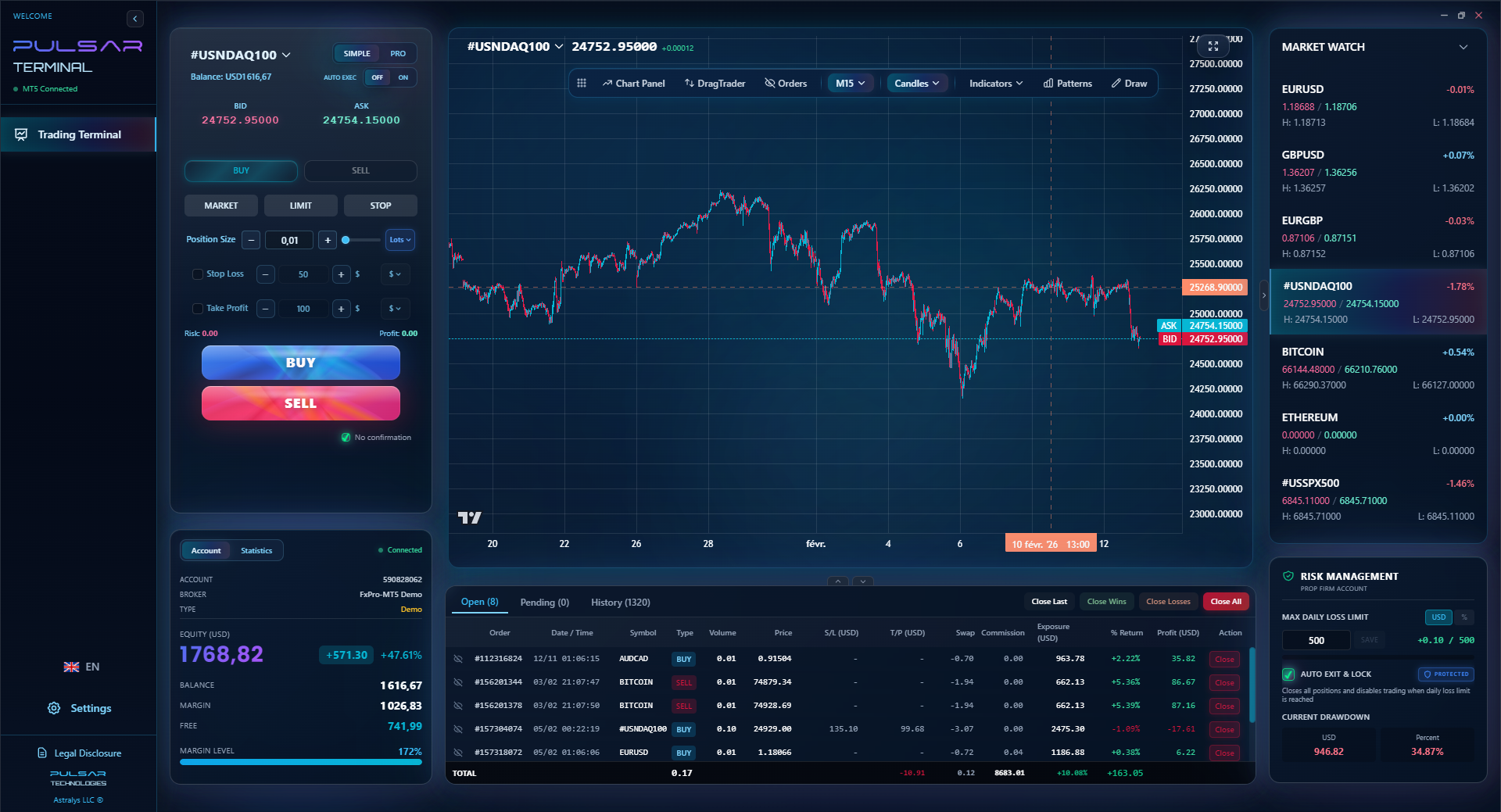
Managing multiple trades and complex strategies on a tight spread platform like IG's is easier with tools that automate order management directly on your chart.
Pulsar Terminal
L'outil MT5 tout-en-un : ordres glisser-déposer, multi-TP/SL, trailing stop, grid trading, Volume Profile et protection prop firm. Utilisé quotidiennement par 1 000+ traders.
If you've decided IG is for you, here's how to navigate it from Nigeria.
- Sort Your Funding First. This is step zero. Open a domiciliary account (USD) with your Nigerian bank if you don't have one. Understand all the fees for incoming and outgoing wires. Alternatively, set up and verify a Skrill/Neteller account, funding it with your Naira card (staying under CBN limits).
- Open the Account. Go to IG's international site (not the UK-only one). During sign-up, you'll select Nigeria as your country of residence. Be brutally honest on the application about your experience and financial situation. They will ask for proof of address (utility bill) and ID.
- Start Small. Once verified, make a small test deposit ($100-$200) using your chosen method. Confirm it arrives, you can trade with it, and you can withdraw it back to your Nigerian source. This tests the entire pipeline. I skipped this once and assumed everything worked. A $2,000 deposit got stuck for weeks due to a beneficiary name mismatch.
- Adapt Your Trading. Remember the 30:1 use. Recalculate all your position sizes. Get familiar with their platform's specific order types. Their version of a trailing stop or guaranteed stop works differently than on MT4.
- Keep Impeccable Records. For FIRS. Document every trade, every deposit, every withdrawal. You are solely responsible for calculating and paying your 10% tax on profits. IG won't send any reports to Lagos.
Using IG Group forex from Nigeria is a statement. It says you're playing the long game, on a global field, with the big boys. It's not the easiest path, but for the right trader, it can be the most secure.
FAQ
Q1Can I legally trade forex with IG Group from Nigeria?
Yes. It is legal for Nigerian residents to use their personal funds to trade with international brokers like IG Group. IG operates under its UK (FCA) license and accepts clients from Nigeria, though it does not hold a local CBN license.
Q2How do I fund my IG trading account from Nigeria?
Direct Naira card funding is unreliable due to CBN restrictions. The most common methods are: 1) Using a USD domiciliary account at a Nigerian bank to send an international wire transfer to IG. 2) Using an e-wallet like Skrill or Neteller as an intermediary. Both methods involve multiple fees that you must factor into your costs.
Q3What is the maximum use IG offers to Nigerian traders?
As a broker regulated by the UK's FCA, IG offers a maximum use of 30:1 for major forex pairs to all retail clients, including those from Nigeria. This is significantly lower than the 500:1 or 1000:1 offered by brokers regulated in other jurisdictions.
Q4Does IG offer Naira (NGN) currency pairs?
No, IG does not offer forex pairs involving the Nigerian Naira (e.g., USD/NGN). You would need to use a broker that specifically targets the African market to trade Naira pairs, which often come with much wider spreads.
Q5How do I pay tax on my IG trading profits in Nigeria?
You are responsible for declaring and paying a 10% Capital Gains Tax on your gross forex trading profits to the Federal Inland Revenue Service (FIRS). IG will not deduct this for you. You must keep detailed records of all your trades, deposits, and withdrawals to calculate your tax liability accurately.
Q6Is IG Group safer than brokers like Exness or XM for a Nigerian trader?
From a pure regulatory standpoint, yes. IG's FCA regulation (UK) is considered one of the strictest in the world, with strong client money protection rules. Many brokers popular in Nigeria are regulated in offshore jurisdictions with less stringent requirements. However, 'safety' also includes practical access to your funds, which can be more challenging with IG from Nigeria.
Q7What is a realistic minimum capital to start with IG from Nigeria?
Given the funding complexities and 30:1 use cap, a realistic minimum is higher than with other brokers. I would not recommend starting with less than $2,000 to $5,000. This allows for meaningful position sizing after accounting for wire transfer fees and provides a buffer that makes the setup process worthwhile.
La leçon du Prof. Winston
Points clés:
- ✓Funding is your primary obstacle, not the platform.
- ✓10% capital gains tax applies to all profits, no exceptions.
- ✓30:1 use protects you from yourself.
- ✓Start with a test deposit of $200 first.
Cet article vous a-t-il été utile ?
Cliquez sur une étoile
Analyses Trading Hebdo
Analyses et stratégies hebdo gratuites. Pas de spam.
À propos de l'auteur
Olumide Adeyemi
Pionnier du Trading en Afrique de l'Ouest
L'un des formateurs de trading forex les plus actifs au Nigeria. 8 ans d'expérience de trading depuis Lagos. Spécialisé dans les stratégies à petit capital et les challenges de prop firms pour les traders africains.
Commentaires
Avertissement sur les risques
Le trading d'instruments financiers comporte des risques importants et peut ne pas convenir à tous les investisseurs. Les performances passées ne garantissent pas les résultats futurs. Ce contenu est fourni à titre éducatif uniquement et ne constitue pas un conseil en investissement. Effectuez toujours vos propres recherches avant de trader.
Vous aimerez aussi

Cara Trading Forex Sukses: 7 Prinsip dari Trader Profesional
Cara trading forex sukses dengan 7 prinsip trader pro: manajemen modal, disiplin, journal trading, backtest. Data nyata, bukan janji profit palsu.
Jam Trading Forex Terbaik untuk Trader Indonesia: Panduan Lengkap dengan Tabel Waktu
Panduan jam trading forex untuk trader Indonesia. Tabel 4 sesi dunia, jam emas 20:00-00:00, sesi mana yang harus dihindari. Data akurat + tips dari trader berpengalaman.
Top 5 Sàn Forex Uy Tín Nhất 2026: Review Jujur dari Trader Indonesia
Top 5 sàn forex uy tín 2026 untuk trader Indonesia. Review jujur: spread, deposit, withdraw, dukungan lokal. Exness, XM, IC Markets & lebih.
Obtenir Pulsar Terminal
Tous ces calculateurs sont intégrés dans Pulsar Terminal avec des données en temps réel de votre compte MT5. Dimensionnement de position en un clic, gestion automatique des risques et calculs instantanés.
Obtenir Pulsar Terminal